Thursday, November 05, 2015


Behold a silly little lady who has drunk the Kool-Aid

The article below appeared in "New Matilda" under the heading: "Coal Moratoriums As A ‘Radical War On The Poor’. They’re Only Half Right".  It was written by a piece of furniture named Hilary Bambrick, who is allegedly "Chair" of Population Health at the School of Medicine at Western Sydney University.  Professor Bambrick was one of a group denounced by "The Australian" newspaper after she signed an open letter calling for no more coalmines. The original letter was signed by 61 people and it appears that the criticism of their ideas abashed 60 of them. Hilary is still standing, however so I am pleased to give you her attempt at scholarship below.

It is a curious thing:  100% assertion.  No proof or evidence offered. No links; no references.  She has faith and expects all others to share it.  And she feels no need to address obvious criticisms.  Winter is when most people die but she says it is warming that is bad for your health. She ignores total mortality in judging the effects of warming! 

And she attributes recent bad weather events to global warming when even Warmist climate scientits shrink from doing that.  And the events CANNOT in fact be due to global warming -- because there has been no global warming for 18 years.  The satellites are the only way of obtaining a truly global temperature reading and for the last 18 years they just show random fluctuations around a constant mean. Here's the graph:
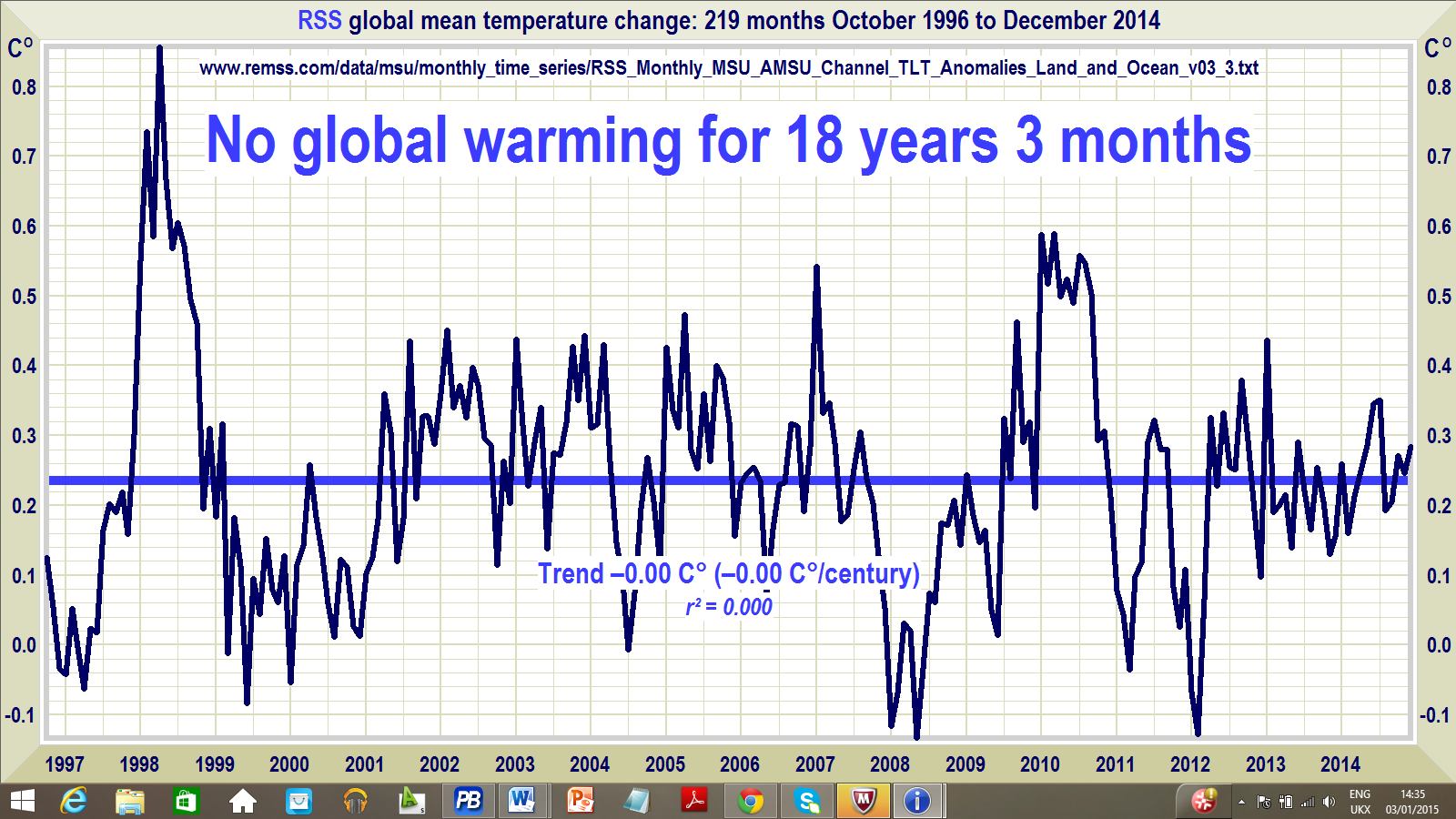


And even the terrestrial datasets show no statistically significant global temperature change over the last 18 years. That KoolAid must have tasted great!

She should become a Jehovah's Witness.  You have to have a strong faith to be a JW and her faith is Herculean.  One quails before the thought of her as a medical researcher, however.  Though she would not be the only medical researcher who believes that correlation is causation.

Isn't she a cute-ums?


On Tuesday last week an open letter called for a global moratorium on new coal mines. Prime Minister Malcolm Turnbull hurriedly dismissed the call as ineffective in reducing emissions, and The Australian accused those who signed the letter of waging war on poor people. This could not be further from the truth.

The letter was signed by 61 people, or ‘coal haters’ as The Australian called us. I am one of them, and here is why.

The planet has warmed nearly 1°C and we’re already seeing the effects. We’re heading into a ‘Godzilla’ El Nino; California is suffering unprecedented drought; Mexico just had a narrow escape from the world’s strongest ever hurricane, and the Pacific has had many more super typhoons than is fair.

We’re now having to construct new scales for measuring and reporting the weather because what we are seeing is outside previous human experience. We’ve added a ‘Catastrophic’ level to bushfire danger ratings, and a new colour to weather maps to depict regions over 50°C. And that’s only at 1°C warming – nowhere near the 4°C we are currently on track for by the end of this century.

As humans we’re not isolated from our environment. Through its effects on water, food, and air, climate change alters the relationship between us and our life-support system.

The health consequences of climate change are many, for example: Deaths and injury from heatwaves, flooding and bushfires; mosquito-borne diseases such as malaria and dengue; or those arising from food insecurity and conflict.

In Australia, we’re relatively well resourced to deal with climate change. We’re healthy, we have robust emergency response and health systems and we can add a tax levy to rebuild after major flooding, for example.

But climate change is not fair, and other countries are not so lucky. Poverty, poor health, ecosystem degradation, and limited infrastructure and services render some populations extremely vulnerable and diminishes their capacity to adapt.

The worst consequences of climate change fall disproportionately on the world’s poor. Already marginal regions will become decreasingly hospitable, and those living there are least able to adapt.

Climate change acts against economic development, and will keep vulnerable people in poverty and exacerbate existing health and economic inequalities.

The health consequences that are easiest to measure, such as deaths from the recent Middle East ‘heat dome’ or even Typhoon Haiyan in the Philippines, are not the biggest impacts in terms of numbers of people affected. The biggest impacts will be those that are least direct, and more complex, such as:

Repeated crop failures triggering famine

Sea level rise contaminating water supplies, and even consuming whole countries

Wars and civil unrest over increasingly scarce resources

Forced migration and deaths at sea

As with public health more generally, prevention is far simpler and cheaper than cure. We’ve known for decades what’s causing the earth to warm, and we’ve known for decades what we should do about it.

There is no ‘moral case’ for continuing to dig up, use and export coal, as Australia’s Federal Resources Minister Josh Frydenberg would have you believe. But there is a very strong moral case against it: Coal kills people.

We have healthy energy alternatives, and we don’t have to wait years to reap the benefits. Quitting coal this morning means cleaner air and better health this afternoon. It’s as simple as that.

These are exciting times. There’s real momentum for change. New polling shows six out of 10 voters in Malcolm Turnbull’s electorate support a moratorium on new coal mines. The divestment movement shows us that, ultimately, market forces will prevail and coal and gas will become untenable. But we can’t afford to wait. Some nudging is required now to get investment in renewables happening sooner, to promote faster returns and drive technological development.

Australia is very well placed to lead clean energy technology, but we risk missing the boat on innovation. Instead we seem hell bent on propping up a withering coal industry, de-funding clean energy technology and running interference with endless reviews into wind farms.

Rather than continuing to subsidise the problem, let’s subsidise the solution.

If politicians worried about the health and livelihoods of the people they govern as much as they worry about the ‘health’ of the economy in the coming financial quarter, we wouldn’t be in this mess.

The signatories to the letter have been labelled as radicals, and perhaps that is true. Certainly the decision to place the value of human health and wellbeing – and that of the planet on which we depend – above short-term economic growth requires heretical thinking. But most of all it requires politicians with the vision to lead this great transition.

Coal is so last century. It’s high time we quit.

SOURCE


‘Tis the season for all that global warming folly

Janet Albrechtsen

With the UN climate summit in Paris due to start later this month, the global warming silly season is well under way.

This week France’s popular weatherman Philippe Verdier was sacked by a French TV station for writing a book that challenges some scientists for inflating the effects of global warming. The UN gabfest, or COP21, is aimed at securing agreement from countries with vastly different levels of development, from the prosperous West to fast-growing economies in China and India, to less developed in Africa, to restrict global temperature rises to 2C. It’s a big ask, which may explain why the madness started even before Verdier was sacked by France 2.

Addressing a September conference in London on climate change and international law, Philippe Sands QC called for a ruling from the International Court of Justice to “scotch” claims by “scientifically qualified, know­ledgeable and influential individuals” who challenge the “consensus” on man-made global warming.

Are we re-entering the Middle Ages where you were treated as a traitor if you mentioned that the king might be dying — even if he was?

More recently, the future king of England, Prince Charles, repeated his favourite claim that the Paris conference was our “last chance” to draw up a “Magna Carta for the Earth”. Charles is no King John. But, equally, Charles seems to have scant understanding of the real Magna Carta, a document that aimed to curb the powers of the king. Charles and his global warming enthusiasts now want a treaty that will deny countries such as China and India the ability to do what rich nations have done — use readily accessible and cheap carbon energy to build prosperous economies.

Here in Australia, just as the Prime Minister turned 61, 61 so-called “eminent” people signed an open letter calling on Malcolm Turnbull to put a moratorium on coalmining and new mines. That went nowhere. It was easily demolished when Turnbull said shutting down our coal industry would make zero difference to ­global emissions.

And if every silly season has a Santa, [Leftist leader] Shorten is  it. More and more, the Opposition Leader resembles a second-rate actor who has assiduously studied a set of lines but hasn’t managed to inject any conviction into the role. This week Shorten has been on “a fact-finding mission” to the Pacific ­Islands. Translation: the Opposition Leader thinks he can use global warming to dent Turnbull’s popularity.

Shorten’s core problem begins with his role in past policy. Shorten rode the Kevin ’07 wave into office when Labor’s position was that global warming was the great moral challenge of our time and required an emissions trading system. As a senior minister, he then backed Rudd’s change of heart to dump the ETS. Shorten was a critical backer of Julia Gillard, when Labor’s new position was “there will be no carbon tax under a government I lead”. He was there too when Labor signed a deal with the Greens to legislate a carbon tax.

Shorten’s shadow boxing was evident as soon as Turnbull became PM. Labor’s attacks on Turnbull’s wealth served only to remind voters we have a PM who was highly successful before he entered politics and understands business. It makes a refreshing change from the career politicians who have never worked in the real world.

With the COP21 summit fast approaching, Shorten is now desperate to make climate change a positive for Labor. But, once again, his problem is one of believability. No one can question that Turnbull genuinely believes in the human drivers of global warming. It drives his critics mad and weakens the knees of his admirers.

Shorten’s history, on the other hand, is replete with stark episodes of him making statements thrust into his hands by spin doctors and pollsters. There’s no detail on the Opposition Leader’s uncosted “aspirational” 50 per cent renewable energy target. Nor has Shorten told us what Labor’s emissions target would be if he were the PM heading to Paris. A four-day visit to our Pacific neighbours does nothing to build Shorten and Labor’s credentials.

The hyperbole around global warming, Magna Cartas, last chances and moratoriums on coal will only ratchet up over the next few weeks. But the hyperbole won’t alter Turnbull’s commitment to take the Abbott government’s policy of a 26 to 28 per cent emissions reduction target on 2005 levels by 2030 to Paris.

None of it will alter the fact, while China and India will happily extract money from the West’s promised $US100bn Green Climate Fund, they won’t agree to a deal that curbs their emissions, and therefore their economic growth. China is building a new coal plant every seven to 10 days and has plans to boost its coal power by 50 per cent by 2040; India is intent on doubling its coal production by 2020.

In other words, none of the hype will deliver a meaningful treaty at the Paris gabfest that is legally binding, enforceable and verifiable. Unless you believe in Santa.

SOURCE


Kiwi criminals who won't go home harshly treated

But one must allow for Leftist exaggeration

A Labour MP has told the New Zealand parliament Kiwis are being locked up, beaten and starved in a harrowing account of the way their citizens are being treated in Australia.

Kelvin Davis last month visited detention centres including the notorious Christmas Island facility, where about 40 Kiwis were being held awaiting deportation.

Australian authorities are rounding up and deporting non-citizens who have served more than 12 months in prison.

"These people are being locked up, they're being beaten up and they're being starved," Mr Davis said.

"The conditions are tantamount to torture and it's happening in Australia, a country we say is our closest ally."

Mr Davis said the offences committed by detainees he met were at the lower end of the scale.  "I know they went to prison, they committed crimes, but they ought not to be punished twice," he said.

"They don't deserve to be picked up as they leave prison and detained indefinitely. Some have been detained for longer than they were in prison."

A fortnight ago, Justice Minister Amy Adams said 167 New Zealand nationals had already been sent home and 585 were waiting to be processed.

Prime Minister John Key last month met his Australian counterpart, Malcolm Turnbull, and discussed the issue.

Mr Turnbull gave an undertaking there would be a more compassionate approach, and said any detainee was free to return to New Zealand while contesting a decision to cancel their visa.

SOURCE


Australia’s fundamentals robust enough to beat the recession odds

The economy is a dangerous place — at least as perceived by some commentators. The list of tripping points that could push the economy into recession tallied by these commentators is long and varied. Some put recession odds as high as one-in-three. Even a Nobel laureate, Paul Krugman, has bought into the debate.

The reality is that Australia has clocked up 24 four years of continuous growth. The last recession was in the early 1990s. Events that were widely expected to deliver recession — the Asian financial crisis, the tech wreck, the global ­financial crisis — didn’t.

The old financial adage that past performance is no guarantee of future returns still holds good. But there are factors at work limiting recession risks. And some of the arguments for recession look weak on closer examination.

Policy settings are very accommodative and the automatic stabilisers are working. The Reserve Bank routinely notes that low interest rates are supporting borrowing and spending and that the availability of credit is not a constraint. The Australian dollar may have taken longer to adjust than expected. But monetary conditions overall are very stimulatory and consistent with a sizeable lift in economic growth momentum.

And policy firepower remains. Our interest rates are well above the near-zero settings in the major economies. They can be cut further. The budget is in deficit but debt is low and fiscal policy can be ramped up. The Aussie dollar would move lower still if a major China/global shock emerged.

The immediate growth concern is the mining construction downturn. The biggest construction boom in 150 years is over. And mining capex will drop by between 3.5 and 4 per cent of GDP by the time the cycle is complete. It is at least as big a drag on the economy as the feared US “fiscal cliff” was a few years ago. But the earlier boom will leave a legacy. The expansion in the mining capital stock is driving a new boom in ­resource exports. These exports will provide a cushion at the ­bottom of the mining capex cliff.

There is also a perception the capex cliff still lies in front of us. And that we will be swept off at any moment. The reality is that mining capex peaked at the end of 2012. The decline is about 2 per cent of GDP. On that metric we are about half way down the cliff.

And it is a case of so far, so good. Economic growth may not be as fast as we would like. But it remains comfortably in positive territory. Job losses are occurring. But they are being offset by job gains elsewhere. The unemployment rate looks to be peaking at just over 6 per cent — sooner and lower than many anticipated. Good old-fashioned Australian luck has helped. We have “exported” part of our problems. The capex boom came with a large import bill. As mining projects wind down, part of the pain is being exported to those countries that provided us with the necessary capital goods. On the jobs front, fly-in fly-out workers are losing their jobs in the Pilbara. But they are becoming unemployed in Sydney and Melbourne where they live. And that is where the job creation is occurring. We are also exporting part of the problem as those on 457 visas move on to the next big project and New Zealanders return home.

But we will need more than luck. We must transit to other forms of growth. Construction is the focus. And unfortunately the results are mixed. A residential construction boom is under way. But non-mining construction ­activity has remained limp. And the drop in public infrastructure spending in recent years is nothing less than disappointing.

Non-mining capex and infrastructure spending may have disappointed for now. But some parts of the economic story that weren’t in the transition narrative may surprise on the upside. Non-­resource exports and the consumer may fill in some of the hole.

The number of exporters doesn’t normally vary much from year to year. But there was a ­significant spike in the 2014 financial year. The spike is all the more interesting because it occurred at a time when the Australian dollar was still strong. The larger part of the drop in the currency has ­happened since then and should push the export trend along.

It seems the Australian dollar was not as big a restraint on the economy as policymakers feared. Non-resource exports may surprise on the upside.

Weak income growth and changed household attitudes to spending/saving/borrowing were expected to weigh on consumer spending. But an array of forces is improving the consumer backdrop. There is a spending flow through from building new homes; there is a wealth effect from higher house prices, the lower dollar is redirecting some spending back onshore and lower petrol prices are boosting spending power. Consumer spending may surprise on the upside.

An expanding group of middle-income consumers in Asia is ­providing further opportunities. These new consumers want larger and better quality housing, more and better quality food, consumer durables, education services, and more holidays. Education and tourism already rank in Australia’s top five exports. Asian demographics also involve an ageing population. And older consumers have certain needs: notably health and financial services. These are well developed sectors in the ­Australian economy.

Australia’s experience in these areas means we are well placed to take advantage. The opportunities are there for those who want to take them.

SOURCE


Wednesday, November 04, 2015


The cup

Once again I watched the Melbourne cup along with most of my fellow Australians. And it was exciting as ever, with a huge change in ranking at the last minute.  And it was a 100 to 1  outsider that came forward at the last moment to win.  Big Orange led for most of the way and would have looked a cert for anyone unfamiliar with cup runs.  It fell right back at the end, however.  And the winner, Prince of Penzance, was a New Zealand horse ridden by a female jockey, the first female jockey to win a Melbourne cup. 

New Zealand horses often do well but this horse was originally bought for only $50,000 so is still a huge surprise. The owners were six mates. Describing themselves as “small fry owners", the men decided to pool their cash and buy a nag they hoped might win at a country meeting. They probably backed their own horse at 100 to 1 so will be rich men now.

I drew the favorite in a sweep but none of the three I drew got anywhere.  But Tom Waterhouse also got it wrong so I am in good company.


The ever immaculate Tom with wife Hoda, a lady of Iranian origins

And a home-made dress won the Fashions on the Field competition


28-year-old Emily Hunter wore an outfit run up by her mother.  She is now in line for some very rich prizes, worth around $100,000 all up.

I can't myself see what was good about the winning outfit but what I know about fashion would fit on the back of a small postage stamp.  I do note however that the winning outfits over the years have tended to be fairly conservative


Australia has a greater percentage of foreigners but less xenophobia than the US. What is its secret?

Australia has control over its borders and filters who comes.  When that faltered, there was rage

Why is there no mop-haired demagogue in Australia denouncing immigrants as rapists?

After all, if America's excuse is anxiety caused by a flood of incoming foreigners, Australia should be twice as anxious. In the US, 14 per cent of the population was born elsewhere, near the record of 15 per cent reached a century ago. In Australia, more than a quarter of the population is foreign-born, and some 46 per cent have at least one foreign-born parent, according to the Australian Bureau of Statistics.

Yet both main parties, the centre-right Liberals and left-leaning Labor, are committed to continued immigration. Politicians who seek to whip up or exploit anti-immigrant prejudice are relegated to the fringe. Is there some secret sauce whose recipe the US could copy?

First, a few caveats. One week Down Under does not quite qualify me as a full-fledged Australianist, but it is long enough to learn that this nation of 23 million people is not a race-blind paradise.

Successive waves of immigration have each aroused anxiety among some Australians that the newcomers would never fit in: Greeks and Italians in the 1950s, Vietnamese in the 1970s, Chinese, Indians and Middle Easterners today. People fret over crime and worry that newcomers segregate themselves in suburban enclaves.

Everyone swears fealty to the national ideal of "multiculturalism", but beneath the surface there is profound disagreement over how much assimilation is desirable. Meanwhile, the captains of industry and government remain mostly Anglo (and male). And a sizeable share of immigrants continue to come from New Zealand and Britain; the country as a whole remains overwhelmingly white.

Still, given that the White Australia Policy was official until the early 1970s, acceptance of a world in which Chinese and Indians represent the fastest-growing groups of immigrants would strike anyone escaping from the GOP primary debates as remarkable.

Paul Kelly, a leading historian and political analyst with the newspaper The Australian, explained that the nation as a whole realised after World War II that it had to "bulk up" its population if it was to defend itself in a dangerous world. Seven million people in a nation the size of the continental US wasn't enough – and when it became clear, with time, that Britain couldn't furnish enough immigrants, "the White Australia Policy buckled, surrendered and was abolished".

"It was a deliberate, bipartisan decision," Kelly told me. "We had to embark on this immigration project to make the nation tenable and viable."

A second critical factor has been Australia's ability to decide who gets in. "The island culture is fundamental," Kelly said. "We control our destiny."

Australia has consistently been a leader, in per capita terms, in accepting refugees from conflict zones. But in 2001, when people from Afghanistan and elsewhere started turning up as boat people, it challenged Australia's sense of control and became "a very traumatic issue", Kelly said.

A conservative prime minister decreed that no boat people would be admitted and was excoriated by human rights advocates. A Labor prime minister in 2007 reversed that call, but when leniency seemed to encourage more and more arrivals – some 30,000 over several years – the nation returned to a no-entry policy. Quickly the boats stopped coming.

Understandably, a policy of turning back asylum seekers at sea continues to disturb many Australians. But Tom Switzer, a conservative commentator and research associate at the United States Studies Centre at the University of Sydney (which was also my host last week), argues that the tougher policy was not only more humane – because so many migrants were drowning during the years of laxer control – but also essential to preserving public support for legal migration.

"Strict controls help damp down xenophobia, and ensure that decent treatment is given to those seeking the nation's hospitality," Switzer wrote recently in the Spectator.

In Europe, a sense of helplessness does seem to be fuelling xenophobic political forces. A senior German official recently told me that the hundreds of thousands of migrants pressing to enter represent the greatest challenge to the continent since World War II. One reason, he said, is the feeling of being out of control; bordering nine nations, Germany seems challenged to define any terms of entry.

The same logic has helped shape US immigration policy under presidents George W. Bush and Barack Obama, both of whom have emphasised border security, deportation and other enforcement measures in part to lay the political groundwork for humane immigration reform. The policy has been successful in tamping down illegal immigration, and maybe also in shaping public opinion; polls show a majority of Americans, and even of Republicans, favour a path to legalisation for the 11 million immigrants in the country illegally, rather than the mass deportation Donald Trump advocates.

Sadly, though, the enforcement success has yet to produce any Australian-style bipartisanship on this issue out of Republican members of Congress or presidential candidates. If there's a recipe for that, no one here has shared it with me.

SOURCE


International Baccalaureate exams begin in Australia and around the world

It is the exam so secret that not even teachers know what it contained until a day after students put down their pens.

Tamper-proof packaging, investment bank-style encryption and invigilators are all part and parcel of the International Baccalaureate, which began around the world on Tuesday.
"A bit of banter between the groups," says Alexandria Smith, left, with Annabelle McMahon.

"A bit of banter between the groups," says Alexandria Smith, left, with Annabelle McMahon. Photo: Janie Barrett

At St Paul's Grammar in Cranebrook, two-thirds of the year 12 cohort took the IB over the HSC this year but, unlike their HSC classmates, none of them could talk about the English exam they had just finished.

Globally, 77,000 students from 400 schools in 148 countries take the transnational certificate that is an alternative to the HSC.

The worldwide nature of the examinations means that students must wait 24 hours before discussing the tests with anyone.

It is a longer wait than most for Australian pupils, who are some of the first in the world to hear the examiner call "pens down" at 11:30am.

"It gives me time to make peace with myself," said 17-year-old Annabelle McMahon. "It's better for me because I get really nervous when I ask people about the exam."

Annabelle's St Paul's classmate, Alexandria Smith, echoed her sentiments. "I'm more happy not knowing anything. We can't improve it now. It is just more stress."

Along with 60 of their classmates and more than 350 other NSW students, the pair will sit up to 12 exams between now and November 24, almost twice as many as their HSC counterparts.

Overall, there are more than 80 IB exams in subjects as diverse as global politics, philosophy, English and maths, with a curriculum that focuses more on breadth than specialisation and has a compulsory community service component.

The IB diploma goes for two years compared to the HSC's one.

"You can be tested on day one of year 11," said Alexandria.

The teenagers said that finishing their IB almost a month after the majority of the rest of state's year 12 students was worth the wait.

The last of the state's 77,000 HSC students will finish their HSC exams when  the Visual Arts exam concludes at 3:30pm on Wednesday.

"There is always a bit of banter between the groups," said Alexandria. "We have had six weeks to prepare and be better equipped for our exams."

"For our HSC friends we are a bit jealous that they do get to go on to holidays now, but my HSC friends said I'm going to be jealous of your ATAR'."

Last year Australian students dominated the International Baccalaureate exams, performing well above the global average and claiming a high proportion of the top marks despite the relatively small cohort.

Overall they made up 10 per cent of the top scores, despite accounting for less than 3 per cent of all students.

The national average of 34.22, which equals an ATAR of more than 90, was well above the global average of 29.95.

Antony Mayrhofer, the Director of Learning Services at St Paul's, said that the IB was becoming increasingly popular as an accreditation for Australian universities.

"But there is not a huge jump into the IB diploma in NSW," he said. "One reason is because the HSC is such a strong credential".

The IB continues on Wednesday with Economics, English and Classical languages. 

The HSC finishes with Visual Arts, Food Technology, French Extension and Modern Greek Extension.

SOURCE


Wowser redux

Ever read a news article that seems to be from an alternate universe? The Guardian's coverage of a recently FOI-ed government report on alcohol advertising felt like that.

For good reason: The 'shelved report' in question was produced by the Australian National Preventive Health Agency, which was abolished over a year ago. ANPHA was finalising the report when the Abbott government pulled the plug.

By writing up the story now, the Guardian is giving us a glimpse of an alternate universe where ANPHA was never abolished.

The report's headline recommendation is that alcohol advertising, which is already heavily restricted, should be banned from one of the few occasions where it is still permitted: daytime sporting events that are broadcast live during weekends and public holidays.

Why? Because "exposure to alcohol advertising .... influences adolescents' awareness of alcohol brands and their readiness to adopt alcohol consumption as a normal activity."
Is alcohol consumption not a normal activity?

More importantly, if this purported brainwashing is so harmful to adolescents, then why has the proportion of 12-to-17-year-olds who abstain from alcohol gone up since 2010, from 64% to 72%?

The dressed-up wowserism in this report is a perfect demonstration of why the Abbott government was right to abolish ANPHA and entrust preventive health policymaking to the Department of Health instead. Ideologically motivated semi-science like this does not deserve a government imprimatur.

SOURCE


Tuesday, November 03, 2015


Refugee advocates do more harm than good

Refugee advocates and other green-Left activists will say and do anything to inflame emotions and inject political acrimony into the border protection debate. Their sanctimony eclipses their respect for the facts.

They protest and denounce their government as heartless. They tweet about the racism and selfishness of their fellow Australians. They denounce Nauru and Papua New Guinea in terms that, in other debates, would be deemed patronising if not racist (Radio National commentator Paul ­Bongiorno this week referred to Nauru as a “prison island aka a guano heap”).

Five years ago, Greens senator Sarah Hanson-Young (who is one of the secular saints of this ­brigade) issued a press release about the unfolding tragedy of an asylum-seeker boat crashing against the rocks of Christmas ­Island (48 were killed) and a few hours later tweeted about watching a band at a pub. This is moral slacktivism writ large.

Another in this communion is Melbourne lawyer Julian Burnside, whose words summarise the twisted politics and derisory view of others within this group. “Stop the Boats policy causes terrible harm to boat people and Australia’s reputation,” tweeted Burnside, “but harnesses xenophobia for political gain.”

It would be difficult to conjure a more superficial view of a serious problem or a more miserable misreading of our national culture.

These compassionistas are not harmless. Back in 2008 Labor and the Greens bowed to the humanitarian hubris and abolished Australia’s strong border protection measures. This triggered a people-smuggling revival, leading to 1200 deaths as more than 800 boats and 50,000 asylum-seekers crossed dangerous waters.

A similar but greater tragedy has unfolded in Europe this year — more than 700,000 asylum-seekers have arrived in the EU, mainly via Mediterranean ­crossings, and more than 3000 have died.

Yet even after seeing what unfolded on our shores, the compassionistas cheer them on. When Tony Abbott spoke in London this week about this diabolical ­dilemma — how open borders could lure tens of millions from South Asia, North Africa and the Middle East — the response was hateful.

Abbott talked frankly about how protecting refugees and ­making their homelands safe was the only sustainable solution. He warned that welcoming unlimited numbers of refugees and economic migrants could undermine the very qualities that make ­European nations desirable destinations. This is what serious politicians need to do — explain hard choices.

“This is so utterly appalling, Tony Abbott,” tweeted human rights lawyer Sarah Joseph. Former Liberal, Democrats and ­WikiLeaks party member Greg Barns tweeted about “Abbott’s racist rant”.

The greatest chutzpah came from Kevin Rudd’s former press secretary, Lachlan Harris, with “What a very small man.” Never mind that Rudd’s policies, designed to appear generous and worldly, actually delivered misery and death.

By referencing the Christian ethos of “love thy neighbour” ­Abbott opened himself up to a simplistic morality play. The ABC’s Julia Baird suggested this maxim should be applied in an “unlimited” fashion. Fairfax Media’s Waleed Aly said Abbott’s approach was the kind reached when “deep down, the actual lives of people in far-off lands barely feature in your moral calculus”.

This moral superiority is coming from people who advocate policies that inevitably lead to chaos, criminal smuggling operations and innocent deaths. Taken to its logical extension, the unrestrained compassion urged by such commentators would be the ruin of Europe with the influx of millions of dependent people.

And it would surrender the countries from which people are fleeing — Syria, Libya, Nigeria, Somalia, Afghanistan and others — to barbarous vandals and ­dysfunction. This approach wouldn’t show much love to your neighbours in Hamburg, Milan or Amsterdam, nor would it do much for your neighbours left behind in Aleppo, Tripoli or Kabul.

Politicians have to make decisions and implement policies that will protect and enhance the lives of their constituents. When they are successful they can — as Western countries such as ours always do — extend generosity beyond their shores through aid and other support and through generous immigration programs.

To hatefully condemn people who deal in these realities as somehow morally inferior is, in fact, an act of prejudiced immorality and hypocrisy. If the compassionistas had their way, tens of thousands more in Australia would be in detention, hundreds more would have died and we could not possibly have agreed to accept 12,000 refugees from Syria.

The slacktivists excel in smugness and in vitriol thrown at their opponents but they have no real arguments or solutions. When it comes to outcomes, all the results come from the actions of those such as Abbott, Scott Morrison, Julie Bishop and Peter Dutton (and let’s give credit to the belated endorsements from the ALP leadership) who are prepared to soak up ­unconscionable abuse to run effective policy.

Last week in Nauru, I came face to face with those who pay the human price for strong border protection. An Iranian widow cried as she explained her thwarted hopes for her adult son, while he sat between us translating her torment. There was Syrian father Jafar and his five stranded sons, and many others.

We understand boatpeople deliberately tried to buy their way in while others wait forlornly for assigned humanitarian places but we all understand their motivation. None of us could blame anyone from seeking a better life in Australia.

But such feelings of empathy have never been in dispute and don’t provide answers. The issue is how to resolve the dilemma.

The refugees stuck on Nauru and Manus Island are the price we pay for sending a strong signal to the smugglers and potential customers. It is incredibly tough, but the policy outcome is crucial, fair and, ultimately, compassionate.

What those refugees need is permanent resettlement places, somewhere. And the tragic paradox is that the best option effectively has been killed off by the posturing of the compassionistas.

John Howard’s Pacific Solution was made to look and sound tougher than it actually was because in reality, of the 1153 asylum-seekers resettled from Nauru and Manus Island between 2001 and 2008, about 30 per cent went home, 30 per cent to other countries (mainly New Zealand) and 40 per cent came to Australia.

Yes, most of them got to Australia or New Zealand.

Critically, this generous outcome was kept quiet so that it wouldn’t encourage more smuggling. But later, to score political points and justify their ­rejection of offshore processing, opponents put it all up in lights.

“The truth about the Pacific Solution,” Rudd said in the 2013 election campaign, “is that 70 per cent, thereabouts, of those people sent by Mr Howard to Nauru and elsewhere as part of the Pacific Solution, used it as a weigh station and within a couple of years were in Australia anyway.”

This was part of a deliberate campaign to discredit the Pacific Solution.

Ideally, Australia would, again, gradually and quietly, resettle most of the refugees in Nauru and Manus Island on our shores. This would be compassionate and cost effective. And if no one made a song and dance about it, Operation Sovereign Borders wouldn’t be compromised. But in the present climate of confected hysteria, this can’t happen; the compassionistas have made it impossible.

Finding third country options is the critical task — and it is not proceeding well. So refugees will bide their time in the offshore centres for extended periods.

And the slacktivists whose actions have helped create the problem will make wild allegations and complain loudly, apparently ­convinced that if only we were all as compassionate as them, all the problems of the world would ­disappear.

SOURCE


Hizb ut-Tahrir: National anthem is ‘forced assimilation’

Scott Morrison has described speakers at a Hizb ut-Tahrir conference as “clowns” and said they were “no friends” of the Australian Muslim community.

The Islamist activist group told its followers yesterday that Muslims should not have to submit to an oppressive campaign of “forced assimilation” such as singing the national anthem­ or pledging support for democratic values in the citizenship oath.

The call came at a conference in Sydney where Muslims were encouraged to make use of printed material which recommends “refusing to partake in any of the government’s counter-terror­ism programs and initiatives”, and says co-operation with spy agencies “is outright haram (forbidden)”.

The Treasurer said the conference differed significantly to Saturday’s National Mosque Open Day, an initiative that saw mosques open their doors around the country in an attempt to improve social cohesion and break down misconceptions.

“On Sunday we saw no friends of Australia in the way that they were carrying on those speakers, the speaker in particular, and no friend of the Australian Muslim community either. They are no friends of that community, they do them no favours,” Mr Morrison said on 2GB radio.

He praised the Lebanese Muslim Association’s co-founder Samier Dandan and Islamic community leader Jamal Rifi for pursuing the mosque open day event.

“I just wish there was more people like them and not the clowns we saw carrying on on Sunday,” Mr Morrison said.

“When I was at Lakemba (on Saturday) I met a group of people who’d come down from the Blue Mountains, another one that’d come from Manly, other people had come up from the (Sutherland) Shire, they were asking really honest questions, they were getting I think very honest answers.”

Mr Morrison also said attendees at a Shia mosque had expressed their concerns about the Victorian primary school who allowed Muslim students to walk out during the national anthem.

“They were just as mortified and just as embarrassed about that as any of the rest of us would be,” he said.

Anthem is ‘forced assimilation’

Hizb ut-Tahrir speakers told followers at yesterday’s event that Australian Muslims should not have to submit to an oppressive campaign of “forced assimilation” such as singing the national anthem­ or pledging support for democratic values in the citizenship oath.

A slick magazine handed out to the 800 or so attendees recommends exposing ASIO’s “predatory tactics” publicly, because “the best way to send cockroaches scurrying is to turn on the lights.”

The Hizb ut-Tahrir conference held in Bankstown in Sydney’s west, entitled Innocent Until Proven Muslim, was the group’s strongest yet in condemning what it claimed was a brutal campaign by the government and security agencies to oppress Muslims and force them into compliance.

One speaker, Hizb ut-Tahrir figure Wassim Doureihi, said the government attitude was that “you cannot allow Muslims a momen­t to breathe” and raids by security agencies on the Muslim community were designed to “terroris­e its inhabitants” with a policy to “tie their hands, beat them, break their nose” and “all on the basis of nothing”.

Hizb ut-Tahrir describes itself as a global political party whose ideology is Islam.

Its ultim­ate goal is the creation of a caliphate to rule all Muslims around the world according to sharia.

Although former prime minister Tony Abbott promised to “crack down” on the group, which is banned in some countries, it has not been proscribed, and Malcolm Turnbull is believed to side with those in the security establishment who argue it is best left in the open.

Hizb ut-Tahrir spokesman Uthman Badar told the conference the federal government “claims to afford freedom, but seeks to impose values and beliefs” on Muslims.

This imposition was reflected in the oath when taking out citizenship, he said, with new citizens required to pledge alleg­iance to Australia “whose democratic belief­s I share”. “It’s not enough that you obey the law, no, you have to adopt our values,” Mr Badar told the conference.

Similarly, he said, schoolchild­ren were required to sing the nation­al anthem, which he said “reflects a disputed view of history”. “If you don’t share those values, why should they be forced to sing it?” Mr Badar said.

“It is nothing less than forced assimilation ... sought to be justif­ied by exaggerated fear of a security threat.”

The comments follow a backlash from many politicians and commentators to news last week that the principal of a Victorian primary school had excused Muslim­ students from singing Advance­ Australia Fair.

The conference heard a series of members of the Muslim community, some by prerecorded audio­visual clips and some live from the floor, deliver testimon­ials of what they claimed was oppress­ive behaviour by officials against them as Muslims, at airport­s, in police raids and in high-security prisons.

Among other speakers, British Muslim barrister and broadcaster Ibtihal Bsis, who created controversy in Britain by telling a group of young Muslim women that the Islamic State terrorist group was not really a problem, said in a prerecorded video to Australian Muslims that, when they needed strength, they should “look at your brothers in Syria who stand and fight against an unjust ruler”.

SOURCE


Second rotation of soldiers to Iraq depart Australia

SOME 300 Australian Defence Force members were formally farewelled in Brisbane yesterday ahead of their departure for Iraq under Operation Okra.

The Chief of the Defence Force, Air Chief Marshal Mark Binksin, AC, the Chief of the Australian Army, Lieutenant General Angus Campbell, DSC, AM, the Commander of the Army's 1st Division, Major General Stuart Smith, AO, DSC; and Federal Member for Ryan Jane Prentice MP, joined families and friends of the ADF members at the farewell parade.

The second rotation of the ADF's Building Partner Capacity contingent, known as Task Group Taji 2, is a combined force of Australian and New Zealand Defence Force (NZDF) personnel.

Air Chief Marshal Binskin said the second rotation of Task Group Taji would carry on the important work of the ADF members currently serving in Iraq.

"Our Building Partner Capacity mission is critical to increasing capability across Iraq's security forces and enabling them to take the fight to Daesh.

"Those Iraqis who have completed Coalition-led training programs perform at a higher standard than their peers demonstrating greater skill, confidence and resilience on the battlefield.

"I know the men and women of Task Group Taji 2 will continue to build on the outstanding work of their predecessors in the region," he said.

Lieutenant General Campbell expressed his well wishes for the deploying contingent.

"The soldiers of Task Group Taji 2 will partner closely with Iraqi Security Forces and I am confident they will impart their professionalism, knowledge and skills; underpinned always by our values of courage, initiative, respect and teamwork," he said.

"We wish them all the best with their mission, and importantly, a safe return to family and friends."

The Commander of 7th Brigade, Brigadier Adam Findlay, AM, whose troops make up the majority of the departing force, thanked the families and friends of the deploying personnel for their support.

"This parade is not only about the soldiers. This parade recognises the contribution and support of the families of our soldiers and the broader Brisbane community," Brigadier Findlay said.

"We have spent the last few months conducting training focused on replicating the conditions the troops may face in Iraq. Our soldiers are ready and well prepared for any challenge this deployment may bring."

Commander of Task Group Taji 2, Colonel Gavin Keating, said the aim was to help to empower the Iraqis to shape their own destiny.

"Building Partner Capacity is all about training the Iraqi Security Forces so they can defeat Daesh and achieve peace and stability," he said.

"We are very fortunate to be able to build on the excellent work completed by Task Group Taji 1 and are looking forward to working with our NZDF partners."

Task Group Taji 2 will comprise a headquarters element, training team, force protection and support elements.

Operation Okra is the ADF's contribution to the international effort to combat the Daesh terrorist threat in Iraq.

SOURCE


Busting tax myths of Deloitte

Deloitte Australia's  Mythbusting tax reform report has made a useful contribution to the tax debate, but is misguided in a number of areas.

Deloitte confirms that super tax concessions are nowhere near as large as many commentators argue. I've created an interactive graph that shows the Budget cost of the Age Pension compared with the budget cost of superannuation tax concessions under two benchmarks: the income tax benchmark, and the expenditure tax benchmark.

The natural conclusion of this is that it is unwise to slash these concessions -- but this is what Deloitte is recommending. If there aren't large problems with the taxing of super, then it isn't clear why the system needs as large a change as Deloitte proposes.

Deloitte estimates its changes to the tax on super contributions will increase revenue by $6 billion -- and unhelpfully call this tax increase a 'reform dividend'. A tax impost isn't a reform dividend. Australia gets a reform dividend if growth increases, and large tax increases won't generate this growth.

The Deloitte report usefully busts the myths that negative gearing is a tax loophole that is driving property prices through the roof and (correctly) argues negative gearing shouldn't be removed solely on the basis that rich people are using it.

However there is an inconsistency in the report: it argues the Capital Gains Tax (CGT) discount should be wound back particularly because the discount is more often used by the rich. Consistency would argue that it is poor policy to remove
any tax concession simply because the rich are using it.

Deloitte is also correct in arguing that there should be a CGT discount (to reduce the overtaxation of saving).  But the report does not justify why the current approach is too generous or why their proposed discount of 33⅓% is an improvement.

Deloitte's report provides some useful analysis for the tax reform debate, arguing that taxes should be lower on saving, and tax rules shouldn't be changed solely because the rules are used by the rich. However, neither of these arguments justify their proposals for changing the tax treatment of super or capital gains. In busting some myths, they have generated some of their own.

SOURCE


Monday, November 02, 2015


Australia mulls sending illegals to Kyrgyzstan

The Green/Left call this idea hilarious, absurd, desperate etc.  But why?  Is it because the country is poor?  The Left do not usually mock the poor.  Is it because the Kyrgyz are Muslims?  So what is absurd about sending Muslims to a Muslim country?  Is it because Kyrgyzstan is a long way away?  Hardly.  It is very close to where many of the illegals come from.  If they ever get sent there they could walk home.  So what is it behind the mockery?  It seems clear that the mockery is motivated by unacknowledged racism.  It is the Kyrgyz themselves who are seen as absurd

Australia's government refused to comment on a report Saturday that said it was considering resettling refugees it currently houses on two Pacific islands in the Central Asian state of Kyrgyzstan.

Canberra has made no secret of the fact it is in talks with a number of countries about taking refugees now living in the tiny state of Nauru and Papua New Guinea's Manus island but did not confirm the Kyrgyzstan option.

"We are having conversations with other countries to support our offshore processing arrangements and when we're in a position to make relevant announcements, the minister for immigration will do so," Finance Minister Mathias Cormann told Sky News.

The Weekend Australian story, which named no sources, said that majority-Muslim Kyrgyzstan was seen as a potential option for resettling refugees, in particular Hazara people from Afghanistan.

It said other former Soviet bloc countries were also understood to be on the list of options, along with some African and South American states, but named no other country specifically and gave no indication of whether talks were underway.

A spokeswoman for Immigration Minister Peter Dutton made no comment on the story but referred to recent statements in which Dutton confirmed discussions with the Philippines and "other countries".

"We have had bilateral discussions with other countries, including the Philippines at an officials level, at a ministerial level over a number of months," Dutton told journalists in Canberra on October 9.

"If we can strike other arrangements with other countries, we will do that, but I won't publicly speculate on it."

Under Australia's hardline policy to stop asylum-seeker boats reaching its shores, those arriving by sea are denied resettlement in Australia even if found to be genuine refugees.

Instead they are turned back to their country of departure or sent to Nauru or PNG where more than 1,500 are now being held.

Australia has already struck an agreement with Cambodia to accept refugees in exchange for millions of dollars in aid but only a handful of people have taken up the offer and the deal has been strongly criticised by rights groups.

The Philippines said Tuesday it was "seriously considering" an Australian government proposal but stressed it would not accept any refugees permanently given its responsibilities to its own people, about one quarter of whom live in deep poverty.

Australia's Greens, staunch opponents of the conservative government's immigration policies, ridiculed the idea of sending people to Kyrgyzstan.

"What next? Are we going to send people to Mars?" leader Richard Di Natale said.

"This is ridiculous that we would look for any option other than the most logical, humane and economically responsible option which is to ensure we process people here in Australia and, if they are found to be genuine refugees, that they are settled here."

SOURCE


A Christian school exercises its freedom of religion

Christian school told homosexual his daughter, seven, could not talk about her parents because they did not want her to 'promote' homosexuality, which is well within the teachings of scripture (See Romans Chaps. 1 & 2, for instance, where Paul condemns Roman sexual practices, including sodomy)

A private school has publicly announced that children of same-sex parents are not welcome to attend, after it was discovered that a Year One pupil at the school has gay fathers.

A school parent is accusing Western Australia's Foundation Christian College of discriminating against his family due to his homosexuality, according to the Mandurah Mail.

Brendan, who would prefer not to disclose his surname, claims the school forbade his seven-year-old daughter from discussing her two fathers or the topic of homosexuality with her classmates.

The Mandurah school principal Andrew Newhouse responded to the controversy by openly confirming that children of same-sex parents will not be allowed to enroll at the Christian school.

Mr Newhouse – a former Family First candidate in the 2013 Federal election – has allegedly accused Brendan of 'fooling' the school during the initial interview and says Brendan's daughter would never have been accepted if they'd known she had two fathers.

The conflict was instigated by a conversation the little girl had with her classmates in which she mentioned she has two fathers, the Mandurah Mail reports.

'(My daughter) got talking about Tony Abbott and gay marriage and mentioned that her dad is with (my partner) and she was shut down by her teacher and then the teacher had to explain to the class what 'gay' is,' Brendan told the publication.

The girl's parents were called into a meeting with the school, who informed the parents that the student could not mention having two dads or broach the topic of homosexuality, as the school doesn't promote 'gay'.

Brendan is living with his male partner while sharing custody of his daughter with his ex-wife, according to the Mandurah Mail.

After another confrontation with the principal, Brendan chose to remove his daughter from the school. The ordeal has left the little girl confused and upset, according to her father.

'She doesn't like it that they don't like her dad,' said Mr Newhouse. 'Why does my daughter have to go through this and lose her best friends due to the person I am? 'I carry a lot of guilt and I hate that my daughter has to deal with her dad not being accepted.'

Mr Newhouse released a statement in the wake of the controversy to stand by his actions.

'The Board has a clearly enunciated Christian world view which all parents are made aware of before enrollment is confirmed,' said Mr Newhouse.

'Recently, a father withdrew his Year 1 (sic) daughter from the college as he came to understand the College was unable to support his worldview.

'A same-sex world view is not congruent with our Christian world view.'

'While we respect the rights of others to hold different world views, the College has an obligation to the parents to maintain the Christian worldview in all aspects of the college.'

SOURCE


Let the ALP see UK’s Jeremy Corbyn fiasco as a cautionary tale

Stephen Loosley, a former ALP senator and national president of the party, argues below that the ALP must keep close to the political center if it is to win power

Denis Healey, the British Labour titan who died earlier this month, had a lacerating turn of phrase.

At the Bournemouth Labour Party conference in 1985, I stood by watching in the media green room while he did interviews following his conference speech. In his address to the delegates, he had argued for unilateral rather than multilateral nuclear dis­armament. A young television journalist seized on this policy shift.

“Mr Healey, you have changed your position?” was the opening question. Fixing him with a cold stare under those trademark bushy eyebrows, Healey replied: “Yes, I have. In my experience, the only people who never change their views are television journalists and university academics.”

At that point, the interview was virtually over.

But there is one memorable line sometimes attributed to Healey that was actually the work of a parliamentary colleague.

It was Labour MP Gerald Kaufman who famously described his party’s 1983 election manifesto, which was effectively a chronicle of Labour Party conference resolutions, as “the longest suicide note in history”.

The note included nationalisation of the largest 250 British companies and unilateral withdrawal from NATO. The indulgence and nonsense of this particular document, which reflected hard-Left fantasies of the era, helped deliver Margaret Thatcher an overwhelming electoral victory and a second term.

However, the 1983 manifesto pales by any comparison with the impact of the election of Jeremy Corbyn as British Labour leader in a farcical “rank-and-file” ballot of party members, thousands of whom joined very recently, paid a token fee and voted online. No care and no responsibility.

The wide-open door to the ballot box prompted Tory Chancellor George Osborne to quip that he had to be sure to cast his final three votes before the poll closed.

Now, the concept of unelectability is a chimera. Both Paul Keating and John Howard were once so dismissed. But Corbyn is as close to unelectable as it is possible to be, and matters are likely to get worse, much worse.

It is not simply Corbyn’s history of political conversations with extremists abroad but, rather, his apparent positions on where modern Britain should stand, from NATO to the national anthem and the renationalisation of the railways.

Corbyn’s election has moved Labour dramatically to the Left, vacating the centre ground to the Conservative Party, which has moved to occupy it in the absence of the Liberal Democrats.

Make no mistake, as Prime Minister David Cameron’s speech in Manchester to the Tory conference made clear, the Conservatives are campaigning with a view to winning the 2025 election: 2020 seems assured and it is difficult to argue that Labour can recover to be competitive next time.

The American “three strikes rule” seems to be in play: a political party sometimes seems to need to be beaten three times before it comes to its senses. British Labour is not so much lurching from crisis to crisis as permanently occupying space in the political equivalent of a National Health Service intensive care unit.

For Australian Labor, struggling in the polls, certain lessons may reasonably be drawn from the British experience.

First, the parliamentary Labor Party should always be the core element in deciding the party leader.

MPs are in the best possible position to determine who should lead, both in parliament and in the country.

Why is it possible to be certain of this? Simply because MPs see prospective leaders in all their dimensions and under all kinds of pressures. And, after all, the MPs have the most to lose from an electoral disaster.

Just recall that when Ed Miliband defeated brother David last time for the Labour leadership, David Miliband won the parliamentary and constituency party votes, losing narrowly only in the union section of the electoral college. Given all that subsequently happened under Ed Miliband’s watch — Cameron re-elected, the loss of Scotland and the elevation of Corbyn — who could possibly argue the MPs got it wrong?

Second, moving Labor to the Left reduces the party to a pressure group competing with the Greens and other splinters. The modern Western electorate — be it in the US, Britain, Australia or elsewhere — is dominated by the centre ground. This is where elections are determined, not inside the inner-city cycleways in London, Melbourne or Sydney, which exercise far too much influence in the national affairs of parties of the Left.

Third, politics is a serious business and not a dinner party game, played over pinot noir and cheese in Annandale or Carlton. Hard decisions are required of leaders; priorities must be established; the public interest must prevail over siren songs of populism. Corbyn talks numbingly about merely debating the issues in the absence of clear decisions.

Finally, significant parts of British Labour not only have disowned Tony Blair but now revile his governments, despite their modernising achievements and their electoral endorsements. For Australian Labor, the answer is in evidence. Embrace the Hawke and Keating years in deeds as well as words; deny the Coalition the model; endorse aspiration while never losing sight of the millions of working people whom the ALP should always seek to represent.

None of the above is beyond Bill Shorten and his colleagues in the federal ALP. The alternative is sobering. British Labour may not survive as a viable parliamentary opposition, despite the efforts of mainstream activists to group together as Blue Labour in the centre ground.

The Momentum faction, which exhibits more than a few of the tendencies of the Trotskyite/fascist Militant group from the 1980s, is gearing up for a complete takeover and a purge of moderate MPs. The future is grim for those who remember Hugh Gaitskell’s clarion call to “fight, and fight, and fight again to save the party we love”. The party that was once loved may actually be past saving.

SOURCE


Baby drought as Australia's fertility rate falls to 10-year low

Still a much better figure than most European countries

The average number of babies Australian women are having has fallen to the lowest level in 10 years – the level it was when the federal government introduced a baby bonus to boost population growth.

The national fertility rate has dropped to 1.8 children per woman, down from 1.88 children last year.

"This rate has been declining since 2008, though not reaching the low recorded in 2001," said AJ Lanyon, the regional director at the Australian Bureau of Statistics.

Altogether, 299,700 births were registered in Australia in 2014, down from 308,100 in 2013.

The country's fertility rate started increasing in 2002 and sat at two children per woman from 2007 to 2010, coinciding with the peak of the mining boom.

However, it has all been downhill since 2010, despite the introduction of government-funded paid parental leave in early 2011.

Demographer Peter McDonald said it was "impossible" to know if the baby bonus, child care rebate and tax rebates introduced after the 2004 election caused the spike. He believes it was due to women in their 30s deciding not to delay having children any longer. The recent decline was because those women had finished having their children.

The extra government support "may have helped people in making their decision to go ahead with the first birth", Professor McDonald said. A rate of 1.8 was normal for Australia and not a cause for concern, he added.

Meanwhile, a 9.3 per cent decline in births in NSW has been attributed to a clerical lag, with the state's birth rate expected to return to normal. This means the national rate could actually be around 1.85, according to Professor McDonald.

Overall, women aged between 30 and 34 were the most fertile, recording 120 babies per 1000. They were followed by women aged 25 to 29, with 95 babies per 1000.

Teenagers and women over 40 now have roughly the same fertility rate - 12.9 babies and 14.4 babies per 1000 women respectively. This is a historical low for teen pregnancies, which fell from a peak of 55 babies per 1000 girls in 1971. 

For the first time the ABS mapped birth rates and found families in city centres have a much lower birth rates than outer suburbs, where the rate exceeds two children.

Artists Piers Greville and his wife Bridget Mac still live close to Melbourne's CBD and are an example of families choosing to have one child.

Lucien Greville-Mac was born in early 2012 when the national fertility rate was at 1.9, just slightly higher than it is now. The couple were living in Berlin but returned home when Lucien was born. Mr Greville says they are content with one child and he has "a feeling that there is enough people in the world without [us] contributing to a population explosion". 

"We thought one child might allow us some of the lifestyle we had before having a child," Mr Greville explains.

It also gives them a chance to concentrate on raising one person, rather than being stretched by two. Friends with multiple children tell him that two children were harder than one.

Asked whether Lucien might miss having siblings, Mr Greville says they try hard to socialise with other families as often as possible.

SOURCE


Apple Pay to launch in Australia through American Express in 2015

Apple has bypassed banks unwilling to give up their dwindling card fees to accept Apple Pay by doing a deal via American Express in Australia and a host of other countries.

Amex's global head of mobile products and payments, Tony Prentice, said its customers in Australia and Canada will be able to use Apple Pay on iPhones, Apple Watch and iPad this year and in Spain, Singapore and Hong Kong in 2016.

"We believe it is critical to be on the forefront of seamless and innovative payment solutions for our card members and we are pleased to be able to deliver on that with Apple Pay," he said in a statement.

Some banks in Australia now offer contactless payments on Android mobiles, but Apple has struggled to get agreement with banks to launch via Visa and MasterCard networks outside the US and Britain.

Even in the US, the number of people actually using Apple Pay is estimated to be very low. This is in part because contactless payments are much lower than in many other countries.

Unlike Google and other mobile wallet providers, the tech giant wants a cut of the fees the card schemes pay to the banks, but these interchange fees - which amount to about $2 billion annually for all Australian banks - are much lower in Australia and Europe than the US.

In August, Commonwealth Bank chief executive Ian Narev told Fairfax Media Apple would find it hard to convince banks to give up revenue in return for being able to offer Apple Pay.

He said CBA already offered the same functionality as Apple Pay through its app – for users of Android phones – for two years, so it was difficult for Apple to argue it is providing much value. In the US, Apple Pay was innovative because tap-and-go was not a feature of that market.

A spokesman for CBA said on Wednesday: "Apple Pay is an interesting proposition and on its arrival in Australia we'll evaluate the best payments solution for our customers," he said.

"Commonwealth Bank currently offers NFC payments via Android phones and via PayTag for compatible iPhone phones. As we have always done, we will announce any future enhancements to our applications when they are ready for customers."

A Westpac spokesman said it provides contactless cards and payments on Samsung Android phones via NFC. "It is not appropriate to comment on any discussions we may have had with Apple."

Other major banks privately said talks were ongoing with Apple. But one said the Amex deal represented a very small part of the credit card transactions in Australia and believed it would put minimal extra pressure on banks to to do a deal.

Apple would not confirm whether it is in talks with any banks or discuss the terms of the deal with Amex. "You will need to speak to the banks about their plans," a spokeswoman said.

Apart from its so called "companion cards", American Express issues its cards directly rather than relying on banks. The fees it charges are also on average about twice the rate for Visa and MasterCard, at about 1.7 per cent per transaction.

Amex wouldn't comment on whether Apple will take some of its fees. American Express already works on Apple Pay in the US and Britain, along with Visa and MasterCard.

More than 95 per cent of Amex cards have chip and PIN authentication rather than magnetic stripes now after all card schemes and banks in Australia began discontinuing these cards from August 2014.

Bank consultant, Grant Halverson of Mclean Roche, said banks own most of the payment terminals in Australia and could easily frustrate any upgrades to these needed to accept Apple Pay. He said banks would feel no extra pressure to do a deal with Apple.

"They will be sitting back patting themselves on the back saying 'look they have caved in and gone with Amex'."

But he said Amex, which has 19 per cent of all credit card transactions in Australia - the second largest single share after CBA - may be able to pick up a lot of new customers from the deal if it now makes offers via Apple.

"Around 34.9 per cent of mobile phone's in Australia are Apple phones. In the first six months of 2015, 1.29 million iPhone6 were sold in Australia. So adding in sales for the second half of 2014, there are around 2 million iPhone 6 in the country with Apple Pay installed," he said.

"The big opportunity for Amex is to go after 2 million Apple phone users. If you are one of those people who are excited by technology then they are probably going to send offers to Apple customers and make it very quick and easy."

In a statement, Jennifer Bailey, vice president of Apple Pay, said: "With a global issuer like American Express, we are thrilled to seamlessly bring our easy, secure and private way to pay to more customers internationally."

SOURCE


Sunday, November 01, 2015


Biffo uses the words 'darkie' and 'n****r' on TV

Biffo has never pulled his punches (sometimes literally) and he clearly does not like censored speech in others. Surprisingly for a Leftist, he sometimes gets things right.  Note that The High Court of Australia ruled in 2002 that the word "n*gger" is not offensive in Australia so there is little doubt that "negro" is also not generally offensive in Australia.  It was clearly seen by the media personalities as incorrect, however

Former Labor leader and controversial columnist Mark Latham has repeatedly used racial expletives including the N-word in a televised discussion about political correctness.

Mr Latham used the highly offensive terms ‘n****r’ and ‘d**kie’ on Channel Nine's recently launched The Verdict on Thursday night, leaving host Karl Stefanovic stunned at the rant.

The terms were used during a debate around the question of whether 'political correctness is killing Australia', which quickly resulted in a heated discussion of Eric Abetz's recent use of 'n***o'.

The terms were used during a debate around the question of whether 'political correctness is killing Australia', which quickly resulted in a heated discussion of Eric Abetz's recent use of 'n***o'

The Senator had called U.S. Supreme Court Judge Clarence Thomas a ‘n***o’ during a radio interview about the push for marriage equality on 2UE.

But panellists Mr Latham and News Corp columnist Miranda Devine, rejected that ‘n***o’ was offensive.

Mr Latham appeared to use the term to intentionally offend, and the audience sounded shocked at his statements.

‘I am happy to make my weekly donation to Australia’s outrage industry by saying: “N***o, n***o, n***o",’ he said.

‘Back in the ‘70s and ‘80s, n***o was actually a respected, dignified alternative to really racist terms like n****r and d**kie.’

Social media was awash with disgust following his comments, with Twitter users widely criticising Mr Latham.

SOURCE


What Did We Get for the $400 Billion that Rudd and Gillard borrowed?

Just an excerpt below from what one blogger has been able to track down:

4 – Increased welfare – $20 billion-$40 billion

This one depends on how tough you want to be. In 2006-07, welfare spending was $92 billion. For 2015/16, it’s budgeted to be $154 billion.

Within this, among other things, are our current annual welfare bills for:

    ‘families with children’ – $38.1 billion;

    assistance to the aged – $60.1 billion; and

    assistance to people with disabilities – $29.5 billion.

To illustrate just some of the welfare money being wasted on people with no need for it, one need look no further than:

    School Kids Bonus – which started in 2012-13 and which costs $2 billion annually. Apparently, if you have children in school and earn up to $100,000, you’re special and need a bonus; and

    Family Tax Benefits A and B – where, for example, if your family earns ‘only’ $150,000, you need a handout. To be fair, this ‘middle class welfare’ was a legacy of John Howard’s and probably his biggest mistake as this spending has become firmly entrenched. At least Howard had the money to pay for it at the time.

All up, welfare spending has increased by 6% each year since 2006-07.

Given that annual revenue growth was about 4%, you could be generous and say that welfare spending was 2% too high each year over this period (i.e. welfare should only have increased in line with government revenue). In this case, the total wasted spending has been $20 billion.

Alternatively, you could be ‘tough but fair’ and say that welfare should only have increased by the inflation rate (around 2%-3%). In this case, the wasted spending has been $30 billion – $40 billion.

You could also be firmer and say that welfare spending should have been cut given that it amounts to 35.5% of total government spending.

It’s up to you.

Meanwhile, many elderly pensioners still cannot afford to run any heating or air-conditioning. Perhaps they should be having kids?

3 – GFC stimulus package – $42 billion

The infamous ‘stimulus package’ with its $900 cheque mail out program was Rudd’s panicked response to the GFC. In fairness, some stimulus might have been defensible in the circumstances. However, a real leader would have taken time to do actual thinking and then taken a calm and measured approach to the situation (and would have probably realised that nothing needed to be done in Australia). Rudd, on the other hand, needed several changes of underwear and invited everyone – including the dead – to buy a new TV.

2 – NBN – $56 billion

Trying to list all of Labor’s blunders on this project is like trying to individually bag every grain of sand on Bondi Beach.

The insane cost for this white elephant is after the Liberals mercifully put some brakes on the project (going from fibre to the premises to fibre to the node). Just imagine how much more it would be if we were still hopelessly pressing on with fibre to EVERY premises under Labor.

Something tells me that this version of Rudd and Conroy’s ‘napkin’ cost benefit analysis wasn’t far off the reality. And yes, they were trying to tell us at the time that full fibre to the premises would ‘only’ cost $37 billion.

Of course, a real cost benefit analysis probably would have concluded that this kind of project is best left to the private sector which isn’t exactly miles away from rendering the NBN redundant. Just imagine if the private sector was allowed to handle this project or properly compete during this time. Instead we were lumped with a government created monopoly where there was not even the slightest whiff of natural market failure. Marx would be proud.

Let’s just say that the less than 25% take-up rate for the fastest speeds offered by NBN says it all.

To any person with intelligence, it all boils down to a question of cost and priorities – and the NBN certainly doesn’t fall into the ‘we need $100 billion right here right now’ category (which is what fibre to the premises would probably ended up costing). I have no doubt that one day in the not too distant future, we will all require ‘Lamborghini internet’ for modern life in ways we cannot possibly imagine today. However, today is not that day and we simply don’t have the $100 billion for it in any event.

Why couldn’t we have built the fibre skeleton across the nation first and then seen how things were going, rather than starting with fibre to the premises in Tasmania?

1 – Interest on loans – $90.4 billion (rising to well over $150 billion)

I promised irony and here it is. The biggest contributor to our debt is the interest on it. It’s not even close and it’s still contributing at a rate of $15.6 billion per year and rising. You are not seeing things. Here’s our sordid interest bill history:

    2007-08 – $3.5 billion
    2008-09 – $3.9 billion
    2009-10 – $6.3 billion
    2010-11 – $9.3 billion
    2011-12 – $11.4 billion
    2012-13 – $12.5 billion
    2013-14 – $13.4 billion
    2014-15 – $14.5 billion
    2015-16 – $15.6 billion

NB: interest on debt also amounted to $3.5 billion in 2006-07 based on government bonds on issue. However, there was no net debt in 2006 despite this due to returns the government was receiving elsewhere.

Over the next four years, our debt is projected to grow by another $80 billion (that’s the next four years of projected budget deficits). The total interest payments we’ll be making over this time will be around $70 billion – $80 billion. That’s right, the extra amount we’ll be borrowing is just enough to pay the interest on the loan. Feels great doesn’t it?

The second most expensive item on the list (NBN) is not even close and isn’t going to have $15-20 billion added to the pile every year for the next four years – unless we vote Bill Shorten in.

When the interest bill is the biggest contributor to your debt by miles, then you know something has gone disastrously wrong.

Last word

If you’ve been keeping count, then you’ll have noticed that about $320 billion of our money has been tracked down. That still leaves a lot left over to account for our $400 billion loan.

About $50 billion can be accounted for by Rudd and Gillard’s refusal to accept the reality of the government’s declining revenue in 2008-09 and 2009-10 and their attempt to keep our ‘lifestyle intact’. Instead, they defied all logic and kept increasing spending in too many areas of the economy that were never going to provide any return on the ‘investment’:

Budget

When normal people are confronted with less income, they cut spending and balance the books until things improve. Sometimes that might mean making hard decision like selling the house or a car or moving the children into public schools. As for Rudd and Gillard….

As for the remaining tens of billions, it’s a case of death by a thousand cuts and almost impossible for a hobby blogger like me to track down. Even if I could, the list would be hundreds of items long and impossible to digest. I can only say that it’s all in there somewhere:

I think it’s time for a stiff drink

SOURCE


Only adoption can rescue abused kids

Miranda Devine

A WOMAN who is 6½ months pregnant last week threatened to commit suicide unless she had an abortion. The 41-year-old mother-of-two told doctors at the Royal Women’s Hospital in Melbourne her life was in a “diabolical state”, with financial and relationship problems, and she couldn’t cope with ­another baby.

The story made news on Friday because the hospital’s “termination review panel” ­reportedly refused the late-term abortion, leading the state Health Minister Jill Hennessy to express concern about “limited access to abortion”.

There is, of course, an alternative, which in a previous era would have been seen as a natural win-win for everyone, particularly the baby: adoption.

But adoption has become such a dirty word in Australia that not only is it barely mentioned as an alternative to late-term abortion, it is not even used to rescue abused and ­neglected children.

The scandalous power of the anti-adoption industry is laid bare in a brilliant, searing new book by child protection ­expert Jeremy Sammut, ­research fellow at the Centre for Independent Studies. The Madness Of Australian Child Protection makes the moral case for adoption to rescue Australia’s ­underclass children.
Adoption in Australia is peculiarly low; last year we had only 203 local adoptions, compared with 50,000 in the US.

Meanwhile, child abuse and neglect is soaring, with 43,000 children shifted in and out of government-funded, out-of-home “temporary” care.

Mistreated children are ­reported repeatedly to welfare authorities that refuse to ­remove them from drug-­addled, violent, dysfunctional parents until it is too late.

“Children are not removed from unfixable families in a timely fashion, and these children are not provided with safe and stable adoptive families.”

Sammut cites various reasons for this perverse situation, including the emphasis on ­official apologies for past practices of forced adoption and “Stolen Generations”.

The radical shift from child rescue to family preservation is grounded in the 1960s radical school of social work which is hostile to “supposedly bourgeois institutions, such as marriage and the nuclear family”.

Add in a simplistic social justice credo which claims that adoption victimises the poor by denying their “right” to parent children, and you have an ideological perfect storm. Three case studies give Sammutt’s conclusions added power.

? Dean Shillingsworth, a two- year-old boy strangled by his mother, who shoved his body into a suitcase and threw it in a lake in Western Sydney in 2007. Dean had been the subject of 34 reports about his ­welfare.

? Ebony, a seven-year-old autistic girl who died of starvation in her parents’ Housing Commission home on the NSW mid-north coast in 2007, also was the subject of numerous child welfare reports.

? Four-year-old Chloe Valentine died from horrific internal injuries after her single mother and de facto repeatedly placed her on a motorbike and filmed her falls while they were drunk and high on ice, in South Australia.

Chloe had been the subject of 21 welfare reports. The state welfare department, ­incredibly, had approved a case plan which allowed Chloe’s mother to use drugs.

They are victims of the prevailing orthodoxy in child protection, which is to keep children with their “family” at almost any price.
“Children suffer prolonged exposure to abuse and neglect by clearly unfit parents because of the policy and practices of family preservation, which seek to fix even the kinds of families that starve and strangle children,” Sammut writes.

The underclass children caught up in the child protection system live in homes that are “unimaginable to most Australians,” writes Sammut. “In these chaotic worlds of ­unchanged nappies, putrid kitchens and garbage-strewn rooms, fridges are full of grog and parents feed drug habits while pantries and children’s bellies remain empty.

“There is regular violence between adults instead of consistent care and loving, nurturing interactions with children.”

But the prevailing social work ideology is that you can’t be “judgmental” about what constitutes a “good family”.

Thus the links between the rising rates of single motherhood over the past 40 years and rising rates of child mistreatment are ignored, and parental drug use is tolerated.

The only solution is to dramatically increase adoptions.
Sammut proposes national annual adoption targets, and an incentive payment scheme that rewards states that increase the number of adoptions.

If the children of the underclass are to receive the “fair go all Australians should expect as their birthright” then we have to make tough decisions to ­remove them from people who have foregone the right to call themselves parents. 

SOURCE


Paul Zanetti on Waleed Aly

HERE he goes again. Waleed Aly preaching to the rest of us about ‘morality’.  Mr Aly would do very well tidying up affairs in his own backyard before lecturing Australians.

Waleed Aly is a Sunni Muslim. As are Islamic State. And we all know how Islamic State follows Islamic teachings to the letter. The evidence is all over the internet. They proudly advertise Sunni Islam in all its gory technicolour.

The latest tut-tutting from Waleed Aly is in today’s Sydney Morning Herald in one of his regular columns, a moral mound looking over the rest of Australia.

His piece is headlined:

DOCTORS PROTEST OVER ASYLUM SEEKERS SHOW US WHAT REAL MORALITY IS ALL ABOUT

Fancy being reprimanded by Waleed Aly about morals.

In his most condescending tone we’re advised by Mr Morality how ‘deaths at sea’ is a ‘crassly nationalistic argument’.

Really?

I – and most compassionate folk – thought stopping ‘deaths at sea’ was a humanitarian ideal. But that could be just our simplistic view of the world.

The column is dripping with so much erroneous righteousness, so much so that I began thinking it was a parody piece and waiting for the final punch line.

He makes the hopelessly dangerous case that doctors at Melbourne Royal Children’s Hospital should not discharge kids back to detention because these doctors are ‘not political’.

Which is exactly why these doctors should not be getting involved in a political debate. They should simply do their job. Leave the repercussions to our politicians who know more than the doctors about the impact of political decisions, particularly the lessons learnt by the inhumanely lethal Labor-Greens model advocated by Aly.

Moving the children on the mainland sounds like the right thing to do on the surface but will have devastatingly deadly consequences.

In Aly’s world, first we release the children onto the mainland on ‘humanitarian grounds’.

Then the parents and family must absolutely join them on ‘compassionate grounds’.

Then we’ll have a wave of kids sent to Australia by ruthlessly opportunistic people smugglers who must immediately be sent to the mainland (because they’re children).

Followed by the parents (for the childrens’ sake).

He argues the doctors’ judgement is clinical and ethical, without a hint of nod to the clinical and ethical consequences of their demands – kids  torn from their mothers’ arms and dropping to bottom of the ocean. And how many kids will be intentionally harmed once it gets out that ‘harmed children’ are the ticket to the mainland?

Ethical? Clinical?

If Waleed gets his way, people smugglers will be advising parents this is their best bet to settling in Australia.

The reason kids are in detention is because their parents illegally attempted to enter Australia – queue jumpers pushing genuine refugees to the back of the line. The illegals chucked their papers away, having used the same papers to country-hop to the last Indonesian port before Australia.

My criticism is not of the doctors per se who I have no doubt do care about the kids’ welfare.

It’s the consequence of their demands that have me more than a little worried. More kids on the mainland equals more dead kids on the bottom of the ocean.

Which is worse? A kid in detention or a dead kid?

Whose up for the morality test? Waleed’s hand is up, sir.

While he’s on his self-righteous crusade, he reminds us that the notion, ‘that each individual is sacred; that no individual can simply be sacrificed in order save others – lies at the heart of our civilisation’.

He goes on, “It’s the reason we’ve prohibited torture. It’s why we’ve abandoned the death penalty in this country, no matter the crime. Indeed, it’s the basis of the whole idea of human rights, which this nation was so instrumental in distilling into law. It’s meant to be the basis on which we do our public reasoning. So it’s hugely significant that right now, it’s also the opposite of the argument our politicians are running.”

He hasn’t finished yet. He’s on a roll.

Cop this, “It’s the morality that can make anything from slavery, to torture, to Stalinism possible: an ethos that has no rules, only results; where nothing has intrinsic value except whatever “greater good” you wish to serve.

Under this sort of cover, almost any atrocity can be sanctified. And if it can do even that sort of heavy lifting, then what’s the mental disintegration of a few hundred asylum seekers – whether they’re children or not?”

Here are some inconvenient truths about Waleed Aly.

He’s a former executive member of the Islamic Council of Victoria, yet we’re still waiting to hear him condemn all the horrific atrocities in the name of, and for the advancement of his religion.

He has the connections, he has the profile, he has the community ear. But does he have the moral fortitude?

His gall at demanding from our government what he turns a blind eye to in his own belief system, is breathtaking.

The slavery, torture, human rights abuses, death penalties and atrocities he claims might be sanctified by us, is actually sanctified and practiced as a means to enter Islam’s Paradise.

Once Waleed Aly starts lecturing his own side about tidying up the atrocities of Islam from within, then he can get on that moral high horse about the rest of us.

Not a word has he ever uttered about the ‘morality’ of Islamic teachings. Credibility factor : zero.

SOURCE


Malcolm Turnbull should champion free speech on race

It’s good to hear the Prime Minister has great faith in the Australian people. He is right to say we are able to conduct a civil debate about same-sex marriage.

The wisdom of Australians doesn’t end there, of course. Which is why Malcolm Turnbull should also start a conversation about the proper limits of free speech in this country.

The PM has been quick to reopen the economic debate too. Good for him that he is keen to put his mark on the new government as a reformer capable of conversing honestly with Australians, negotiating with the mixed bag of independents and even extracting a dose of bipartisanship from Labor.

Now it’s time for Turnbull to take a confident step into the cultural arena. Whereas Tony Abbott disappointed many Australians, especially the Liberal base, by dumping an election promise to reform section 18C of the Racial Discrimination Act on the premise that it was causing division within the Muslim community, Turnbull can score an important, long overdue win for freedom.

In the process, he can also turn the jeers he faced at the recent NSW Liberal conference into cheers by taking on an issue that Abbott dropped.

And let’s face it, Turnbull may be just the person to win over people in a way the former PM never could.

Indeed, Turnbull’s lovey-dovey honeymoon with the press has a focus so soft and blurry it makes the final scenes of The Bachelorette look like gritty TV.

Sections of the media who couldn’t bear Abbott have found their man in Turnbull. ABC 7.30 host Leigh Sales giggled and smiled her way through an early Turnbull interview, apologising for interruptions in a manner Abbott could only have dreamed of.

The Australian Financial Review last week ran a rather hilarious piece by academic Elena Douglas. Quoting Manning Clark (of course), Douglas drew the distinc­tion between two types of Australian prime ministers: the “enlargers of life” who want “all human beings to have a life and have it more abundantly” versus the “punishers and the straighteners”.

Douglas claims Australia has never had an enlarger from the Right — until maybe now, with the arrival of Turnbull. That’s probably news to millions of Australians who voted in the Howard government four times, but that’s for another day.

The point is that Turnbull is in a particularly blessed place right now and it can’t last.

One way to transition from the honeymoon weeks into a stable, long-term relationship with the Australian people is to seek out their respect on the economic and cultural reform fronts.

Turnbull shouldn’t waste time drawing on his political capital wisely, carefully and boldly to go to places that Abbott could not.

Of course, dark clouds will gather, special interest groups will squeal and the going will get tougher when the reform process moves to the pointy end of fine details and negotiations. But again, Turnbull may be the right person to handle this.

Last week Turnbull said the government had no plans to change the RDA at all. He should reconsider. There is a simple and convincing conversation to be had around free speech. It goes something like this: the current balance in Australia around so-called hate laws is entirely out of kilter.

On the one hand, laws that aim to stop real cases of hate speech and incitement to violence have failed us.

Turnbull can point to NSW, where there are moves to change section 20D of the NSW Racial Discrimination Act. That law set the bar so high that, since its 1989 enactment, not a single prosecution has been launched against those who preach hatred or incite violence in NSW. State prosecutors couldn’t even manage to bring a case against Ismail al-Wahwah, the head of Hizb ut-Tahrir, who in a sermon last March called on Muslims to rid the world of “Jewish hidden evil”.

The PM could point out that reforming section 20D is entirely sensible, that surely we can all agree to set a legal bar against hate speech that incites or encourages violence. Only then can we hope to shut down the hate preachers who have free rein to radicalise impressionable Muslim boys.

The PM could then point out that other laws at the federal level have set the bar too low, to the point where words that merely offend or insult someone are prohibited.

He could say the case for reforming section 18C of the federal RDA should never have been about Andrew Bolt. It’s about a law that allowed a federal judge to say he didn’t like the tone taken by a writer. Turnbull could say the bar here is too low in a liberal democracy such as Australia.

Defamation laws protect reputations; laws that protect feelings have tilted the free speech balance sheet in the wrong direction. Surely it’s time to correct the balance, to ensure real hate speech and genuine cases of inciting violence are outlawed and expressing opinions, even if they offend some people, are protected?

If Turnbull meant what he said on The Bolt Report earlier this year — that it is a sensible reform to excise “offend” and “insult” from section 18C — he should support senator Bob Day’s private member’s bill that seeks to do just that.

Turnbull is in the position as leader to launch a compelling, conviction-filled conversation about why our freedoms and our values matter, why we must defend them and why we need to reform misguided laws that impinge upon them.

The PM can already count on support from some on the Left, among them David Marr, Jonathan Holmes and Julian Burnside. Turnbull even may convince a few free-speech nay-sayers. Can’t you just see those people who have never defended free speech when it meant defending opinions they despise, cocking their heads towards Turnbull, listening to him rather intently and saying, “Heck, doesn’t he make sense?”

To be sure, others on the Left will never give an inch on free speech. For them, even a minor change to the balance sheet will deliver their worst nightmare — more open debates on anything from immigration to climate change. From hounding Geoffrey Blainey out of the University of Melbourne in the 1980s to stopping Bjorn Lomborg from even getting a foothold in an Australian university this year, these anti-freedom crusaders will always defend the barricades of their own minds with anti-free speech bazookas.

Beyond those walls, Turnbull can win this debate. First, he needs to conquer his reluctance to give his long-time internal opponents a win, men such as Cory Bernardi and Ian Macdonald, who both support Day’s private member’s bill. There is something far more important at stake than a few internal enemies grandstanding over a win. If Turnbull chooses, he can score a win for freedom in Australia in a way that others never could. How ’bout it, Prime Minister?

SOURCE