 Australian Politics
Thursday, January 04, 2018
Carbon war: Tony Abbott fires up for battle
Malcolm Turnbull is facing a backlash over his energy policy as conservative MPs including Tony Abbott condemn a proposal to allow power companies to meet emissions targets by buying permits from overseas as a “carbon tax” by stealth.
Mr Abbott has slammed the government’s in-principle support for including international carbon credits in Australia’s energy policy, arguing that the move will see Australian businesses and consumers shovelling money to foreign carbon traders, with huge potential for rorts.
Energy and Environment Minister Josh Frydenberg announced the new stance on carbon credits when releasing the final report of his 2017 review of climate change policies on December 19.
“As flagged in 2015, the review considered the role of international units and as a result the government has now given in-principle support for their use,” he said. “The final decision on the timing and appropriate quantity and quality limits will be taken by 2020 following further consultation and detailed analysis.”
Carbon credit schemes reward carbon abatement projects, such as tree planting in developing countries, potentially allowing Australian energy companies to buy the credits from the tree-planters to offset their own emissions. Business groups have strongly backed the move, arguing that there is no reason to waste efforts on higher-cost domestic abatement options when credible, less expensive alternatives are available abroad.
Liberal backbencher Craig Kelly has joined Mr Abbott in voicing strong opposition to the government’s move, while the Nationals’ George Christensen has previously expressed concerns about the international trading of carbon credits.
Mr Abbott said his position on international carbon credits remained the same as it had been when he was prime minister and party leader.
“I don’t support carbon trading, which is a carbon tax under a different name, and I certainly don’t support overseas carbon credits being available to Australian businesses,” he told The Australian. “That just means that Aussie consumers end up shovelling our money to foreign carbon traders, and we all know the potential for rorts there.”
Mr Frydenberg hit back last night, saying the role of international carbon credits had been on the table since Mr Abbott’s government announced in 2015 Australia’s Paris commitment.
‘’Since then we have conducted a major climate review in which industry groups representing energy intensive businesses across the economy including the BCA, AiG and the Minerals Council have made it very clear they strongly support the use of international permits," he said. “It is worth noting that Mr Abbott’s position on international permits is closer to the Greens than that of Australia’s big employers.”
In recent days, the Prime Minister has hailed his government’s national energy guarantee as a “real breakthrough” and key achievement in 2017.
Although the government won support for the guarantee in the Coalition partyroom, the latest development in the policy has inflamed the internal divisions that in 2009 saw Mr Abbott overthrow Mr Turnbull as opposition leader.
Mr Kelly said international carbon credits would put an extra cost burden on Australian businesses that would not be borne by competitors in countries such as China, the US and India.
“We’d be doing this at a time when every Australian business that uses energy is under enormous international competitive pressure through the higher cost of energy and with the company tax cuts in the US,” Mr Kelly said.
“Businesses in Australia are going to be struggling to compete internationally without us effectively putting on a further new green tax, forcing them to buy pieces of paper from overseas.”
Mr Kelly said the Abbott opposition’s criticisms of the Gillard government’s policy in 2011 remained relevant. “All those arguments are just as relevant today as they were back then,” he said, likening international carbon offset schemes to someone saying they were going to go on a diet over Christmas, but continuing to eat and paying a “diet offset”.
“You keep eating and someone from the Third World gets paid to starve,” he said.
Sky News commentator and former Abbott chief of staff Peta Credlin dubbed the timing of the announcement last month as a “getting out the trash” move, given it was released the day after the mid-year economic and fiscal update and the day of Mr Turnbull’s cabinet reshuffle.
In December 2010, Europol revealed it had arrested more than 100 people connected with carbon offset fraud, with links to organised crime networks in Europe and the Middle East. Consequently, trading volumes on Europe’s carbon market fell by 90 per cent, with a loss to European taxpayers of $6.6 billion.
In 2011, now Foreign Minister Julie Bishop wrote an opinion article attacking the then Gillard government’s policy of support for international carbon credits.
“It is naive at best for the prime minister to assume that such a scheme will emerge, given the clear signals internationally that major emitting nations are moving away from trading in carbon credits,” Ms Bishop wrote.
“Of more concern is that Julia Gillard appears blithely or wilfully unconcerned about the fraud and criminal activity that has beset trading in carbon credits.”
Asked whether her views had changed, and whether she supported the Turnbull government’s policy of in-principle support, Ms Bishop said in 2011 there had been widespread allegations of fraud in relation to international carbon credits.
“Since then, an international framework has been established through the Paris Agreement which provides unprecedented transparency, accountability and global co-operation on governance issues,” she said.
“The government is working to reduce emissions and meet our international obligations under the Paris Agreement through a broad range of emissions reduction policies and initiatives.
“We support, in principle, the use of international permits as part of our comprehensive suite of policies.”
SOURCE
More African vibrancy in Melbourne
THE first question to roll off the tongue of the African kid, as he leaned out the window of a white station wagon, was innocent enough. But it marked the only polite exchange of the day.
“Hey, man, you got a cigarette?" he said.
But almost before he received a reply, the car sped off, leaving behind about 10 other teenagers, loitering in the heat outside the Ecoville Community Park in Tarneit.
“You better not be trying to take our photo," said one.
“You don’t want to die on New Year’s Day.
“And I’ll f---ing kill you."
Another youth, his back to the wall, the peak of his cap slanted across his face, didn’t take kindly to questions.
“What are we doing here?" he said. “We’re f---ing your grandmother, that’s what we are doing."
The group was an ominous presence, leering, yelling, leaning on fences, throwing rocks, spouting obscenities.
Nearby, the footpath was littered with “nangs" — little canisters that hold nitrous oxide, normally used in whipped cream siphons but which can be easily inhaled for a quick buzz.
But these African youths have been getting their thrills in other ways, too.
For months, they have been congregating in large numbers late into the night.
Locals say they zero in on innocent residents jogging past or walking their dogs, mounting verbal or even physical attacks without rhyme or reason.
A man attacked by three African teens two months ago was repeatedly punched and kicked, and suffered a major eye injury.
Residents who avoid the area are quick to dismiss critics who argue that the escalation in crime isn’t linked to African youths.
“They are out of control," Paul Singh, 34, said. “They should be punished or sent home. But here they are — not scared of anybody. “It’s terror," he said.
“Terror for our kids, our families, and our wives. I always feel scared, and these guys are getting away with it."
Mr Singh places the blame squarely on the state government. He urged Premier Daniel Andrews to give authorities greater powers to end the crime wave.
Five police officers arrived at the centre just after 1pm on Monday. Ushering the youths away from the building, they questioned them for almost 20 minutes, then left after the group appeared to walk away.
But it meant little to watching neighbours, who said that by 8pm, the youths would be back, and in far greater numbers.
The gangs hanging around the community centre for months have been linked to vandalism sprees.
Another Tarneit resident, Harish Rai, 57, said he was still waiting to be formally interviewed by police after being attacked. “I went for a walk through the park and they were watching me," he said. “I heard them laughing and then they came from nowhere. They punched and kicked me. “I used to walk every day. Now I know not to."
There have been other victims, too. Some have been robbed, their mobile phones or wallets ripped out of their hands.
“It’s scary," Mr Rai said. “Nobody should have to live like this."
SOURCE
Australian wages stall, as immigration soars
This is exactly what classical economics would lead you to expect. Australia's extraordinary rate of immigration intake has greatly increassed the supply of labour and increasing the supply must tend to reduce its price (wages)
The Treasurer has a new favourite mantra — "1,000 jobs a day".It's a new take on the familiar "jobs and growth" three-word slogan the Prime Minister took to the last election.
Scott Morrison is correct as there were 371,000 new jobs created over the past year, which averages to more than 1,000 per day.
But it's a much less impressive statistic when compared to the breakneck growth in Australia's population.
Australia's population swelled by 388,000 in the year until June — which is more than 1,000 people being added to our population every day. When you have a population growing that fast, you need to create a lot of jobs just to keep up.
For a Treasurer and Prime Minister who are interested in trumpeting headline figures like GDP, high population growth helps to inflate the numbers.
Simply by letting more people in, you bump up the overall size of the economy.
However, it doesn't necessarily make life any better for the people who live in the country and arguably, makes it a lot worse.
ABC business reporter Michael Janda explains how the jobs data are calculated and what to look for in the figures. This is more people competing for jobs and housing, pushing down wages and pushing up property prices.
Australia's population growth is extraordinarily high when compared to our global peers, at 1.6 per cent per year. This is more than double the rate of the US, nearly three times the rate of the UK, and four times the rate of France.
On current projections, Australia will hit 38 million people by 2050.
This high rate of population growth is driven mostly by high immigration. Net migration was 245,400 people over the past 12 months — which was a 27.1 per cent increase over the year before. That's more than the total population of Hobart in new migrants coming to the country in a single year.
This is also a huge additional supply of workers (although a proportion would be children or the elderly).
The simple economic rule of supply and demand means these new workers effectively lower the price of labour, which means lower wages.
At the height of the mining investment boom, attracting talent from overseas made sense in many occupations to allow projects to be built.
Although be careful when talking about 'skill shortages'. Often it isn't a case of there not being enough people with those skills.
Instead, it's a case of businesses not being willing to pay enough money to attract people and thus choosing to sponsor foreigners who will work for worse pay and conditions.
Australia is not currently anywhere near full employment.
At 5.4 per cent unemployment, Australia is well above the US which is sitting at 4.1 per cent and the UK at 4.2 per cent.
There are currently 707,000 unemployed Australians. These are people currently looking for work. But that's only part of the story as there are currently about 1.1 million Australians who are 'underemployed'. These are people who are currently working (perhaps as little as one hour a week) but want to work more hours.
So the number of Australians currently looking for more work is 1.8 million.
There is still a huge amount of 'slack' in the labour market which is keeping people from getting a decent pay rise. Companies are much less likely to offer big pay rises to workers if they know there's a big supply of other workers who are desperate for a job or more hours.
SOURCE
Federal official wants to kill more Aboriginal children
After the "stolen generation" hoax hit, child welfare officials became very reluctant to remove abused Aboriginal children from their families. So many children were killed or injured who could have been saved. So the galah below thinks MORE children should be left with their families. Ideology trumps reality
And the idea that Aboriginal families can be "helped" is a joke. How? Take their grog away? But that would be "paternalistic", wouldn't it? Many have tried to lift Aborigines out of their behavioral sinks but none have succeeded. The only people who ever did any good with them were the missionaries
The outgoing Aboriginal children’s commissioner in Victoria opposes hard limits on the number of Indigenous children being removed from families, saying it could put lives at risk.
Andrew Jackomos, the country’s first Indigenous children’s commissioner, favours measures to reunite families. But he says hard targets to limit removals could have dangerous consequences.
Reducing the number of Indigenous children removed from their families and placed in out-of-home care was one of the two areas most commonly cited by Indigenous organisations in the lead up to the Turnbull government’s review of the Closing the Gap targets, many of which expire in June.
The other is a target to reduce the overrepresentation of Indigenous people in the prison system. The two are inextricably linked: the Australian Institute of Health and Welfare found in 2016 that children who were known to the child protection system were 14 times more likely to also be involved in the youth justice system.
Jackomos said: “I would oppose a straight out-of-home-care target. My worry is that if you have targets straight on the number of kids removed then you may see kids who need to be removed not removed, so we just need to be smart about it.”
But one reason for his one-term tenure, and his reluctance to accept hard targets on rates of child removal, is contained in closed files delivered to the children’s minister, Jenny Mikakos, concerning the deaths of children who were known to child protection.
Thirty-six children died in those circumstances in 2016, of which four were Indigenous.
“Many of the child death inquiries we do are of young babies who have been murdered,” Jackomos said. “They are of young babies that should have been removed because the situation wasn’t safe. And in other cases I see child death inquiries where the children are teenagers and they’ve stayed in resi[dential] care. I wonder, was it safer for them at home?”
Jackomos said the focus should be on getting separated families back together as quickly as possible – with targets to promote reunification rather than simply limiting removals, which he said could put some children at risk.
“We can achieve that by intervention and prevention, and working with mums and dads. In a lot of cases I see children have been removed and then we just forget about mum and dad,” he said. “If we had that reunification target I think that would go a way towards improving services to them.
For Aboriginal children, “home” might mean returning to live with their parents, or it might mean living with a grandmother, aunt or cousin. Whichever family situation applied, Jackomos said, they should be supported, and that would ensure fewer children were removed in the long run.
The Yorta Yorta man will finish in his current role on 31 January – and start work the next day as a special adviser on Indigenous self-determination in Victoria’s Department of Premier and Cabinet.
Speaking in his office in his final weeks in the role, Jackomos said the commissioner’s job, which includes providing independent oversight of children in the child protection and youth justice systems, was not one that anyone should do for more than five years.
“If you’re a Koorie person, if you’re involved in reading the stories and trying to make changes … I think you need time out,” he said.
About 5.5% of the Australian population under the age of 18 identifies as Indigenous, yet Indigenous children made up 36.2% of all children in out-of-home care in 2016 and 55% of all children held in youth detention. Rates of out-of-home care for Indigenous children are 10 times higher than for non-Indigenous children, and rates of youth detention are 24 times higher. You can’t fix one without addressing the other, Jackomos said.
SOURCE
Posted by John J. Ray (M.A.; Ph.D.). For a daily critique of Leftist activities, see DISSECTING LEFTISM. To keep up with attacks on free speech see Tongue Tied. Also, don't forget your daily roundup of pro-environment but anti-Greenie news and commentary at GREENIE WATCH . Email me here

Wednesday, January 03, 2018
We have an issue with Sudanese gangs – here’s how we can tackle it
By Nelly Yoa, a Sudanese footballer of refugee origins. His solutions to the gang problem are mainline but unlikely to achieve much. Africans worldwide are very violent. A more effective solution would be to return whole Sudanese families to their point of embarcation once one of them becomes involved with crime. That would be a strong motivation for Sudanese themselves to monitor their wayward youth and make efforts to rein them in. And an exception from deporting the whole family could be given if any member of the family were first to incriminate a criminal member
As a South Sudanese man who personally knows and mentors members of youth gangs in and out of prison, I firmly believe we have a major issue among young South Sudanese people in Melbourne.
After watching the horrendous and appalling behaviour committed by my fellow South Sudanese youth in the past few weeks, I am furious – and in total disbelief – to hear our top cop and government officials say there are no Sudanese gangs in Melbourne.
Nobody should ever try and cover up or defend this unacceptable behaviour – to do so is immoral and inexplicable. It is upsetting and completely false.
Keep in mind that some parents of offenders are not aware that their teens are in custody. The reason is because many Sudanese families have more than eight children and many of them are raised by a single parent.
Undeniably, yes, these gangs do exist and neither the police nor the government should say otherwise.
It is a fact that South Sudanese are overrepresented in crime statistics and are causing great harm and fear across communities in Melbourne.
I firmly believe young Sudanese people need to adapt and contribute to the Australian way of life immediately.
Yet nothing has been done by the government, Victoria Police or Sudanese community leaders. There's been a lot of talk, but no action.
I call on the government to act swiftly in assisting Sudanese teens to integrate into society. Melburnians are sick and tired of excuses. We've got to make sure people are held accountable.
Some of these kids have gone too far now. They're a disgrace to themselves, to their families and to their community.
This behaviour has been ongoing for nearly two years. Enough is enough. It makes me ashamed and embarrassed to call myself a Sudanese. It should not be tolerated moving forward into 2018.
I know what these kids are going through – but I also know what it's like to be on the wrong end of their aggression.
I migrated to Melbourne from war-torn South Sudan in 2003, in hope of a better life. Coming to Australia, it was a little bit difficult to integrate due to the culture shock and language barrier. But, eventually, you teach yourself to adapt to the Australian way of living. Not only does it became a lot easier over time, you also learn to contribute and be thankful for this enormous opportunity given to you.
In 2011, I became the victim of a high-profile machete attack in Melbourne after coming to the aid of a stranger. As a good Samaritan, I ended up being a victim and nearly bled to death.
It didn't stop me. After my unsuccessful trial in England with Chelsea Football Club and Queens Park Rangers Football, earlier this year I switched codes to pursue an AFL career. I'm currently training with an AFL team.
I've always remained positive throughout everything I've been through. I've always been determined and driven to succeed.
As a professional athlete and as a person who overcame a lot of adversity throughout my life, I'm using this principle as a torch to guide these troubled youths to a positive, successful life. So let's create a solution that will prevent this from escalating further.
I regularly volunteer at the Melbourne Remand Centre, Melbourne Assessment Prison and Parkville Youth Justice Centre, where I meet with offenders of Sudanese descent. I try to direct them into a positive pathway while they're in custody, and when they get released.
Here are five of my core, constructive solutions that could be implemented to help tackle issues with youth in general, but especially Sudanese youth.
1. Create spaces for young people to express their opinions – and listen to them
Rather than simply acknowledging them as victims or perpetrators of violence, it’s vital to engage youths as social actors, with their own views and their own contributions to make.
2. Enhance the peace-building, knowledge and skills of young people
It’s important to provide young people with the tools they need to become more effective change-makers.
In concrete terms, this means giving them access to the teachers, facilitators, educational programs and networks who can hone their conflict resolution and leadership skills.
Sudanese youth have caused so much havoc across other communities in Melbourne in the past 18 months that other ethics communities have disengaged with them due to fear, harassment and violence.
Peace-building with other communities is paramount to restore trust and faith.
That means reassuring other ethics communities that Sudanese are a great community and will eventually change in years ahead, preventing the recurrence of violence by addressing root causes and effects of conflict through reconciliation, institution building and political, as well as economic, transformation.
Some of the most successful interventions find ways to leverage the things young people are interested in — arts, sports, media, informal learning and personal relationships — to teach peace-building skills.
For instance, youths are more likely to remember conflict management lessons they’ve learned through sports.
3. Build trust between youths, governments and community
Young people tend to view governments as beset by corruption.
Conversely, governments often fail to take into account the views of youths in policymaking, and may have different priorities for peace.
Youth mobilisation in peace-building efforts is more likely to be successful if young people are given the capabilities and opportunities to work with local and national governments.
Activities that promote the legitimisation of youths and foster their representation in local and national policymaking processes are crucial.
4. Promote intergenerational exchange
Youths are deeply influenced by the attitudes of their peers.
But rather than working with youths in isolation, peace-building projects that seek to engage youths should also include parents and elders.
We need to seek more inclusive means for young people to express themselves and interact with the wider-population.
5. Strengthen monitoring and evaluation
Monitoring and evaluation activities need to be undertaken, improved and made routine across all peace-building initiatives which seek to engage youth.
We need to use qualitative evidence and participative approaches in particular to evaluate the impact of youth engagement in conflict resolution.
SOURCE
Victorian gang violence: PM blames Daniel Andrews government
Miranda Devine says: Red Ted’s government a dangerous virtue-signalling joke which is destroying VicPol. Now we see what happens when you apply left wing, soft-headed criminology theories to the real world
Malcolm Turnbull has blamed the Andrews Labor government for Victoria’s youth crime crisis, after the state’s federal cabinet ministers called for federal intervention following a spree of violent incidents involving African gangs.
Mr Turnbull said the federal government had boosted the capability of the Australian Federal Police, but that ultimately law and order was a state and territory responsibility.
“We are very concerned about the growing gang violence and lawlessness in Victoria and in particular in Melbourne,” the Prime Minister said.
“This is a failure of the Andrews government. It’s very important to understand that community policing is the role of the state government, or the territory government, and ... that’s their responsibility.
“The Australian Federal Police is a small and specialised police force that obviously deals with matters of particular federal responsibility, including terrorism. We also provide a considerable intelligence and technological support to state police forces in respect of gangs.
Mr Turnbull said Victoria Police was a much larger organisation than the AFP, and required political leadership from the Victorian government to do its job.
“What is lacking is the political leadership and the determination on the part of Premier Andrews to ensure the great policemen and women of Victoria have the leadership, the direction, and the confidence of the government to get on with the job and tackle this gang problem on the streets of Melbourne and, indeed, throughout other parts of the state,” he said.
Health Minister Greg Hunt, who is from Victoria, said gang crime in the state was “clearly out of control”.
“We know that African gang crime in some areas in particular is clearly out of control and the failure is not the police, but the Premier,” he said.
Mr Hunt said Victorian Opposition Leader Matthew Guy had a law and order plan.
“The solution is very clear — it’s Matthew Guy’s plan — and that is tough on drug crime, tough on gang crime, call it out for what it is, and tough sentencing laws and giving the police, Victorian police, the resources they need to do the job that they want to do.”
Victorian Police Minister Lisa Neville yesterday defended the Andrews government’s record, saying anyone found guilty of a crime “regardless of their nationality” should expect “to feel the full force of the law”.
She said Victoria Police had referred 18 non-Australian citizens who committed crimes to the federal government for visa cancellation over the past year.
SOURCE
High tide at Fort Denison in Sydney Harbour
You can see that if the sea is rising, it's not rising very much. More evidence that the alarmist figures put out by the climate bigots are a crock. Al Gore prophecies rises of several metres
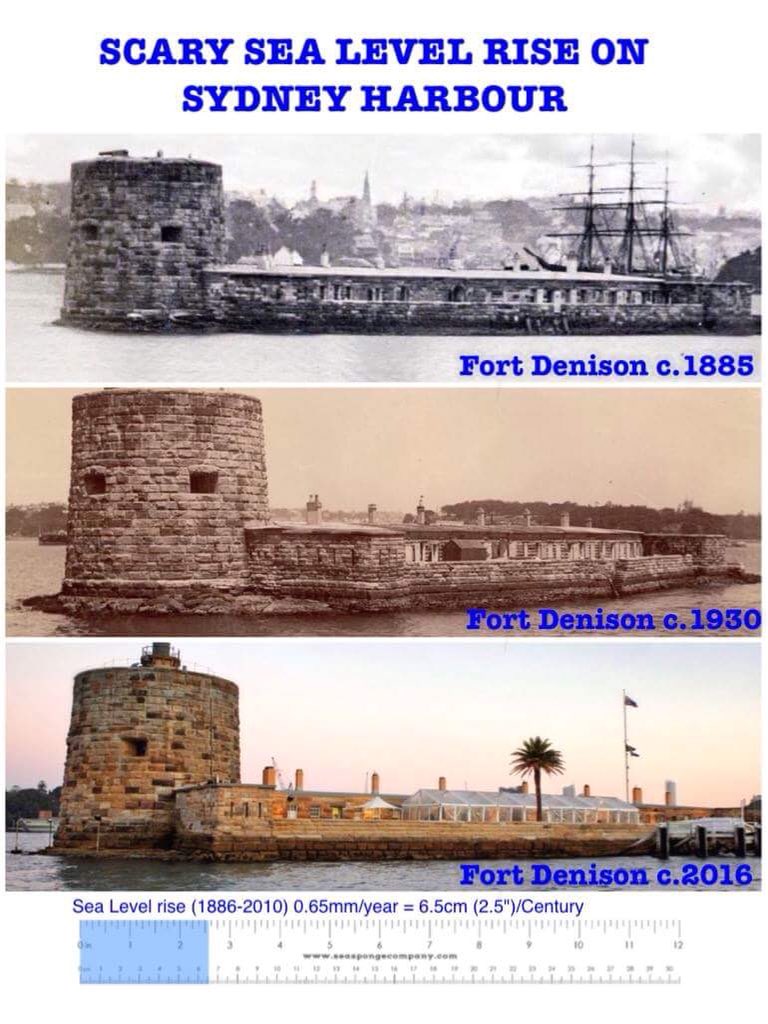
There has in fact been some rise over the 128-year-long tide gauge record. Since 1886 it indicates a long-term rate of sea-level rise of two and a half inches (6.5cm) a century. That's hardly enough to knock anybody off their horse.
But wait! There's more! Here is a plot of the rise:
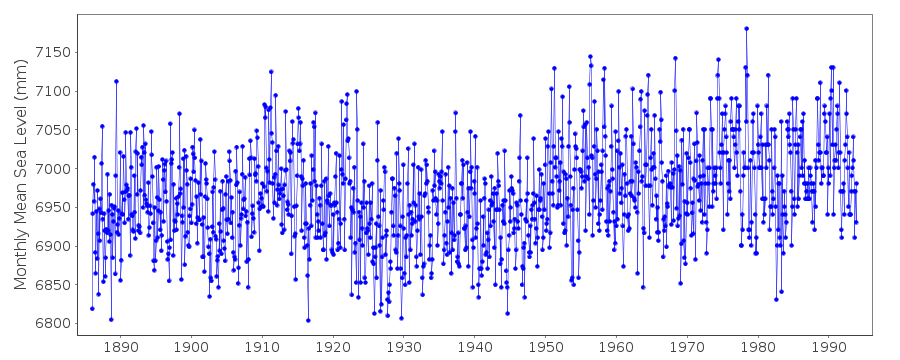
You can see that the sea level has been plateaued since 1950 -- exactly the time that the climate bigots say global warming began. So NONE of the rise was due to global warming. The small amount of global warming we appear to have had in recent decades did not shift the sea level one iota. Fun!
New literacy teachers recruited as NSW government axes Reading Recovery
A team of 50 literacy and numeracy experts will be recruited to support NSW teachers as the government axes the controversial $50 million Reading Recovery program, which is used in more than 900 schools but was found to be ineffective.
Principals were told in November that the NSW Department of Education would no longer be supporting Reading Recovery, which targets year 1 students who are struggling with literacy. Students undergo a one-on-one intensive program for up to 20 weeks.
In NSW, Reading Recovery is in 60 per cent of schools and at least 14 per cent of year 1 students take part in it.
It is understood principals will still be able to run Reading Recovery from their own budgets but from 2019 the government will redirect the $50 million it spends annually on Reading Recovery to other "evidence based" literacy and numeracy programs.
The government says the new positions are part of the government's $340 million NSW Literacy and Numeracy Strategy, which includes investment in the early education years through to supporting students to reach minimum literacy and numeracy standards in the HSC.
For the first time, year 9 students this year needed to achieve three NAPLAN band 8s in reading, writing and numeracy to pre-qualify for their HSC. If they did not, they will need to sit an online literacy and numeracy test.
The education minister, Rob Stokes, said the 50 new positions would support teachers with face-to-face professional learning in "new approaches to monitoring and supporting" literacy and numeracy from kindergarten to year 10.
The new positions will focus on understanding and diagnosing students literacy and numeracy tests, effective reading in the early years including systemic phonics, writing across the curriculum and number skills and algebraic thinking.
"This investment means that every teacher will have access to evidence-based professional learning to ensure every student has the best opportunity to develop strong literacy and numeracy skills," Mr Stokes said.
"This focus on literacy and numeracy skills is more important than ever in light of evidence that young people today will face a very different future when they finish school."
Despite its widespread use, Reading Recovery – which is also in the US, Canada and Britain – has had its critics and in 2015, influential US literacy academic Louisa Moats told education bureaucrats in Victoria that it was "indefensible" to spend money on the program.
Dr Moats said if she had a child with a learning disability she would refuse to let them take part in a Reading Recovery lesson. "The instruction is directing their attention away from what they should be paying attention to. It's just not OK, it's harmful."
The federal government is also focused on literacy and numeracy in the early years of primary school, with the education minister Simon Birmingham backing a proposed reading test that would be based on the phonics screening check used in the UK since 2012.
Education ministers discussed the phonics checker at December's Education Council meeting but it is understood no decision on the test's implementation was made.
Mr Stokes has said that he "sees no reason" why it could not be rolled out in NSW but some education academics in Australia and the UK oppose the screening check, which tests 40 words, including 20 pseudo words such as pib, vus, yup and desh and 20 real words.
SOURCE
Posted by John J. Ray (M.A.; Ph.D.). For a daily critique of Leftist activities, see DISSECTING LEFTISM. To keep up with attacks on free speech see Tongue Tied. Also, don't forget your daily roundup of pro-environment but anti-Greenie news and commentary at GREENIE WATCH . Email me here
Tuesday, January 02, 2018
Australia's greenhouse gas emissions increase for third consecutive year
These figures are very dodgy. There is no way such a figure could be directly measured. They are estimated by adding together the amount of cement produced, the amount of coal mined and the number of sheep farting etc. There are many ways that could be inaccurate. Such figures could be fairly good at enabling year to year comparison but fluctuating commodity prices are a big influence on Australia's economic activity so are probably much less accurate than world figures, where losses and gains are more likely to average out
And what does it matter anyway? Belief in global warming is just climate bigotry -- impervious to any evidence about the truth or falsity of the theory
New Environment Department figures shows gas emissions grew by 0.7 per cent last financial year, which has been blamed on an increase in gas production and exports.
That comes after a 0.8 per cent increase during the 2015/16 financial year, which was accompanied with a warning Australia was not on track to meet its 2030 emissions reduction target.
But Energy Minister Josh Frydenberg said the latest data showed the Federal Government was expected to achieve its 2020 climate change target reduction of 294 million tonnes compared to 2000 levels.
In a statement, Mr Frydenberg said Australia was, "[continuing] to close the gap on the 2030 target" despite the annual increase in gas emissions.
"Australia beat its first Kyoto Protocol target by 128 million tonnes of emissions, and updated data released today by the Department of Environment and Energy shows Australia's emissions are now at their lowest level in 28 years on a per capita and GDP basis," Mr Frydenberg said.
Opposition energy spokesman Mark Butler said the Government's revised emissions targets for 2030 would only be 5 per cent below 2005 levels.
"Ignoring land sector emissions, 2030 emissions are projected to be almost 10 per cent higher than 2005 levels," Mr Butler said.
The Environment Department's long-awaited review of climate change policy found Australia accounted for 1.3 per cent of global carbon emissions.
Mr Frydenberg said the report proved the Federal Government had the right mix of policies to meet climate change goals, while also securing reliable and affordable power supply.
He said the emissions reduction fund was now, "one of the world's largest domestic carbon offset markets" with more than 191 million tonnes of abatement secured with an average of price of $11.90 per tonne.
The department report also considered the role of international emissions trading, with the Federal Government now giving "in-principle support".
This would allow businesses that have low emissions to sell excess usage to other organisations that have higher pollution rates, which may help reduce compliance costs.
"The final decision on the timing and appropriate quantity and quality limits will be taken by 2020 following further consultation and detailed analysis," Mr Frydenberg said.
Climate Council chief executive Amanda Mackenzie said the latest figures showed Australia risked becoming, "the global climate laggard".
SOURCE
2018: Crunch time for Australia’s economic renewal
Company tax a big issue
As many of us enjoy the holiday ritual of heading to the beach to unwind and recharge, we can reflect on a year that ends in better shape than it began.
Despite frustrating Senate intransigence and a revolving door of federal MPs tripped up by citizenship issues, many more Australians have found work and non-mining business investment is turning the corner. A national plan for reliable, sustainable and affordable energy exists, and our budget position is on the mend. Green shoots are appearing.
During the break we cannot afford to lose this hard-won momentum; we cannot rest on reform.
Next year, the Australian community is counting on us to develop the conditions to compete globally, create and expand businesses, generate the jobs of the future, improve productivity, help lift sluggish economic growth and deliver higher wage growth.
We cannot sleepwalk during the summer while other nations surge ahead, re-energising their economies after the global financial crisis.
This time last year I described US President Donald Trump’s platform of aggressive company tax cuts and deregulation as a global game changer. The Business Council of Australia has spent the past 12 months sounding the alarm on the dangers to the nation of a seismic tax shift in the US. Those risks are now a reality. Congress has green-lighted a drop in the US company tax rate by 14 percentage points to 21 per cent almost overnight. The modest plan for Australian business, which remains bogged in the Senate, proposes a gradual reduction in the tax rate of five percentage points across a decade.
Our company tax rate has been frozen for 16 years while the rest of the world has pushed us further down the international leaderboard. Without urgent action, our competitiveness is at risk; next year is crunch time for Australia.
The Trump tax cuts represent a de facto tax increase on all Australian businesses as we battle for global investment. Safeguarding Australian jobs, living standards and economic growth will require action to keep us competitive. The government’s enterprise tax plan will help do that. The International Monetary Fund and Treasury are clear: without reform we will see capital sucked out of the Australian economy.
The US is not alone in moving to supercharge its economy. Belgium is close to passing legislation to reduce its company tax rate and even France, which traditionally has put high taxes on business, has announced a significant reduction from 33 per cent to 25 per cent.
The average company tax rate across the OECD is 24 per cent and falling. The average across Asia is 21 per cent. Britain is moving to 17 per cent.
There is a plan on the table to ensure Australia doesn’t slip further behind. Next year, let’s just get on with it.
As we head into the new year, business knows it, too, must get its house in order. We will continue to tackle the lightning rod issues that bug the community.
With many Australians worried about the rapid pace of technological change, business understands we must take ownership of the transition already under way in our workplaces.
We need to explain the impact of new technologies and ensure workers have the skills for the years ahead. This will be a major focus of the Business Council during the coming months.
Another area of concern we worked through this year was addressing the complaint that big business failed to trade fairly with small business.
In response, we developed the Australian Supplier Payment Code. This voluntary industry-led initiative sets fair terms to pay small business suppliers within 30 days. The combined turnover of signatories so far to the code is $400 billion, and these organisations employ nearly 400,000 people.
The BCA and the Council of Small Business Organisations of Australia also signed a memorandum of understanding, committing us to work collaboratively on issues such as taxation and workplace relations.
We recognise the best policies are those that encourage the growth of all existing businesses and help create new businesses.
We must now remind Australians of the enormous contribution business — large and small — makes to their lives every day.
From the people serving at the checkout to the truck drivers and the workers on the front desks, business keeps the country running. We are pivotal to creating jobs, expanding the economy and delivering the wealth and economic prosperity the community shares.
Business employs 10 million of the 12 million working Australians. The tax businesses and their employees pay provides about $235 billion, or 60 per cent, of the taxes that underpin the services we want and expect. Business represents almost six million mums and dads who own shares in Australian companies that pay dividends and taxes. It’s where our superannuation is invested.
Business isn’t a villain; it’s absolutely essential to our economy.
Without business, the world would be a very, very different place. An anti-business agenda would spell disaster for the country. There would be little job creation, let alone wage growth. The best way to boost wages is through productivity improvements, a more competitive economy and a focus on growth.
This means creating an environment that allows business to thrive. We need to reduce the unnecessary red tape and regulations that cripple Australian businesses from responding and adapting to economic change.
We also need to be armed with a well-trained and highly skilled workforce.
Earlier this year, I took the unusual step for a chief executive of the BCA in calling for a new form of protectionism. By this I didn’t mean winding back the clock and retreating to trade barriers and inefficient industry subsidies. Instead, I want to see Australia protect our capacity to compete on a global stage, protect our ability to develop new businesses and expand existing ones that can export around the world. We need to safeguard our ability to innovate and to protect the creation of rewarding, high-paying jobs.
This new Australian protectionism can help ensure we are the most skilled, the most trained and the most resilient people on earth. Why shouldn’t this be our aim? Australians deserve nothing less.
As technology transforms the economy, we need to future-proof ourselves. But first we need to rebuild our tertiary education system, tearing down the silos between higher education and vocational education and training.
Next year, the BCA will continue to press the case for a single tertiary funding system to ensure no Australian falls through the cracks of a changing workforce.
The VET sector is the main vehicle for training workers for some of Australia’s biggest employers and industries. It will be crucial in retraining and expanding the skills of workers for the jobs of the future. By shifting to one tertiary funding system, we can help break the stigma that a vocational qualification is any less prestigious than a university degree. It is not.
I am proposing each Australian be given — and be in control of — their own portable lifelong skills account.
This would enable them to study short courses and modules from a university or a VET provider to build on their existing qualifications, essentially piecing together the credentials they need for the new world of work.
I am urging all parties to focus on the holistic reform of the tertiary sector to ensure it is more responsive to the demands of future workplaces and the skills mix workers will need.
As we enter the new year, we have an opportunity to build on the tentative signs of economic renewal under way.
The release last week of the mid-year economic and fiscal outlook confirms Australia’s revenue growth overwhelmingly is driving the improved budget position.
If parliament is unwilling to support the government in its efforts to restrain expenditure, then business will need to do the heavy lifting on delivering economic growth.
The outlook forecasts economic growth of 2.5 per cent in 2017-18, lifting to 3 per cent in 2018-19. We can no longer continue to accept annual growth with a two in front of it.
The IMF warned last month Australia’s economic recovery was lagging that of other major countries. Now, more than ever, we must pull out all stops to accelerate economic growth and boost investment to ensure businesses can generate revenue and stronger growth.
We cannot simply tread water. Let’s pick up the pace and make real progress in narrowing the gap with our global rivals. Let’s bring it home next year. Introducing a fairer, competitive company tax system that ensures Australian businesses are no longer forced to compete with one arm tied behind their backs is a good starting point.
Regaining our global competitiveness is not about statistics; it’s about protecting our quality of life.
It’s about restoring Australians’ sense of hope, rekindling their aspirations for themselves and their family. It’s about ensuring they have a good job and can build a better life.
We want every single Australian to have the opportunity to realise their potential. We want Australians to be rewarded for their hard work, ambition and drive, and to feel that together we are moving ahead.
SOURCE
Australia's least-competitive industries earning big profits
Economists have no quarrel with businesses making profits. The shareholder-owners who provide the financial capital needed to sustain those firms are entitled to a return on their investment, one that reflects not only the (opportunity) cost of their capital, but also the riskiness of the particular business they're in.
Economists call such a return on equity "normal profit". But sometimes the various barriers to new firms entering a market limit competition, allowing the incumbents to make profits in excess of those needed to induce them to stay in the industry.
These are called "super-normal" profits (super as in "above"). Now get this: the other name for super-normal profits is "rents" – economic rents, to be precise.
We're used to thinking of rent-seekers as businesses or industries that ask governments for special treatment. But it's common for rents to be sought in situations that have nothing to do with government favours.
One of the most informative pieces of economic research undertaken last year was conducted by Jim Minifie, of the Grattan Institute, who made detailed estimates of the economic rents being earned in particular industries – something no government agency would be game to do.
He focused on the two-thirds of the economy made up by the "non-tradable private sector", excluding export and import-competing industries and the public sector.
He found that the annual return on equity in the most competitive part of this sector averaged 10 per cent. That compares with returns exceeding 30 per cent in internet publishing, which includes online classified advertising of homes, jobs and cars.
Then came internet service providers on 25 per cent and wired telecom on a fraction less. Supermarkets were on about 23 per cent, sports betting on 22 per cent, liquor retailing on 19 per cent, and wireless telecom and (get this) private health insurance on about 18 per cent.
Delivery services and fuel retailing are on 15 per cent, with banking not far behind on 14 per cent, level pegging with electricity distribution and airport operations.
But the rate of an industry's super-normal profit or economic rent isn't the same as its absolute amount. Most industries with very high rates of profit are quite small.
Measured in dollar terms, the most rents are in banking, followed by supermarkets, electricity distribution (just the local poles and wires), wired and wireless telecom.
Minifie estimates that rents account for 20 per cent of the non-tradable private sector's total annual after-tax profits of $200 billion. This is equivalent to more than 2 per cent of gross domestic product.
Another way to judge the significance of super-normal profits is to express them as "mark-ups" – as proportions of total sales.
The average mark-up across the whole non-traded private sector is 2 per cent. So, if rents were eliminated, but costs didn't change, average prices would fall by 2 per cent.
Within that average, however, the mark-up in internet publishing is 26 per cent. Then come airport operations on 20 per cent, wired telecom on 19 per cent and electricity distribution on 12 per cent.
Further down the league table, electricity transmission – the high-voltage power lines, not the local poles and wires – has an estimated mark-up of 7 per cent.
But get this: the banks' mark-up is just 4 per cent and the supermarkets' is a bit over 3 per cent.
How come, when super-profits account for more than half the supermarkets' total profit? Because supermarkets are a high-volume, low-margin business (as are banks).
Minifie notes that Coles and Woolworths are so big they achieve huge economies of scale. And, as dairy farmers well know, they achieve further cost savings by using their market power to force down the prices they pay their suppliers.
Trick is, they pass much of these cost savings on to their customers, but keep enough of them to remain highly profitable.
Coles and Woolies have substantially higher profit margins than their smaller rival IGA, even though their average prices are lower than IGA's prices. So the big two's costs must be a lot lower than IGA's.
The list of industries with the highest super-profits reminds us how badly governments have stuffed-up the national electricity market, how much better they could be doing in controlling the prices of monopoly businesses such as Telstra, airports and port terminals, and in charging for liquor and gambling licences, not forgetting the indulgent treatment of private health funds.
SOURCE
Turnbull and Shorten face the battler factor in 2018
The political signposts this month show the coming year will provide some pretty brutal lessons for our political elites, at state and federal level. Whether they pay attention is up to them. On past experience, they probably won’t.
Signpost No 1
The New England by-election of December 2
An extraordinary swing towards Barnaby Joyce, despite his Kiwi citizenship woes, confirms that a candidate who can connect with voters at a grassroots level can overcome any number of hurdles.
This seat in northern NSW teems with a demographic readers will recall as “Howard battlers”. This group is socially conservative, has a lower-than-average income due partly to a heavy reliance on commonwealth welfare cheques, and tends to live in regional areas or on the urban fringes.
They are the digitally disrupted, out of work or underemployed as a result of declining or automating manufacturing. And they are the closest thing Australia has to Trump and Brexit voters.
Joyce’s rural reawakening had him talking about the sorts of issues we used to hear on ABC radio’s Country Hour in the 1960s: export prices, local jobs, farm debt, and bringing the Canberra public service closer to the voters and taxpayers it is meant to serve.
There seemed to be a focus on the local positives and a lack of the debilitating and mutually destructive negative campaigning that helped erode primary vote support for the Coalition and the Labor Party last year down to the lowest levels in their history: 42.1 per cent and 34.7 per cent respectively.
The impact of this style of campaigning can be measured by the result, which was a 7.2 per cent swing to Joyce, despite by-elections normally going against the government of the day.
And this in a state where at the last state election our modelling showed the Nationals brand was on the nose, as the local Liberals weren’t voting for the Coalition’s junior member. They certainly did this time, as did many working-class Labor voters. It turns out that, compared with last year, Joyce won more votes from country families of the sort that used to dominate the old Queensland Howard battler profile back in the noughties.
These voters re-elected the old populist ALP premier Peter Beattie in February 2004 with 56.4 per cent of the two-party-preferred vote and then, eight months later, returned John Howard as the Coalition prime minister with 57.2 per cent of the 2PP vote.
Voters for Joyce included a large bloc of welfare recipients chasing cheaper housing on the outskirts of town, middle-income male tradies, male hospitality workers, renters, European migrants and — the clincher — traditional Labor voters. We even noted the presence of public servants, presumably including those who at first didn’t want to move from Canberra (check out our online map at elaborate.net.au, where the swing map shows you the impact of each demographic group and how it helped).
The battler demographic is strongest in Queensland and NSW. One Nation hoovered them up as Senate primary votes last year. One Nation’s impact on the Coalition primary vote is stark. According to quarterly state breakdowns of Newspoll published in The Australian on Tuesday, the Coalition’s primary vote in NSW fell from 41.9 per cent at the federal election last year to 35 per cent in the three months to December. And the Liberal National Party’s primary vote in Queensland since last year’s federal election is down from 43.2 to 32 per cent.
In the same timeframe, One Nation’s primary vote in NSW has lifted from 0.6 per cent at the federal election last year to 10 per cent in the three months to December. In Queensland, it has moved from 5.5 per cent to 15 per cent.
If you want to see where such voters live, drive through Longman, the highly marginal federal electorate north of Brisbane where Labor’s Susan Lamb may face a by-election early next year due to a possible referral over British citizenship. Labor won the seat last year on One Nation preferences.
If, next year, the LNP fails to hold or improve on its 2016 vote in this seat, you can be sure the Coalition cannot win enough seats to survive the next federal election, due by mid-May 2019. The Howard battler voting bloc represents 13 per cent of Queensland voters and holds the key to the outcome of the next federal election. Members such as Joyce are a defence against its defection.
Signpost No 2
The Bennelong by-election of December 16
When political commentators look at voting trends, they can be too quick to point to religion or ethnicity as a driver of voting behaviour. Working-class Australians are apparently a bit harder to notice for some commentators, who more readily spot a Muslim in traditional dress. Similarly, a young, second-generation Australian professional family becomes a Chinese voter. This is more of a comment on the commentator than the group in question.
The significance of the same-sex marriage process became apparent when our research at Australian Development Strategies broke down the Bennelong vote booth by booth.
The contest involved a sitting member, John Alexander, whose 2016 vote we modelled as being about 7 per cent above what it should have been.
In other words, Alexander turned a 53 per cent Liberal seat into a 60 per cent seat because 7 per cent of typical Labor voters liked him enough to vote for him.
Many of these voters would have been of Chinese ancestry, as Bennelong is the seat with the highest percentage of Chinese speakers in the country, at 20 per cent. So, if the Chinese like you in Bennelong, you’re doing OK. And according to my source of advice on China, a professional of Chinese and Australian ancestry, Alexander appealed because “he’s had a distinguished national career as a sportsperson, and he’s an older bloke with some grey hair and a Western name”.
At the by-election we saw a roughly 5 per cent swing against Alexander. Commentators seized on how the Chinese community voted, especially in view of the federal government’s recently unveiled foreign interference laws. We also had just seen the demise of young ALP senator Sam Dastyari, who, it is fair to say, is pretty close to a few members of Australia’s Chinese community, as indeed are many other politicians.
To give credit where it’s due, Labor opponent and former NSW premier Kristina Keneally did her best, putting on the Chinese favourite colour red whenever possible. But she was relentlessly negative about pretty much anything to do with her opponents.
Yet when we had a look at modelling the result, Chinese ethnicity faded from significance. The swing against the Coalition was largely driven by the progressive left, including groups that opposed holding the same-sex marriage plebiscite but ended up voting Yes. The swing against Alexander was also the result of the conservative demographics in Bennelong — those who supported the No position in the plebiscite and who then opposed the limited amendments to the Marriage Act passed on December 7, little more than a week before the by-election.
The working-class religious right didn’t flirt with the Australian Conservatives in Bennelong: it just voted Labor, joining the progressive left.
You’d have to say it takes a particular set of political campaigning skills for a government to come up with a non-binding plebiscite supported by more than six out of 10 Australians that still costs it votes the week after the enabling legislation was passed.
The only thing that held the government vote together in Bennelong in the last week of the campaign was the big group of mainstream middle-class Australians who voted Yes to same-sex marriage and are still wondering what the fuss was about.
The lesson here for the government next year is that sometimes you lose more in the long run from always following the soft option — in this case a plebiscite. Think banking royal commission.
Across both seats, New England and Bennelong, we saw a range of swings of up to 12 per cent for and against the Coalition, but an average swing to the Coalition of about 1 per cent.
This was in a sample of two seats out of 150, one urban, one mixed rural and provincial, with the same sitting members. The idea that you can apply the swing in Bennelong to a swing pendulum and call this a landslide for the opposition makes sense to Bill Shorten and Keneally, but not to me.
The trends in by-elections early next year — we could see them in the Labor-held seats of Batman (Victoria), Fremantle (Western Australia), Braddon (Tasmania) and Longman (Queensland), the Xenophon seat of Mayo (South Australia), and perhaps the Coalition seats of Chisholm (Victoria) and Mitchell (NSW) — will depend to a great extent on the state of the labour market at the time. And the battlers.
Signpost No 3
The December 19 Newspoll
This showed 46 per cent of South Australians support Nick Xenophon as premier and 32 per cent support his SA Best candidates. In theory, this means South Australian voters on March 17 may elect Xenophon as premier and prove voters have a choice when inept political machines and factional timeservers keep dishing them up profoundly underwhelming leaders and opposition leaders.
Now, there’s a tough option for our political class in Canberra.
At the moment, given the extraordinary level of hostility to the major parties in SA and the corresponding support for Xenophon’s party, the SA seat of Mayo would easily be retained by Rebekha Sharkie if she were able to run.
A by-election in the inner Melbourne seat of Batman, reportedly without a Coalition candidate, would be won easily by the Greens.
My Tasmanian sources tell me local “rough diamond” Jacqui Lambie could win the northwestern provincial seat of Braddon if she ran against Labor’s Justine Keay, as the conservative Tasmanian Liberals have an unfortunate tendency to put up candidates who can win preselections but not elections.
The Liberal Party’s federal vote in Western Australia has been improving since the demise of the unpopular Barnett state government, but this will not have an impact on Labor’s Josh Wilson holding Fremantle in an early by-election, as the seat is safe Greens-Labor.
The Liberals probably could facilitate a Greens victory by not running — but that would require the Liberals admitting they couldn’t win, and this probably would be beyond them.
Longman would be retained by Labor’s Lamb, given the bureaucrats now running the Queensland LNP are busy trying to pretend they did a great job in losing the state election last month, if only they could stop people talking about it in public. So I’ll do it for them. The combined LNP was a good idea when we had optional preferential voting in Queensland elections. Now we don’t, and this has made the LNP country candidates more fearful of One Nation and the LNP urban candidates more vulnerable to the Greens and Labor, as we saw in the recent state election results.
This is why rural LNP members such as George Christensen and Keith Pitt have threatened to quit the LNP, and why LNP urban state MP Scott Emerson lost Maiwar to the Greens.
If Labor was comfortably returned in Longman it would be a sign the game was up for the Coalition, as Longman is a blue-ribbon Howard battler seat. If Labor can win and hold this demographic, the party can win regional Queensland and urban fringe seats across the nation.
Chisholm could be interesting if Liberal MP Julia Banks somehow found herself up for a by-election, which I think is unlikely given the referral mechanisms likely to be employed. It’s a bit of a Melbourne sister seat to Bennelong, with a very strong aspirational Chinese community focused on educational opportunities in local state schools and has a large migrant community.
Its base level of support for Labor in our model is about 54 per cent and Banks won it last year with a strong personal vote of about 6 per cent. The odds would favour Labor winning narrowly in a by-election.
Alex Hawke would easily retain the NSW safe Coalition seat of Mitchell if he were forced to face a by-election, although I can’t see that happening.
Overall, you’re looking at mixed bag here, with Labor losing up to three seats to Greens or independents and the Liberals under threat in Chisholm, with no chance of winning back Mayo from the Nick Xenophon Team.
This means Labor is the party likely to be going backwards federally next year, putting pressure on Shorten, a bloke looking increasingly like a Labor version of former Liberal prime minister Billy McMahon, a man renowned for his skill at white-anting leaders and self-serving political intrigues, if not for his popularity or electoral success.
The worst that could happen here would be for Malcolm Turnbull to lose Shorten as Opposition Leader because his replacement would be Anthony Albanese and that would spell big trouble for the Coalition. I think this is likely to happen, probably just before the next federal election, as we saw in New Zealand — and closer to home in 1983, when Bill Hayden surrendered the ALP leadership to Bob Hawke.
Longer term, if the next federal election isn’t held until early 2019, we can expect to see continuing Labor governments in Queensland, Western Australia, Victoria and possibly South Australia, and probably a new Labor government in Tasmania, where Opposition Leader Rebecca White looks like she can win in May.
These will be a plus for the federal Coalition, as big-spending, ideologically driven Labor state governments become vote losers for Labor’s federal candidates when local voters find all the red overdue notices hidden behind the kitchen dresser and their taxes start to rise.
The really heavy lead in the saddlebags for the federal Coalition is the big-spending and highly factionalised Coalition government in NSW, whose vote will drop during the next 18 months in direct proportion to the drop in house prices and associated state revenues.
This is why I would expect to see the Prime Minister hang on for his federal election until the last possible date of mid-May 2019, after the NSW election set for March 23. At that time, we can expect the federal government to reach for the personal income tax cuts, as for Labor this is a promise too hard to match, given its spending commitments to public sector unions. Against Shorten as alternative prime minister, this could be enough.
SOURCE
Posted by John J. Ray (M.A.; Ph.D.). For a daily critique of Leftist activities, see DISSECTING LEFTISM. To keep up with attacks on free speech see Tongue Tied. Also, don't forget your daily roundup of pro-environment but anti-Greenie news and commentary at GREENIE WATCH . Email me here
Monday, January 01, 2018
Feminist Push to make childcare unaffordable
The Leftist IEU (Independent Education Union) have issued the call below. Government "quality" mandates, including high staff numbers and sweeping educational requirements for child-minders, have already pushed up the costs of child-minding to the point where most working mothers spend a large slice of their earnings on child care. The union wants a leap in pay for child minders that could push many working mothers out of the workforce altogether. So I support the call. Young children need their mothers at home, as the research by Erica Komisar has shown.
The claim that a university education is an important qualification for becoming a child minder is absurd and I would like to see the evidence for the claim. Some education could no doubt help but why university?
The IEU lodged evidence and submissions to support its pay equity claim for early childhood teachers just before Christmas.
This is the latest step in the IEU pay equity case that has been running before the Fair Work Commission since 2013. The Union is seeking pay rises for university qualified teachers in preschools and child care centres.
"The claim is based on comparisons with male employees male teachers in primary schools and male engineers. At present, teachers in early childhood, who are almost all female, can earn tens of thousands of dollars less than teachers in schools. For example the top award rate for a teacher in a child care centre is less than $70,000 whereas a teacher in a primary school earns close to $100,000" says Carol Matthews, Assistant Secretary of the NSW/ACT Branch of the IEU.
"We are certainly not seeking rates of $156,000 as some media outlets have claimed," she added. "The top rate for a teacher in a child care centre under our claim would be just over $100,00".
The claim only affects a small proportion of the overall number of staff in services and the Union calculates the impact on costs would be relatively small.
"Parents would not necessarily bear the brunt of these increases. The sector is already funded by state and federal governments to the tune of billions of dollars. Governments should also fund fair pay rates for university qualified teachers as they are so important to children's
development".
The Union states the importance of university qualified teachers to improved learning and social outcomes has been known for decades and is a central plank of the federal government strategy for early childhood education and care.
Via email
Left’s year of Trump-phobia and other insults
There was much hope that the Year of the Rooster would usher in a time of honesty and moral fortitude, which would fit in with the search for individual and collective wellness throughout the land. And there were good signs when it was realised that, contrary to many a prediction by Canberra academic Hugh White, another 12 months had passed without a military conflict between the US and China.
Alas, it soon became evident that 2017 was a bit like any other time — replete with hyperbole, historical distortion, wish fulfilment and false prophecy. Month by month:
January: London-based Australian economist Steve Keen is fawned on by Fairfax Media’s Patrick Commins for his foresight. It’s almost a decade since Keen predicted a 40 per cent drop in home prices following the global financial crisis. Keen seems to hold the view that he is so far ahead of his time that his prophecies are yet to be fulfilled. Writer George Megalogenis praises former Labor prime minister Gough Whitlam for having Justin Trudeau-like progressive policies on refugees. Megalogenis overlooks the fact Whitlam tried to stop Vietnamese refugees from coming to Australia when he was in office.
February: Federal parliamentarian Bob Katter appears on Sky News’ Paul Murray Live and alleges that, as treasurers, Labor’s Paul Keating and the Coalition’s Peter Costello “doubled the dollar in value”. He just made this up but was not corrected by the presenter. ABC Radio Sydney presenter Wendy Harmer, a member of the eco-catastrophist club, rails against the construction of Western Sydney Airport at Badgerys Creek on environmental grounds. She reckons it will add to the heat in western Sydney, making the area “unlivable”. Harmer also predicts that the tarmac will melt — which makes you wonder how people live and travel in, say, Dubai.
March: ABC journalist Eric Campbell announces that not only is President Donald Trump a “dreadful man” but he has a “dreadful family”. Campbell asks, how did this nightmare happen? The answer is, Trump got elected. Australian National University astrophysicist Brad Tucker tells Leigh Sales on ABC’s 7.30 that it would take about 750,000 years to reach a recently discovered new solar system. Asked about any qualities that would make the planets in it habitable for humans, Tucker replies, “Firstly, you don’t have Donald Trump as president.” Journalist Paul Bongiorno tweets that “everything” about Nauruans is “undemocratic, unaccountable and offensive”.
April: The Sydney Morning Herald opens up on the NSW Liberal Party. Heath Aston declares that Bronwyn Bishop’s grip on her seat of Mackellar had once been considered “North Korean in its dominance”. Which makes it unclear how she lost preselection. Aston describes Margaret Cunneen SC as part of “the conservative Catholic mafia” that supports Tony Abbott. The use of a term such as “Muslim mafia” would not be cleared for publication at a Fairfax Media newspaper. Meanwhile, journalist Sean Nicholls suggests that there was an attempt by the NSW Liberal Party’s right wing to derail the moderate candidate in North Sydney in a “suicide bomber-like” move. Really.
May: ABC TV’s Media Watch presenter Paul Barry tweets: “No idea if this is true — claim that Trump impeachment process has begun.” It hadn’t. Bongiorno tweets: “There has been a death at Buckingham Palace, world awaits for an official announcement.” The vibe is that Prince Philip had died. He hadn’t. OnRadio National’s Breakfast, Fran Kelly and Alice Workman agree that the Perth-based Liberal MP Andrew Hastie is part of the “Catholic right”. He isn’t a Catholic.
June: Visiting British political operative Alastair Campbell advises a supportive audience on ABC’s Q&A that he told his former boss Tony Blair that where Adolf Hitler “took a few years before he started to go for journalists and judges, Trump did it in week one”. Blair thought this “over the top” — but not, apparently, Q&A presenter Tony Jones. Meanwhile, on The Drum, guest panellist Rory O’Connor supports his 80-year-old uncle’s view that Trump is “doing the same thing” as Hitler did. Harmer expresses surprise that a terrorist attack occurred in an up-market suburb such as Brighton in Melbourne.
July: News emerges of ABC management setting up a staff meeting where those assembled are asked to sit in a ring and talk “through” a plastic toy about how they feel. This attempt at corporate wellness has still not led to the appointment of a conservative in any of the ABC’s prominent programs. The ABC’s Marius Benson opines that “the Trumps look too much like Ceausescus” — a reference to the murderous Romanian communist dictator and his wife. Late at night, Sky News’ Ross Cameron tweets: “In a world where trust seems hard to place, the moon will never let you down.” Now, that’s handy to know.
August: Sky News presenter Kristina Keneally declares that she would “like to think that Jesus, who excoriated the scribes and Pharisees, would have been a fan” of Tim Minchin. Jesus claimed to be the son of God, Minchin is a proud atheist. Failed environmental prophet Tim Flannery reckons that in China “the air’s unbreathable, the water’s undrinkable and the food’s inedible”. Yet there are more than a billion Chinese. Melbourne barrister Julian Burnside QC links Malcolm Turnbull’s warning on terrorism with the propaganda of Nazi Hermann Goering. On Twitter, Van Badham foretells that Trump will be just like Hitler.
September: Senator Derryn Hinch fesses up that even a “close friend … doesn’t like me”. Some time after Peter FitzSimons praised the Italian health system, his wife Lisa Wilkinson complains of her medical treatment in an Italian hospital that “was like walking into a building in Beirut”. The Age’s Julie Szego sees similarities between Turnbull’s language and the “wilful distortion worthy of Uncle Joe” Stalin. Sky News’ David Speers reflects that Labor has “held more positions on coal than the Kama Sutra” — opening up a whole new way to interpret Vatsyayana’s tome.
October. Erik Jensen informs The Drum that “racism is the reason” he is editor of The Saturday Paper. Writing in Fairfax Media, Steve Biddulph preaches against “dysfunctional men” such as Trump, John Howard, Abbott, Peter Dutton and Eric Abetz. He describes Howard as a “dismal human being”. This is abuse posing as argument. Journalist Sarah Macdonald “just can’t get over how much smarter Hillary (Clinton) is than Trump”. But not smart enough to campaign in Michigan or Wisconsin, it seems. Peter Greste reckons it would have been better if the September 11, 2001 attacks had been classified as mass murder, not terrorism.
November: The Yes case in the same-sex marriage postal survey prevails by about 62 per cent to 38 per cent despite a Griffith University analysis of Twitter that concluded the No side would gain a narrow victory. Two reporters on the influential ABC radio AM program claim that in Rhodesia, which became Zimbabwe, Robert Mugabe “led a guerilla uprising against the British”. At the time, the country was not a British colony. Greens MP Adam Bandt reports that when he “heard that a head of government was cancelling parliament … I thought I was hearing about Zimbabwe, not Australia”. The reference was to the Prime Minister’s decision that the House of Representatives would not sit for one scheduled week. Just one.
December: The year concludes much as it began with so many media types presenting with Trump-phobia. On Late Night Live, presenter Phillip Adams and his panellists David Marr, Laura Tingle and Tony Windsor all agree the US President is a dud. According to Marr he’s a “buffoon”. According to Tingle, Trump is “bringing the world to the edge of nuclear disaster one week and being a buffoon the next week”. Meanwhile, The Saturday Paper ends the year with an explanation for the present state of the vale of tears in which we live. Its front-page declares: “It’s all John Howard’s fault.” Well, at least we know.
SOURCE
I’m a student. Here’s how free speech died at university
UNIVERSITIES really do have a free speech problem, and it should no longer be considered controversial or ‘right-wing’ to say so
Luke Kinsella
ONCE upon a time, society designated universities as intellectual battlegrounds where fights weren’t won by intimidation, but with logic and reason. That’s what separated them from the outside world and its ugly improprieties.
Censorship was antithetical to these refuges of intellectual civility. In fact, it was a sign of cowardice. Unlike the outside world, universities were sanctuaries where all ideas were welcomed and everyone had a seat at the table.
Not anymore. Students around the world have a disturbing intolerance to different opinions. When faced with unfamiliar or offensive views, their gut reaction is to ban them, or condemn those who have them.
In 2015, the Boston Globe reported on a petition created by students at Wesleyan University in protest of their student newspaper’s decision to publish an op-ed critiquing Black Lives Matter (BLM). The petition garnered 147 signatures and called for the newspaper to have its funding revoked. It said the paper failed to ensure Wesleyan University was a ‘safe space for the voices of students of colour’.
I’ve experienced this first-hand. In 2017, I was a columnist for my student newspaper. I wrote a column about the threat to free speech at universities, which every member of the board of editors refused to publish — thus proving my point. Their reason? My criticism of the BLM protesters at Wesleyan.
My editors interpreted my criticism of individual BLM protesters as a rejection of BLM’s entire platform. I never actually criticised their core message: that African-Americans are too often the victim of unjust police brutality — a proposition I agree with.
I criticised the censorious behaviour of individual protesters. There is a difference. Regardless, I was accused of expressing a “damaging” opinion that “endangers students” and is “invalidating to people of colour”.
I have no reservations in describing these students, who I come across every day, as bullies. They’ll laugh at you. They’ll ban you. They’ll make unfounded generalisations about what you believe. And when they know they’ve lost, only to rid themselves of any passing cognitive dissonance, they’ll insult you.
Students should obviously be safe from physical violence. But saying my opinion is “damaging” equates speech with violence. As does the Wesleyan petition, which implies conservative beliefs make students ‘unsafe’.
The belief that speech can be equivalent to violence is an extremely common myth at universities. Students think sticks and stones may break their bones, and words WILL (literally) hurt them. This myth has some sinister implications.
If you think an opinion will cause you physical harm, you’ll seek ‘safety’ from it and use violence in ‘self-defence’. As a result, students defend the ideological homogeneity of their university like they would defend their own physical safety.
We need to teach students that words can’t cause physical harm, and they should never be safe from offensive or confronting ideas. After all, that’s kind of the point of university. You’re supposed to seek out people with whom you disagree, not hide from them, or ban them.
Earlier this year, Ben Shapiro’s visit to UC Berkeley attracted 1000 angry protesters, which forced the university to pay $600,000 in security fees. The pioneers of the 1960s Free Speech Movement, which originated at Berkeley, would hardly consider this ‘free’ speech.
And Berkeley is no anomaly. Since 2000, the Foundation for Individual Rights in Education (FIRE) has updated a ‘Dis-invitation Database’ that records attempts to disinvite speakers from coming to American universities. The number of dis-invitations has reached 360 (so far).
Instead of actually disproving opinions they dislike, they’ll just insult them. They have an array of go-to jargon and insults, but their favourites include: ‘problematic’, ’violent’, ‘unsafe’, ‘hate speech’, ‘bigoted’ and ‘invalidating of lived experiences’. They blame everything on a white supremacist, heteronormative, capitalist, imperialist, patriarchal society.
They act like the most victimised people in the world, but many of them are literally the most privileged people of all time. They live in Australia in the 21st century and often, come from extremely privileged families and go to the most prestigious schools in the country.
Using any of the above labels is like a rallying cry for professionally outraged student protesters, who make their peers afraid to associate themselves with certain opinions. FIRE found that 54 per cent of students admit “they have stopped themselves from sharing an idea or opinion in class at some point since beginning college”.
Too often, these labels are complete misnomers. Students will throw them around haphazardly with no concern for the ramifications. Take, for example, the protesters at Shapiro’s event, who chanted: “No Trump, No KKK, No fascist USA” — despite Shapiro not being a Trump supporter, a Klansman or a fascist.
Earlier this year, the University of Sydney Union (USU) blocked funding of the Conservative Club’s screening of a documentary that explores social issues relating to men, and critiques feminism.
The screening went ahead, but was protested by 50 to 60 students screaming: “Sexist, racist, anti-queer, bigots are not welcome here.” Conservative Club member Renee Gorman responded, saying: “I’m not a bigot or a racist, I’m not anti-queer, I’m not all the labels they’ve attached to me.”
Actual bigots exist, but students waste their time going after innocent people. Why do they do it? I think there are four potential reasons. Four reasons why this craziness is going on.
Firstly, students (both left and right) have forgotten the art of respectful disagreement. Pivotal to effective disagreement is giving your adversary’s motives the benefit of the doubt. But students don’t do that — they assume peoples’ motives to be impure, unless proven otherwise.
People are no longer ‘right’ or ‘wrong’, they’re ‘good’ or ‘evil’. Your political opinions are a reflection of how good you are as a person and anything considered ‘offensive’ isn’t just incorrect, it’s immoral, and not worthy of discussion. Pew Research found 40 per cent of American students believe the government should prevent people from saying offensive comments.
Students live in impenetrable echo-chambers — particularly on social media. As a result, they can’t substantiate their opinions against challengers. Why? Because they never have to. Students expect agreement; they expect detractors to change their mind immediately. But in their frustration, they resort to baseless insults. Students’ first instinct is to protest for their beliefs, rather than sit down with the people that disagree with them.
The left is particularly guilty in this regard, but mostly because they make up the majority of students. The right have their stupid go-to slurs as well, which include: ‘Marxist’, ‘social justice warrior’, ‘cuck’ and ‘feminazi’.
At university, political disagreements should be so commonplace, they’re forgettable. But disagreements are so rare, tense and combative, that onlookers watch them as a form of entertainment. Instead of participating, most students grab the popcorn.
The second reason is a form of identity politics which says it’s not the merit of one’s argument that matters, but their racial, gender or sexual identity. Students believe some identities are more qualified to speak about certain issues than others. So most political arguments take the form of: As an X, I believe Y.
And if you speak about a Y that falls outside the scope of your X, you’re not taken seriously. You can only speak about issues pertaining to your own personal identity.
For example, in discussions about feminism, only a woman’s opinion matters. When a man states his opinion, no one actually proves him wrong. Instead, he’s dismissed as not having the necessary ‘lived experience’ to have a valid opinion. Logic and evidence has ceased being the standard for truth, and identity has filled it’s place.
The third reason: virtue signalling. At university, your level of outrage toward certain people and opinions directly corresponds with your social status. Student leaders are ideological clones of each other.
Students will find any way to publicise themselves ‘fighting the good fight’. The more outraged you are, the better person you’re perceived to be. The more you hate the other side, the more your side loves you.
Sometimes, activism is less about actual causes, and more about gaining social brownie points. And with social media, students can broadcast their good deeds to everyone they know. It makes them feel good, and within their respective echo-chamber, it makes them look good.
Students want the thrill and excitement of calling out actual bigots. It gives them a sense of certainty, meaning and belonging. So if some innocent people are caught in the crossfire to provide that sensation, then so be it.
The fourth and final reason is that there is a short supply of bigotry, but a high demand for it. Students want to be offended, and for that, they need offensive people. But as racism and sexism have declined, they have to maintain their high level of outrage by lowering the bar for what’s considered offensive.
Or as sociologists Bradley Campbell and David Manning put it: “As progress is made toward a more equal and humane society, it takes a smaller and smaller offence to trigger a high level of outrage. The goalposts shift, allowing participants to maintain a constant level of anger.”
This is why students often go after innocent people, and have dramatic reactions to seemingly minute offences — or, as they call, ‘micro-aggressions’.
This outage culture only suppresses debate between the left and right — which is no accident. Students don’t want a debate because debates ‘give a platform’ to ‘dangerous ideas’. They want their opinions to be treated like facts.
Despite my dark depiction of universities, I can assure you: I’m not alone. This isn’t some fringe alt-right rant. If you don’t trust me, trust the over 1400 American professors who have joined Jonathan Haidt’s Heterodox academy, an organisation dedicated to improving free speech and viewpoint diversity at universities.
Or trust President Barack Obama, who has also spoken out against political correctness, censorship and the “coddling” of students.
It’s about time we face the facts. We are witnessing the death of universities as they once were, and as they were meant to be.
SOURCE
Islamist extremism: dance with an enemy we dare not name
The Islamist extremists are winning. Victory is unlikely and, in any event, a long way off but their immediate aims are being achieved, if not in the battlefields of Iraq and Syria, then at least in the democracies of Europe and the Western world.
The signs are ominous in Australia, where 15 years after the Bali bombings this is the enemy whose name we are too often too timid to mention. The extremists have us second-guessing the cultural superiority of our Western liberal democratic model and have conjured a collective and misplaced guilt among us about the treatment of Muslims.
From the fundamentalist preachers to the bloodthirsty terrorists, the ultimate goal of Islamist extremists is simple: global Islamic dominance. To achieve it they need to weaken and harm the West, fuel Muslim grievances and assert their cultural power through demographic changes and political influence.
They loathe our tolerance, freedom of expression and plurality, yet skilfully use these Western strengths against us as they subvert our ways by convincing many of us that we are to blame for their atrocities. We can see the Islamist success in shaping this narrative all around us.
The Palestinian cause is used as a constant irritant. Just this month, popular singer Lorde was bullied into cancelling a concert in Israel while no one seems to care that she will sing in Vladimir Putin’s Russia.
Likewise, we saw the UN General Assembly vote by an overwhelming majority to condemn the US for recognising the obvious reality that Jerusalem is the capital of Israel. And after I argued last week that Melbourne’s Flinders Street horror was an Islamist terror attack — because that was the motivation cited by the Afghan-Australian attacker — Anglican priest Rod Bower described my comments as “poison” that could “drive fragile psyches over the edge”. See what he did there — it is always our fault.
The success of Islamist propaganda can be seen in the fact after a Muslim man allegedly mowed down 19 people on a Melbourne city street and referred to “mistreatment of Muslims” to explain his actions Victorian police denied there was any evidence of a connection to terrorism. Given this is the season for resolutions, is it too much to ask that we start being forthright about the grave threat of Islamist extremism?
The paradoxes generated by the politically correct virtue-signallers who have taken over our politics, bureaucracies and, it seems, even the upper echelons of our law enforcement agencies are deeply worrying. After the Martin Place siege in Sydney and the Flinders Street attack, police and media downplayed terrorism but talked up mental health issues.
Even ASIO once denied links between terrorism and refugees despite the truth that each contemporary, fatal, Islamist terrorist incident in this country has involved refugees. Unpalatable as they are, we must start with the facts. We are told not to stigmatise mental health issues yet we see it used as an explanation for mass casualty attacks. As bollards go up in our cities are we to believe this is to protect us from the mentally ill or the drug-addicted? Why has this suddenly become a problem?
Law enforcement and intelligence agencies need to maintain strong links with Muslim communities to foster co-operation. They also want to maintain social cohesion and avoid the divisions between Muslim and non-Muslim people that the extremists seek to accentuate. And we should take care not to overstate the extent of the problem. We are talking about individuals of concern in this country who number only in the hundreds and a pool of people susceptible to radicalisation that may number in the thousands. Still, the dangers are obvious.
Yet obfuscation in public information about terror attacks and police actions can only undermine confidence in law enforcement and create concern about government responses to the extremist threat, therefore creating the conditions for the mistrust the authorities want to avoid.
Besides, it is insulting to Muslim and non-Muslim Australians to deny the realities they can observe. It suggests people cannot deal with facts as they fall. We are intelligent enough to understand the threat of Islamist terrorism and sensible enough not to blame all Muslims for any attacks. Time and again we see that despite self-conscious warnings so-called Islamophobic backlashes never materialise.
Politicians and police are servants of the public and should have a clear bias towards sharing information in a forthright fashion rather than keeping secrets, unless confidentiality is important for operational reasons. Initially ruling out terrorism should not be difficult; if the offender is a non-Muslim and not espousing any religious or political cause then police may be able to announce early on that they do not suspect terrorism.
But if the attack is perpetrated by a Muslim immigrant who specifically cites Muslim grievances, the public ought to be told immediately that there are indications of a terrorist motive. Additional qualifiers about other factors and ongoing investigations would be understood but the public deserves to hear as many of the relevant facts as possible. Melbourne’s new loudspeakers will be a waste of time unless someone is prepared to speak into them.
At Martin Place, NSW police delayed action and hoped to wear down Man Haron Monis as they would in a domestic siege situation, rather than treating it as an Islamist terror attack where loss of life was inevitable. Yet while this was unfolding they launched an operation to protect Muslims in public places from a Martin Place-inspired backlash. (Of course the backlash never came; even the “I’ll ride with you” hashtag campaign was based on a fabricated episode.)
When Curtis Cheng was assassinated in an Islamist killing at Parramatta the police hierarchy told the public hours later that there was nothing to suggest terrorism. Yet we soon learned the attacker, dressed in black garb, had yelled “Allahu akbar” at the scene before he was shot dead.
There is a disturbing pattern here of police and politicians bending over backwards to discount terrorism even when there are obvious indications Islamist extremism is the motivation.
Experts have long pointed to the overlap between disaffected, mentally disturbed and even drug-addicted people and the Islamist cause. It is a dangerous cocktail that can self-generate lone-wolf terrorists or be exploited by extremist manipulators.
In the wake of Martin Place, Clive Kessler, emeritus professor at the University of NSW’s school of social sciences, wrote how the interception of any future “psychotic loner” attacks could be a matter for mental health and security agencies. “But most such incidents are the work of psychotic, sociopathic, disturbed or even ostensibly normal individuals who fall in with, and whose ideas and perverse impulses mesh them into, small like-minded groups, sometimes even broad social movements,” he said.
Kessler wrote of the importance of serious debate within and about our Muslim communities covering the triumphalist and resentful elements of the faith that are shared by the mainstream but taken to violent ends by the extremists. This is the core of the debate. Unless we intelligently confront reforms needed to undermine the Islamist extremist ideology, all the bollards in the world cannot save us.
Psychiatrist and author Tanveer Ahmed, who comes from a Bangladeshi Muslim background, also has written about the overlap between disaffected individuals — particularly refugees — and Islamist extremism. He points out that attacks do not need to be well organised or sanctioned by groups such as Islamic State or al-Qa’ida to be categorised as terrorism. It is about motivation.
Ahmed has written about how paranoid individuals may project their personal resentments through Islamist ideology. Those who are mentally ill or have criminal backgrounds have a higher risk of adopting extremist and violent practices. “None of these factors make the contribution of Islam and particular interpretations that encourage attacks upon non-Muslims irrelevant,” he explains.
Yet it is the essence of the motivation — the Islamist ideology — that politicians and authorities seem most keen to avoid. They prefer to talk about hardware and firepower — and mental health.
Will the loudspeakers installed in Melbourne’s CBD warn of mental health outbreaks? Are the military weapons of the NSW police to be trained on people who are disturbed and ill?
Or do we need to accept that the Islamist aim of disrupting our society by targeting infidels and innocents cannot be truly defeated until the ideology itself is exposed, confronted and eradicated?
SOURCE
Posted by John J. Ray (M.A.; Ph.D.). For a daily critique of Leftist activities, see DISSECTING LEFTISM. To keep up with attacks on free speech see Tongue Tied. Also, don't forget your daily roundup of pro-environment but anti-Greenie news and commentary at GREENIE WATCH . Email me here
Subscribe to:
Posts (Atom)


 Evelyn Rae, a conservative Australian political commentator


 Margo Robbie -- a beautiful australian
 My son Joe at ANU
 One of the happiest pictures ever -- Cleo Smith, aged 4


