Wednesday, September 20, 2017


ZEG

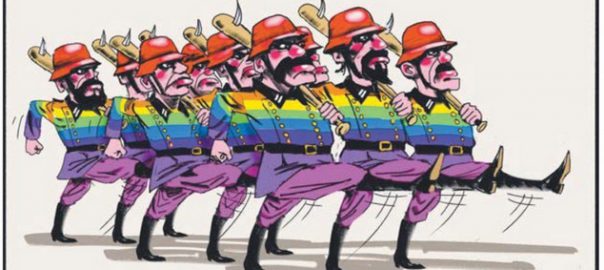
In his latest offering, conservative Australian cartoonist ZEG is profoundly skeptical of "gender fluidity".  The delusions of a few are now to be accepted as normal?


ROUNDUP OF LEFTIST HATE

Three current articles below

Gay student heckled after declaring his support for ‘No’ campaign.  Skywriters harassed

And they call conservatives haters!

A GAY man campaigning against same-sex marriage has claimed there are thousands of homosexual Australians like him whose views are being “drowned out” by the “yes” campaign.

The Queensland university student is seen proclaiming his views to a heckling crowd in a video shared online by former prime minister Tony Abbott.

“We’re here today because we support marriage as it has always been, between one man and one woman,” the man says at the demonstrated at the University of Queensland. “I am here, specifically, because I’m gay and I am standing up against them.

“They want to drown us out. They want to drown me out. They want to speak for me. They want to speak for me because I’m gay and I am standing up against them.”

The man goes on to claim there ae “thousands” of gay Australians who are against same-sex marriage, and says they are being vilified for their views.

“There are thousands of gay people in this country who are against same-sex marriage, who see the effects that it will have on the family, on schools, on politics, on churches,” he says.

Referring to supporters of changes to Australian marriage laws, he says: “These people hate us. They call us Nazis, bigots, homophobes. Where is the real hatred?”

Sharing the video with his followers, Mr Abbott, who has become a leading voice in the campaign against marriage reform, inferred the clip was a “case in point” that supporters of same-sex marriage were “responsible for bullying and hate speech”.

The former Liberal leader shared a second clip from the event in which it could be seen same-sex marriage campaigners had attempted to take over the demonstration, chanting “yes” over the top of the man’s words.

The demonstration, held on Monday, comes as the electoral watchdog has received complaints about the “Vote No” skywriting over Sydney on the weekend not being properly authorised.

Skywriting

The words “vote no” appeared four times over the city on Sunday morning, a day after the Coalition for Marriage launched its campaign against same-sex marriage.

A grassroots campaigner against same-sex marriage crowd-funded more than $2500 on GoFundMe to pay the pilot to write the message in the sky. One woman donated $1000 to the cause.

The anonymous author of the GoFundMe page declared it was “time for traditional Australian’s (sic) to take a stand”. “It’s time we all sent a clear message that we will not put up with our way of life been (sic) deconstructed any further,” the page said.

The author later announced the money had been frozen by the website “until we give our names and locations”.

The page was inundated with messages of condemnation. “I feel sorry for all of you,” one woman wrote.

“What an awful way to live your lives. I can’t imagine being so hateful.” Organisers said they were “keen to stay fairly anonymous” and defended their actions.

According to the Daily Mail, flight tracking information confirms a Cessna owned by Skywriting Australia left the message in the sky. The company’s charges start from $3990. Social media users began to circulate the company’s contact information and posted the abusive messages they’d sent.

One message called the business owner an “a***hole” while another post said it was “probably the end of your business”.

One text message to the business owner read “usually fighting hate with hate isn’t my style, but you really are a sh** human. You’re definitely the biggest piece of sh** in Australia today. Probably tomorrow too. Hope you’re proud of yourself. Don’t be surprised by the hate coming for you. Titt for tatt, it’s only fair, right? You stupid, ignorant, remorseless, pathetic, old, LOSER”.

Another read “I hope the weather gets hotter this week. It might help to warm your cold black heart #loveislove”.

Prime Minister Malcolm Turnbull, who is encouraging a “yes” vote, told reporters people were entitled to express their views.

“If you want people to respect your point of view you’ve got to be prepared to respect theirs,” Mr Turnbull said.

SOURCE

Leftist hate leads to a firing

A Canberra businesswoman says she 'fired' a contractor who posted to social media that 'it's okay to vote no' to same sex marriage.

Madlin Sims, who runs a party entertainment company, posted a blunt message to Facebook this week announcing she had a staff member go.

'Today I fired a staff member who made it public knowledge that they feel "it's okay to vote no"',' Ms Sims wrote.  'Advertising your desire to vote no for SSM is, in my eyes, hate speech. Voting no is homophobic. Advertising your homophobia is hate speech. 'As a business owner I can't have somebody who represents my business posting hate speech online.'

Speaking to Daily Mail Australia, Ms Sims explained the contractor had been representing her business by often posting photos of parties she worked at. 

The small businesswoman said she didn't want the woman's views associated with her company. 'It's all quite public she worked for the business... That's not something I want to be affiliated with,' she said.

She compared it with employing a staff member who posted racist material online. Ms Sims added she had gay friends, staff members and clients. 'It's just like if I had a racist person working for me especially someone who's so vocal with their beliefs.'

In the post, Ms Sims urged her friends to vote 'yes' in the upcoming same sex marriage survey and listed three justifications for her staffing decision. 

'1. It's bad for business.

2. I don't like s*** morals.

3. I don't want homophobes working for me, especially in an environment with children.'

The 'yes' and 'no' campaigns are currently canvassing the country for votes

The apparent sacking is likely to spark the ire of the No campaign, which has made concerns about freedom of expression a major plank of its argument. 

But Yes campaign representatives have said it's 'misleading' to suggest same sex marriage would affect freedom of speech. 

SOURCE

Same sex marriage supporters hostile towards billboard


Even a church is not allowed to preach Christian teachings, apparently

A BILLBOARD outside a Brisbane church has sparked outrage ahead of the same-sex marriage vote.

The Bellbowrie Community Church posted the sign: “God designed marriage between a man & a woman”.
The sign that caused outrage at a Bellbowrie church.

It was condemned on social media, and critics took to the church’s Facebook page to object.

“Hopefully there are churches in the area that cater to ALL Christians and not just the ones who fit in the narrow minded view of this “Church of God”. I’m sure Christ would be very disappointed in your view of Christianity,” one post said.

Others started taking to the church’s review section and posting one-star reviews.

“A closed-minded group which overtly discriminates against members of our valued community and their (very reasonable) quest for marriage equality,” one woman wrote.

Cartoons of same sex couples and sailors waving rainbow flags were posted in the comments under unrelated posts by the church.

All the reviews and comments about the issue later disappeared.

A spokeswoman for the group 4070 Says Yes said the message on the church sign was not representative of the majority of residents.

“Our community has implored the church to remove the offensive sign, making phone calls, writing letters, emails and meeting with officials to point out the damage and distress it is causing,” she said.

“The church, self-appointed spokesperson of our community, has instead increasingly closed down avenues for feedback.”

But Pastor John Gill said it was not a message of hate, and simply presented God’s view.

“There are two sides to this debate so it was no surprise that some do not agree with the sign. But what did surprise me was the degree of malice expressed by some, which could only be described as hate speech,” he said.

Pastor Gill said freedom of speech was important to Australians.

“This means gay people are entitled to speak their minds, and anybody who does not agree with their views should still respect them and not abuse them for expressing their opinions,” he said.

“In a free country, Christians also have this right. They do not expect everyone will agree, but should they not expect the same freedom to speak and be given the same respect that they give to others?”

Pastor Gill said the Facebook activity had been “difficult” for many in the church. “And as a result, many now realise that it is no longer easy to hold and express a Christian viewpoint in Australia,” he said.

He said he had answered every negative email and extended an invitation to everyone who contacted him to meet in person.

“There have also been a few occasions where a protester with a signboard has protested on the street outside the church,” Pastor Gill said.

“The beauty of a free country is that they are welcome to do this and we don’t begrudge it. It can be hot out there, so we have tried to give any protester some bottled water when somebody has been at the church.”

“There are however some in the community who are supportive of the sign and have thanked me for our stand, but are afraid to say anything on Facebook for fear of being abused,” he said.  “But apart from Facebook, I have had more supportive emails, phone calls and visits than I have had negative ones.”

Pastor Gill said his congregation is free to vote in the plebiscite however they choose.  “As a pastor, it is not my place to tell people how to vote,” he said.

“Many of us have friends and family who are gay, and it is absurd to think we hate them. We love them very much. It is possible to hold different views, yet still love people. So this does not need to be a source of division throughout Australia. We can differ, yet still respect and care for each other and let the voting determine the issue.”

SOURCE


Australia's fraudulent Bureau of Meteorology

Enough is enough. The Bureau of Meteorology yet again stands charged with fabricating temperature records.

This time, thanks to the diligence of scientist Jennifer Marohasy, the bureau has been caught red-handed regulating temperatures to keep them above a predetermined minimum — at least for two NSW automatic weather stations, one located in Goulburn, the other at Thredbo.

The BOM initially admitted it had set an arbitrary limit of minus 10C for the Goulburn station, but then changed the story to the equipment being “not fit for purpose” — because it got too cold — even though the same instruments are used in the Antarctic. The actual temperature measured was a record July low for Goulburn, at minus 10.4C, so why, if the equipment was faulty, didn’t the bureau leave a blank instead of rounding up to minus 10C?

Allowing the bureau to defend itself, Environment Minister Josh Frydenberg called for an internal review.

In 77 pages, it acknowledged that, indeed, Goulburn and Thredbo were governed and, minimum limits were set. This was blamed on a filter being installed into these weather stations 15 and 10 years ago respectively. No limits were imposed on maximum temperatures. Yet implicitly, we are asked to believe that the historical temperature record has not been compromised.

Before filters were installed, Goulburn recorded minus 10.9C in August 1994 and, in that cold winter, Thredbo went down to minus 13.6C and nearby Charlotte Pass to minus 23C on June 29, a record low for Australia. Charlotte Pass weather station was decommissioned in March 2015.

Ironically, the bureau’s newest location, near White Cliffs in NSW, home to some of the nation’s hottest temperatures, last August recorded minus 62.5C, due to a “hardware fault”.

A BOM-friendly technical forum, part of former minister Greg Hunt’s plan to buy time and “kill off” a proposed Abbott government probe, has foreshadowed “the need for a major revision of the dataset”.

Predictably, though, it did not address specific claims by Marohasy and others, and seems satisfied the bureau’s dataset is well maintained. Really? This may fool ministers, but for a sceptical public, time has run out.

British author and journalist Christopher Booker says: “When future generations look back on the global warming scare of the past 30 years, nothing will shock them more than the extent to which the official temperature records — on which the entire (global warming) panic ultimately rested — were systematically ‘adjusted’ to show the Earth as having warmed much more than the actual data justified.” He says this practice has been observed by experts around the world and “raises an ever larger question mark over the entire official surface temperature record”.

He is joined by John Theon, retired chief of NASA’s Climate Processes Research Program and responsible for all weather and climate research, who testified before congress that “some scientists have manipulated the observed data to justify their model results. In doing so, they neither explain what they have modified in the observations, nor explain how they did it.”

Take the article NASA published in 1999 showing 1934 was the US’s warmest year. Across the ensuing decade, by cooling the past and warming the present, 1998 jumped five places to become the warmest. Whistleblower John Bates, recently retired principal scientist at US National Oceanic and Atmospheric Administration, described how his agency manipulated data to manufacture a non-existent increase in global temperatures.

Why should Australia be any different? We remember the Climategate emails from despairing programmer Ian Harris: “Getting seriously fed up with the state of the Australian data, so many new stations have been introduced, so many false references”.

Science writer and blogger Joanne Nova has raised scandal after scandal concerning the BOM’s record-keeping.

She refers to historic data being destroyed, and the influence of adjustments on Australia’s warming trend. She reports private auditors advising the bureau of almost a “thousand days where minimum temperatures were higher than the maxes”.

Taxpayers outlaying $1 million a day for reliable temperature data deserve better than this.

When Australia’s bureau transitioned from mercury thermometers to electronic sensors more than 20 years ago, to ensure readings from these devices were comparable with the old thermometers and complied with World Meteorological Organisation guidelines, parallel studies were undertaken at multiple sites.

A key conclusion was that readings from the new electronic sensors needed to be averaged over one to 10 minutes. However, rather than implement practices consistent with their finding, the bureau records one-second extremes (or noise), which can be announced as new record highs.

Inherent inconsistency aside, this calls into question whether Australian data is WMO compliant. Marohasy discovered this as part of her investigation and believes it is more damning than even the imposition of minimum limits, as it affects the recording of temperatures from all 695 automatic stations.

Marohasy is a respected scientist, known for her forensic work. While attempts will be made to dismiss her evidence as an arcane academic skirmish over recording methodology, it is a smoking gun that threatens the integrity of global temperature records.

It affects every Australian. It strikes at the heart of renewable energy policies. Globally, trillions of taxpayer dollars are at stake.

The government has a duty to inform the Intergovernmental Panel on Climate Change, should it have sufficient grounds, that the bureau is not complying with WMO guidelines. Sooner or later, closed eyes must open.

Now, with Marohasy’s evidence adding to the credible findings of other experts, there can be no confidence in any future official assurances. Further delay of a proper independent audit, which includes dissidents, can be interpreted only as a cover-up. One way or another, the truth will out.

SOURCE


Students to undergo literacy and numeracy tests from YEAR ONE as part of new national assessment plan

There have always been assessments of one sort or another done in all years so I see no problem with them being nationally co-ordinated

A new national assessment will see students in the first grade undergo literacy and numeracy tests so they don't 'fall between the cracks.'

At present the NAPLAN system tests children from years three, seven and nine on their reading, writing and mathematics skills but there isn't a national standard for students younger than those year groups.

Minister for Education Simon Birmingham explained that Australia's results in primary and secondary academics had declined and was hoping a new system could prevent errors learned in the earlier years from carrying forward, the Herald Sun reports.

At the moment the idea of a nationwide check hasn't been developed but there are reports it could be integrated into the syllabus by 2019.

A panel of researchers and experts advised the Minister that a 'light check' on school students that age could help bolster results in the long term.

'By identifying exactly where students are at in their development early at school, educators can intervene to give extra support to those who need it to stop them slipping behind the pack.'

Instead of being a test conducted in anxiety-inducing school halls the year one 'check' would be far more relaxed and be administered by teachers known to the students.

An online system would then tally up the child's score and release the information to the principal and parents alike.

Mr Birmingham said he would hold discussions with state and territory leaders and education authorities over a trial and implementation roll out.

SOURCE

Posted by John J. Ray (M.A.; Ph.D.).    For a daily critique of Leftist activities,  see DISSECTING LEFTISM.  To keep up with attacks on free speech see Tongue Tied. Also, don't forget your daily roundup  of pro-environment but anti-Greenie  news and commentary at GREENIE WATCH .  Email me  here


Tuesday, September 19, 2017


We've turned our unis into aimless, money-grubbing exploiters of students (?)

As an economist, Ross Gittins often has substantial things to say.  But as a Leftist he is also a compulsive moaner.  So the points he makes below are cogent but most of them are disputable.

The one area wherein I agree wholeheartedly with him is his condemnation of relaxed assessment standards for overseas fee-paying students.  This practice is, I think, still a minority one but will surely be a big negative eventually when our universities send home to Asia students whose knowledge and skills don't match what is on the pieces of paper we give them.  It devalues our degrees.

Gittins may also have half a point in saying that Lecturers are poorly paid.  In my day we were paid well above average and there does seem to be some slippage from that.  But with salaries closing in on $100,000 pa it's still a long way from  poverty.  Many junior software engineers get about that and they are undoubtedly bright sparks.

And Gittins again has half a point in saying that tenure is now harder to get.  I was appointed with tenure, a rare thing nowadays. But there has to be a balance.  Tenure protects divergent thinking but it also promotes laziness. Once you can't be fired, why work?  I suspect that the delayed granting of tenure that we now see is not a bad balance.  It ensures that for at least a large part of one's academic life we do some work.

But his other points are contentious.  Recorded Lectures are bad?  I would think they are wholly good.  They relieve students of the pressure to take notes, though they can still take notes if they want or need to.  There was only one course I did in my undergraduate days in which I took notes.  Otherwise I concentrated on listening instead. And I am sure I learnt far more that way.  My grades certainly did not suffer from it.

"Overcrowded" lecture halls?  I don't know what he is talking about.  A lecture hall is not a high school classroom.  In my academic career I often fronted up to a lecture in an auditorium with 1,000 or more students in front of me.  And I was able to allow students to interrupt with questions.  So I would think it was a poor lecturer who couldn't handle that.

He says that universities put too much pressure on academics to do research.  I would say that they do too little.  There are now whole tertiary institutions which devalue research.  And many lecturers in all institutions do little of it. But it is only by doing research that you get a real hold on knowledge in your selected field.  You cannot be at the cutting edge without doing your own research.  Otherwise you are just reading the conclusions of others.

But in the end, Gittins's big beef is that the present system of running our universities amounts to a sort of "privatization", which is of course anathema to Leftists.  I think he should throw off those ideological blinkers and look at what is actually happening.  He looks at that so far only "through a glass darkly"


Of the many stuff-ups during the now-finished era of economic reform, one of the worst is the unending backdoor privatisation of Australia's universities, which began under the Hawke-Keating government and continues in the Senate as we speak.

This is not so much "neoliberalism" as a folly of the smaller-government brigade, since the ultimate goal for the past 30 years has been no more profound than to push university funding off the federal budget.

The first of the budget-relieving measures was the least objectionable: introducing the Higher Education Contribution Scheme, requiring students – who gain significant private benefits from their degrees – to bear just some of the cost of those degrees, under a deferred loan-repayment scheme carefully designed to ensure it did nothing to deter students from poor families.

Likewise, allowing unis to admit suitably qualified overseas students provided they paid full freight was unobjectionable in principle.

The Howard government's scheme allowing less qualified local students to be admitted provided they paid a premium was "problematic", as the academics say, and soon abandoned.

The problem is that continuing cuts in government grants to unis have kept a protracted squeeze on uni finances, prompting vice-chancellors to become obsessed with money-raising.

They pressure teaching staff to go easy on fee-paying overseas students who don't reach accepted standards of learning, form unhealthy relationships with business interests, and accept "soft power" grants from foreign governments and their nationals without asking awkward questions.

They pressure academics not so much to do more research as to win more research funding from the government. Interesting to compare the hours spent preparing grant applications with the hours actually doing research.

To motivate the researchers, those who bring in the big bucks are rewarded by being allowed to pay casuals to do their teaching for them. (This after the vice-chancellors have argued straight-faced what a crime it would be for students to be taught by someone who wasn't at the forefront of their sub-sub research speciality.)

The unis' second greatest crime is the appalling way they treat those of their brightest students foolish enough to aspire to an academic career. Those who aren't part-timers are kept on serial short-term contracts, leaving them open to exploitation by ambitious professors.

However much the unis save by making themselves case studies in precarious employment, it's surely not worth it. If they're not driving away the most able of their future star performers it's a tribute to the "treat 'em mean to keep 'em keen" school of management.

But the greatest crime of our funding-obsessed unis is the way they've descended to short-changing their students, so as to cross-subsidise their research. At first they did this mainly by herding students into overcrowded lecture theatres and tutorials.

An oddball minority of academics takes a pride in lecturing well.

Lately they're exploiting new technology to achieve the introverted academic's greatest dream: minimal "face time" with those annoying pimply students who keep asking questions.

PowerPoint is just about compulsory. Lectures are recorded and put on the website – or, failing that, those barely comprehensible "presentation" slides – together with other material sufficient to discourage many students – most of whom have part-time jobs – from bothering to attend lectures. Good thinking.

To be fair, an oddball minority of academics takes a pride in lecturing well. They get a lot of love back from their students, but little respect or gratitude from their peers. Vice-chancellors make a great show of awarding them tin medals, but it counts zilch towards their next promotion.

The one great exception to the 30-year quest to drive uni funding off the budget was Julia Gillard's ill-considered introduction of "demand-driven" funding of undergraduate places, part of a crazy plan to get almost all school-leavers going on to uni, when many would be better served going to TAFE.

The uni money-grubbers slashed their entrance standards, thinking of every excuse to let older people in, admitting as many students as possible so as to exploit the feds' fiscal loophole.

The result's been a marked lowering of the quality of uni degrees, and unis being quite unconscionable in their willingness to offer occupational degrees to far more people than could conceivably be employed in those occupations.

I suspect those vice-chancellors who've suggested that winding back the demand-determined system would be preferable to the proposed across-the-board cuts (and all those to follow) are right.

The consequent saving should be used to reduce the funding pressure on the unis, but only in return for measures to force them back to doing what the nation's taxpayers rightly believe is their first and immutable responsibility: providing the brighter of the rising generation with a decent education.

SOURCE


Town of the damned: the Australian town with ‘staggering’ child sex abuse rate

Aboriginal men very commonly abuse their women and children but it seems to have got really out of hand in this community.  Only a much increased police presence would seem to offer any hope of control

ONE tiny town is in the grip of a paedophile epidemic which in a population of 1400 has seen 184 sexually abused. Warning: Confronting.

ROEBOURNE, Western Australia, is in the grip of a paedophile epidemic that has seen such a high incidence that child sex abuse is “normal”.

Police have charged 36 men with more than 300 offences against 184 children from Roeburne and surrounding communities.

West Australian Police Commissioner Karl O’Callaghan has described the rate of alleged child sex offending in Roebourne as “staggering” and the problem as “a cancer”.

The former gold rush town, which has a greater population of around 1400, lies in the Pilbara region 1500km north of Perth.  The Pilbara, with vast mining resources and sparsely populated Aboriginal towns, covers 500,000 square kilometres stretching from the Indian Ocean to Central Australia.

Roebourne, where the streets are lined with brick and stone colonial buildings, has dwindled since its 19th century boom as the largest settlement between Darwin and Perth.

It has now been singled out as a festering mess of intergenerational child sexual abuse where kids are more likely to be raped than almost anywhere else on earth.

“It’s a war zone out there and the victims are little kids,” Mr O’Callaghan told the ABC in a recent news report following the multiple arrests of local men under ­Operation Fledermaus.

In a nine-month operation across areas including Roebourne and the neighbouring city of Karratha, police identified almost three times as many suspects as the number arrested.

The scale of the abuse uncovered was the worst WA Police had ever seen and the communities were in an “almost unrecoverable crisis”, Mr O’Callaghan claimed.

Earlier this month, The Australian reported that child sex abuse in Roebourne was so “normal” that even jailing known paedophiles was not enough to end it.

That was the opinion of West Australian Child Protection Minister Simone McGurk who visited Roebourne following the ­Operation Fledermaus arrests. “Yes, you would have to say that, through the sorts of numbers we are starting to see,” she told West Australian Bureau Chief, Paige Taylor. “It’s intergenerational. Many of these perpetrators were victims themselves.”

Alcohol, drugs and violence afflict the Roebourne and surrounding communities whose population is more than half indigenous.

In September last year, police made a public announcement to residents encouraging them to report child abuse.

Several Aboriginal women, young people and children came forward and in the same month, police charged three Roebourne men with child sex offences against girls aged between 13 and 16.

A 45-year-old man was charged with indecent dealing with a child over 13 and under 16 years, offering a prohibited drug and possession of drug paraphernalia.

A 52-year-old man was charged with two counts of sexual penetration of a child over 13 and under 16 years and one count of indecent dealing with a child over 13 and under 16 years.

A 39-year-old man has been charged with indecent dealing with a child over 13 and under 16 years.

Minister McGurk said “child protection workers, specialist police officers and other dedicated resources [were] on the ground giving support to the families and the community”.

“I’d like to acknowledge the strength of the children, the families … who have the courage to come forward,” she said.  “Actually coming forward is a first step in systemic change.”

Commissioner O’Callaghan, however, identified another factor in the community, which is 80 per cent on welfare. In an article he wrote for The West Australian, Mr O’Callaghan said child sex offenders were spending welfare money on drugs and alcohol to lure children.

“A further pattern emerging is that offending activity seems to increase when offenders receive substantial amounts of money and spend it on a combination of alcohol, drugs, gambling and sex.

“Knowing that welfare payments contribute to increases in many types of offending, particularly alcohol and drug-related offending, is hardly rocket science.

“Linking such payments to an increase in sexual abuse of children, however, is a much newer phenomenon.”

Communities in WA and South Australia were trialling a cashless debit card for welfare recipients, which cannot be used for alcohol, gambling or illicit substances.

Seven years ago, a WA government report painted a bleak picture of the life of Aboriginals in Roebourne.

The Roebourne Report said alcohol abuse, child neglect, violence and crime were occurring at an alarming rate.

Annual alcohol consumption in Roebourne Shire was 26.8 litres per person, three times the state average.

Cannabis use was rife among young people.

On fortnightly welfare pay days, gambling soared and children were left to their own devices. Unsupervised children roamed the streets at night and house break-ins were viewed “as the rite-of-passage for many Roebourne youth”.

A high proportion of Roebourne children considered vulnerable in terms of their physical, social and emotional development.

According to Roebourne local, Violet Sampson alcohol abuse has turned the town’s grandmothers into safe house operators.

Ms Sampson told news.com.au that she began looking after her grandchildren when their parents were out drinking. “I have three kids here,” she said. “When their parents split up and went off drinking, the kids came to me.

“When they need a good sleep, without overcrowding and a feed, I take them. “And they can go to school in the morning.

“It’s what grandmothers do here in Roebourne, Karratha. Aboriginal families we look after the kids.”

SOURCE


'If you don't know, vote no': Gay, conservative professor joins the push to oppose same-sex marriage

Flinty was a good-looking guy in his early years so I always suspected that he had a good time with the ladies. It seems I was wrong

Professor David Flint, who is openly gay but discreet about his personal life, quoted another gay conservative, Sydney broadcaster Alan Jones, to argue why voters should vote 'no' in the federal government's postal vote survey.

'As Alan Jones said in 1999, if you don't know, vote no,' the 79-year-old academic told Sky News Australia.

'We just don't know what's going to happen.'

Jones, a perennial top-rating broadcaster on radio 2GB, is actually in favour of gay marriage but shares former Liberal prime minister John Howard's concerns about religious freedom.

'I'll be voting 'Yes' for same sex marriage. But John Howard is right. We must protect parental & religious freedoms and freedom of speech,' Jones tweeted last week.

The phrase 'if you don't know, vote no' was used by opponents of Australia becoming a republic during the November 1999 referendum on whether to cut ties with the Queen.

That phrase actually belonged to future prime minister and Howard government minister Tony Abbott, who was the leader of the 'No' case 18 years ago as an ardent constitutional monarchist.

Mr Abbott is now a leading 'No' case campaigner, despite having a lesbian sister, Christine Forster, who supports gay marriage.

Professor Flint, who is also a monarchist, has joined gay couple Ben Rogers and Mark Poidevin in publicly speaking out against gay marriage.

The men from Wollongong, south of Sydney, fell in love 15 years but don't want to tie the knot. Mr Poidevin, a practising Catholic, opposes gay marriage on the grounds it could be a slippery slope that leads to polygamy.

'If we make one exception for one community - that being the same-sex couples - where does it stop?,' he told the ABC's 7.30 program earlier this month.

'Do we then see other cultures being allowed to have multiple marriages?  'Do we allow, see the age of consent being lowered for another group of minorities? 'That is my concern of where it would lead.'

Mr Poidevin hasn't always opposed the idea of same-sex marriage, having popped the question to his partner five years ago.

Professor Flint, a former head of the Press Council and the Australian Broadcasting Authority, is a former Labor Party member turned conservative with close ties to John Howard, who is spearheading the 'No' campaign.

Gay former High Court justice Michael Kirby is a monarchist who supports gay marriage and will be voting 'Yes'.

The Coalition for Marriage launched its 'Vote No' campaign at Sydney's Darling Harbour on Saturday night.

Ballots are being sent to Australian households and are due back by November 7.

SOURCE


AGL gets more from Greenie subsidies than it get from burning coal

No wonder it wants to shut down its coal generators -- thus leaving Australia with insufficient base-load power

Australians are on track to pay more than $500 million to AGL to fund its flagship solar generators, as the energy giant prepares to shut down its Liddell coal power station, a move that has prompted warnings of a power shortfall that could lead to blackouts and price hikes.

The company has already ­secured $230m in direct grants and is forecast to gain far more under the renewable energy ­target, deepening the political divide on energy policy as the federal government considers cutting ­future aid to make coal more competitive.

The scale of the subsidy is now a key question in the government’s debate on whether to ­embrace a clean energy target, as opponents of the idea challenge AGL and others to prove that wind and solar schemes can work without taxpayer handouts.

Malcolm Turnbull and his cabinet ministers are yet to decide on whether to adopt a clean ­energy target but are unwilling to continue the heavy subsidy, ­putting a priority on more reliable power supplies, including coal and gas.

The two AGL solar farms in western NSW generate a combined 359,000 megawatt hours of electricity, just 4 per cent of the ­capacity of Liddell, but have ­secured more long-term investment than the coal power station under laws that continue the ­renewable subsidy until 2030.

Investors are warning the ­government against a halt to the taxpayer assistance for renewables, arguing this would lead to an investment freeze that would ­intensify the energy shortages in the decade ahead.

Former resources minister Matt Canavan said the subsidy going to AGL from taxpayers and electricity consumers contrasted with claims that renewables would be more efficient than coal regardless of government assistance.

“AGL keeps telling everybody that renewables no longer need a subsidy — well, if that’s the case, why do we need a clean energy target?” Senator Canavan said.

The Australian understands the government is aiming to encourage more investment in reliable power with a “capacity pricing” structure that could favour coal and gas and meet Mr Turnbull’s stated aim of improving the ability to “dispatch” power at short ­notice.

Even so, AGL is seeking to shut Liddell in 2022, rejecting a ­government push to keep it open a further five years, and is planning to replace it with renewable power and “peaking” gas that can fire up when electricity supply is low.

AGL chief financial officer Brett Redman told The Australian the subsidies for the solar farms would shrink in the decade ahead as the value of renewable energy certificates declined.

Mr Redman also sent a clear warning that the government’s looming decision on a clean ­energy target would not change the company’s assessment that a new coal-fired power station was not viable.

“The economics are now somewhat overwhelming — the world of electricity generation is heading down the renewables path,” Mr Redman said.

“Even without the impact of carbon-emissions policies, we would absolutely be heading down the path of building more renewables. Coal-fired power will not be built in that world.”

The AGL solar projects at ­Nyngan and Broken Hill received $166.7m in direct grants from the Australian Renewable Energy Agency and another $64.9m from the NSW government, as well as qualifying for credits under the renewable energy target.

The Australian estimates the Nyngan project receives more than $18m a year for its 233,000 megawatt hours given an $80 price for renewable energy ­certificates, while the Broken Hill project receives about $10m a year for its 126,000 megawatt hours.

While taxpayers funded the initial grants, households pay for the renewable certificates because the cost is passed on to them in their electricity bills.

TFS Green analyst Marco Stella wrote in RenewEconomy on September 4 that the spot price for these certificates rose above $85 in late August.

AGL stands to receive $589m from the original grants and consumer subsidies for the two solar projects over the period to 2030 if the price holds at $80 until 2020 and then falls to $60 for the ­subsequent decade, an outlook described as conservative by two sources familiar with the market. This falls to about $480m if the renewable certificates fall to $30 in the next decade. It drops to $375m in the unlikely event the certificates fall to zero from 2021.

AGL sold the two projects to its Powering Australian Renewables Fund last November, making no cash profit in the sale. It owns 20 per cent of the fund while 80 per cent is held by Queensland Investment Corporation for clients including the Future Fund.

Mr Redman said the two projects were built in response to government calls for early investors to demonstrate large-scale solar and when the cost of the technology was much higher than it is today.

He said “we’d build a wind farm in every backyard” if the spot price of certificates stayed at today’s levels, but added this was unrealistic and the values were likely to fall in the early 2020s as they had in the past.

The government is weighing up whether to embrace a “reliability energy target” or a “strategic reserve” to offer financial rewards to AGL and others to build gas power, given the industry belief that major new coal power stations will not be viable.

This will get a higher priority than new schemes to subsidise renewables.

However, the rewards to AGL and others for their existing solar or wind projects cannot be altered because the Senate is highly unlikely to allow a change to the renewable energy target rules that apply until 2020 and continue payments until 2030.

The government has decided it has nothing to gain from ­starting a fight over the RET that it cannot win, leading it to keep the rules as they were agreed by Tony Abbott as prime minister in 2015.

SOURCE

Posted by John J. Ray (M.A.; Ph.D.).    For a daily critique of Leftist activities,  see DISSECTING LEFTISM.  To keep up with attacks on free speech see Tongue Tied. Also, don't forget your daily roundup  of pro-environment but anti-Greenie  news and commentary at GREENIE WATCH .  Email me  here


Monday, September 18, 2017


Dumping green folly will secure energy future, reboot economy

In the blink of an eye we are confronted by a national energy pricing and supply crisis. This is the cost of virtue signalling — that propensity for those on the political left, including moderates in the Liberal Party, to advocate policies aimed more at demonstrating their moral superiority than delivering practical results.

This nation’s most pressing economic challenge, it is also the most volatile political dilemma that threatens to derail Malcolm Turnbull’s career for a second time. (It cost him the Liberal leadership in 2009.) Climate and energy are set to define the next decade of ­national affairs just as they have plagued us since 2007.

To comprehend the politics we need a helicopter view; to examine first principles and the true aims of the policies. Far too much of the debate is predicated on gestures rather than results.

We are an energy-rich nation. Last year we exported 388 million tonnes of coal (valued at $35 billion) to supply affordable and ­reliable energy to countries such as Japan, China, South Korea and India. Our liquefied natural gas exports are doubling from 30 million tonnes a couple of years ago to almost 80 million tonnes (valued at $42bn) by 2019.

Australia also remains one of the largest exporters of uranium (nuclear energy is the ­silver bullet if we ever get serious about emissions) and, after a price and volume slump, trade will ­rebound to values of more than $1.2bn during the next few years.

While we happily export our energy advantage, we have deliberately sacrificed it at home. Households are paying some of the highest electricity prices in the world and manufacturing industries have been closing or downscaling because of cost pressures created in part by rapidly rising power prices. Energy bills are also creating commercial hardship for struggling retailers as well as hospitality and other sectors.

The largest single factor in the power crisis is the renewable ­energy target demanding 23 per cent of electricity be supplied by renewables, which are subsidised by consumers. When the renew­ables (mainly wind turbines) supply power they can do so at zero cost, thereby undercutting the viability of baseload generators and hastening their demise. The trouble is renewable ­energy can’t supply all our needs at any time and, crucially, is intermittent and unreliable. So we still need all of the baseload and peaking generation.

Under this formula we must ­either be caught short of supply or need to almost double our investment in energy so every megawatt of renewable energy is backed up by storage or thermal generation.

And just when we need more rapid-response gas generation to back up wind energy we have a gas supply/price issue courtesy of long-term export contracts and state restrictions on exploration and exploitation. What a mess.

What we don’t ever hear our major party politicians ask is why we are doing this to ourselves. We might also expect this would be a line of inquiry for media in fearless pursuit of their audiences’ interests. But no; incurious acceptance of the imperative for emissions ­reductions is universal in the public broadcasters and love media.

News Corp papers and Sky News are the only mainstream media likely to offer a plurality of views. Journalists who sail with this zeitgeist will justify their position by pointing to the political consensus on the emissions reductions targets set in Paris. But public and media debate should not be about accommodating convenient bipartisan compromise; it should be about reality and the public ­interest.

If the justification for our self-imposed energy crisis is saving the planet, then any reference to the facts will expose the futility. Australia’s carbon emissions make up about 1.4 per cent of global emissions and we are looking to reduce them by 26 to 28 per cent by 2030. Simultaneously, emissions are rising elsewhere by quantities that dwarf our total emissions, let alone our inconsequential reductions.

As this newspaper reported this week, China has 299 coal-fired power stations under construction and India 132. Indonesia, Japan, Vietnam, South Korea, The Philippines, South Africa and other nations also are expanding coal-fired generation so that an extra 621 plants are under way. Yet we disrupt our economy, surrender a natural economic advantage, shed jobs and reduce our standard of living to phase out a handful of plants.

On the first principle of whether our efforts do any environmental good — no matter the urgency or otherwise of climate action — the answer is our efforts are pointless. So we are then left with the diplomatic commitment to Paris that both major parties support.

Astonishingly, less than a day after Donald Trump won the US election promising to abandon Paris, Malcolm Turnbull announced Australia’s ratification. The Prime Minister thumbed his nose at the obvious opportunity to hold out, see if the US withdrew (as it has) and perhaps forestall our own commitment.

The accord is dramatically weakened without the world’s largest economy, especially given other powerhouses such as China and India will continue to increase their emissions. (Ironically, perhaps no country is making a greater contribution to emissions red­uct­ions than the US through its innovation in areas such as fracking and battery technology.)

The Paris Agreement is not binding, so we don’t need to meet our targets anyway. Yet the political-media class seems viscerally locked onto them.

Turnbull talks about the energy “trilemma” of affordability, reliability and emissions reductions. But even the Finkel review noted these objectives are at odds with each other.

Chief Scientist Alan Finkel tried to prescribe “policies that simultaneously provide a high level of energy security and reliability, universal access to affordable ­energy services, and reduced emissions. This is easier said than done. There is a tension between these three objectives.”

Neither Turnbull nor Finkel or Labor are willing to compromise on the third leg of the trilemma. Their starting point is emissions reductions; and they accept that reliability and affordability can be compromised to meet the target.

Finkel says: “The uncertain and changing direction of emissions reduction policy for the electricity sector has compromised the ­investment environment in the NEM.” But his solution — and that of the Coalition and Labor so far — is to try to formulate a settled, preferably bipartisan, emissions reductions scheme.

So the aim is to provide investment certainty even if it locks in higher electricity prices. The obvious alternative of relegating emissions reduction aims in favour of cheap, reliable power is simply not considered, even though we know it would have no discernible ­impact on the global environment. (We can always run other carbon abatement and energy efficiency schemes if we feel the need.)

The only pragmatic argument against scrapping the emissions reduction imperative is that it, too, may fail to break the investment strike because potential investors will still fear a future carbon pricing scheme. The political temptation is to lock in expensive and debilitating long-term policy solely to deliver the certitude of bipartisanship. This is the ­antithesis of seeking bipartisanship in the national interest.

All the federal government has succeeded in doing so far is taking ownership of the energy mess from the states. The Coalition will not admit that the RET — which it has backed, along with Labor, out of political convenience — is the heart of the problem.

On present settings the government is doomed to fail at the next election and then we will see a Labor government lock in permanently higher energy costs through a carbon pricing scheme. Perhaps the only salvation for the Coalition — and the economy — would be to call time on this green folly in the interests of protecting consumers, boosting jobs and rebooting a competitive advantage.

It would be a risky gambit contested by the rent-seekers in the energy sector. But it would be a fight for the national interest. The question is whether Turnbull, who has always claimed to be as green as Labor, can find it within himself to make the case.

SOURCE


Israel Folau says vote no, David Pocock says vote yes — but does anyone care?

ISRAEL Folau isn’t known for making political statements. His Twitter feed is usually full of snaps of his training sessions for the NSW Waratahs, endorsements for brands he spruiks and posts about his deep religious faith.

All that changed at 2.16pm on Wednesday when Folau became one of the most prominent people so far to say ‘no’ to same-sex marriage.

Folau’s forthrightness move came as a surprise to some. His Wallabies team are supporting marriage equality. Also, it was only a few years ago that Folau was on the front cover of lesbian and gay community publication, the Star Observer, publicising the Bingham Cup, a global rugby competition fought between gay and inclusive rugby teams.

But, Folau insisted, his no vote was also no judgment. “I love and respect all people for who they are,” he wrote.

His position puts him at odds with not just the Australian Rugby Union but just about every major sporting code in Australia, all of which have increasingly pinned their colours to the rainbow mast, publicly cracking down on homophobia.

This weekend in Melbourne, teams from both sides of the Ditch have competed in the annual Purchas Cup, the “Bledisloe Cup” of gay rugby.

Players competing have told news.com.au they are worried Folau’s no stance could hold “sway” with some fans who are on the marriage fence.

Away from the battles on the pitch, can a sports star win the battle for the hearts and minds of sports fans when it comes to same-sex marriage?

Israel Folau was previously a cover star of LGBTI magazine the Star Observer supporting a gay rugby tournament.

Israel Folau was previously a cover star of LGBTI magazine the Star Observer supporting a gay rugby tournament.Source:Supplied
And what effect does a sports great saying ‘no’ while a code says ‘yes’ have on a punter?

Monash University’s Dr Kerry O’Brien has studied extensively how sport influences behaviour, such as drinking. He agrees sport can have a big impact on supporters in “transmitting values, attitudes and norms”.

Of course, some feel codes should keep out of the debate entirely. Like AFL legend and Footy Show panellist Sam Newman.
He told Mark Latham on his Outsiders online show that he was unhappy at seeing rainbow flags fluttering at the SCG.

“People go to the football to get away from political agendas. That’s their outlet and I honestly don’t know why they (the AFL) do it.” People had the right to be whoever they like,” Newman said, but he would banish all “agendas” from stadiums bar breast cancer appeals.

SOURCE


Thought crime fears motivate same-sex marriage opponents at 'no' campaign launch

Leading "no" campaigners, including Turnbull government MPs, say they fear it will become illegal to oppose same-sex marriage in word or even thought, if gay marriage is legalised.

The extraordinary claims, made at the campaign launch for the Coalition for Marriage on Saturday night, went as far as expressing fear that thought crime would be punished by law.

Cory Bernardi drives 'No' campaign

The South Australian senator claims that the anti same-sex marriage campaign is on the 'right side of legal and moral history'.

Matthew Canavan, a member of Prime Minister Malcolm Turnbull's cabinet until he resigned over his dual citizenship, told the 1500-strong Sydney audience: "The 'yes' side want to make it illegal to just express a different view about marriage, that is their agenda."

On the sidelines, he told Fairfax Media he feared "a strong push to effectively eradicate the view that marriage should be between a man and a woman, to make it illegal".

Asked if his concerns about freedom extended as far as thought-crime, replied: "Yeah, well it is. The anti-discrimination [laws], particularly the state-based ones, are very wide ranging in application."

Senator Canavan was backed by Turnbull government minister Concetta Fierravanti-Wells and Australian Conservatives leader Cory Bernardi, who said these were valid concerns of same-sex marriage opponents.

"If the state redefines marriage, it also redefines how you can speak, think, advocate and believe about marriage," Senator Bernardi said. "That is the very real consequence of what is to come if we lose this battle."

Several speakers at the $15-a-head event cited the case of Tasmanian Archbishop Julian Porteous being hauled before the state's anti-discrimination commission over a booklet opposing same-sex marriage - a case in which the church prevailed.

Speakers also portrayed the "no" side as the victim of a concerted campaign by elites, the media and big business. There were boos from the audience for Sydney lord mayor Clover Moore, who is backing the "yes" side with ratepayers' money.

Coalition for Marriage spokeswoman Sophie York described the "yes" side as "carefully orchestrated, cashed-up and ruthless".

To rapturous applause, she suggested a "no" vote in Australia could be the start of a global "push back" against same-sex marriage, which has been legalised in more than 20 countries.

Outside, 60-year-old Doreen Kirchner from Pennant Hills said she feared moral decline if marriage were to be expanded to include gay couples.

"I think if same-sex marriage gets in it'll be a slippery slope downhill morally. And I want to protect my children and my grandchildren and my great-grandchildren," she told Fairfax Media.

"I don't have a problem with gays per se, I don't have a problem with them having a civil union. But the Marriage Act is for a man and a woman."

SOURCE


Universities going smoke-free

Earlier in the week, the University of Queensland announced it hoped to become a smoke-free educator by mid-2018 and early indications suggest the majority of students support the announcement, however an outraged group of students have created an opposing campaign and begun posting contested messages online.

One of the leaders of the UQ DARTS Facebook page, which advocates against the smoke-free plan, is Kurt Tucker - former president of the university's Liberal National Club. Since the announcement on Tuesday, the page has posted that the decision would see smoking banned in residential colleges and described the decision as "enforcing a complete ban", which is misleading according to the university.

UQ announced it intended to become smoke-free from July 1, 2018, and that the decision "aligns with UQ’s responsibility and desire to provide healthy and vibrant campuses, and reflects evolving societal norms". The university has started education campaigns to encourage staff and students to reduce or quit smoking and UQ's efforts would continue to ramp-up as the July deadline approached.

Since a Parliamentary Committee Inquiry last year, the Queensland government has been working with all tertiary education providers to reduce the use of tobacco on campuses. The Queensland University of Technology and Australian Catholic University are already smoke-free, while the University of the Sunshine Coast has announced it aims to become smoke-free by the start of 2018.

UQ Occupational Health and Safety director Jim Carmichael said the announcement would see the implementation of a strategy based around "informing and educating".

He added that university officers would not confiscate cigarettes and take disciplinary action if they saw students smoking on campus, but rather question whether they realise the risks, ask them to move off campus and discuss whether they have any intention of quitting. However, Mr Carmichael said firmer discussions and potential disciplinary action would be used against repeat offenders, but he hoped it would not come to that.

Mr Carmichael said initial surveys of students saw the "vast majority" of respondents say the decision was a great idea. This was supported by a poll in the Facebook group UQ StalkerSpace, which acts as a "platform for discourse about University of Queensland campus life" according to the description. The poll asked whether group members supported UQ going smoke-free in 2018, and the results, as of Saturday afternoon, showed a clear victory for the 'Yes' option, which had received almost five times the number of votes the 'No' option had.

On the flipside, UQ DARTS spokesman Sam Jackson described the university's decision as a "complete ban" which he labelled as "disappointing" and "a real shame", claiming students had not been given a sufficient consultation period.

The Facebook page also claimed that the university's decision "means nearly 3000 students will be unable to smoke in their own homes" because the policy will incorporate the residential colleges on campus.

"Whilst we do not deny there are no negative effects of smoking, it is not the Vice-Chancellor's role to erode personal freedom and responsibility," Mr Jackson said.

Security concerns were also raised by Mr Jackson. He said if students were asked to leave the security of the campus grounds to smoke at night, they risked being attacked.

However, Mr Carmichael emphasised that a "hard-line approach" would not be used and the university would "encourage students not to smoke, rather than put themselves at risk". He also added that the university's decision could not directly affect the residential colleges, because they were independently managed. The individual college masters could decide whether they wanted to follow the university's decision.

SOURCE

Posted by John J. Ray (M.A.; Ph.D.).    For a daily critique of Leftist activities,  see DISSECTING LEFTISM.  To keep up with attacks on free speech see Tongue Tied. Also, don't forget your daily roundup  of pro-environment but anti-Greenie  news and commentary at GREENIE WATCH .  Email me  here



Sunday, September 17, 2017


Mate, it’s time to drop the Murphy name

Talk of Lionel Murphy’s “little mate” featured prominently in yesterday’s revelations about the late High Court judge, and not just about his friend Morgan Ryan. Someone’s little penchant clearly led him astray. A weakness for Asian prostitutes and orgies? A very silent partnership in a brothel with organised crime figure Abe ‘Mr Sin’ Saffron? A Swiss bank account? Presumably High Court judges were so poorly paid back then that a cash-strapped Murphy, also a recipient of a ministerial pension, had to moonlight.

It appears though that the second job was a lucrative one. In September 1985, in between Murphy’s two trials for attempting to pervert the course of justice, The National Times reported on the judge’s property holdings. They comprised “a building in the heart of Fyshwick, Canberra” (Australia’s porn capital), a house in Forrest, ACT (Canberra’s most expensive suburb), six units in Queanbeyan NSW, and a “harbour-front house in Sydney.” In addition he shared “173 hectares on the Yass River with some business associates.”

Nonetheless the Hawke government later made an ex gratia payment of $420,000 (around $1.1m today) for Murphy’s legal costs. After all, apart from his impressive property portfolio, and whatever was stashed in the alleged Swiss bank account, his Honour clearly was short of a quid.

It seems incredible in the wake of the additional allegations that the Hawke government did not initially oppose Murphy’s return to the bench following his acquittal. “The allegations against Justice Murphy”, said government frontbencher Gareth Evans in April 1986, “have been dealt with comprehensively, fairly and finally by the criminal courts.”

It was a much less forgiving Gareth Evans who, as Opposition Attorney-General in 1980, urged the Fraser government to pursue conflict of interest allegations against Sir Garfield Barwick, then High Court chief justice and former attorney-general in the Menzies government. “The standards we require of our judiciary are higher than might be reasonable to require of anyone else,” said Evans. A standard far beyond the absence of a criminal conviction, perhaps? To quote then Age journalist Claude Forell “To be innocent of criminal conduct is a necessary but not sufficient test of ethical and moral fitness to be a justice of the High Court of Australia.”

At the time of Murphy’s acquittal, the Stewart Royal Commission, which was investigating the so-called Age Tapes, had provided the Hawke government with a secret volume. Among those revelations were details of intercepted phone conversations between Murphy and Ryan. The royal commission had put seven matters to Murphy, but he refused to respond.

As reported yesterday, the subsequent commission of inquiry into whether Murphy’s behaviour amounted to ‘misbehaviour’ as per section 72 of the Constitution, considered the judge had a case to answer in respect to 15 allegations. They included offering an inducement to a police officer in return for providing information concerning a prosecution; perjuring himself at his first trial; illegally receiving copies of the diaries of NSW Chief Magistrate Clarrie Briese (one of the main witnesses in his prosecution); being knowingly concerned in an attempt to blackmail a NSW Liberal MP; using his political connections to get favourable treatment for Saffron and his business associates; and pressuring then NSW District Court chief judge James Staunton to arrange an early trial for his friend Ryan, who was to be tried on a charge of conspiracy.

The behaviour alleged was said to have occurred in the period 1979-1986, when Murphy sat on the bench. There is no Australian precedent for this level of malfeasance by a judge, let alone one of the High Court. In the absence of these allegations remaining unresolved, then High Court chief justice Sir Harry Gibbs was right to (unsuccessfully) oppose Murphy’s resuming his position on the bench.

Already the Murphy apologists are rallying. “When you look at the breadth of the allegations, how absurd they are,” said the sympathetic biographer of Murphy and Gough Whitlam, Jenny Hocking, yesterday, “It’s a pity they’re getting the circulation that they are.” How ironic that Hocking, a professor of Australian studies, would oppose the release of publicly-held material in respect to her subject. This is the same Hocking who insists that the National Archives release private correspondence between former Governor-General Sir John Kerr and the Queen.

Let’s examine one of those allegations in light of the material’s release, that being the so-called Greek Conspiracy case involving alleged mass social security fraud (as it turned out few of those charged were convicted). The Commonwealth Police chief inspector in charge of that matter, Don Thomas, and his superior, assistant commissioner John Davies, met in 1979 with Murphy and Morgan Ryan for lunch at a Kings Cross restaurant.

Thomas stated that Murphy’s High Court associate had contacted him to arrange the meeting. He was not aware that Ryan would be attending and said later he felt uncomfortable about it. “I’ve invited an old friend to come to lunch”, said Murphy when introducing them. Murphy was in charge of the seating arrangements, and sat next to Thomas.

During lunch, Murphy told Thomas that the criticism of the handling of the Greek Conspiracy case was “political”. “We need to get into power in Victoria and we need the Greek vote,” he rationalised. Thomas declined Murphy’s invitation for him to arrange a meeting between himself and a Labor MP. Murphy allegedly said to Thomas “We’ll soon be in power again. We need to know what is going on. We need somebody in the Australian Federal Police — somebody at the top. If you are willing to do that we can arrange for you to be an Assistant Commissioner when it is formed. We have friends on both sides.” Thomas told Murphy he was not interested.

Even if one does not accept that Murphy said this, what legitimate motive would a High Court judge have to lunch with a mere chief inspector of police? And why was Ryan present?

In 1981, Ryan himself would be charged with forgery and later conspiracy in respect to an immigration scam. He was convicted of conspiracy in 1983, but later successfully appealed the decision. In 1987 the Commonwealth Director of Public Prosecutions discontinued the charge.

According to intercepted phone conversations Murphy agreed to make inquiries about the two AFP officers investigating Ryan, James Lewington and Robert Jones. In the transcripts, Ryan later asked “Have you been able to find out about those two fellows who are doing the investigation; are they approachable?” Murphy reportedly replied “The answer was definitely no; they were both very straight.” Does Hocking really believe the allegations against Murphy are still “absurd” in light of this damning revelation?

In the leftist institutions of academia and the legal profession, Murphy is still revered. “I am greatly relieved to hear that the Lionel Murphy Library in this building still bears the name of that creative Attorney-General,” said former High Court judge Michael Kirby in a speech at the Attorney-General’s Department in February 2011. The National Portrait Gallery features a painting of him, along with a lengthy inscription which makes nary a mention of Murphy’s shenanigans.

It is time for the administrators of these legal scholarships, foundations, and libraries to quietly disassociate themselves from Murphy’s name. If they are after a replacement name, how about Briese or Paul Flannery, former judge of the NSW District Court? Both suffered, Briese terribly, as a result of blowing the whistle on Murphy when he attempted to improperly influence them to obtain a favourable outcome for Ryan. That is the price they paid for being a jurist who puts his integrity above doing favours for mates, be they little or big ones.

SOURCE


Do private education dollars count?
                               
Despite new international education data showing Australia spends more on education compared to the OECD average, some media managed to report the opposite -- that we spend less.

How was this mathematical magic achieved? By sleight of hand that makes one category of funding vanish before the audience's eyes. And it requires no rabbits and hats ... just the blithe assumption that: Australia = Australian government.

Of course -- and as you would expect -- if we take into account both public and private money, Australia spends significantly more than the OECD average at all levels of education. This is because, in part, Australia has a relatively high proportion of students attending non-government schools compared to most other countries.

Common sense dictates that if people are spending more of their own money on education, the government should spend less, all else being equal. It's an incredibly strange mentality to think a private dollar is somehow worth less than a public dollar.

In regards to school education, Australian school spending was 3.8% of GDP, higher than the OECD average of 3.6%. Furthermore, public spending on schooling as a percentage of total government expenditure in Australia was 9.4%, much higher than the OECD average of 8.1%. Australia's spending in terms of money per student is also higher.

Based on this data, there is no justification for claims of widespread underfunding in Australia's school system.

In addition, this confirms there is no clear link between school funding and student outcomes at a national level. For example, Japan outperformed Australia on all recent international literacy and numeracy tests but spent much less money.
The comparable data released by the OECD is for 2014 and is always several years delayed, so the figures do not take into account all the large increases in 'Gonski funding' which only began in 2014 and increased at a faster rate in subsequent years. If anything, the numbers likely understate Australia's current level of school spending relative to the rest of the world.

This is a further indication the 'Gonski 2.0' school funding increases are exorbitant, and the government should reduce the excessive funding growth in future years. 

SOURCE


New hospital is a Taj Mahal

This week saw the opening of Australia's most expensive building -- the new Royal Adelaide Hospital. The Royal Adelaide saga has had its share of  political controversy, dissension, threatened walk outs, peace agreements and court appearances.

However, the gigantic $2.4 billion in capital cost is just the start of the impost on taxpayers. The final bill be will north of 10 billion dollars over thirty years. The SA government is on the hook for one million a day till 2046 -- and this will only cover the initial building, ongoing maintenance and provision of non-clinical services in accordance with the private public agreement struck by the state government.

But according to the myths that rule the health debate, this must mean South Australians finally have some good economic news. While the cost of everything else in the state is increasing, led by the highest electricity prices in the nation, the people of South Australia can rest easy in the knowledge they will continue to receive state-of-the-art health care for 'free'.

This, of course, is equivalent to the South Australian state treasurer's voodoo economics claim that the state budget has a surplus 'net operating balance' for 2017-2018.

The even bigger irony is the warnings by health bureaucrats about a 'honey pot effect' -- hordes of patients with minor aliments piling through the front doors.

With 800 beds -- of which all inpatient beds are single rooms -- 40 operating theatres, state of the art technology and "relaxing and healing spaces"  who can blame the punters for seeking the bounty that politicians have promised.

The further irony is that the Royal Adelaide has an emissions reduction target of 50% compared to other hospitals.

If only the boffins had thought of a health policy offset instead of pouring even more money into bricks and mortar hospital infrastructure, before this Taj Mahal of a health project was ever conceived.

The better strategy for the health of the people of South Australia -- and the health of their wallets -- would have been for the South Australian government to have listened to the decades of research showing that health care dollars are far better spent preventing people from going to hospital than building new ones. Another tragic example of how great research and ideas fall on deaf ears when hands are in the money pot.

SOURCE


Israel Folau Is Hardly A Homophobe

The latest public figure to fall afoul of the militant elements in the yes campaign in the same sex marriage plebiscite is Australian Rugby Union star Israel Folau. He put out a respectful tweet stating that he loved and respected people for who they were but would not support gay marriage.

Of course the usual leftist trolls which infest twitter replied to his tweet to accuse him of being a horrible person and treating gay people as inferior.

There were also those who attacked his Christian faith which is the basis for his belief that marriage is between a man and a woman.

But if the yes side thought it was a good idea to label somebody like Israel Folau a homophobe then their abuse is seriously mislaid.

Just because somebody opposes same sex marriage doesn’t make them homophobe and Israel Folau has actively campaigned against homophobia in his sport of rugby union.

In 2014 he was an ambassador for the Bingham Cup which is an international gay Rugby union tournament that was being held in Australia that year. A spokesperson for the Bingham Cup said at the time “Israel is a strong advocate for ending all forms of discrimination in sport”.

He was also happy to appear on the cover of Australian gay magazine the Star Observer to promote the tournament.To their credit the Star Observer acknowledged Folau’s previous activism when reporting his recent tweet, but not before a snide remark at him at th end of the article

When during a game between the ACT Brumbies and the NSW Waratahs Brumbies player Jacques Potgieter was alleged to have used homophobic slurs, in the aftermath Folau said there was no place for homophobia in rugby.

If Folau is a homophobe which is itself a loaded term designed to demonise people then there are a lot of people who have no problem socialising or working with gay people who would also be considered homophobes.

So even though Folau has gone out of his way and used his profile to help gay people feel included in Rugby, because he has a traditional view of marriage that all counts for nothing and he appears to be on par with a gay basher.

Of course you don’t need to imagine if this is the type of abuse an ally like Folau receives what is dished out to others who questions other areas of the LGBT agenda. It has been on display this whole plebiscite campaign. All of this over the top abuse of people during this plebiscite is turning s few people who would be allies in the opposite direction.

Of course Israel Folau is an easy target for these people, it is much harder for these activists to take real homophobes such as Islamic State. Yes campaigners should just respectfully disagree with Folau’s view but still view him as an ally. The people who have directed this abuse at him need to think past their simplistic wooden view of this debate.

SOURCE
Posted by John J. Ray (M.A.; Ph.D.).    For a daily critique of Leftist activities,  see DISSECTING LEFTISM.  To keep up with attacks on free speech see Tongue Tied. Also, don't forget your daily roundup  of pro-environment but anti-Greenie  news and commentary at GREENIE WATCH .  Email me  here


Friday, September 15, 2017


In Praise of New Zealand

As we all know, New Zealanders hate Australians -- just as Canadians hate Americans and Scots hate the English.  Big brother is rarely popular.  But I forgive them.  They can't help it. So I am going to perhaps make them feel a little better.

For a small population, they have done remarkably well in business.  Take wines.  Australia has long had a lot of success in selling wines to the world.  The Poms buy twice as much Australian wine as French. So the idea that anybody could sell much wine to us is improbable. Yet the Kiwis have done it.  Sauvignon Blanc from the Marlborough region is now a big seller in Australia.  The one I sometimes buy is under the "Giesen" label.

And New Zealand chocolate?  Not Belgian, not Swiss?  Yes.  For a long time Whittakers of NZ used to export small bars of milk chocolate filled with nuts to us.  Then they managed to get a big order from Australia's biggest supermarket:  Woolworths.  Now they have on offer everywhere a great range of all sorts of choolate.

And New Zealand cheese?  Australia has many dairies that make cheese but more or less forever New Zealand has been selling us a cheese called Epicure.  It was what you bought if you wanted a strong-tasting cheese.  Then a few years back they started selling us "Mainland" cheese in a number of varieties.

But here's the latest.  Australia is a big market for pre-sliced cheese.  And the odd thing is that sliced cheese is the only cheddar cheese that you can buy.  Presumably cheddar slices more easily.  The "national" Australian cheese is "Tasty".  From the look of the supermarket shelves "Tasty" is what 80% of Australians buy.  Lots of dairies make it.  It is basically a cheese that is made as sharp in taste as possible without becoming crumbly.  It is a compromise cheese and, true to their British heritage, Australians like to compromise.  It's less hassle than the alternative.

So when I was looking yesterday for a pack of sliced cheese I saw a newcomer there, a brand called "Hillview" that was cheaper than any other.  Being born frugal, I bought it.  When I got home I tried it and found it to be perfectly good so I wondered why it was so cheap.  So I studied the pack.  And there in small letters was, "Made in New Zealand". They have now invaded our big market for sliced cheese!  They will do well.

UPDATE: My trip to the supermarket this morning yielded a big surprise.  Hillview has really invaded the market. Today there was a big new display of Tasty cheese by them.  They have obviously stitched up a good deal with Woolworths and are here to stay.


Hidden Costs Are Driving Up Cost Of Living And House Prices
         
New economic modelling shows hidden costs are driving increases in cost of living, surging house prices and mortgage stress

Hidden costs and regulatory creep are driving up house prices and the cost of living according to a new report commissioned by Master Builders Australia.

“Surging house prices are stretching household budgets and placing more families under mortgage stress,” Denita Wawn, CEO of Master Builders Australia said today.

A new independent economic study by Cadence Economics and commissioned by Master Builders confirms that hidden land costs and red tape are major factors in rising house prices and increased cost of living.

“It means that new home buyers are actually paying more for land than they are spending on building their new home,” she said.

“The same constraints have prevented the supply of new homes keeping up with demand over the past decade,” Denita Wawn said.

“Previous analysis by Master Builders has shown that increased infrastructure investment outlined in the Federal Budget could result in an additional 93,000 new homes by 2021, which would go a long way to closing the gap with the Government’s estimated housing shortfall of 100,000 dwellings,” she said.

“Now this new report shows that removing regulatory constraints at the state and territory level will be essential to unlocking this new supply,” Denita Wawn said.

Importantly, the report highlights that these problems exist in all states and territories despite the different market conditions that prevail in each jurisdiction and the benefits to these communities if the recommendations are implemented. In particular, the report supports the Governments intentions to place conditions on housing related funding to the State/Territory Governments, and backs calls to set benchmarks in terms of additional housing supply – specifically for affordable housing. 

“Master Builders is calling for reforms to unlock the supply of more new homes. We want action to be taken now to preserve home ownership as a mainstay of Australian life,” Denita Wawn said.

Media release


CFMEU NSW faces fines of more than $2.4m for Barangaroo strikes

The national construction union faces unprecedented fines of more than $2.4 million for unlawful industrial action on Sydney's Barangaroo building site.

CFMEU NSW boss Brian Parker has been issued an individual fine of $45,400 and his colleague Robert Kera, who the court heard had described Australian Building and Construction Commission inspectors as "f---ing dogs", was handed a $41,250 penalty.

Mr Parker and Mr Kera are also among officials referred to the Director of Public Prosecutions for possible criminal prosecution for allegedly giving false evidence. The judgement noted evidence that Mr Parker's failure to recollect was likely to be an unwillingness to be fully frank.

The union was also ordered to pay for prominent advertising in two Sydney major newspapers to make its members and the public aware of their actions and fines.

The union's national office was fined $1.32 million and its NSW branch $956,250. Fines for other individual officials ranged upwards of $3000.

The Federal Court has found the union officials coerced workers into unlawful strikes on July 24 and 25 in 2014 that saw about 1000 construction workers walk off the job at the $6 billion Barangaroo project.

During the height of the dispute, union officials were reported calling Lendlease employees "dogs", "lower than a paedophile grub" and latte-sipping "soft c---s".

Federal Minister for Employment Michaelia Cash said the lawless industrial strikes at one of the largest construction sites in the southern hemisphere involving 1,000 workers had demonstrated the militant union's disregard for the law. "Recidivist, militant CFMEU officials continue to believe the law does not apply to them," Senator Cash said.

"Enough is enough – Bill Shorten must immediately and unreservedly cut ties with what has become Australia's most notorious union."

In his judgement, Federal Court judge Geoffrey Flick said the CFMEU was a "recidivist" offender and had "long demonstrated by its conduct that it pays but little regard to compliance with the law and indeed has repeatedly sought to place itself above the law". "It is difficult, if not impossible, to envisage any worse conduct than that pursued by the CFMEU," Justice Flick said.

"The CFMEU assumes a prominent role in the industrial affairs of this country and has consistently exhibited a contempt for compliance with the law," he said

"It is difficult to perceive how such conduct can be regarded as in the best interests of the bulk of its member and the workers it supposedly represents. Such conduct may promote the CFMEU as a "militant" union. But the constraints imposed by the law apply to all – including the CFMEU."

Senator Cash said there are more than 90 CFMEU representatives before the courts for more than 1,300 suspected contraventions.

A spokesman for Lendlease declined to comment. A spokeswoman for the CFMEU said it is studying the decision.

SOURCE


Nationals reject George Christensen's bid to ban the burqa - but only just

George Christensen's motion to adopt a policy of banning the burqa was defeated 55-51. The Nationals have rejected renegade MP George Christensen's motion to ban the burqa - but only by a few votes.

Mr Christensen says he will continue to push for the Turnbull government to adopt the policy of banning the face covering from government buildings and public spaces despite his own party's decision.

The urgent motion came to a vote at the Nationals federal conference on Sunday and was defeated 55 to 51.

Mr Christensen said the ban was needed for security reasons but also noted the party was "bleeding to the right" on such issues. The motion comes just weeks after One Nation leader Pauline Hanson caused a firestorm by wearing a burqa to Senate question time as part of her bid to ban it.

"Sadly my push to ban facial coverings in public places where it assists with security and safety just fell short of being passed as policy of the Nationals," Mr Christen said shortly after the vote.

"The federal conference of The Nationals voted 55-51 against the measure with several delegates in favour not being able to be present for the vote. As my local electorate and the LNP's Dawson branch strongly support a ban on facial coverings, I will continue to push for this to be government policy."

Nationals leader Barnaby Joyce voted against the motion, despite disliking the burqa, citing Australia's trade with countries such as Indonesia, Saudi Arabia and Jordan. "In the agriculture sector, we do a lot of business with Islamic countries. I get along with them, they get along with me, and I just want to make sure that relationship continues on," he said before the vote.

"Have a discussion about security, have a discussion about issues, but just make sure you don't wander off into the realm of  discussing another person's religion. What people believe and how they talk to their God is their business."

Liberal cabinet minister Josh Frydenberg welcomed the Nationals decision, saying the government would not adopt a ban. "We need to be tolerant of all faiths. That being said, for me it is a confronting piece of clothing," he told Sky News.

Mr Joyce's deputy, Fiona Nash, also voted against Mr Christensen's motion. However, sidelined cabinet minister Matt Canavan and junior minister David Gillespie both supported the motion.

The Nationals on Saturday voted to remove all subsidies for renewable energy providers over a five-year period and to freeze them at their current level for the next year.

SOURCE

Posted by John J. Ray (M.A.; Ph.D.).    For a daily critique of Leftist activities,  see DISSECTING LEFTISM.  To keep up with attacks on free speech see Tongue Tied. Also, don't forget your daily roundup  of pro-environment but anti-Greenie  news and commentary at GREENIE WATCH .  Email me  here


Thursday, September 14, 2017


ZEG

In his latest offering, conservative Australian cartoonist ZEG says Turnbull and Shorty are two peas in a pod


Deception on freedom of religion key to SSM Yes case

Bible Christianity is a threat to the legitimacy of homosexual behaviour so most homosexuals are hugely hostile towards it.  And the pinkshirt element are very angry and aggressive people. They want tolerance for themselves but will show no tolerance to Christians. 


Once they get homosexual marriage accepted, their campaign against the churches will be stepped up. Anti-discrimination laws, for instance, will be used to attack those who disagree with homosexual marriage. Ultimately there will be no freedom of religion for Bible-believers or Muslims.  A No vote is needed to stop the pinkshirts in their tracks


With the Yes case positioned to win the postal plebiscite, it is more important than ever the misleading and false claims of its advocates — that there is no religious issue at stake — be confronted and the ramifications put on the table.

These claims are made by senior Coalition and Labor politicians. Indeed, it seems they think rejection of the religious argument is fundamental to the success of their campaign. This is alarming because it implies the Yes case depends on persuading the public of a false proposition.

The government and parliament, despite years of emotional debate, declined to address the wider religious freedom question. The political class engaged instead in a great pretence: that the only such issue concerned the wedding ceremony and protections in the Marriage Act for clergy and celebrants, an extremely narrow view of religious freedom.

Given legalisation of same-sex marriage means the laws of the state and laws of most religions will be brought into direct conflict over society’s most essential institution, the one certainty is ongoing legal and political trench warfare over the balance between acceptance of the same-sex marriage norm and the scope for freedom of belief and religion.

There is a litany of examples from the overseas experience. Fatuous remarks that “the world hasn’t come to an end” in countries that have legislated same-sex marriage are just that — and designed to deceive.

Having refused to confront the issue the advocates of the Yes case now get agitated and self-righteous when it has become an issue in the plebiscite. This was inevitable. While some aspects of the No case are obnoxious, its warnings about religious freedoms risks are entirely valid. What matters is that the many highly intelligent political champions of the Yes case are trapped: they are selling a shoddy intellectual bill of goods and many of them know it.

The first point is that religious freedom guarantees in this country are inadequate. This was agreed and documented in February’s Senate select committee report. Unlike many Western nations, Australia has no statutory expression of a stand-alone right to religious freedom. There are far greater legal protections in relation to sexual orientation than in relation to religious belief.

This is an anomaly given that under the International Covenant on Civil and Political Rights freedom of religion is an inviolable right. The risk now is our parliament undermining Australia’s commitment to the ICCPR.

Evidence presented to the Senate committee shows that statutory protection of religious belief is weak both in federal law and a number of states. It mainly exists as “exemptions” from anti-discrimination law. The Anglican Diocese of Sydney made the obvious point to the committee that this failed to treat freedom of belief and religion as a fundamental human right. Marriage Alliance said: “We submit that religious freedom is a fundamental human right (and) that framing a debate in terms of exemptions misunderstands this fact.”

There was strong support in submissions for parliament to legislate to enshrine religious guarantees as a protected attribute in federal anti-discrimination law. This is the pivotal point. The committee unanimously agreed there was a “need to enhance current protections for religious freedom”. The Human Rights Law Centre said: “Religious freedom should be protected in law. Indeed, we are on record in a number of inquiries supporting the addition of religious belief to protections under federal anti-discrimination law.”

Committee chairman Liberal David Fawcett warned that “if Australia is to remain a plural, tolerant society where different views are valued and legal” then such action on religious freedom is essential. What was the reaction of the Turnbull government and Labor to the Senate report?

It varied between disregard and contempt. The reason is apparent — politics. Labor has abandoned any interest in addressing the inadequacy of religious protection laws with its embrace of the LGBTI cause. As for the Coalition, the story is the weakness of its conservative caucus. The deeper point is the churches are vulnerable and the politicians know it.

The lamentable situation was summarised by the University of Sydney’s Patrick Parkinson: “There have been numerous bills introduced into parliament to enact same-sex marriage over the last few years and what has been common to most of them has been a minimalist protection for freedom of conscience.”

The second core conclusion is that this battle over rights will continue after same-sex marriage is legislated. In Denmark the Lutheran Church has had its rights restricted. The Swedish PM has said priests should no more be allowed to refuse to marry same-sex couples than medical professionals should be exempt from abortion procedures. The Speaker of the British House of Commons says “proper equal marriage” won’t happen until the churches are compelled to obey by law. Australian Greens formally say they want the religious exemptions in anti-discrimination law to be wound back. Many in the ALP left have the same view.

We are being put on notice. You would have to be politically blind to deny the reality (an option many politicians have deliberately chosen). The post-same-sex marriage battle is already under way. This is because while many people genuinely see same-sex marriage as an issue of non-discrimination, this was never its essence. It is an ideological cause seeking fundamental changes in Western society, laws and norms. It will continue apace after the law is changed.

Marriage equality is an ideology and ideologies, by nature, do not settle for compromise victories. As Benjamin Law says in Quarterly Essay: Moral Panic 101: “It might be stating the obvious but same-sex marriage is far from the final frontier in the battle against homophobia.” The struggle will continue — in schools and in institutions. Law says the two biggest LGBTI issues are Safe Schools and same-sex marriage.

He says Safe Schools is “supposed to discomfort people” by up-ending how we see gender and sexuality. He talks about exploding accepted norms with queer theory, inviting “people to reconsider why anyone should be obliged to identify as female or male at all”. The aim is to introduce Safe Schools across the country and make it compulsory.

The pretence by Yes case politicians that the plebiscite has no consequences for the Safe Schools program treats us like fools. Legislation of same-sex marriage will tilt the scales decisively in this struggle between sexual rights and religious freedom. This legal and cultural change will influence decision-makers everywhere — public servants, corporates, media and educational institutions.

The churches will remain a prime target and the fact their protections are weak makes them highly vulnerable once the assault gains momentum.

The Yes case bases its campaign on human rights but misses the exquisite irony that you cannot cherry-pick human rights and keep your integrity. As Parkinson said, consistency of principle means those who justify their campaign on human rights need to give proper consideration to how rights can be balanced.

That hasn’t happened in Australia, not even remotely. Every sign is Australia will legalise same-sex marriage devoid of any serious attention to religious freedom issues and, as a result, religious protections will be exposed and sacrificed.

The politicians are doing this because they think they can get away with it. They are entitled to that judgment. What they are not entitled to is a gross deception. The assurances they give on religious protection are worthless — their inaction proves that. People, regardless of how it affects their vote, need to know the reality.

SOURCE


Free speech in Australia under heavy threat over homosexuality

 Free speech is under siege. Everywhere we look, there’s a new attack on the rights and liberties of Australian citizens. In the same-sex marriage postal vote, gay-left militants are showing their true colours.

For them, “marriage equality” is not about love and tolerance.  It’s part of a spiteful obsession to get their own way in life, wiping out contrary points of view.  Instead of debating the issue, freely and openly, their preferred tactic is authoritarianism: vilifying, bullying and boycotting anyone who disagrees with them.

If a doctor like Pansy Lai says she believes in traditional man-woman marriage, they try to have her thrown out of the medical profession. If two parliamentarians have a civil debate about the Marriage Act, hosted by a beer manufacturer like Coopers, the militant tendency tries to close down the company. If parents organise a meeting at their local church to discuss the education of their children and Safe Schools program, as they did in Brisbane last Thursday night, gay-left protesters try to block them from entering the building.

Is this a forerunner to the type of division and intimidation that will dominate Australian politics if the Yes vote succeeds?

A nation where anyone who chooses not to worship at the altar of homosexuality and gender fluidity will be run out of town?

I fear for the Christian cake-makers and tailors who chose not to be involved in gay and transgender marriage ceremonies. In the United States, with the passage of “marriage equality”, these small businesspeople have been attacked and demonised — fighting all the way to the Supreme Court to defend their rights.

The only way to stop a similar reign of terror in Australia is to vote down the postal ballot.

The Turnbull government is not proposing to legislate to protect the religious freedoms of these people.

The only practical freedom for Christians and conservatives is the freedom of gay marriage never coming into law.

If gay-left militancy and legal inconsistency weren’t bad enough, last month there was a third strike against free speech in Australia.

The High Court refused to hear Major Bernard Gaynor’s appeal against his unfair dismissal from the Australian Army.

In June 2013, Gaynor received a notice from the Chief of the Defence Force David Hurley, confirming his sacking on the grounds of “intolerance of homosexuals, transgender persons and women” that were “contrary to (Defence’s) policies and cultural change program”.

As a political activist, in his private time, Gaynor had made a series of contentious statements — most notably, that he would not allow gays to teach his children at school. This is not something with which I agree, but so what. They are Gaynor’s children, not mine or anyone else’s.

As a father he has the right to decide what’s best for his family. Having outlined his views publicly, they should have been seen as an exercise in parental belief and free speech.

Hurley acknowledged that Gaynor “was not on duty, in uniform or performing any service for the Army at the time of the comments”.

He also said Gaynor had “interacted with male and female Defence members in a cordial and respectful manner in the workplace”. Gaynor was a decorated war hero, having served in Iraq. He hadn’t done anything other than articulate political opinions consistent with his Christian faith and parental responsibilities.

Yet he was out on his ear.

After two years of court action and huge personal expense, the High Court ended Gaynor’s matter by not even hearing it.

It’s like the old line about homosexuality: I don’t care what they do, as long as they don’t make it compulsory.

In today’s ADF, it is compulsory, even in one’s private life, to gushingly support same-sex and transgender relationships. How is this relevant to national security? It’s another politically correct distraction from the core responsibilities of government.

Australia urgently needs a Free Speech Act. Twenty years ago, in the Lange case, the High Court declared that Australians enjoyed the “implied rights” of freedom of political speech. As our constitution is based on a vigorous parliamentary democracy, we need to be able to debate issues without censorship or punishment.

Yet in Gaynor’s case the High Court ignored this principle. If it won’t defend its own precedents for free speech, Parliament must legislate instead.

SOURCE


‘Grow a spine’

The pinkshirts say that there should be no debate on homosexual marriage because it will upset their delicate little egos to have their practices questioned in public.  It is a very poor excuse for trying to suppress free speech

Nationals senator Matt Canavan says people offended by the same-sex marriage debate need to “grow a spine” and stop being “delicate little flowers” amid warnings the campaign was having an impact on the mental health of gay people.

Mr Canavan said this morning the debate had not been “that bad” in response to a statement by the National Mental Health Commission which issued concern about the impact the campaign could have on gay people.

“Can’t we just all grow a spine and grow up? The debate hasn’t been that bad, indeed if there is any complaints to be had it’s from those who advocate Yes, some of the vile tweets and statements we have heard from Yes campaigners,” Mr Canavan said.

“But I can ignore that, let’s stop being delicate little flowers and have a proper debate.

“This is an institution that has stood the test of time for thousands of years, it is an institution that remains a union between a man and a woman in a majority of countries, all countries really in our region and that is going to be maintained for years.”

Mr Canavan said it was hypocrisy for Yes campaigners to call No advocates bigots, given they would not go to Indonesia and do the same.

“Say we do change the law here in Australia and apparently if you do hold a different view and hold a traditional view of marriage you are a bigot, how do we go to Indonesia and talk to them in reasonable way?

“These people say if you hold a different view you are a bigot, Indonesia is not going to change.”

SOURCE


‘Marketing con’ fears as Elon Musk’s SA battery costs remain secret

A contract between US tech billionaire Elon Musk and the South Australian government for the world’s largest lithium-ion battery hides the cost and key details, fuelling claims the deal is a “marketing con”.

The contract says the grid-­connected battery facility is to be commissioned and operational by December 1.

“The facility will provide ser­vices to maintain power system security, integrity and stability for the South Australian electricity network, prevent certain load shedding events, provide supply during critical peak periods and participate in ancillary services and wholesale electricity markets,” the contract says.

The contract value is “not disclosed” and the contract is “not disclosed in full as it contains confidential business information”.

Mr Musk’s company Tesla won a public tender in July from about 90 other bidders. It will build a 100-megawatt battery to store energy from French renewable company Neoen’s Hornsdale Wind Farm near Jamestown, 230km north of Adelaide.

Mr Musk won the contract after promising to build the giant battery in 100 days or it would be free. Although the contract start date is listed as July 6, the “100 days or it’s free” pledge starts only once a grid interconnection agreement has been signed.

The opposition said it was outrageous the state government could disclose what it paid Origin for gas, Caltex for fuel and Qantas for air travel, but could not say how much it was paying a foreign billionaire for a battery.

“With every passing day Labor’s secret deal sounds more like a marketing con than a genuine plan to deal with South Australia’s electricity problems,” Liberal deputy leader Vickie Chapman said. “Jay Weatherill needs to be honest with the people of South Australia about how much public money he is handing over to a foreign billionaire.

“The last time the government was being this secretive about a contract it was the Gillman land deal. That ended up being investigated by the Independent Commissioner Against Corruption.”

It is understood specific financial and technical details of the contract have been kept commercial-in-confidence at the request of Neoen and Tesla. The cost is estimated at about $50 million.

Tesla will not comment, but will make a “milestone” announcement at the site on September 29.

Sources said Neoen, Tesla and the government were negotiating with the Australian Energy Market Operator and private transmission company ElectraNet for approval of the connection agreement as soon as possible.

Construction has started at the site and the batteries are being shipped to South Australia.

A government spokesman said the project would stabilise the wind-reliant grid and add competition to reduce prices.

“Instead of criticising aspects of the plan that AEMO says will improve grid security, (Opposition Leader) Steven Marshall should announce his own energy policies, rather than keep them ­secret,” the spokesman said.

On Tuesday, a fleet of generators that arrived in South Australia from Europe at the weekend were awaiting installation at two sites as part of the Weatherill government’s plan to prevent blackouts this summer ahead of the March state election.

The state government further delayed its Energy Security Target to January 1, 2020, after criticism from companies including Tesla. The target requires retailers to source 36 per cent of the state’s electricity needs from gas gener­ators and other synchronous power sources.

SOURCE

Posted by John J. Ray (M.A.; Ph.D.).    For a daily critique of Leftist activities,  see DISSECTING LEFTISM.  To keep up with attacks on free speech see Tongue Tied. Also, don't forget your daily roundup  of pro-environment but anti-Greenie  news and commentary at GREENIE WATCH .  Email me  here