 Australian Politics
Tuesday, July 24, 2018
When Yes means No (?)
"Enthusiastic consent" to sex means "You must explicitly ask for permission to have sex." If it's not an enthusiastic yes, then it's a no. A lot of perfectly normal sex would become illegal with such a law and consent would still be hard to prove or disprove with such a law. It would be the ultimate intrusion of government into private life. Even the Fascists did not go that far
A message from Bettina Arndt [bettina@bettinaarndt.com.au]below:
I have just completed a skype interview with Lorraine Finlay, a very brave law lecturer from Murdoch University in Perth, about proposed changes to sexual consent laws in NSW. Lorraine is a former WA State Prosecutor and co-author of the 2015 book “Criminal Law in Australia”.
The NSW Law Reform Commission has been asked to review the laws and the state government is pushing hard to promote these changes. What worries me is that there is hardly anyone involved in the public debate explaining why enthusiastic consent laws are a really bad idea – despite the fact that in America these laws have been in place for decades and the results are very clear. They dramatically shift the burden of proof favouring rape accusers and denying due process rights for young men. Across the United States, legal organisations, law professors and other academics have been speaking out about the damage caused by such laws. Yet, here in Australia, it looks like once again we will allow the feminist narrative to silence proper debate on the issue.
I’ll be letting you know when the Law Reform Commission is seeking further public consultation and hope I can inspire many of you to express your views. Along with this video I am posting some relevant material on my low bar below the video, so you have material you can use to make your arguments. Rest assured that all the women’s organisations will be arguing for enthusiastic consent laws to be introduced – just one more means of pushing for their end goal which is more rape convictions. We need to get active to protect the legal rights of young men. Think of your sons and all the young men you know and love - they will be even more vulnerable if we let these changes go through.
So here’s the video:
Please help circulate this so we can alert people to what is going on here.
Senior High school English courses drastically dumbed down in Queensland
NATASHA BITA
ENGLISH students will study DJ playlists and street art in a new senior high school syllabus branded "edutainment". Online games, as well as websites set up by tattoo artists, are listed as "texts" in the new Queensland Curriculum and Assessment Authority (QCAA) guidelines, starting next year.
Year 11 and Year 12 students will not even have to read any books in Essential English - a basic course for students who plan to work straight after high school. While mainstream English students will study Shakespeare and Australian novels, the Essential English students can watch YouTube videos and logs, analyse SMS text messages or interpret Twitter or Facebook posts instead.
The curriculum defines designers, digital storytellers and vlog creators as "writers", along with novelists, poets and playwrights. The "texts" students can study include "non-verbal or visual communication", including street art and apps.
One assignment task is "an explanation of a DJ's playlist that has been designed for a function or event". Another is "selling or explicating a website designed to enhance the public image of a popular text producer". "Text producers can include, but are not limited to: tattoo artists, authors, film and theatre directors, photographers, musicians, hair and make-up artists, and graphic designers," the document states.
Students will also be taught how to write job applications and resumes, and study work-place signage and work-related legislation. QCAA chief executive Chris Rider said the syllabus "suggests study topics about aspects of popular culture that students will find engaging and relate to".
State Education Minister Grace Grace said the new syllabus had been designed by experts for the needs of vocational students. Education academic and former teacher Kevin Donnelly yesterday criticised the new Queensland syllabus as "edutainment".
Not online. From p.3 of the "Courier Mail", 21 July, 2018
Just another Leftist tyrant
An embattled Labor backbencher is facing further allegations of bullying and abuse against staff - as senior party figures are said to be closing ranks on the future of her position in government.
Emma Husar, a first-term federal member for Lindsay in Sydney's outer-west, has now been accused of treating staff like 'slaves' in addition to making one perform domestic duties.
It comes following a string of bullying allegations from her former staff, which Ms Husar has strongly denied.
However, matters now seem to have escalated with the first-term politician allegedly involved in a probe that could lead to being disendorsed by the Labor party before next year's election.
And one former staffer told The Australian Ms Husar's expectations for her staff 'crossed the line'.
'To be told to do the dishes is one thing. The way you're told, and the way it's presented, is a different thing. Everyone had a turn at being her slave,' they said.
Additionally, questions are now being raised about Ms Husar's use of her electoral allowance following suggestions it may have been used to household items.
During her term in office, staff allege it was common for Ms Husar to require them to serve in work time as 'babysitters' for two of her three children, to wash dishes, walk her dog, clean up dog excrement among other duties.
Earlier this week, a former male staffer has claimed to Sky News he was instructed to do the dishes to learn about his 'white male privilege'.
In a Friday phone conference, Labor bosses were said to have questioned how Husar’s alleged behaviour could have gone unchecked for so long, given the turnover of more than 20 staff members in just two years.
The allegation came after BuzzFeed revealed the New South Wales branch of the Labor Party had been investigating Ms Husar since March, looking into allegations of bullying harassment, verbal intimidation and misusing staff.
One former staff member alleged to the website that Husar had called them 'c***s' and 'f***wits'.
Others have reportedly accused her of making her staff babysit her children during and outside work hours and walk her dog.
Her Penrith electorate office has also seen a high turnover of staff since she won her marginal seat at the July 2016 elections, with 20 people resigning during the past two years.
Ms Husar, who hails from Labor's right faction, has vehemently denied the allegations leveled against her but did not specifically refute individual claims.
'The assertions that have been made do not reflect who I am or how my office operates,' she said in a statement sent from Opposition Leader Bill Shorten's office late today. 'I was horrified to learn that complaints have been made. At no time has any staff member raised these issues with me.'
Ms Husar said her office was a 'professional and respectful workplace'. 'I am a single mum with three children, working hard and doing my best. If I have let anyone down, I apologise,' she said.
'I respect and am cooperating with the independent process that is underway, and will not be commenting any further.'
Senior federal Labor frontbencher Anthony Albanese, who was raised by a single mother, praised Ms Husar, who has spoken in parliament about the struggles of raising an autistic son.
'What I know about Emma Husar is that she's a single mum, works incredibly hard, represents her electorate very strongly,' he told Nine Network today. 'I find her a terrific person to deal with. I find her a very good local member of parliament.'
Senior federal cabinet minister Christopher Pyne said any investigation should be allowed to run its course. 'I'm not obviously privy to what these complaints are and I think you'd be unwise to comment on them unless you have all the facts,' he told the Nine Network.
The Labor Party's NSW branch confirmed to Daily Mail Australia that an independent investigation was underway. 'The ALP has an independent process for assessing complaints,' a spokesman from Essential Media Communications said. 'The independent process also provides advice to the party on what action, if any, is necessary in response. 'The process is mindful to provide protection to the complainant and also procedural fairness to the subject of the complaint.'
Ms Husar, who won Lindsay in 2016 with a four per cent swing, previously worked in the electorate office of Labor frontbencher Ed Husic.
SOURCE
Africans want police assistance with murder of African girl
Will that inspire them to help the police to apprehend their gang-member children? Will Victoria Police admit they have an African gang problem? Reading between the lines, what happened was African tribal warfare
The mother of a 19-year-old girl stabbed to death during a wild apartment brawl has paid tribute to her 'happy and lovely' daughter as her cousin demands justice.
Kenyan-born Laa Chol was killed when a group of young African-Australians crashed a party at a rental flat in Melbourne at 5am on Saturday.
Her shattered mother Ojwanga Abalo said the teenager 'loved everyone,' adding: 'I miss my daughter'. 'Just whenever you saw her, it was a happy moment. There were no sad moments,' she told the Herald Sun. 'She helped me with everything... I don't know what I'm going to do without her,' she added.
Ms Abalo said she hoped police would catch her daughter's 'cowardly' killer.
Miss Chol's cousin Nyawie Dau, who moved with her to Australia in 2005, also urged police to find the culprits and lock them up. 'We need justice for Laa. They need to find whoever did this,' Miss Dau said.
Miss Chol was partying at a $125-a-night apartment on the 56th floor of a block with a group of young African-Australians in their late teens and early 20s. A second group crashed the party and a fight broke out, leading to Miss Chol's stabbing around 5am.
A police spokesman said detectives 'do not believe the second group was invited by either the person who booked the apartment, or the deceased.'
It comes after the Homes Affairs Minister released a statement calling for a crackdown on Sudanese gangs in the wake of the death.
'This is a tragic and needless loss of a young life,' he said. 'There is a major law and order problem in Victoria and more people are going to be hurt until the rule of law is enforced by the Victorian Government.
'We don't have these problems with Sudanese gangs in NSW or Queensland.'
Mr Dutton accused Victorian Premier Dan Andrews of failing to acknowledge the issue of Sudanese gangs. 'He is out of touch and more people will get hurt or worse until the problem is fixed,' he said.
He urged Mr Andrews to change Victoria's bail laws which he described as 'pathetic.'
SOURCE
Electricity Bills in South Australia and Other Australian States Skyrocket
South Australians pay three times as much as Americans for electricity
Like many European countries, South Australia is betting on renewable energy for its electricity, closing coal plants in favor of less carbon sources, with the outcome that its residents are becoming energy poor due to skyrocketing electricity prices.
The region’s reliance on subsidized, intermittent and unreliable wind and solar power has resulted in skyrocketing power prices. Over 100,000 Australian families had their power cut off last year, and another 100,000 are on payment plans with their power providers, making over 200,000 residents energy poor in one of the most energy-rich nations in the world.
109,000 Australian households had their electricity disconnected last year because they were unable to afford their electricity bills, which included over $3 billion in subsidies for Chinese- made solar panels and wind turbines. Electricity bills include the cost of generating power, transmitting it through high-voltage lines, distributing it to homes and businesses, and government subsidies provided to encourage development of renewable energy.
In Victoria, one of Melbourne’s bayside pubs is rationing its heating and cooling and cutting down on staff because of power bills that have reached $24,000 a month. The pub will have to sell over 120 additional pots of beer each day to keep pace with power bills that have tripled from $8000 a month after last year’s closure of the Hazelwood coal power plant. The closure of the 1600-megawatt Hazelwood plant in March 2017 resulted in the loss of over 20 percent of the state’s generation capacity. The electricity company blames the closure of the Hazelwood plant for the tripling of the pub’s power bill.
In Victoria, average retail household power bills increased almost 16 percent to $1275 compared to a year earlier. Average wholesale prices in 2017 increased 85 percent in Victoria (VIC) and 32 percent in South Australia (SA). Average wholesale prices in New South Wales (NSW) and Queensland (QLD) increased 63 percent and 53 percent, respectively.
Prior to the Hazelwood plant’s closure, the plant’s access to low-cost coal kept power prices among the lowest in the electricity market that supplies eastern Australia. Without the Hazelwood plant, the region became a net importer of electricity in the second half of 2017. To cope with the loss of coal-fired electricity, 500 percent more natural gas was used for power generation in 2017 and renewable energy surged, particularly roof-top solar as consumers looked to alternate sources rather than their power supplier.
Conclusion
South Australia, Victoria, and other Australian states are suffering from high electricity prices and potential blackouts because of their unsustainable mix of intermittent renewable energy with insufficient back-up power. Because of high electricity prices and energy poverty, residents with the help of the government are looking towards solar rooftop panels and home storage batteries, which are also costly, to form a virtual power plant and hopefully lower prices.
The United States should learn from Australia’s experience and not be too hasty at turning its generating sector over to intermittent renewable energy. Wind and solar power represent almost 8 percent of the current U.S. generating mix, which so far has not destabilized the grid.
But, costly tax credits for wind power have caused negative electricity prices that have resulted in traditional technologies, at times, being uncompetitive. Wind generators are awarded tax credits equivalent to cash from taxpayers for generating power even when there is no financial need for it. Without the proper back-up power and policies that support it, the United States could end up facing similar cost and unreliability issues and challenges as these Australian states.
SOURCE
Posted by John J. Ray (M.A.; Ph.D.). For a daily critique of Leftist activities, see DISSECTING LEFTISM. To keep up with attacks on free speech see Tongue Tied. Also, don't forget your daily roundup of pro-environment but anti-Greenie news and commentary at GREENIE WATCH . Email me here

Monday, July 23, 2018
Simple solution to STEM teacher shortage
Both ideas put forward below have great merit but they do not exhaust the possibilities. Another idea is to make teaching into more attractive work than it is today. It seems fairly likely that a fair percentage of mathematically talented people are fairly nerdy types and they would be very much pushed away by the boisterous and occasionally violent classrooms that greet government school teachers today. Almost all teachers report problems with indiscipline and it is a major reason reported for teacher turnover.
So it is a problem generally, not only for maths teachers and solving it in general would help bring back mathematical enthusiasts who have been deterred from teaching in the first place.
And both the source and the solution for indiscipline are historically as clear as day. Leftist ideas that forbid physical punishment are the fons et origo of contemporary problems. The few disciplinary options that are now available to head teachers are plainly insufficient. The orderly classrooms of yesteryear are now rare. As a result, education for all is now regularly disrupted. As usual, Leftist ideas have proved destructive.
So physical punishment needs to be an option again. It was until recently. I remember it myself. So it can clearly be an option again. It would require a revised legal framework but it would substantially fix education, including STEM education
Faced with the shortage of qualified teachers for science, technology, engineering, and maths (STEM) subjects, the federal government recently announced its intention of solving this problem - but it is a state and territory issue.
Alan Finkel, Australia's Chief Scientist, delivered an excellent speech last week extolling the importance of teaching rigorous content knowledge in STEM subjects. He identified the problem of many student arriving at university to study STEM-related degrees without the necessary foundations. Clearly, we need to improve the quality of maths and science teaching across the school system.
But it is difficult to attract science and maths graduates to the teaching profession. Approximately 20% of Years 7-10 science and maths teachers in Australia do not have any university qualification in their subjects.
One straightforward idea to encourage STEM graduates to become teachers - which CIS has been advocating for many years - is to allow differential, market-driven pay rates for teachers depending on the demand for qualified teachers in their subjects.
This isn't like the simplistic `pay all teachers more' or `introduce performance-based pay' solutions.
Rather, teacher salaries should be higher or lower depending on whether there is an oversupply or undersupply of teachers in the subject. For example, if there is an oversupply of history teachers and an undersupply of science teachers, then schools should be able to pay science teachers relatively more.
While this might seem an absolute no-brainer, it is surprisingly controversial. Education unions tend to oppose differential pay rates, which helps explain why we continue to have set teacher salaries that only vary with experience and expertise, and not with subject area. As long as this is the case, it is very hard to see an end to Australia's STEM woes.
The truth is maths, engineering, and science graduates tend to be in demand by many employers, and so they have to forgo relatively high-paying jobs to go into teaching.
Another impediment for STEM graduates becoming teachers is that they must take two years off paid work to do a Master of Teaching. Until recently, it was possible to do a one-year Graduate Diploma of Education instead.
The benefits of a Masters compared to a Diploma are arguable - and university teacher education degrees often don't equip teaching graduates with evidence-based practices. So it is hard to argue that STEM graduates should have to do a further two years of full-time study to become qualified teachers.
Introducing differential teacher pay rates for STEM teachers won't solve the problem overnight, but there seem to be few other viable options.
SOURCE
Queensland Government employs 4300 in a public service jobs spree
And what could they do that they couldn't do before?
SARAH VOGLER
THE Palaszczuk Government has undertaken one of its biggest public service hiring sprees since coming to office. New figures show about 4300 full-time-equivalent staff were hired in the three months to March, the biggest increase since the March quarter in 2015.
It comes as the state's public service wages bill continues to climb by about $1 billion a year, according to the latest Budget figures. Debt is also on track to reach $83 billion by 2021-22. The majority of new staff were hired by the health and education departments.
Premier Annastacia Palaszczuk and Treasurer Jackie Trad yesterday released the March quarter public service figures in a pre-Estimates dump alongside the long-awaited KPMG report into the effectiveness of Labor's hiring spree. The public service has grown by 26,401 since the last quarter under the former Newman government in December 2014. The KPMG report, which was handed to the. Government in July last year, found there was evidence to suggest the services provided had "generally kept up with demand", but took issue with the way the Government measured service delivery. It said that, while some areas had improved, others had not including child safety, where it found the data indicated NO vidence to suggest the number of FTE (full time employees) had resulted in an improvernent in response times.
Premier Annastasia Palaszczuk defended the decision to release the KMPG report yesterday rather than before the last election and the most recent Budget. She said the. Government had been working to implement its recommendations. She and Ms Trad insisted work was under way to ansure the public service growth was kept in line with population growth as promised.
Former QUT vice-chancellor Peter Coaldrake has been commissioned to review the way the public service is counted and managed. Contractors and labour hire workers not now included in quarterly data will be counted, with Ms Pal-aszczuk promising to drive down their cost.
Deputy Opposition Leader Tim Mander slammed the spending of "$165,000 of taxpayers' money trying to prove that hiring more public servants has improved services".
Together secretary Alex Scott questioned the KPMG measurement methods.
Not online. From "Courier Mail" 21 July, 2018. p.2.
Visa queues swell as Peter Dutton's migration cuts bite
Families are set to wait longer to bring in husbands and wives from overseas as the Turnbull government presides over a growing queue for permanent migration, in another sign of its tougher line on population growth.
Employers are also feeling the impact of a cut to the migration program amid business warnings that both major parties are "playing with fire" by shutting out workers who contribute to the economy.
Applications for family visas, including spouses who have married Australians, fell to 125,000 in the year to June but only 47,000 were granted, leaving tens of thousands waiting for a decision.
Applications for skilled worker visas fell to 145,000 during the year but only 111,000 were granted, highlighting the number of employers who could be missing out on workers they want from overseas.
Home Affairs Minister Peter Dutton has overseen a cut to the permanent intake from 183,608 last year to 162,417 in the year to June 30, trimming both skilled and family visas.
"I want to make sure we scrutinise each application so we're getting the best possible migrants," Mr Dutton said last week.
Fairfax Media sought figures on the number of applications lodged during the past year and was told the number of family stream applications fell 12.6 per cent while the skilled applications fell 17.7 per cent.
Total refusals increased 46 per cent and total withdrawals increased 17 per cent as a result of the "increased focus on integrity" but the total number of finalisations was similar, the government said.
The numbers reveal the hidden side of the government's tougher line on permanent residency, with many applicants waiting within Australia on other visas while they seek a decision on permanency.
Both major parties are now hardening their language about foreign workers, with Opposition Leader Bill Shorten accusing the government of doing nothing about 1.6 million people from overseas who have work rights in Australia.
"This government does not want to talk about the growing problem of people coming to Australia with temporary work right visas and they're doing nothing about that," he said.
Australian Chamber of Commerce and Industry chief executive James Pearson said businesses and jobs were at risk from the "starving of skills" from visa changes.
"They are stoking the unfounded fears of some in the community who are being told that skilled migrants take jobs off Australians," Mr Pearson said.
Australians have a right to gain a visa for a spouse but are often expected to wait more than a year, with Home Affairs saying 75 per cent of applications are processed within 23 months and 90 per cent are processed within 32 months.
SOURCE
‘White feminists’ blame colonisation for indigenous domestic violence
Why not blame it on the Dinosaurs? Might as well. The causal chain is just as absent
A new taxpayer-funded report that claims domestic violence against indigenous women and children is caused by colonisation has been criticised as a kind of “white feminism” that excuses male violence in some cultures and ignores victims of domestic crises.
The national organisation Our Watch, funded by the commonwealth, state and territory governments, released a report yesterday examining ways to prevent family violence affecting Aboriginal and Torres Strait Islander women and children that appears to blame settlement for contemporary violence.
The organisation is chaired by Natasha Stott Despoja and has just two indigenous members on its board — Vicky Welgraven and Jeremy Donovan — alongside Lieutenant General David Morrison and former NSW Liberal MP Kerry Chikarovski.
“While there is no one ‘cause’ of violence against Aboriginal and Torres Strait Islander women, its three key underlying drivers can be understood as: the ongoing impacts of colonisation for Aboriginal and Torres Strait Islander people, the ongoing impacts of colonisation for non-indigenous people and in Australian society and gendered factors,” the report says.
“(This includes) both gender and inequality in a general sense, and specific gendered drivers of violence that are a consequence of colonisation.”
Indigenous academic Marcia Langton said some of the conclusions in the report were an “outcome of white feminists ignoring the voices of Aboriginal women”.
“White feminists largely have a poor understanding of the challenges faced by frontline Aboriginal female workforce with little support from police and courts,” she told The Australian.
“The male perpetrators are represented in court; victims and families are not. Still, across most of the country, this is the case. Aboriginal women victims of domestic violence are ending up in jail at astonishing rates.” The latest statistics from the Australian Institute of Health and Welfare, released in February, show that indigenous women are 32 times more likely than non-indigenous women to be hospitalised because of family violence. Similarly, indigenous men are 23 times more likely to be hospitalised.
Two in five indigenous homicide victims — 41 per cent — were killed by a current or former partner, compared with one in five non-indigenous homicide victims, the data shows.
National Congress of Australia’s First Peoples co-chairwoman Jackie Huggins said while the drivers of violence were “inextricably linked with the legacy of colonisation”, it was time to change focus.
“Now peoples and communities need to come together to find solutions. Colonisation should never be used as an excuse for violence,” Dr Huggins told The Australian.
“In the past, the conversation about family violence has talked about women in a way which has erased the experiences of Aboriginal and Torres Strait Islander women facing family violence. I’m very pleased to see the voices and experiences of our women being elevated in these conversations.”
Our Watch acknowledges that many indigenous women have white partners or partners from other backgrounds, and that men should never be taught that violence can be excused.
One of the key recommendations of the Our Watch report is for “specific healing strategies for women, men, children and young people as well as holistic strategies to enable community healing”.
In an essay in Griffith Review published in April, Professor Langton dismissed the concept of healing for violent men.
“Another excuse for the violence — the dominant one, I think — is that Aboriginal men are the victims of ‘colonisation’ and ‘need to heal’ before we can deal with the violence,” she wrote.
“Again, the argument, the logic and the consequences are repugnant and should be dismissed. The logical answer is that men who do not approve of such violence should stand beside Aboriginal women advocates to end the violence and defend their cause.
“They should report perpetrators of assault and rape to the police. They should demand that the criminal justice system deal with these matters effectively. But the justification for violence is that Aboriginal men have been colonised and are victims who need to be addressed as a priority over their victims. Why? Well apparently because men come first, if we follow this specious reasoning.”
Dr Huggins agreed that the effects of colonisation played a huge role in under-reporting of violence, because “many peoples mistrust the police, and for good reason”.
Our Watch chief executive Patty Kinnersly told The Australian the report was clear that there was no excuse for violence against women. “It unequivocally points to the need to ‘challenge the condoning or excusing of violence’ in all contexts — by men, women, Aboriginal and Torres Strait Islander people, and non-indigenous Australians,” she said.
“It examines the impacts of colonisation and intergenerational trauma as ways to develop a deeper understanding of the issue, because they are some of the many factors driving it. It also prominently features input from Aboriginal people — both men and women — who stress that while these issues need to be understood and addressed, they are not excuses for violence.
“Changing the Picture states explicitly and frequently that nothing excuses violence, and instead seeks to offer insights that will prove constructive in building a future free from violence.”
The resource also debunks some of the myths about indigenous violence and says explicitly, despite the claims of some men, that “violence against Aboriginal and Torres Strait Islander women is not a part of traditional culture”.
Social Services Minister Dan Tehan said Our Watch was an independent body and the content of the report was a matter for its members. “The government’s Stop it at the Start domestic violence campaign emphasises as its priority personal responsibility and respectful relationships.”
SOURCE
‘The police might as well put on masks and join in’
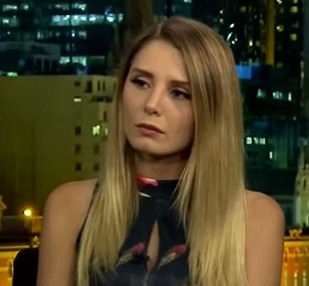
Far-right provocateur Lauren Southern has accused Australian police of inciting violence and 'participating' in protests during a controversial speaking event she held in Melbourne.
Ms Southern appeared on Sky News with conservative journalist Andrew Bolt, who asked the Canadian if she had even been 'presented with a police bill for protecting you from thugs?'
'Never in my life,' the 23-year-old responded. 'This really does seem like an incentive for violence. Not only do you get to beat people that you don't like and attack them but they're going to be oppressed economically as well.'
'The police are quite frankly participating ... They might as well be members of Antifa at this point, just put on the masks and join!'
Political commentator Andrew Bolt said he was 'calling out Victoria Police and their masters in the Labor government' for 'cooperating with violent fascists of the left to stop conservatives or people of the right from holding meetings
'Police and the fascist left make it too frightening or too expensive for conservatives or the right to hold meetings in Melbourne,' Bolt said.
'Conservatives must pay a fortune or risk violence. What on earth happened to our democracy and our free speech?'
Police anticipated violent protests and earlier this week let event organisers know that it would cost them $68,000 for the police presence.
SOURCE
Posted by John J. Ray (M.A.; Ph.D.). For a daily critique of Leftist activities, see DISSECTING LEFTISM. To keep up with attacks on free speech see Tongue Tied. Also, don't forget your daily roundup of pro-environment but anti-Greenie news and commentary at GREENIE WATCH . Email me here
Sunday, July 22, 2018
Lauren Southern needs a new t-shirt
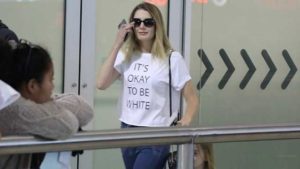
Jeremy Sammut below preaches in favour of the individual and against the fractionating into groups preached by the Left. I wholeheartedly agree with him. He does not however confront the question: "How do we get there from here?"
And that is the fatal flaw in his criticism of Lauren Southern below. Multiculturalism has an almost complete monopoly of the media. We are constantly told that no other system of thought can possibly be virtuous. We are constantly presented with the wonders of all sorts of minority groups. And those groups are always held up relative to white males. White males are the boogeymen, the villains. You can be proud of your identity as long as you are not a white male.
That monologue has to be disrupted if we are to defeat racism. Because multiculturalism has become a form of racism. White males are what the Jews historically were: A group that is too successful and has to be cut down to size wherever possible.
So Lauren disrupts that monolithic narrative. She shows that another view is possible. And in so doing she exposes the emperor's clothes. She openly challenges the "consensus" and shows that there is no answer to her challenge. Multiculturalists abuse her but no reasoned argument from them is forthcoming. Trump won power by challenging the hate that the Left pour out on ordinary white people so there is great potential for Lauren's message also to hit home.
White males do still undoubtedly rule the roost so they are not as vulnerable as Jews once were but it does get tiresome to be identified day in and day out as the source of all evil. And it is more than tiresome. It is borderline deranged. Lauren is in the end standing up for sanity.
Below is a picture of two blue-eyed, blond-haired white men of European origin who rule very big roosts. Multiculturalism seems to be some way off yet.

It is fair to say that in these politically correct times there is a lack of political leadership around many contentious social issues that many politicians and community leaders hesitate to speak out about.
It is also a truism that politics abhors a vacuum. However, we should be careful not to fill the vacuum with another vacuum.
This thought is prompted by the controversy generated by the visit to Australia by the 23-year-old Canadian alt-right activist Lauren Southern.
Southern — who had already tried to drum up publicity over her initially rejected visa application — pulled another stunt upon arrival in Brisbane by wearing a t-shirt emblazoned with the slogan ‘It’s Okay to be White.’
This was followed by Southern — who speaks fluent soundbite — telling the media how pleased she was to be in country committed to “Western culture — something that may not be here for much longer if left-wing Australian politicians continue their pathological worship of multiculturalism.”
If Southern’s heart is in the right place, her arguments certainly aren’t. For many of the things she is saying on western culture and multiculturalism, claims to stand for, and literally wears on her ‘T’, are mutually exclusive.
Yes, ‘hard’ multiculturalism poses a danger to Western culture when migrants from countries with conflicting cultural values migrate and are not encouraged to integrate with the norms and values of their new country.
But, no: the answer to multiculturalism is not to practice a different form of identity politics — a new form of tribalism — by being proud of ‘whiteness’.
What is actually worth defending about Western culture (and is the antidote to identity politics and multiculturalism) is the fundamental principle of respect for the individual — regardless of superficial differences such as those that are literally skin-deep.
If Southern really wants to defend Western culture and all it should truly stand for, she should buy a new T-shirt.
This one should be emblazoned with that famous quote by one of the greatest proponents of the respect for the individual, Dr Martin Luther King: “judge not by the color of their skin, but by the content of their character.”
SOURCE
Violent "protesters" picket Lauren Southern speech
The violent Left again. Stalin lives in them
A protester yelling 'I love Muslims' has stormed the stage during alt-right provocateur Lauren Southern's speech.
Nita Habibi was tackled by security at the event after throwing herself at the speaker in front of the auditorium. Habibi shouted 'I love freedom of speech' and 'I love refugees' as she was dragged out of the event at La Mirage Reception and Convention Centre in Melbourne's north.
Dramatic footage shows security bundling the protester off the stage, with Miss Southern apparently unharmed.
As Habibi was dragged off stage, Miss Southern's supporters can be seen cheering and clapping.
'[Southern spouts an extremely Islamophobic rhetoric that is nothing short of hate speech. She is a dangerous individual whose false views on Muslims stir up polarisation and violence,' Habibi told The Australian after the event.
Violent protests erupted outside the event where Southern, 23, and co-speaker Stefan Molyneux kicked off their Australian tour on Friday night.
A number of protesters got violent and began to throw rocks at a bus arriving with ticket holders, the Herald Sun reported.
Miss Southern will be travelling across Australia for her speaking tour
Violence erupted between protesters and counter-protesters, with punches thrown and people being dragged over protective barriers.
Victoria police are on the ground in the area, including riot police and mounted police, who are working to keep the protests at bay.
The violent protesters could be heard shouting slogans, 'unite to fight the right' and 'Nazi scum'.
Victoria Police say they are "disappointed" after protesters clashed with riot and mounted police outside a Melbourne venue.
Police anticipated violent protests and earlier this week let event organisers know that it would cost them $68,000 for the police presence.
The young provocateur is known for her controversial views on multiculturalism, Islam and feminism and was banned in March from entering the UK.
The Campaign Against Racism and Fascism says Southern is 'a notorious racist and Islamophobe'.
'She is known for her involvement in the racist attempts to obstruct NGO search-and-rescue boats trying to help shipwrecked migrants in the Mediterranean," the group alleged in a Facebook statement.
Victoria police insisted on being present for crowd control and security after another right wing activist, Milo Yiannopoulos, visited Melbourne in December 2017, prompting violent protests from the far left.
More than a dozen men were sought by police after Milo Yiannopoulos' speaking show descended into chaos.
Police in riot gear intervened when verbal clashes turned physical between around 500 left-wing and 50 right-wing activists.
Several protesters were seen throwing punches and rocks, while others brandished make-shift weapons including wooden clubs and sticks.
Yiannopoulos, who held his first Australian tour last month, slammed the 'violent' left-wing protesters for causing the trouble outside the event.
'There was a lot of kerfuffle out front,' he told Alan Jones on 2GB Radio the day after the chaotic scenes.
'It was not as the newspapers reported ''a clash between the far left and far right'' it was the left, showing up, being violent to stop freedom of speech.'
Miss Southern and her speaking partner Stefan Molyneux are set to speak in Perth, Adelaide, Sydney and Brisbane after Friday's talk in Melbourne.
SOURCE
'Immigrants should blend in and adopt Australian values':
Migrants to undergo new test about forced marriage, genital mutilation and freedom of speech before being granted citizenship
Australia should introduce a 'values test' for immigrants applying for citizenship, federal Citizenship Minister Alan Tudge has said.
The country is veering towards multicultural segregation and must do more to ensure the integration of migrants, Mr Tudge warned in a speech at the Australia/UK Leadership Forum in London overnight.
He said immigrants 'must blend into the fabric of our nation' and can't expect to bring 'their entire practices, language and culture with little expectation placed upon them to share or mix with the local community.'
'Our ship is slightly veering towards a European separatist multicultural model and we want to pull it back to be firmly on the Australian integrated path,' he said.
'Some of the challenges to social cohesion that we are facing today are similar to ones that the UK is facing - such as ethnic segregation and liberal values being challenged.'
Mr Tudge said a proposed English language skills test for those seeking permanent residency should be extended to include a 'values' assessment.
'We place an emphasis on Australian values as the glue that holds the nation together,' he said.
'We do this through requiring people to sign a values statement before coming into Australia, satisfy a citizenship test and pledge allegiance before becoming a citizen.
Questions that could be included in updated citizenship test
Can you strike your spouse?
Does Australia's principle of freedom of religion mean that in some situations it is permissible to force children to marry?
Under what circumstances is it appropriate to prohibit girls from education?
'The weakness of this, however, is that we presently have few mechanisms to assess people against their signed statement.'
He added: 'We need muscular ongoing promotion of our values: of freedom of speech and worship, equality between sexes, democracy and the rule of law, a fair go for all, the taking of individual responsibility.'
A revamped citizenship test including a values test and a harder English test was rejected by the senate last year - but ministers have said another attempt at reform will be made this year.
In April, Daily Mail Australia reported how sweeping changes could be made to the Australian citizenship test in a bid to test the values of migrants looking to settle in the country permanently.
A set of questions determining if a potential citizen shares the same values as the nation could be added to the test, including questions on domestic violence and child marriage.
Sample questions include: 'can you strike your spouse?', 'does Australia's principle of freedom of religion mean that in some situations it is permissible to force children to marry?'
Applicants may also be asked: 'Under what circumstances is it appropriate to prohibit girls from education?'
The values questions are intended to be put to the public for their opinion, and could include topics such as genital mutilation.
There will also be an English test which requires the applicant to display reading, writing and listening skills.
Prospective citizens with a permanent or enduring incapacity, as well as those aged under 16, would be exempted from the English reading, writing and listening test.
Applicants will also have to demonstrate steps they have taken to contribute and integrate into their community, whether by employment, school enrollment or membership of community organisations.
The test can only be taken by those who have held permanent residency for four years, whereas previously it was one.
Behaviour inconsistent with Australian values will also be taken into account during the process, with a light shone on criminal activity - including domestic violence - and involvement in organised crime.
Applicants can take the test three times, and then must wait two more years before taking it again. Previously, there was no limit to the amount of times the test could be taken.
Cheating will result in an automatic fail.
The move came just two days after Prime Minister Malcolm Turnbull announced an overhaul of the 457 temporary foreign worker visa.
'Membership of the Australian family is a privilege and should be afforded to those who support our values, respect our laws and want to work hard by integrating and contributing to an even better Australia,' Mr Turnbull said.
'We must ensure that our citizenship program is conducted in our national interest.'
Speaking on Wednesday at the Australian Chamber of Commerce and Industry Breakfast, the Prime Minister said the changes are intended to help increase national security, as well as social cohesion.
'Australia must continue to attract people who will embrace our values and positively contribute - regardless of their nationality or religious beliefs,' he said.
'This is important for temporary visas and vital for permanent residency and citizenship.
'Citizenship must be valued and we are making changes so that the practices and principles of those obtaining citizenship are consistent with our cultural values.
'Our reforms are designed to get more out of our migration system, to realise its potential to contribute to our economy.'
Mr Turnbull said five million people had committed to becoming Australian citizens since 1949, helping to secure and enrich the nation.
Immigration Minister Peter Dutton said the country should not be embarrassed to say it wants great people to call Australia home.
'We want people who abide by our laws and our values, and we should expect nothing less,' Mr Dutton said.
SOURCE
Teachers are being encouraged to show LGBT movies to students to increase 'diversity' - as 'concerned' education expert warns schools will have to be 'very careful'
Teachers have been encouraged to show LGBT movies to students as a measure to increase diversity in the classroom.
The New South Wales Teachers Federation released a list of approved films which feature lesbian, gay, bisexual, trans, intersex and queer (LGBTIQ) themes deemed 'appropriate to study in class'.
Films include Love, Simon, Gayby Baby, Pride, The Perks of Being a Wallflower and Battle of the Sexes, according to the NSW Teachers Federation.
Some of the selected movies, including The Danish Girl and Perks of Being a Wallflower, are classified mature (M) and are advised for audiences older than 15-years.
However, Gayby Baby, Pride and Battle of the Sexes are classified under Parental Guidance (PG).
'There is now an array of films available with LGBTIQ characters and research indicates that when students see themselves in the content studied in class, they are more likely to be engaged and feel part of the school community and culture,' the organisation wrote online.
'This has positive implications for LGBTIQ students' wellbeing and educational outcomes. It also provides non LGBTIQ students with a broader range of experience and can assist with empathy and understanding of others.'
None of the films are prescribed under the NSW curriculum, but the federation said teachers are encouraged to use the movies so students can learn to 'connect and collaborate with a diverse group of people'.
Love, Simon, which was released earlier this year, focuses on issues of identity, consent, respectful relationships and cyber-bullying.
It features a gay male lead character.
The 'bold' film has been described as a 'poignant, coming of age teenage movie with a difference', however, 'not suitable for younger viewers', according to the Australian Council on Children and the Media.
The council president Elizabeth Handsley said while it was possible to show adult themed movies in classrooms, it is a 'concern'.
None of the films (The Danish Girl, left, and Battle of the Sexes, right) are prescribed under the NSW curriculum but the federation said teachers are encouraged to use the movies so students can learn to 'connect and collaborate with a diverse group of people'
'It is an interesting proposition to be showing M films in schools: that would concern me as it has the tendency of undermining the classification message,' Professor Handsley told The Australian.
'You need to be very careful doing so in a school setting ... where there's a whole range of students with a range of maturity levels and background experiences.'
The NSW Education Department spokesperson told Daily Mail Australia schools were required to acknowledge the diverse views held by parents and the community about what was suitable for students to study.
'Parents have the right to remove their children from any school activity or NSW curriculum learning that they are concerned about,' the spokesperson said.
'Films or TV programs rated M or M15+ may be shown to some students in circumstances where the material is determined by the principal to be age-appropriate and contributing materially to learning under the NSW curriculum.'
The department said principals had to inform parents about the content of an activity beforehand.
SOURCE
Posted by John J. Ray (M.A.; Ph.D.). For a daily critique of Leftist activities, see DISSECTING LEFTISM. To keep up with attacks on free speech see Tongue Tied. Also, don't forget your daily roundup of pro-environment but anti-Greenie news and commentary at GREENIE WATCH . Email me here
Friday, July 20, 2018
‘Program did not consider the impact on victims’: ABC slammed by MP over NZ deportation piece
Leftists going into bat for violent criminals is routine. Note the Tookie Williams disgrace. The great hulking brute killed weak little Asians without a second thought -- but the California Left did its best to save him from execution
In this case however there is something else involved. Unmentioned on all sides is that the offenders were mostly Maori or part Maori and Maori have a high crime rate. Kiwis don't want them back if only for that reason. It gives them a real law & order problem. Their underlying objections are racist but they dare not mention that
THE ABC has been slammed by Australian politicians over its Foreign Correspondent program which investigated why the country is “detaining, cuffing and deporting more New Zealanders than any other group”.
Journalist and former Wallaby Peter FitzSimons, who was the guest reporter on Tuesday’s night’s program, had gone to New Zealand to see how deportation had affected the relations between the two countries.
More than 1300 Kiwis have been deported from Australia — for committing crimes or being found to be of bad character — in the past three years, with another 15,000 set to be sent back over the next decade.
However it copped major backlash from Coalition ministers who say it failed to interview any victims.
“I watched the entire program, and I have to say I felt the ABC program did not consider the impact on victims,” Assistant Home Affairs Minister Alex Hawke told Sky News.
“There wasn’t a victim on the show, and what we’re talking about is serious criminal offences.
“In the domestic violence cohort I can tell you, there are sexual offences against women in front of their children in many cohorts in different parts of the world in Australia, and they’re serious, serious offences.
“The ABC program did argue, it kind of presented that we are doing something unfair, or that we are doing something wrong.
“The Australian Government makes no apology for deporting serious criminals who are not citizens of Australia.”
Peter FitzSimons talks to deportee Ko Haapu. The ABC was slammed by Home Affairs Minister Alex Hawke for the program failing to talk to victims.
New Zealand Justice Minister Andrew Little claims that Australia is breaching human rights with its hard-line deportation policy. But Mr Hawke dubbed this “irresponsible”.
He took to Twitter during the night of the program to express his disappointment in Mr Little:
Since the Migration Act was amended in December 2014, it gave powers to Australia’s Department of Home Affairs together with Home Affairs Minister Peter Dutton the ability to cancel the visas of people who could pose a risk to the community or who they’ve deemed are not of “good character”.
Mr Dutton also took to his Twitter account during the Foreign Correspondent piece to share the millions of dollars Australia has saved from cancelling visas of particular persons:
During his Sky News interview Mr Hawke had a direct message for Aussies living across the Ditch.
“We would as the Australian Government say to citizens in New Zealand, ‘Well you must obey the law, and if you don’t obey the law you may be deported back to Australia.’
“We’d like to hear the same message from the New Zealand Government.”
Foreign Correspondent followed the case of former New Zealand soldier turned motorcycle gang member and deportee, Ko Haapu. He had also previously worked as security detail for former NZ prime minister John Key.
“I wasn’t on criminal charges … but I was still treated as a prisoner who has committed a crime,” Haapu told FitzSimons.
In the program titled “Don’t Call Australia Home” FitzSimons found that under the changes to the Migrant Act, “just being a member of a bike gang, an organisation suspected of criminal behaviour, was enough to get Haapu deported on ‘bad character’ grounds, even though it’s not illegal in Western Australia to belong to one”.
Mr Hawke said he was unable to comment on any individual case, but that many deportees who spoke to the media were not telling the whole truth.
“If people want to go into the public domain about their case, they should reveal to the public of Australia and New Zealand the full details of all of their cases, including the wrongdoing they’ve been engaged in, and what you see in the media quite often in relation to criminal deportation cases is only part of the story,” Mr Hawke said.
“The vast, vast, vast bulk of the crimes we see are shocking. They are repeat offenders, in many cases people have been warned several times over the past, when we had weaker laws, before this Government came to office, they received a warning that if they commit another crime they will be deported.
“It’s not their first crime, not their first time, and so I’d ask people to look very carefully into the details of any case in the public domain, and there is always more to the case in many cases than you’ll see in the public domain.”
“I’m unable to speak about any case, and you can ask me a hundred ways but I can’t do it. But I can say, look, if you’re involved in a criminal gang and you’re well known as a criminal gang associate, then obviously issues will pertain to your character,” Mr Hawke said.
“They are considerations. If you’re not a citizen of Australia, we have a perfect right to consider your character if you’re here on a temporary visa or another form of visa.”
During the program, when confronting Mr Dutton about Haapu’s case, FitzSimons put it straight to the Home Affairs Minister.
“He was held with no charge, no crime committed,” he said.
“Peter, he was a member of the Rebels outlaw motorcycle gang, and we know that they are part of a syndicate which is the biggest distributor of drugs in our country,” Mr Dutton told FitzSimons.
FitzSimons hit back saying, “You imply a raft of strong allegations, accusations against the fellow that we can’t see.”
“Well, Peter, that happens every day. I mean, there’s intelligence that’s gathered that’s not released for a variety of reasons,” Mr Dutton said.
Both politicians reiterated that the “Australian Government won’t apologise for deporting people with a criminal background, with criminal offences or of bad character”.
A spokeswoman for the ABC told news.com.au that Foreign Correspondent had interviewed three deportees and there was no attempt on behalf of the program to downplay the seriousness of any of the crimes.
“One received a 12 month prison sentence for domestic violence; his wife was approached but did not want to appear on camera,” the spokeswoman said.
“The second was a convicted drug dealer, and interviewing victims of a drug dealer is not feasible in this context.
“The third was sent back on grounds of bad character and has not been convicted of a crime, so there were no victims to interview.”
The spokeswoman said that is true that the deportees were convicted criminals or had been judged to be of bad character, and are hard to empathise with, “but their cases do raise some difficult questions of principle — for example, whether it is correct to keep someone in prison for a long period without charge or conviction, and whether it is fair to deport and separate from their family someone who has done their jail time and officially paid their dues to society.”
She explained that the intent of the story was to reveal to the Australian audience the depth of feeling in New Zealand — as expressed by ordinary Kiwis and senior political leaders — about Australia’s policy.
“We were surprised by the level of anger and felt it warranted reporting, given that it potentially impacts on our relations with such a close neighbour and ally.
“Given the strength of the critique from New Zealand politicians, we felt it deserved a response from the Australian Government, which we obtained by way of an interview with Home Affairs Minister Peter Dutton.
“It was reasonable for the program to explore such questions. Ultimately, of course, it was left to the viewer to decide.”
On the day the program aired (July 17), guest reporter FitzSimons posted a comment to his 67,000 Twitter followers to tune in: “My stint as Guest Correspondent on Foreign Correpspondent (sic), tonight, 8pm. See what you think!”
Many commented on his tweet, voicing their disappointment on how Australia is treating the New Zealanders in question, while others agreed with the Government’s policy.
One person tweeted: “I’m a Kiwi living in Aus and I totally support what Aus is doing. It’s a privilege living here, why should Aussies put up with someone tattooed with FTP on their neck?”
Another congratulated Fitzsimons, saying: “Excellent job. It is an embarrassing policy and not a good look for Australia. We have to do better by NZ.”
SOURCE
‘They prefer to back a regime of murderous thugs’: Left-wing Australian unionists push for Israel ‘genocide’ motion
Leftist antisemitism goes all the way back to Karl Marx, who hated Jews even though he was one. In his day it was a common saying: "Der Antisemitismus ist der Sozialismus der dummen Kerls." (Antisemitism is the socialism of stupid people). Not much has changed
A SENIOR union official has broken ranks with his colleagues to speak out against an “anti-Semitic” push to condemn Israel for the “genocide” of Palestinians.
The resolution, which called on a Labor government to immediately recognise a Palestinian state, was passed overwhelmingly by the Left Caucus at the Australian Council of Trade Unions Congress in Brisbane on Monday afternoon.
The Left Caucus makes up roughly 400 of the estimated 1000 union delegates attending the three-day union meeting, which will set the scene for Labor’s upcoming National Conference in December.
“The motion itself condemned Israel for the ‘genocide’ of the Palestinian people and called on a Labor government to immediately recognise the Palestinian state based on the 1967 borders,” said Jeff Lapidos, tax branch secretary of the Australian Services Union.
The left and right factions met separately on Monday to put forward motions that would then be debated on the floor of the congress. ACTU members collectively represent an estimated two million Australian workers.
A delegate from the Australian Manufacturing Workers’ Union put forward the anti-Israel motion, calling for it to be put direct to the ACTU executive to avoid debate on the floor, where it would be voted down by the right.
“They didn’t want a divisive debate,” Mr Lapidos said.
“He made it clear that the Right Caucus didn’t support the motion but the left had a majority at the ACTU executive, so the plan obviously is to discuss it behind closed doors and ram it through.
“I got up and spoke against it, that it was wrong and shouldn’t be supported. I spoke for a minute or two, someone else spoke in favour for 30 seconds, then it was passed by an overwhelming majority by a vote of the hands.”
In 2011, ACTU secretary Sally McManus said she vigorously supported the Boycott, Divestment and Sanctions campaign against Israel “to end the violation of human rights and to campaign against Israel as a means of peaceful resistance”.
Mr Lapidos stressed he was speaking in his personal capacity and not on behalf of the ASU, which unlike more militant left-wing unions does not take positions on international affairs.
He said the motion was effectively a “vote of no confidence” in the Labor Party’s current policy on Israel “which is to be even-handed”, and was the only motion that had to be “debated behind closed doors”.
“For reasons I don’t fully understand, the left in Australia has developed a very anti-Israel, anti-Semitic passion,” he said. “Instead of backing the only democracy in the Middle East, they prefer to back a regime of murderous thugs. That’s what Hamas is, that’s what the Palestinian Authority is.”
Mr Lapidos said it was a “big distraction for the ACTU”. “Most ordinary working people aren’t interested in the socialist revolution,” he said. “They want a better outcome for them and their families.”
An AMWU spokesman said, “It would be inappropriate for us to distribute any motions before they have been debated and voted on at the ACTU executive or congress. We don’t intend to make any further comments about this matter.”
Peter Wertheim co-chief executive of the Executive Council of Australian Jewry, said accusing Israel of genocide was an “outrageous lie, in fact an inversion of the truth”.
“It is Palestinian terror groups such as Hamas, which has a charter pledging that it will ‘obliterate’ Israel, who adopt the cowardly practice of hiding behind Palestinian civilians in Gaza while targeting Israeli civilian population centres with thousands of rockets and mortars, and burning hundreds of hectares of crops and nature reserves in Israel with incendiary devices,” he said.
“The Palestinian population in Israel, the West Bank and Gaza has increased fivefold since Israel was established, but if the Palestinian leadership had their way, the Jewish population of the country would be evicted or exterminated.
“This is why Israel defends its people so determinedly. Israel has offered the Palestinians statehood on at least three occasions, but the Palestinian leadership gives far higher priority to destroying the Jewish State than establishing a Palestinian State.
“If the ALP Left really champions human rights, as it claims, it should come to grips with these realities instead of indulging in outdated polemics.”
Labor’s foreign affairs spokeswoman Penny Wong distanced the party from the motion. “This is a motion before the ACTU Conference — it is a matter for them and has no relationship to the position of the Federal Parliamentary Labor Party,” a spokesman said.
“Labor has long supported, and continues to support, a two-state solution to the Israeli-Palestinian conflict. We support Israel’s right to exist within secure and recognised boundaries and the creation of a Palestinian state in the West Bank and Gaza.
“A just two-state resolution will require recognising the right of both the Israeli and Palestinian peoples to live in peace and security.
“Labor, whether in government or opposition, will continue to work with the parties to the conflict, with our allies, and with the wider international community to achieve a peaceful resolution of the Israel-Palestinian conflict.”
SOURCE
Queensland conservatives slams school union education program
A new program to educate high school students about their rights as workers is union indoctrination, the Queensland Opposition says.
The Queensland Council of Unions has put together a program called the Young Workers Hub, which will educate Year 11 and 12 students who have part-time jobs about their rights at work.
It will also offer contact channels for young people to seek support if they have questions or issues at work, as well as a "campaigning arm" to allow young workers to "make their workplaces better".
The Opposition says the program is an attempt to get young people to sign up as union members.
"This is nothing more than a political union membership drive and they're starting young because they're not getting the members that they want," the Liberal National Party's education spokesman Jarrod Bleijie told reporters on Thursday.
He drew a distinction between the QCU's program and similar classes run by the Queensland Chamber of Commerce and Industry, saying the business advocacy group was not an "external body of a political party".
He also accused Education Minister Grace Grace of being "too close" to the issue because she was a QCU official before entering politics.
But Ms Grace defended the program, which requires schools to opt in.
She said teenagers who were already working deserved to know about their rights at work to avoid exploitation.
"I'm sure no parent wants to see their child exploited or working in an unsafe environment," the minister said in a statement.
Children in Queensland can legally work once they turn 13, with exemptions down to the age of 11 for some jobs such as delivering pamphlets door-to-door.
SOURCE
McDonald’s move to ban plastic straws angers Australians
There is NO justification for this. Ocean detritus comes from Africa and Asia, not Australia
FIRST it was plastic bag ban rage — now Australians are turning to McDonald’s to take out their anger and frustration.
News the fast-food giant is going to make sipping a thickshake harder has outraged people across the country — and the world — who say the plastic ban is being taken too far, causing them too much inconvenience.
The environmental impact speaks for itself — more than 10 million plastic straws are used in Australia every day.
They contribute to the estimated 150 million tonnes of plastic filling our oceans and by 2050 experts estimate there will be more plastic in the ocean than fish.
But news of the McDonald’s move to phase out plastic straws over the next two years has caused people to flood social media in anger, with many joking it is the “last straw”.
One Facebook user said it was “overkill looking for public praise”.
“What about the lid on the drinks that uses so much more plastic,” he said.
“Then we have plastic spoons and knives and forks they give you. This campaign is bordering on insane.”
Many agreed the plan to roll out the change to all 970 restaurants nationwide by 2020 was more about the company’s corporate image than the environment.
“Plastic straws make up less than 0.003 per cent of the plastic in the ocean. The straw ban is f*****g pointless and shifts the blame from corporations systemically destroying the environment to individuals,” said one Twitter user.
Paul Harvey, an environmental scientist at Macquarie University, has previously said without appropriate exemptions, a federal legislative ban on single-use plastic straws could prevent people in need from “accessing a basic medical aid”.
“We need to ensure that we have the right strategy to accommodate those who still depend on single-use plastics,” he said.
Disability rights groups across the world have been vocal in their views, highlighting people with conditions such as cerebral palsy and multiple sclerosis need straws to eat and drink.
“Other types of straws simply do not offer the combination of strength, flexibility, and safety that plastic straws do,” said one US group after the move to ban straws there.
Worldwide people have been active in their straw ban campaigns, claiming success when companies announce their changes.
Campaigners claimed victory when Starbucks announced it would stop using plastic straws in its stores by 2020, with a petition to encourage them gaining 150,000 supporters.
Even kids have started their own petitions to encourage giants such as Disney World to ban straws and lids.
Others include a petition to stop Subway with more than 95,000 signatures, and ongoing McDonald’s pushes around the world.
In Australia, McDonald’s will start trialling paper straws in August in two outlets.
The move comes as supermarket giants Woolworths and Coles get rid of free plastic bags.
Woolworths has also said it will stop selling plastic straws by the end of 2018 and will remove plastic packaging from a further 80 fruit and vegetable lines in a bid to appease increasingly environmentally conscious customers.
McDonald’s says the trial is part of a larger, long-term global effort to identify viable, sustainable alternatives to its single-use plastic straws.
“We know plastic straws is a topic our customers are passionate about and we will find a viable solution,” McDonald’s Australia supply chain director Robert Sexton said.
Greenpeace Australia applauded the decision.
“It’s wonderful McDonald’s is making a commitment to reducing consumption of single-use plastic and we look forward to seeing more detail around this proposal to see the overall impact,” Greenpeace spokesman Simon Black said.
McDonald’s paper straws are the same as those it’s trialling in the UK.
SOURCE
NSW, Qld keep economy ticking
A jobs boom in NSW and Queensland has helped drive the unemployment rate to its equal lowest in six years.
The national jobless rate was unchanged at 5.4 per cent in June, according to the latest Australian Bureau of Statistics figures, with 50,900 net new jobs added in the month but no drop because more people are seeking work.
"We are seeing a real rise in confidence and investment and in jobs growth across the country," Prime Minister Malcolm Turnbull said in Sydney on Thursday.
The largest jobs increase was in NSW (up 27,300) and Queensland (up 14,800), while the highest fall was in Victoria (down 6600).
The only increase in the jobless rate was in Victoria (up 0.5 percentage points to 5.6 per cent), while in Tasmania - which has faced tough economic times in recent months - the rate was down 0.7 percentage points to 5.8 per cent.
Mr Turnbull noted the improvement in Queensland and Tasmania, where the coalition is seeking to unseat Labor in two of five by-elections being held on July 28.
"What we are seeing is the consequence of an economic plan that encourages businesses to invest," he said.
After the by-elections the government is planning to again seek the Senate's support for cutting the corporate tax rate for all-sized businesses to 25 per cent.
Asked by AAP on Thursday about the government's commitment to bringing on the tax cut laws in August, Treasurer Scott Morrison said: "The plan is the plan and we still want to see it passed by the end of the 2018/19 financial year."
Mr Turnbull said the government had also achieved the lowest percentage of Australians on working age on welfare in 25 years.
Mr Morrison said he was encouraged by the rising participation rate, which at 65.7 per cent was 0.1 percentage points short of the record.
"Not only are more people going out and getting jobs, more people are going out there to get jobs," he said.
The youth unemployment rate was the best financial year result since 1988/89, "the year Taylor Swift was born", he said. "I reckon that would be something for Taylor Swift to sing about."
SOURCE
Posted by John J. Ray (M.A.; Ph.D.). For a daily critique of Leftist activities, see DISSECTING LEFTISM. To keep up with attacks on free speech see Tongue Tied. Also, don't forget your daily roundup of pro-environment but anti-Greenie news and commentary at GREENIE WATCH . Email me here
Thursday, July 19, 2018
Victorian judge bans niqab in court's public gallery
A Victorian judge has banned a woman whose husband is facing terrorism charges from wearing a niqab in court, saying it posed a potential security risk.
The woman applied through her husband’s lawyers to wear the face veil, which she said was a “a fundamental way in which she observes her faith”, while sitting in the public gallery to support him through the six-week trial.
She said she had been permitted to wear the niqab during a committal hearing in the magistrates court and was willing to show her face to security guards manning the metal detector and weapons check at the court entrance to verify her identity.
But the supreme court judge Christopher Beale said the risk of a mistrial or other incident caused by “misbehaving” in the public gallery would be heightened if a person could not be instantly identified because their face was covered, and ruled that the risk outweighed the infringement upon the woman’s right to freedom of religious expression.
“Deterrence, identification and proof are all served by a requirement that spectators in the public gallery have their faces uncovered,” he said in a decision handed down on Monday.
Beale said lawyers for the accused had indicated there were other women who would also wear niqabs in court if permission were granted, which would further confuse identity issues because “such dress tends to be very similar”.
Lawyers for the woman argued that she did not pose a security risk and would abide by all court orders, but Beale said the stress felt by people accused of serious crimes was often shared by family members and that “as a consequence of that stress, incidents happen from time to time in court”.
“Australia is obviously a multicultural society and I agree that religious dress should be accommodated as much as possible, but the right of religious freedom and the right to participate in public life are not absolutes,” Beale said in his decision.
He said the Victorian charter of human rights recognised that rights “may be subject to limitations which can be ‘demonstrably justified in a free and democratic society based on human dignity, equality and freedom’”.
Lawyers for the woman said there was an implied right of wear a veil when not giving evidence, citing a number of cases in Commonwealth countries.
Those cases generally concerned whether a person was able to wear religious facial coverings while giving evidence and did not contest a person’s right to wear religious attire when not on the stand. Among them is a ruling by the New South Wales court of appeal concerning a civil damages trial against NSW police, which upheld the trial judge’s ruling that the complainant could not wear her niqab while giving evidence.
“A requirement that spectators have their faces uncovered is not to force anyone to act immodestly,” Beale said. “First, the exposure of one’s face in a courtroom cannot reasonably be viewed as an immodest act: subjective views to the contrary cannot rule the day, or the management of a courtroom.
“Second, if someone feels strongly that it would be improper for them to uncover their face in court, they can choose not to attend.”
He said the trial could be livestreamed to another room in the court building to allow the woman to follow it if she chose not to remove her veil.
The Victorian equal opportunity and human rights commissioner, Kristen Hilton, said religious and cultural rights were protected under Victorian law, and that those rights also applied in a courtroom.
“Victorian law is clear that when courts are acting in an administrative way – such as making decisions about procedure in the courtroom – they must consider and act compatibly with human rights,” Hilton said.
“The law allows for restrictions on human rights, such as restricting a person’s right to observe their religion or culture through what they wear, but limits are only justified where there is clear evidence the limit is reasonable.”
SOURCE
'Absolute prize': Why selective schools are eclipsing private schools
Because they are more selective. Private schools cater for a wider ability range
Selective schools have overtaken private schools as the state's most advantaged, with schools such as Normanhurst Boys and Hornsby Girls now eclipsing elite colleges such as St Ignatius, Barker and Ascham.
More than half of the state's top 20 most socio-educationally advantaged schools are now state selective because they are the "absolute education prize" for parents, a report from the Centre for Policy Development has found.
Securing a selective school spot requires such investment of time and money that almost three quarters of their students come from the highest quarter of socio-educational advantage, and only two per cent from the lowest.
But their popularity has come at a cost; researchers also measured the wider ''brain drain'' when new selective schools were established, and found that results and enrolments at neighbouring suburban schools fell.
The report, part of a series on equity in schools, argues that selective schools were designed to cater for all high achievers but are now dominated by the children of parents with the resources to pay for things like coaching.
"It reflects the ferocious competition to get into these schools," said co-author Christina Ho. "They are public schools, you wouldn't expect to see them at the top of these advantage lists. It doesn't seem possible for them to be eclipsing private schools.
"But among middle class families they have become the absolute education prize. Families begin planning years in advance. Tutoring begins in early primary school, costing thousands. If you don't start planning early, you jeopardise your chances.
"Those resources are not available to most families. That's how you end up with this concentration of [advantaged] families."
The socio-educational score of a school looks at the education and occupation of its students' parents.
The report also looked at selective schools' impact on suburban high schools by studying the opening of four partially selective schools in Sydney's south-west in 2010, namely Bonnyrigg, Prairiewood, Moorebank and Elizabeth Macarthur.
Between 2005 and 2017, the number of HSC ''distinguished achievers'' rose at those selective schools. At Moorebank, the proportion rose from 13 per cent to 28 per cent. But neighbouring high schools experienced no increase or a decrease.
In some cases, their number of high achievers halved. Enrolment dropped, too.
Co-author Chris Bonnor said the loss of high achievers to selective schools made neighbourhood schools less desirable. "They lose enrolments, they lose those aspirant students that make up [more challenging] classes," he said.
A teacher from one of the south-west Sydney schools affected, who wanted to remain anonymous, said the impact on her school had been stark. "We used to be able to say to parents, 'we can help your children get really good results'," she said. "We can't say that any longer."
The NSW government is reviewing the selective school and primary school opportunity class tests amid concerns that wealthy families are gaming the system by engaging tutors for their children.
A department spokesman said the final report would be released later this year.
But Dr Ho said the review was "tinkering around the edges of the admissions system," and called for bigger changes. "We have the means, the technology, and the model that could inform a much more far-reaching review of selective schools so we don't have this segregation of students," she said.
Mark Jordan's two children, Sophia, 15, and Bill, 12, both attend the partially selective Sydney Secondary College Balmain Campus. Bill might have attended a private school if he didn't get into Balmain, and did some coaching ahead of the entrance test.
With the money he has saved on private school fees, Mr Jordan invests in extra coaching. "We spend about $1800 [a year]. It's not a small amount of money but it's a lot cheaper than private school fees."
''We've noticed less diversity than we expected,'' Mr Jordan said. ''So we think the entry process could be unfair."
SOURCE
Why more Kiwis are deported from Australia than any other group
No mystery. Kiwis can come here without checks -- so their crooks come too
NEW Zealanders are being deported from Australia in huge numbers, and it’s becoming huge problem for both countries.
“WE DON’T want you here, the broader community doesn’t want you here.” That was the message from an Australian Federal Police superintendent to motorcycle club members when a notorious New Zealand-born bikie was arrested for his bikie links in 2015.
The visa of Aaron Joe Thomas Graham was cancelled and he was set to be deported back to New Zealand.
The situation has become a familiar one in recent years. More than 1300 Kiwis have been deported from Australia in the past three years, with another 15,000 set to be sent back over the next decade.
In last night’s Foreign Correspondent, journalist and former Wallaby Peter FitzSimons goes to New Zealand to see how deportation has affected the relations between the two countries.
“I wasn’t on criminal charges … but I was still treated as a prisoner who has committed a crime,” Ko Haapu, a former New Zealand soldier turned motorcycle gang member and deportee, told FitzSimons.
In the program titled “Don’t call Australia home!” FitzSimons found that under the changes to the Migrant Act, “just being a member of a bike gang, an organisation suspected of criminal behaviour, was enough to get Haapu deported on “bad character” grounds even though it’s not illegal in Western Australia to belong to one.”
Since the Migration Act was amended in December 2014, it gave powers to Australia’s Department of Home Affairs to together with Home Affairs Minister Peter Dutton the ability to cancel the visas of people who could pose a risk to the community or that they’ve deemed are not of “good character”.
Peter FitzSimons talks to deportee KO Haapu. He fought in the NZ army in Afghanistan against the Taliban, after settling in Perth he joined the Rebels motorcycle gang. Source: ABC
Peter FitzSimons talks to deportee KO Haapu. He fought in the NZ army in Afghanistan against the Taliban, after settling in Perth he joined the Rebels motorcycle gang. Source: ABCSource:Supplied
It gives coward punchers, drug dealers and violent offenders a one-way ticket to their home country — anyone with a criminal record who isn’t an Australian citizen can now be deported.
However in Haapu’s case, he told FitzSimons he wasn’t there on criminal charges. “I was there on immigration which are two different things,” he said.
FitzSimons finds that Australia’s detaining, cuffing and deportation of New Zealanders is riling Kiwis and straining relations across the ditch.
He says there’s real resentment in New Zealand — and that even he’s taken aback by the anger of New Zealanders — from ordinary citizens to political heavyweights — at what they see as a lopsided relationship.
The general consensus is that New Zealanders don’t think they have been treated fairly as a country, with the New Zealand Justice Minister even labelling the policy as a breach of human rights.
“Well we just need to see the evidence instead of the emotions,” Mr Dutton told FitzSimons.
“They’re New Zealand citizens, they’re not Australian citizens. And it’s no breach of human rights, in fact it’s a breach of, ah, civil rights of Australians who fall victims to these criminals and Australia won’t tolerate it.
“It doesn’t matter who we’re talking about. The criteria for us is whether you’ve committed an offence against Australian citizens and that’s the test that we apply.”
Last year, more than 600 Kiwis were deported on grounds of “bad character”.
When confronting Mr Dutton about Haapu’s case, FitzSimons put it straight to the Home Affairs minister. “He was held with no charge, no crime committed,” he said.
“Peter, he was a member of the Rebels outlaw motorcycle gang, and we know that they are part of a syndicate which is the biggest distributor of drugs in our country,” Mr Dutton told FitzSimons.
“In fact, this passed through the parliament with bipartisan support. If you’re a member of that gang, you face deportation.”
FitzSimons hit back saying, “You imply a raft of strong allegations, accusations against the fellow that we can’t see.”
“Well, Peter, that happens every day. I mean, there’s intelligence that’s gathered that’s not released for a variety of reasons,” Mr Dutton said.
New Zealand’s Acting Prime Minister Winston Peters recently asked Australia for “a fair suck of the sav, so to speak, where international protocols are observed.”
It was in relation to a 17-year-old boy, the youngest New Zealander to be detained since the special powers came into effect four years ago, who landed himself in a Sydney juvenile detention centre.
His offences had not been disclosed, but his lawyer argued they were “stock standard” and not enough to spark deportation.
When he was about to be released, the boy was instead taken more than 12 hours away to an immigration holding centre in Melbourne and was awaiting deportation since March.
Mr Peters made a direct appeal to Australia to release the teenager saying it was a signatory to the United Nations Convention on the Rights of the Child and called on the country to live up to its obligations.
“This person is regarded as a child or a minor, and I’m just reminding the Australians — you’re a signatory, live up to it,” Mr Peters told reporters earlier this month. .
“They are clearly in breach of it. There’s no complication. They know that, we know that.
While career crooks are among the deportees, Mr FitzSimons says lesser players have been hit by tougher immigration rules allowing deportation for anyone sentenced to more than a year’s jail — even if it’s suspended.
In the program, FitzSimons discovers change can bring opportunities for some of the deportees.
He tells of how Australia, once the receptacle for Britain’s unwanted convicts, has itself become a player in the exile business.
SOURCE
Keep Australia’s coal-fired power plants operating, says AEMO report
The nation’s independent energy market operator yesterday called for Australia’s fleet of coal-fired power stations to remain in operation for as long as possible.
Extending the operation of this fleet for as long as they are economically viable represents the “ least-cost option” for the next twenty years, according to the recommendation. It is thought the move would ward off any future price shock, as Australia transitions to a more renewables-involved grid.
Deputy Prime Minister Michael McCormack says the report speaks a lot of sense.
“I certainly know that the ACCC report and the AEMO report, they do give hope for investment in coal. Certainly other technologies as well, but coal has to be party of the mix,” he says.
“But we also need to as a nation, know and understand there are some of those coal-fired power stations which could be enhanced, which could be revitalised and expanded. That could also provide a solution if the investment isn’t there for new coal-fired power stations.”
The report and this kind of sentiment is predicted to flare up debate around AGL’s planned 2022 closure of the Liddell power station. McCormack says government should not “ rush in and nationalise things” when it comes to privately operated assets, also reiterating his technologically agnostic stance.
“The ACCC chairman said only last week, that only a technology neutral approach will get prices down. Whenever government prescribes that the technology should be one thing or another, that is when you get higher prices.”
SOURCE
Posted by John J. Ray (M.A.; Ph.D.). For a daily critique of Leftist activities, see DISSECTING LEFTISM. To keep up with attacks on free speech see Tongue Tied. Also, don't forget your daily roundup of pro-environment but anti-Greenie news and commentary at GREENIE WATCH . Email me here
Wednesday, July 18, 2018
ZEG
In his latest offering, conservative Australian cartoonist ZEG is amazed at the ACTU importing a Hollywood personality to star at their congress
Australia's ABC panned over Paul Bongiorno's Uncle Tom slur
This is a bit hard to sort out, but it seems that Bongiornio found an ABC panel show to be boring. He attributed that to the fact that the participants were all Leftists and "Uncle Toms". Whether that was true or not, his usage of the term "Uncle Tom" was greeted as politically incorrect. In the original novel about him, Uncle Tom was a good guy. But Leftists hate that
Warren Mundine [An Aborigine] has slammed a “hypocritical and disgraceful” response from the ABC after it distanced itself from commentator Paul Bongiorno and his reference to the indigenous businessman with the racial slur “Uncle Tom”.
In a statement provided to The Australian yesterday, the public broadcaster said: “Mr Bongiorno is not an ABC employee; his Twitter account is not an ABC account; any tweets are Mr Bongiorno’s own.”
It came a week after Bongiorno tweeted on July 8: “As many ‘righties’ on Dky (sic) after dark panels … and that includes ‘Uncle Tom’ lefties craving relevance.”
Mr Mundine told The Australian last night the tweet was written in clear reference to him, and described the ABC’s reaction as unacceptable. “Any organisation that reacted in this way would deserve to be pilloried for their pathetic, weak response,” he said.
Bongiorno apologised last night for causing offence and said he never intended to use a racist slur but he objected to Mr Mundine calling for the ABC to sack him.
“I am an independent commentator and journalist, currently on holidays; it is passing strange that the only reaction to some who take offence is to demand one of my employers sack me,” he tweeted.
“My tweet was in response to an attack on the ABC for only having ‘lefty’ panels. I made the point that there is plenty of evidence to show Sky has ‘rightie’ panels or acceptable ‘lefties’, which was my intention using the term ‘Uncle Tom.’ ”
SOURCE
Turnbull says there is ‘real concern about Sudanese gangs’ in Melbourne
Malcolm Turnbull has said there is “real concern about Sudanese gangs” in Melbourne and defended earlier remarks by Peter Dutton suggesting people were afraid to go out for dinner in the Victorian capital because of the fear of “African gangs”.
On Tuesday, Turnbull defended the home affairs minister’s remarks in January, while insisting his government had “zero tolerance for racism”.
The prime minister’s comments come amid escalating campaigning by the Coalition on immigration and crime in the lead-up to both the super Saturday byelections on 28 July and the Victorian state election later this year.
On Monday, the Liberal senator Dean Smith used the fact Australia’s population will soon tick over to 25m to call for an inquiry into population growth, while Dutton injected the immigration debate into the byelection campaigns in Longman and Braddon by boasting that permanent migration has fallen on his watch.
Turnbull picked up on that theme in an interview on 3AW radio on Tuesday, noting that permanent migration of 163,000 people in the past financial year was “the lowest its been in a decade”.
Despite describing immigration as an exercise in “recruitment” of the “best and brightest” to Australia, the prime minister suggested it was “good that it’s down, on the basis we’re not taking any more than we need”.
Business and industry groups have blasted the reduction, noting Australia has taken 12,500 fewer workers on skilled visas in the past year and warning of labour shortages in areas outside Sydney and Melbourne.
On Tuesday, the Infrastructure Australia chief, Philip Davies, told the Australian the country lacked “national-level, long-term planning” about population growth and had been “lazy” in planning for its infrastructure needs.
Turnbull said it was “not right” to claim there was no planning around population levels, citing intergenerational reporting started by the former treasurer Peter Costello, and arguing the level of skilled migration “responds to the demands of the economy”.
“Where there has been a massive failure is in terms of infrastructure,” he said, adding there was “real concern about congestion, in particular”.
Regional Australia had “different concerns” because “in many places they want to see more migration”, he said. Turnbull said his government was considering how to encourage people who come to Australia to work in regional areas to remain by adding conditions to their visas.
On Saturday the Australian Chamber of Commerce and Industry chief executive, James Pearson, told Guardian Australia the government was pursuing a “contradictory policy approach” by attempting to encourage more workers to the regions while lowering the overall migration intake.
Turnbull left the door open to a parliamentary inquiry into population, suggesting the joint standing committee on migration was “always open” to review the issue.
Asked about alleged fears of “Sudanese gangs”, Turnbull said that he had “heard that from people in Melbourne”. “I’ve heard people – colleagues from Melbourne – say that there is real anxiety about crime in Melbourne. It is a real issue. “There is certainly concern about street crime in Melbourne.”
On Monday, the Victorian equal opportunity and human rights commissioner, Kristen Hilton, warned against “racially divisive statements” after a resurgence in race discrimination complaints.
Asked whether Dutton had provoked racial hatred with his comments, Turnbull said it was “nonsense” to suggest that, adding he was “simply seeking to do the best job” as the minister for home affairs, responsible for domestic security and migration.
“There is real concern about Sudanese gangs,” Turnbull said. “You’d have to be walking around with your hands over your ears in Melbourne not to hear it.”
At a later press conference in Baxter to announce an upgrade of the Baxter to Frankston line, Turnbull said “not everyone is frightened of street crime, but a lot of people are”.
“You have to be honest; there are Sudanese gangs in Melbourne. No one is making any reflections about Sudanese migrants, Sudanese [people] in general.”
Last week the Victorian Liberal opposition was labelled “nasty and bigoted” by the state Labor government for releasing a pamphlet warning of “gangs hunting in packs”.
Overall crime rates in Victoria are down, including youth crime. Sudanese-born people are disproportionately represented in some offence categories such as violence and affray, although experts argue this is due to a higher incidence of other factors that are associated with a high crime rate, such as poverty and a lack of engagement in work and school.
SOURCE
My Health Record: privacy, cybersecurity and the hacking risk
Health bodies say the digital record will improve care but privacy advocates say it is an ‘uncontrolled’ data dump
From Monday, Australians will have three months to opt out of a new digital medical record that can hold on to information for up to 30 years after they die.
The digital record, called My Health Record, will be automatically set up for every Australian unless they opt out before 15 October.
It will track Australians’ allergies, medical conditions, previous or current medication, test results and anything else that is uploaded by your doctor – and share it between medical providers.
Doctors say it will improve the quality of care but others are urging people to opt out due to privacy and cybersecurity concerns.
So what are the pros and cons of My Health Record?
The positives
My Health Record has the backing of all of Australia’s peak health bodies, including the Australian Medical Association, the Royal College of Australian GPs, the Pharmacy Guild of Australia and others.
The president of the AMA, Dr Tony Bartone, said it would improve the care that patients receive.
“It will assist in reducing unnecessary or duplicate tests, provide a full PBS medication history (thus helping avoid medication errors) and be of significant aid to doctors working in emergency situations,” he said.
“My Health Record will support practitioners, particularly those who may be seeing a patient for the first time, to have access to the information they need to best care for the patient.”
Currently, 5.9 million people already use My Health Record and 6.46 million medical records have been uploaded to the system. A total of 6,498 GPs, 3,273 pharmacists and nearly a thousand hospital organisations have used it.
Bartone said privacy concerns were understandable and patients should make an informed decision whether to opt out.
“Health information is highly sensitive and we, as doctors, understand that,” he said. “My Health Record gives individuals absolute control over what data is in their record and who is able to view it. This will go a long way to allaying concerns about privacy.”
A spokeswoman for the Digitial Health Agency, which is overseeing My Health Record, said it was a myth that newborn children would be automatically signed up.
Parents can exclude their current children under 18 from My Health Record when they opt out and are given the choice with newborn children. New immigrants will also be given the opportunity to opt out.
The privacy problem
But privacy advocates say that, even with the safeguards, the system takes too much information, stores it too simply and shares it too freely.
If you cancel your record, any information already there will be retained for 30 years after your death or 130 years after your birth (if the date of death is unknown).
Any person who downloaded and stored your record will be able to still view that version of it after you cancel your record.
Bernard Robertson-Dunn, from the Australian Privacy Foundation, described it as an “uncontrolled, uncurated, data dump”. He said sensitive information could be shared with irrelevant people.
“Better sharing of health data among health professional is a good thing – as long as it is done in a controlled manner,” he said. “But if somebody has mental health issues, you don’t want that shared with a dentist or someone who looks at your feet.
“An ex-partner or someone stalking a patient could get at that health information. If you’re at risk from someone, that person might access data about you that identifies where you live or what doctor you’re using.”
He added that certain conditions still carried a stigma that made patients vulnerable to their information being misused.
“If somebody has a medical condition that might result in discrimination – specifically HIV or mental health problems – they don’t want their data shared. There’s vulnerable communities – the gay community, the HIV community, mental health sufferers – who feel at risk.”
Ralph Holz, an expert in cybersecurity from the University of Sydney, said it was also an issue that My Health Record was so centralised.
“It would be safe to assume that some attack is going to be successful,” he said. “There will be some data loss. That is inevitable. The contingency plan with how to deal with that is what is important.
“We always see a problem when we keep data in one place, especially if it is data that is a complete profile. There is a saying in computer science: once the data is out, it’s out. You can never get it back. The danger in building such systems is that it’s enough if they fail once.”
My Health patient data will be safe despite Medicare breach, GPs say
Holz said a breach would not affect individual patients but rather the system as a whole – hackers could use the data to hold the department to ransom, or release the data to third parties.
What are the safeguards?
Patients who don’t opt out of My Health Record but still want to control their privacy can ask for specific documents not to be added to the record, or remove them once they are up.
They can also restrict access to their record by setting special codes. One code – a record access code – blocks access to a patient’s entire record unless a user has their four to eight-character code.
Another code can be used to lock individual documents from access.
Users can also track every instance when their record is accessed. Alerts can be set up to flag when this happens.
However, Robertson-Dunn has pointed out that, once your record is downloaded or copied, that new version can be accessed or shared without notifying you.
The Digital Health Agency said any practitioners who downloaded information to their own system were still subject to Australian privacy laws and access was audited by the Australian Digital Health Agency.
Robertson-Dunn said the system should be reformed in two main ways: decentralisation to store information with medical providers rather than the government, and that My Health Record become opt-in, rather than opt-out.
“I wouldn’t give a stuff about my privacy if it helped me get better,” he said. “It is dynamic and it depends on context.”
To opt out of My Health Record, visit myhealthrecord.gov.au.
SOURCE
NZ a bolthole for people wanting to enter Australia: Winston Peters
Acting New Zealand Prime Minister Winston Peters says he regrets that his country has allowed itself to be used as a “bolthole” for people wanting to enter Australia.
The New Zealand First leader and Foreign Minister, who is standing in for Jacinda Ardern while she is on maternity leave, said he believed Australia’s relationship with New Zealand had been “patchy” since then prime ministers Helen Clark and John Howard signed an agreement in 2001, denying welfare to New Zealanders living in Australia.
Mr Peters said he acknowledged’ Australia’s right to deport New Zealanders who have been convicted of crimes in Australia.
“We first of all acknowledge the right of Australia to write its own laws where the issue of their sovereignty is concerned, we accept that,” he told ABC radio.
“We’ve got enormous respect for Australia and our special relationship, but things have been somewhat patchy since 2001-2002 when our great relationship was ended under an agreement between John Howard and our then prime minister Helen Clark.
“We regret that, and me personally I regret the circumstances behind that, because back then I was warning New Zealand that we were allowing our country to be used as a bolthole to first of all enter New Zealand, and then go as a right because of our special relationship to Australia.
“I warned of consequences then, and I’m saying to the Australian people, I understand. “We understand that we should have been more careful about that, but we do want the restoration of the relationship we once had, and we both need each other.”
Mr Peters’ views appear to contrast with those of Ms Ardern, who has repeatedly condemned Australia for not accepting her offer to resettle asylum seekers on Nauru and Manus Island in New Zealand.
Home Affairs Minister Peter Dutton has refused the offer on the basis that it would create a “back door” means of entering Australia.
Mr Peter’s comments come as self-styled pastor and New Zealand national Logan Robertson faces deportation after his visa was cancelled over allegedly harassing worshippers at two Queensland mosques last week.
Mr Dutton said Mr Robertson was specifically counselled by immigration authorities about his history of extremist rhetoric when he moved to Australia.
SOURCE
Posted by John J. Ray (M.A.; Ph.D.). For a daily critique of Leftist activities, see DISSECTING LEFTISM. To keep up with attacks on free speech see Tongue Tied. Also, don't forget your daily roundup of pro-environment but anti-Greenie news and commentary at GREENIE WATCH . Email me here
Subscribe to:
Posts (Atom)


 Evelyn Rae, a conservative Australian political commentator


 Margo Robbie -- a beautiful australian
 My son Joe at ANU
 One of the happiest pictures ever -- Cleo Smith, aged 4


