Tuesday, March 06, 2007

Muslims too sensitive, says His Eminence


Muslims are overly sensitive and are the only migrants to have plotted violence against Australia, Catholic Archbishop Cardinal George Pell has claimed. Dr Pell said Muslim leaders needed to develop more appropriate responses to criticism. "In a democratic society, every group is criticised - Prime Minister (John) Howard said quite rightly last year that if Catholics rioted in Australia every time they were criticised, there would be regular riots," Dr Pell said. "It's not appropriate that Muslims regularly reply to criticism with insults, denigration and evasions while avoiding the point of issue, and unfortunately we've seen too much of this from some Muslim public personalities." The comments came during Dr Pell's appearance on a panel about Muslims and non-Muslims in Australia as part of the national deliberative poll.

Dr Pell, who began studying Islam after the attacks of September 11, 2001 on the US, said he had met "many wonderful Muslims". "But there are Islamists who are at war with the Western world - most of the victims of these extreme Muslims are fellow Muslims," he said. "So its important to distinguish accurately your real friends from your enemies and from those who only seem to be friends."

Dr Pell said integration was a "key tool" for a harmonious and secular democratic society. "Equal rights however, carry with them equal responsibilities - problems arise when minorities demand special consideration that places them outside the law as it applies to other citizens," he said. "Flexibility and adaptability are called for when refugees and immigrants arrive in our country but there is a limit in (adopting) minority demands beyond which a democratic host society cannot go without losing its identity."

Dr Pell said there was a small minority of Muslims "who really don't identify with Australia at all and are hostile to it". "There seems to be some significant evidence that some of them are planning violence against us here and elsewhere - that doesn't seem to happen in any other migrant group," he said.

Sydney Sheik Taj Din al-Hilali sparked controversy last year when he compared immodestly dressed women to uncovered meat and suggested that rape victims who did not wear Islamic dress were as much to blame as their attackers. He later appeared on Egyptian television to say Westerners were "liars and oppressors" who had less right to live in Australia than Muslims.

Dr Pell said a fear of Muslims had been "created" by the September 11 attacks in 2001, the Bali bombings of 2002 and 2005 and the attacks on London transport in 2005. He said Muslims in Australia were offered the same rights as other citizens but he doubted non-Muslim minorities in the Muslim world were afforded the same equality. "I don't think that's the case. I don't think we could be having a meeting like this in Pakistan or Saudi Arabia," he said. "Christians are being harassed, they're being persecuted and even sometimes in the Sudan being sold into slavery. I would like to know where my Muslim friends stand on this issue."

Sheik Mohammed Omran, from Melbourne's Islamic Information and Support Centre, said it was important to consider why Muslims were fighting against the West. "Why has the youth of England betrayed England even though they are fifth or sixth generation?" Sheik Omran said. "We have to learn from the mistakes of others and not repeat it here." Sheik Omran said Australia had a responsibility to make Muslims feel welcome. "You are the host. When I come to your house as a guest and you welcome me with an open heart, I see your generosity as a human - it doesn't matter what I believe in, I will love you and care for you as much as you care for me," he said. Muslim countries had been great allies of the West during the fight against "our first enemy", communism, and Australia still had a close alliance with Indonesia, which has the world's biggest Muslim population, Sheik Omran said.

Source


Another suspicious hospital death

Queensland Health is about to become embroiled in another medical controversy. The details surrounding the death of Deborah Burgen, 49, will be heard in a coronial inquest today. The Mount Isa hearing is the first significant coronial inquest since Queensland Health was embarrassed by the Davies commission of inquiry in 2005. Paramedics took Ms Burgen to hospital, but she died from surgical complications on February 28, 2005. She was operated on for a twisted bowel.

Ms Burgen's family told The Courier-Mail that: "She was a person who lived for her family. "We feel absolutely robbed, robbed of everything." Unlike the furore embroiling Dr Jayant Patel - who is wanted on several counts of manslaughter, grievous bodily harm and fraud - more than one doctor was assigned to treat Ms Burgen. At least five doctors looked after Ms Burgen over two weeks. One of the doctors who treated Ms Burgen was overseas trained and will give his evidence via video link in India.

Dell Burgen said her sister loved her family and "spoiled them rotten". "She had so much to live for," she said. "She loved to laugh. She would throw her head back and let out a big roar."

State Coroner Michael Barnes, who will hear the case, said the purpose of an inquest was to put on the public record the facts and circumstances surrounding deaths. "It has to consider any changes to policy or practices that could reduce other deaths happening in the future," Mr Barnes said. "The material produced from the inquest can be referred to prosecution authorities of disciplinary bodies for failing to take action."

In yet more embarrassing news for the department, southeast Queensland public hospitals yesterday ran out of psychiatric beds, forcing mentally ill patients, some suicidal, to wait for hours in crowded emergency departments. Australian Medical Association Queensland president Zelle Hodge said hospital psychiatric staff were "almost at the end of their tether" with the huge demand. "The psychiatrists are telling us that they have to work out which are the least sick patients in hospital that they can move out," Dr Hodge said. "People are being discharged not on the grounds that this is an appropriate time for them to go but because they're the person who probably needs the bed least."

Source


A corrupt government "regulator" protected by its Leftist friends

Dumped Tasmanian deputy premier Bryan Green enshrined a monopoly enjoyed by two ex-Labor ministers days after bureaucrats complained that their firm was failing to deliver "essential" services. Documents obtained by The Australian under Freedom of Information show the builder-accreditation company was called to a meeting with senior bureaucrats on February 6 last year to respond to concerns about key failings. The meeting was called after a "formal measure-up" of the Tasmania Compliance Corporation identified failures in a raft of areas, some considered "critically important".

The assessment by the Government's Building Standards & Regulation (BSR) concluded that, after more than two years of operation, TCC had failed to investigate a single complaint against a builder. This was despite at least 12 complaints being made - including at least three that "should have initiated an investigation", according to conclusions of the Government's Director of Building Control, Robert Pearce, on February 1. BSR found the company had failed even to develop a complaints mechanism, despite this being an "essential" part of its role in protecting the public from dodgy builders. BSR also found the firm, run by former Tasmanian health minister John White and ex-Queensland prisons minister Glen Milliner, had failed to audit a single builder, even though this was a "critically important obligation". These and a long list of other failures came despite TCC collecting an average accreditation fee of $495 from 2994 builders and building professionals, giving it an annual income of up to $1.48million.

The 6 1/2-hour meeting between BSR and the company on February 6 addressed a range of "concerns" about TCC's performance. Three days later, on February 9, the outcome of the meeting - at which documents suggest TCC was told to "lift" its performance - was discussed by the Government's Building Regulation Advisory Committee. The committee had pushed for an audit of the TCC since September 2005, when minutes of a meeting show it expressed "concern that TCC is not doing (its) job". Minutes of the February 9 committee meeting show Mr Green's office was informed of the failings. "It was noted that the minister's office is aware of the current issues and difficulties in relation to the TCC's performance."

However, six days later, on February 15, Mr Green signed a secret deal allegedly guaranteeing to protect TCC from competition for three years, with compensation of two years' fee income should the monopoly be revoked. The deal was signed two days before the calling of a state election at which both Opposition parties promised to strip TCC of its role.

Premier Paul Lennon insists he and other senior ministers were unaware of the deal's existence until it was revealed in The Australian on June 13. Mr Green resigned in July. In October, Mr Green, his former adviser Guy Nicholson and Mr White were arrested and charged with conspiracy. All three have pleaded not guilty and Mr Green and Mr White are due to appear in court this month.

Source


NSW: Young criminals to be reined in?

The Left-leaning media might be huffing and puffing about the policy below but it is basically a ripoff of a policy of the British Labour government

Teenagers could be jailed for six months if they disobey antisocial behaviour orders the Coalition says it will introduce if it wins power. The Opposition Leader, Peter Debnam, said yesterday that under the plan youths could be prevented from going out at night, associating with certain people or visiting certain areas. Once a troublesome youth was brought to the attention of a magistrate by police, the magistrate could impose the orders, similar to an apprehended violence order, even though the youth had not been charged with anything. Juveniles who breached the orders would face sentences of up to six months.

The Opposition spokesman on police matters, Mike Gallacher, said the orders would be introduced in "certain areas" first. He did not elaborate on those areas, but said: "It'll be up to the police to determine . where they feel would be the best [area for a trial] based on their crime figures."

On Friday, Mr Debnam announced that he would make it easier for 10- to 14-year-olds to be locked up by overturning the concept of doli incapax, which prevents convictions of children unless prosecutors can prove the child knew his or her behaviour was wrong. And he said his government would allow courts to name children over the age of 14 once they had committed a serious offence. Mr Debnam also announced yesterday that if elected he would provide an extra 600 police, bringing his total promise for extra police to 1700. Last night the Premier, Morris Iemma, accused Mr Debnam, who is behind in the polls, of "desperate stuff" with his latest law-and-order announcements. "It was only on Friday he was locking up 10-year-olds; 48 hours later he's had another attempt to try and up the stakes on the law and order issue."

But Mr Debnam said: "Labor has said we want to send 10-year-olds to jail. What a lie. Our policy is for early intervention to rescue the kids, not lose them to a life of crime."

The president of the NSW Council for Civil Liberties, Cameron Murphy, said imposing antisocial behaviour orders could lead to children being trapped in households where there was alcoholism and violence. The president of the NSW Bar Association, Michael Slattery, compared the orders to anti-terrorism detention orders, and said the "current AVO system works very well".

The Opposition's plan is modelled on controversial antisocial behaviour orders in Britain. The British National Audit office recently found that 55 per cent of orders were breached, and many young people were found to consider receiving such orders as a badge of honour. On Thursday Mr Iemma said he would introduce "better behaviour orders" for youths. Mr Iemma's office said penalties for breaching those orders had yet to be decided. Mr Debnam said the Young Offenders Act would also be amended to allow only one warning and one caution to be given to a young offender "before they attend a youth conference or court for action".

Source

Monday, March 05, 2007

UPDATE ON A HEALTH SYSTEM MELTDOWN

Bureaucracy is a sort of slow-growing cancer. Things look OK at first but the slow decline ends up with the function concerned in a very bad way eventually. The Queensland "free" health service is a very old one (dating from 1944) -- and it is now in such big trouble that patients are dying rather than being helped. The "Dr. Patel" scandal led to apparent reform attempts but the downhill slide continues nonetheless. That there are now three bureaucrats for every health worker is a large part of the cancer. Several articles below. The first is a letter to the editor of the Brisbane "Courier Mail" and refers to the story about elderly public hospital patients being slowly starved that was mentioned here on Feb. 27th. The letter appeared on Saturday, March 3rd.

Hospital shocks

I refer to reports of patients in hospital becoming malnourished. I was a patient in a major public hospital recently. On either side of me were two elderly patients.

Their meal trays would be put on their bed trolleys and half hour or so later the tray person would collect and remove the untouched tray.

I told nursing staff that these people could not reach the trays or feed themselves or get the items open. I was told in a roundabout way to mind my own business. I would struggle out of bed, place the trays close enough to them, open the little fiddly butter/ juice lids and encourage them to eat.

This caused me great distress as for the entire time I was there (three weeks) these two people had very little oral intake. Again when I took it higher to the ward supervisor, I was told politely she would look into it.

I have witnessed enforced a malnutrition on many occasions. It seems the lack of staffing is the crux of the problem. Staff have so many urgent duties to attend to that spending 30 minutes feeding up to 20 patients does not take priority.

On another topic, who made the brilliant decision to mix patient gender in wards at a certain public hospital? It is not good to wake up following surgery to see three elderly male patients sharing the bay with you, and have to spend your time with curtains around your bed to screen out the views of various parts of the male anatomy being left uncovered, as well as procedures being done without any form of privacy being considered. Maybe this is shock therapy to make sure you do not return to this hospital in future.

P. Townsend, Albion

Hypocritical health boss in damage control

Health bosses have sent an urgent memo to staff telling them Health Minister Stephen Robertson has "complete confidence in the public health system". The "Special Broadcast" came after an opinion column in The Sunday Mail criticising Mr Robertson's decision to have heart surgery at a private hospital.

In an email sent on Monday, Queensland Health director-general Uschi Schreiber said: "I am particularly concerned that these media articles include disparaging statements about Queensland hospitals and, by implication, of the people who work in them. "I want to stress that I know from working closely with the minister over the last 20 months that he has complete confidence in Queensaand's public health system and the highest admiration for the people working, in it. "He is a strong advocate for the public health system."

But staff are not convinced, describing the email as "hilarious". One doctor, who declined to be named because of a Queensland Health ban on staff speaking to the media, said if Mr Robertson had faith in the public system he would have used it. "He did exactly what we expected him to do, even though it was a bad political move," he said. "It was a life-or-death situation for him and he's not going to be a patient in a public hospital in a system that he knows is in trouble."

Mr Robertson, 45, chose St Andrew's Hospital at Spring Hill in Brisbane for an angioplasty operation to open his arteries. In the email to staff, Ms Schreiber said: "It is probably worth pointing out that the minister would have been equally criticised had he chosen to occupy a public hospital bed despite having private health insurance."

But one member of staff said Mr Robertson should have gone into a public hospital as a privately subsidised patient. "It would have been a big pat on the shoulders for staff if he had done that," he said. "Morale is low enough without having the Health Minister snubbing us. "They put the email out to stop people making comment, and everyone found it hilarious because we all know the real state of play."

Grandmother Lee Brown, 66, of Redland Bay, has no choice but to wait for her angioplasty at Redland Hospital because she cannot afford to be treated privately. "I read about Mr Robertson in The Sunday Mail while I was in hospital and I thought, `holy mackerel, that's just double standards'," she said. "I don't think these ministers have the faintest idea how to run the health system. They don't live in the real world, where people have to wait for nine hours in casualty."

The above article by HANNAH DAVIES appeared in the Brisbane "Sunday Mail" on March 4th., 2007

Ambulance response time slips

Response times for ambulances sent to code-one emergencies are getting worse despite record funding for paramedics. More than one-third of patients with life-threatening injuries or illness wait longer for help than the government benchmark time. Queensland Ambulance Service figures show response times have slowed for 2006-07. This comes despite a budget of $355.7 million, up $42.4 million on the previous year. If the trend continues to July, about 5000 additional patients will be affected.

A spokeswoman for Ambulance Commissioner Jim Higgins confirmed that the number of first-on-scene responses in under 10 minutes had dropped. But she said paramedics had attended more code one emergency cases than ever before. To March 1, the QAS had responded to 5506 more incidents within 10 minutes com- pared to the corresponding period last year. "Each year the demand for ambulance services continues to grow as a result of Queensland s growing and ageing population,' she said. The QAS continues to boost frontline paramedic numbers, with 280 new paramedic position since 2003."

Emergency Services Minister Pat Purcell last year said ambulances arrived at code one callouts within 10 minutes in 69.38 per cent of cases. The Government had set a benchmark of 68 per cent which had been lowered from the original 70 per cent. But sources told The Sunday Mail the latest figure had dropped to 66 per cent statewide this year. In some regions of Brisbane, the Gold and Sunshine Coasts, response times had fallen to under 60 per cent.

Opposition emergency services spokesman Ted Malone said the slower response was costing lives. "Taking longer than 10 minutes to respond to an emergency (code one) is a matter of life and death," Mr Malone said. "There can be no arguments that patients have died because ambulances have not got to them on time." He also slammed the Government over the $100 annual ambulance levy paid by all Queenslanders - "with little to show for their money"

"Peter Beattie's promise of the world's best anibulance service has proved to be as hollow as most of his promises", Mr Malone said.

The above article by DARRELL GILES appeared in the Brisbane "Sunday Mail" on March 4th., 2007

Injured woman waits in pain

A grandmother who broke her leg had to wait in the sun for more than an hour for an ambulance. Lynne Jones, 59, slipped and injured herself at Redland Bay last month. "I was in a lot of pain. I was lying on the grass in the heat, with ants crawling all over me," said Mrs Jones, of Thornlands in Redland Shire. "It was a Sunday morning. You would expect 15-20 minutes for an ambulance to turn up, not 65 minutes. It was totally unsatisfactory."

Mrs Jones' grandson had called Triple-0 and the operator advised not to move her until the ambulance arrived. When her daughter called about 30 minutes later she was told there was no ambulance at Redland Bay and one had to be sent from Wynnum, 25km away. Mrs Jones said Lions Club volunteers who were running a sausage sizzle nearby kept her comfortable, shading her with an umbrella and using a wet towel to keep her cool in the 30C heat.

One of the volunteers drove to the Redland Bay ambulance station, only to find it locked up. "They were starting to get a bit worried for me," Mrs Jones said.

The paramedic who eventually turned up needed help from the volunteers to get her into the ambulance. He expressed his dismay to her about the delay, she said. "It does make you wonder what we pay our ambulance levy for." Mrs Jones said she had waited 45 minutes for an ambulance after a previous fall at a shopping centre. "The service has got worse, not better," she said.

A Queensland Ambulance Service spokeswoman said higher-priority incidents came ahead of Mrs Jones' non life-threatening case. "At the time, the QAS was experiencing an unusually busy period with nearly twice the average workload for that area," she said.

The above article by DARRELL GILES appeared in the Brisbane "Sunday Mail" on March 4th., 2007


Victoria's Leftist government looks after its own

Thugs paid to protest!

Protesters who clashed with police in the violent S11 riots have been given a secret payout by the Bracks Government in return for dropping legal action. The Government and Victoria Police have agreed to a $700,000 payment to protesters in the confidential deal. The cash is on top of $600,000 taxpayers have paid in fees for the Government's solicitors. Forty-seven demonstrators and law firm Slater and Gordon will share the windfall. The lawyers are believed to be allocating about $600,000 to cover their fees.

All parties in the legal dispute were tight-lipped about the deal yesterday. The protesters sued authorities after wild riots outside the World Economic Forum at Crown Casino in September, 2000. Protesters spat at and poured urine on police and hurled ball-bearings, marbles, nails, nuts and bolts. Those who sued alleged their injuries, including fractures to vertebrae, sternums and wrists, and shock and anxiety, were caused by police action. News of the payout has fuelled worries that the S11 protesters' success could prompt similar action from participants in November's G-20 riots in Melbourne.

It is understood agreement was reached when the event's insurers -- who will cover the payout -- bowed to the prospect of even higher legal costs. And authorities caved in to concerns that even if they beat the protesters and were awarded costs, they would not have been able to get the money from them.

S11 litigants included comedian Rod Quantock, serial protester Ciaron O'Reilly and an SBS TV cameraman. They alleged they were hurt when police cleared a path for WA Premier Richard Court. The protesters sued the state of Victoria and 953 officers who worked at the riot, including former deputy commissioner Neil O'Loughlin - in charge of the police operation - and former traffic assistant commissioner Ray Shuey.

Inspector Glenn Weir, of Victoria Police, said the settlement resolved all proceedings against police and the state relating to the protest. "The parties . . . are all satisfied that an appropriate resolution has been reached without the need for costly and time-consuming court proceedings," Insp Weir said. Lawyers from Slater and Gordon refused to discuss the case this week.

Opposition Leader Ted Baillieu said the deal was another shady deal by Premier Steve Bracks, who was already under the microscope over a secret pre-election agreement with the Police Association. "The Victorian public will be rightly outraged," Mr Baillieu said. "This is yet another backroom deal and people are sick of Labor's backroom deals."

The police paid out more than $6 million after strip-searching hundreds in a raid on Tasty nightclub in 1994. In 2000, 30 protesters baton-charged by police outside Richmond Secondary College in 1993 were paid $300,000.

Source


Attempt to ban Australia's favourite food


Interstate football rivalry is heating up with Victorian nutritionists calling for a ban on the calorie-laden meat pie at matches. Melbourne Nutritionist Shane Bilsborough says fat-filled pies - consumed by one in four fans at AFL and NRL games - should be taken off stadium menus. His call follows a move by top UK soccer clubs, including Arsenal and Glasgow Celtic, to replace meat pies with wholemeal pizzas.

But Sydney University nutritionist and author Dr Jenny O'Dea says: "This is the food police going overboard. "The idea that one meat pie at the footy will make people fat is wrong.'' And leading health food advocate nutritionist Rosemary Stanton said banning foods just made them more desirable. "But there is certainly a case for making pies more healthy. It would actually be very easy to make a much-healthier version of a pie - it would just increase the price,'' she said.

Mr Bilsborough said pies sold at the MCG and Telstra Dome contain an average 35g of fat and sporting events should encourage people to eat healthier foodoptions. "When you go to the football all that is on offer is pies, chips, soft drinks and pasties - it's all rubbish,'' he said.

But Telstra Stadium spokesman Kyle Patterson said fans had a wide range of food options. "It's a matter of balance and we are happy with where we stand - we are in the business of providing choice and if you want a salad when you are here, then you can purchase one,'' he said.

Source

Sunday, March 04, 2007

LEFTIST CONTROL FREAKS IN AUSTRALIA TOO

This sort of thing has become chronic under Britain's Labour government but the Leftist NSW government has the same virus

When the Sydney Harbour Bridge opened in 1932, more than a million people turned up to celebrate. They came on foot and by old-style tram, and they danced all over the road. One boy, aged nine, rode a horse 1300km unaccompanied just to get there on time. But that was 1932, when people were robust, capable of crossing the road without a note from the Premier.

If you imagine the free-wheeling 1930s spirit will reign when the bridge opens to the public for its 75th birthday on Sunday, March 18, think again. At this year's walk, you won't be able to wake up, decide it's a lovely day, put on a pair of sandals and just go. You'll be told when and how and even with whom you can walk. You will have to register before the day, which means going to a website, giving your name and getting a ticket, which will in turn give you a time-slot - say 10am-11.30am - during which you'll be allowed to set off. If you're walking in a group, the organisers want to know how big it is. And you won't be allowed to add to the group once your number is approved. You can only walk one way, and you won't be allowed to stop. There will be no lunches on the bridge.

The organisers - it's the Premier's protocol department, apparently, although the event is sponsored by The Sydney Morning Herald - provide all manner of advice that adults were once thought not to to need: comfortable walking shoes are "critical" while sunscreen is "important", and there must be no rollerblades, no skateboards, no bicycles, no popping open the champagne, and - perhaps worst of all - no glorious golden retrievers straining at the lead. No pets at all.

There will be an Aboriginal smoking ceremony, but that has organisers in a spin. Children, the elderly, the asthmatic and the weak of heart, consider yourself warned. Organisers say: "Smoke may irritate eyes and throat so ALL bridge walkers are advised to stay upwind of the smoke drums".

Pedestrians on the bridge yesterday couldn't understand it. Jogger Ally Corbett said the bureaucracy could "ruin the fun". And Kieran Knox, walking hand-in-hand with Natalie Meredith, said: "I reckon they should block it off and have a festival".

The regulations come during a week in which a Sydney couple were told they couldn't smoke in their own apartment because it annoyed the neighbours. The week before, the Mexican wave was banned at the cricket. And Waverley Council in Sydney's east wanted to ban Australian flags on Bondi beach, air-conditioners and swimming pools.

There was a time when adults were able to pop outside without a hat -- and if they got sunburnt, well, bad luck, it was a lesson learnt, and one to pass on to the kids. Now the Government steps in to warn us even about the perils of getting blisters on the back of our feet. Scott Crebbin, a spokesman for the bridge walk, said: "It's about ensuring it's safe, comfortable and spread across the day."

Source


Leftist luminary shaky on the facts

How characteristic! Conservative commentator Gerard Henderson replies to an attack by wealthy Leftist columnist and broadcaster Phillip Adams

PHILLIP Adams must be running out of topics for his weekly missive in The Weekend Australian Magazine. Only this can explain his use of an entire column last Saturday devoted to me. He constantly referred to me as “Poor Gerard” or “PG”. Pretty funny, eh? Adams confuses ridicule with humour. It’s a standard put-down to cite an opponent by his or her first name, preceded by the adjective poor. It is also a substitute for argument.

However, there was some (unintended) wit in PA’s recent column.  Namely, the assertion that he is “un-insultable”. In fact, PA has one of the thinnest skins in Australian public life.

Last week Adams alleged that we fell out when he chaired an event at the 1999 Adelaide Festival of Ideas. The implication in the piece was that I objected to his introduction and compared it unfavourably with what he said about George Monbiot. In fact Monbiot was not on the platform – he appeared at the festival in 2003.

The leftist in question in 1999 was Beatrix Campbell, who has a regular spot on Adams’s ABC Radio National program. Their combined wit is on display with their constant reference to British Prime Minister Tony Blair as the “beau Blair”. How funny can you get?

In July 2003, Adams sent me a mocking letter. In response, I laughed at your man’s pompous “Phillip Adams AO” letterhead. It seemed ridiculous to me that an irreverent commentator, who regularly laughs at others, should feel the need to proclaim his gong on his personal letterhead. Ever sensitive to criticism, Adams accused me of envy. Shucks.

In conclusion, I should correct two howlers in Adams’s column last Saturday.

As I have repeatedly told Adams, I did not want to replace Jonathan Shier as ABC managing director in 2002. First, I am happy at The Sydney Institute. Second, I would not find any attraction in the task of heading down to Canberra to get a load of taxpayers funds to supplement the lifestyle of Adams and his fellow comrades at the ABC. I note that Adams now concedes that the only source for his rumour is an anonymous ABC board member who might have been telling him a fib. Really.

Finally, Adams’s claim last week that James McClelland was perhaps John Kerr’s closest friend is ridiculous. I knew both men. They did not even talk to one another during the final 15 years of the former governor-general’s life. Before he died in 1991, Kerr attempted a reconciliation with McClelland but the latter rejected the approach.

Source


Taking ownership of black housing

Realistic black leader Noel Pearson explains why privatising welfare housing for blacks can lessen the problem of passive welfare in black settlements

Is inadequate housing and overcrowding the cause of the social chaos and abuse in my home town, Hope Vale, that I described in Inquirer two weeks ago? I may placate my critics if I said yes, but there is no necessary causal connection between overcrowded housing, under-investment in infrastructure and abuse. There are many places in the developing world where large extended families live cheek by jowl in miserably poor housing, and there is no violence, incest and chaos. Many of the world's poorest people are strong in family life and socially rich, even if they are materially poor.

Poor, overcrowded housing does relate to health issues and many social tensions and problems. But it is to engage in denial to say sexual and other violence against one's own people is the consequence of government neglect of housing and infrastructure needs. The honest answer as to the source of the abuse I described last week is grog and drugs. It is the epidemic of grog and drugs, and the chaos and breakdown of social and cultural norms that they have occasioned, that have resulted in people abusing their own kith and kin.

Abuse is not a question of bricks, mortar and money. It is a question of collapsed social and cultural norms and the breakdown of moral codes within families and communities. The problem with the prevailing norms today is that there is too much tolerance of abuse. The great majority of people in dysfunctional communities are not engaged in pathological behaviour and they are opposed to the abuse. The problem is that they are passive and there is a social paralysis in the face of horrific problems.

Most Hope Vale people hate the abuse. But they won't stand up to the abusers. And they won't insist that the behaviour of the abusers must be confronted. Many of them deny the connection between the grog and drugs and the noise and abuse. Yes, they will admit the connection when pressed, but then they will say; "Oh, but it's the irresponsible drinkers who make it bad for the responsible ones." Or they will say: "It's not the grog that's the problem, it's the boredom", or the lack of jobs, or government neglect, or the lack of recreational facilities, or the overcrowded housing.

This is what is known as the symptom theory of substance abuse. This theory argues that addictions to grog and drugs are not the primary problems; their abuse is only a symptom of other problems. The symptom theory is an ideology of social denial of addiction. The denial that the individual addict needs to avoid facing up to their addiction as the cause of their misfortunes, and that of their kin, is furnished by the progressive ideology of the symptom theory. Therefore the editor of the National Indigenous Times newspaper, Chris Graham, argued last week that the main cause of violence in indigenous communities is government under-spending on Aboriginal programs and infrastructure. Both the addicts engaged in abuse and the majority of Hope Vale community members, who would love nothing better than for the abuse to stop, are misled by people such as Graham who put forward the so-called "bleeding obvious" explanation of overcrowding and under-investment in bricks and mortar as the reasons for social problems.

I would say most indigenous people and leaders across the country would concur with Graham's view. It is a measure of the extent to which we are unable as a people to face up squarely to the devil of substance abuse and the perverse ideology it generates. Does this mean overcrowding and insufficient investment in housing and infrastructure are not substantial problems? Of course not. But if we invested the $2.3 billion that has been estimated as the shortfall in indigenous housing provision tomorrow, we would make little progress with social problems. This investment would be wasted without fundamental policy changes.

The policy changes we propose as part of our reform agenda for Cape York Peninsula proceed from an analysis of housing that differs from that of people such as Graham and Social Justice Commissioner Tom Calma, who see overcrowding and under-funding as the principle problems. While we agree these and other issues such as poor construction and inappropriate design are relevant factors, we believe the poor state of housing is also attributable to the behaviour of householders. Good houses are too rapidly turned into bad houses. The life expectancy of houses on Aboriginal land is ridiculously low, from 10 to 20 years, compared with 50 years for public housing in the mainstream.

Under-funding is not the only cause of overcrowding. The short lifespan of houses worsens the situation as it reduces the number of habitable dwellings. When construction costs of housing in remote areas range from $250,000 to $400,000 a unit, then patently we have to confront the problem. The causes of the destruction of indigenous homes include passivity (people don't value what has been delivered as passive welfare) and the collapse of responsibility. No matter how strong our analysis is on dispossession, government responsibility and indigenous rights, we cannot avoid speaking the truth about passivity and lack of responsibility.

Families must have skin in the game if indigenous housing is to move from passivity to responsibility. This means ownership. The welfare housing model introduced into Aboriginal communities 30 years ago was a poor, inappropriate model characterised by: perpetual tenancy; a mixed record of tenancy management by community council landlords who lose nothing because there is always the next government grant; insufficient rental rates; poor rental collection; and poor maintenance of stock. This model has shaken down to the situation we see today: houses that cost a bomb to repair; houses that have a short life; families expecting to be given a replacement house when the old one disintegrates.

Before we turn to housing on Aboriginal land, we should first acknowledge that home ownership off Aboriginal land - in the mainstream - is an outstanding success. The indigenous home loans program administered by Indigenous Business Australia has resulted in more than 12,000 homes being owned by indigenous families across the country. You compare these privately owned homes with the houses rented by families, black and white, from welfare housing organisations. The contrast is profound. They are well maintained, the owners do not allow over-crowding problems, there is pride and all of the benefits that flow from owning a home.

Home ownership off Aboriginal land is outstandingly successful policy, while welfare housing on Aboriginal land is an irrational disaster. Federal Indigenous Affairs Minister Mal Brough should be working with Aboriginal housing organisations to privatise their housing stock and to vastly increase the funds available through the home loans program administered by the IBA. There should not be waiting lists for loans. Instead of simply cutting off welfare housing allocations to urban areas, the Government should be building on success and pushing the revolution forward. By all means, get away from welfare housing and move people into home ownership, but don't be mean about funding.

As for housing on Aboriginal land, I want to get two issues clear about my views. First, community members should obtain long-term leases, for example 99 years, from communal land trusts, on which they can own their own homes. There is no question of holes appearing on Aboriginal land as a result of foreclosure because the land would remain inalienable outside of the community. Second, this limitation on alienation outside of the community would mean that no real property market can be created in relation to housing on Aboriginal land. Houses will be largely unrealisable assets, more valuable as homes than real estate.

A home ownership program must take into account, therefore, the following issues: first, the affordability of homes in a situation where construction costs are high and incomes are low; second, the undesirability of promoting economically irrational decisions by families as to where they invest their capital (they may be better off investing in realisable assets elsewhere), while understanding the decision to live on Aboriginal land does have its costs.

The Government is talking about 99-year leases, not freehold alienation of title. Why is loss of land therefore being raised as the fear against home ownership? The fact the Government made legislative changes last year that have gone beyond the facilitation of private ownership of leases to community members, and eroded land rights, partially explains the paranoia. But the other source of objection is the failure of people who own their own homes to imagine that the rest of our mob would like the same thing, too.

Source


The decline of Australia's schools

Julie Bishop, the federal Education Minister, was quite matter-of-fact on The 7.30 Report on Wednesday night. "About a third of our 15-year-olds are functionally illiterate." Left unspoken were two other obvious conclusions:

First, these were kids their teachers had given up on. Second, their parents lacked the ability or inclination to rectify the problem at home. For the first time since the mid-19th century, reading has become a chore adults quite commonly delegated to other people and inter-generational illiteracy is becoming an entrenched dimension of disadvantage.

It's with this grim view of the present and the foreseeable future in mind that we should take on board last week's report from the Productivity Commission. As usual, it beat the drum on the benefits of reforming energy markets, transport and infrastructure; unfinished business that can further enhance national prosperity. But it stressed the need for a new agenda: human capital reform. Partly this was a matter of reducing chronic disease and injury to ensure fewer people are excluded from the work force. Partly it was a matter of reforming tax and welfare systems to increase incentives to work. Mostly it was about education.

If ever there were a time for a back-to-basics approach, the Productivity Commission says it is now. The agenda takes in improving early childhood education, literacy and numeracy, better school completion rates and skills training. It estimates substantial reform could add 9 per cent to economic output during the next 25 years, increase household incomes by an average $1800 and lift workforce participation by nearly 5 per cent. It also calculates that during that time it could boost state and federal revenues by up to $25 billion.

The Productivity Commission's brief is to imagine how much better off we'd all be in a more rationally ordered world. Sceptics tend to share Kant's intuition that "out of the crooked timber of humanity no straight thing can ever be made". But even so, within living memory, before 1970, we know that ordinary state school students were regularly achieving much higher levels of literacy and numeracy than their present counterparts. Is it too much to ask the current crop of schoolteachers to replicate these results?

According to the annual Schools Australia report, released on Monday by the Australian Bureau of Statistics, an increasing number of parents think it is. They are giving up on public education in hordes and droves. In the past decade, private schools have grown at nearly 20 times the rate of government schools. The number of state school students has risen by just 1.2 per cent since 1996, compared with 21.5 per cent for Catholic and independent schools, to say nothing of the more radical option of home schooling, for which reliable statistics are hard to find. In Victoria, where dissatisfaction with public education has long been an issue and nearly 40 per cent of senior secondary students are educated privately, overall enrolments remained relatively steady. In South Australia during the decade, government school enrolments fell by 7.7 per cent and in the ACT by 12.3 per cent.

These regional collapses of confidence in public education are certainly spectacular but they need to be seen against the backdrop of long-term change. Since the Karmel report in 1975 and the era of substantial public funding of non-government schools, there has been a fairly steady drift to the private sector. Jack Keating, an educationist at the University of Melbourne, reckons it at about 0.4 per cent a year. Last year 66.8 per cent of Australian children were in government schools and 33.2per cent in the private sector. If, as seems inevitable, the rest of the country follows Victoria's example, the ratio will soon be 64.6per cent to 35.4 per cent.

The question everyone in the political class is tiptoeing around is this. At what point do most public schools simply become sinks of disadvantage, places where a residue of kids with average or below average IQs and more than their fair share of other problems confound everyone's efforts to teach them life's basic survival skills? You could re-formulate the question by asking: at what stage does the abandonment of public-sector education by what used to be called the lower middle classes reach a tipping point?

Some compare the presence of parents who work in the professions to the proverbial "leaven in the lump" of a school community; the dads who are likeliest to coach the soccer team and the mums who volunteer to teach remedial reading. Others, less sentimentally, say that petit bourgeois parents are good at getting grants and zebra crossings out of local MPs because they're more effective at making formal complaints and marketing grievances to the media. Those parents and their children are gravitating towards the larger, academically successful and selective public schools, which are likely to stay that way while most of the smaller, academically weaker schools will stay small and become weaker still. That means average students are probably going to be increasingly short-changed, as the burden of looking after the overall educational needs of communities in non-selective schools becomes a more thankless task, entrusted to an increasingly demoralised bunch of teachers.

There was a time when I would have greeted any decline in public-sector education as a cause for celebration. I still think that a great many state teachers and their appalling unions have preyed like parasites on the long-suffering proletariat. The trouble is that the private sector often employs the same kinds of teachers, is politically correct and third rate in much the same ways and is infected with many of the same fads and questionable methods.

The Catholic parochial system, for example, is almost beyond parody. The values and formation it purports to instil in its pupils is anything but Catholic. Father O'Bubblegum, Auberon Waugh's comic creation, can still be found strumming his guitar and singing the lyrics of John Lennon's Imagine, with no sense of incongruity, at school masses. Vatican II-era nuns can still be heard pushing the feminist pieties and Marxist Sociology 101 they learned as mature-age entrants in diploma courses 30 years ago. Lay teachers who are often neither Catholic nor discernibly Christian are entrusted with religious instruction.

It is scarcely surprising that so few of the kids passing through the system should still be going to church even one Sunday a month by the time they're 20. Apart from the Archbishop of Sydney, George Pell, few Australian Catholic bishops have attempted any sort of reform or reined in their education bureaucracies. Some profess themselves powerless to do so. Accordingly, there has been a marked trend in recent years for traditionally minded Catholic parents to send their children to Anglican or Lutheran schools where, whatever else is lacking, at least the biblical catechesis is adequate.

While the Catholic schools are more aggressively ordinary and anti-intellectual, there's no shortage of paid-up philistines in the independent schools. And let's not forget the genteel ideologues. The social justice wing of the Uniting Church is over-represented, as are the deep greens, people who won't teach phonics and the social studies teachers who fancy themselves in "Sorry" T-shirts. It's gratifying to see how many of the young survive their ministrations with critical faculties intact and a sceptical, often explicitly conservative attitude to all the codswallop they've been taught.

A great deal more could and no doubt should be said about the shortcomings of Australia's Catholic and independent schools. But, whatever private education's failings, if what we conceive as the public sector is to remain viable it is going to have to become much more like its private competition. Whether along the lines of charter schools or various hybrids, public schools urgently need to be rebadged and given a new remit. The less they operate like government agencies, the more confidence they're likely to inspire in parents. The more power parents and principals have, at the expense of head office and the unions, the better the chance of shifting demoralised or incompetent staff and boosting morale. Performance-linked pay is another overdue development.

In the rebadge exercise, there should be a rethink of the ownership and control of schools that aims to capture the benefits that come when an enterprise is owned (and loved) by the people who work there, or even by an individual, rather than by the state. For example, short of outright sale, there's a case to be made for leasing existing public school premises at peppercorn rentals to the entrepreneurial heads of the low-fee colleges that are burgeoning on the outskirts of most of the capital cities. Some, I'm sure, would leap at the chance to take over deadbeat schools, lock, stock and barrel and run them more or less non-selectively on a state subsidy, which would in all likelihood be a fraction of the present cost. In a market system, as Keating argued in The Age last week, they should be rewarded for taking on the most challenging and disadvantaged pupils.

Source

Saturday, March 03, 2007

Teach the teachers

When a friend asked at a school meeting a few years ago what were the key concepts her child would be learning that year, the beginner teacher couldn't answer. In an age when at some schools you can take a course in text messaging it seems even teachers no longer know what our kids are meant to be learning.

Whole terms are wasted on themed units about the Commonwealth Games and the Olympics. After six years in primary school, my daughter could recite to you the entire history of the Olympics -- but she has only a very patchy knowledge about the history of her own country.

The push by both major parties to have a national curriculum is long overdue but it will only be welcomed by parents if it unites the states behind a higher standard rather than the lowest common denominator. And it will only work if the people delivering that new curriculum are well trained to deliver it.

A report out this week found the training and morale of the teaching profession is just as big a problem as the curriculum they teach. The House of Representatives inquiry Top of the Class found one in five beginner teachers leaves the profession within their first five years of teaching. More disturbing for parents is that the report highlighted the worrying fact that the people teaching our kids may often have no command themselves of maths and literacy. Only four of the 31 universities that carry out teacher training require their students to have Year 12 maths.

Melbourne University told the inquiry it would have to disqualify half its student teachers if it required them to have Year 12 maths. That's why the House of Representatives committee is calling for trainee teachers to have their literacy and numeracy skills tested when they start their degree.

Having a good grasp themselves of what they should be teaching our kids is one thing, but knowing how to get that message across is another. In my job I get to question prime ministers and I've performed in front of television cameras and on radio. However, none of these jobs has scared me as much as the time I had to give a talk to the 25 kids in my daughter's class. Trying to hold the attention of 25 nine-year-olds, keep them under control and try to get a message across is no easy feat.

That's why you'd think our teacher training courses would be chock full of practical teaching experiences for our teachers. But they're not. In NSW, a person who graduates with a one-year Diploma of Education will have spent just 20 days in front of a class. Someone who does a four-year teaching degree will get 80 days in front of a class during their university training. In the ACT, the requirement is just 30 days teaching practice.

The inquiry found that very often this very important practical component of a teacher's education is not supervised by universities or assessed because they don't have the staff or the money. All the educational and psychological theory lessons in the world won't help when you've got to control a class of 30 kids, one of whom tries to use the Bunsen burners to set the science lab alight or throws a chair through the window. That's the sort of behaviour my cousin had to deal with in her first year of teaching.

It's when they leave university that the teacher training system really cheats new teachers. The inquiry found very few of them got any help at all settling in or learning to apply the theory they'd learned at university in the classroom in their first year out. In fact, nearly three out of four of them don't even get a permanent job so the schools who take them on have no vested interest in building up their skills.

A Department of Education, Science and Training survey of recent graduates found 57 per cent were engaged on short-term contracts. Fifteen per cent were stuck with the graduate teacher's nightmare of relief teaching work and only 28 per cent were in permanent jobs. The inquiry warned the teaching profession was rapidly ageing and over the next seven years we would be facing a serious shortage of teachers. Just having a warm body in front of a class will be the priority. No parent will be satisfied with this sort of system. Every parent wants their kids to learn the basics.

Source


Some easing of law on surrogate mothers

West Australian families unable to have their own children will soon be able to have a baby through a surrogate mother under proposed new laws. A new bill has been introduced into state parliament to help women who cannot carry a child because of medical reasons, Attorney-General Jim McGinty says. "My heart goes out to those women who cannot carry their own children and want to fulfil their dream of becoming a mother,'' Mr McGinty said today. "Surrogacy is currently not permitted in WA and, as a result, we have had instances where families have travelled interstate, or overseas, to jurisdictions where it is allowed.''

The new laws would not allow surrogacy for commercial gain nor would they force the surrogate mother to give up the child if she decides to keep the infant after birth. Mr McGinty said the surrogacy bill would provide a framework to regulate surrogacy arrangements and provide a mechanism through the Family Court for commissioning parents to be legally recognised as parents of the child.

Under the bill, surrogate mothers would have access to IVF if the commissioning woman would herself be eligible for IVF due to medical infertility. Birth certificates would have both commissioning parents named as the legal parents of the child

Source


Proof that warming in Western Australia is all about the sun

Post lifted from Gust of Hot Air

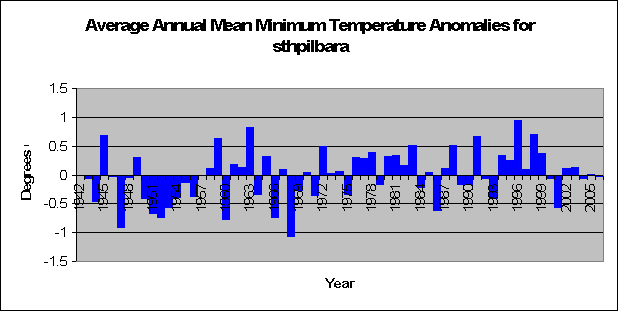
I promised you some good analysis on Southern Pilbara (central-west Western Australia) yesterday when I analysed the temperatures and I keep to my promise so here it is:

Yesterday we came up with the very unusual result that despite the fact that there was no significant increases in temperature from 9pm to 6am in southern Pilbara - and not even any recogniseable patterns - we found that the area recorded a significant increase in minimum temperature. This is very surprising. We also found that in the area temperatures were significantly higher from 9am thru to 3pm when the sun is at it's hottest.

At first look it's quite clear that the reason southern Pilbara is heating up is solely due to the sun. The sun is just getting damned hotter. So why the increase in minimum temperatures, especially when there is no difference in temperatures throughout the night?

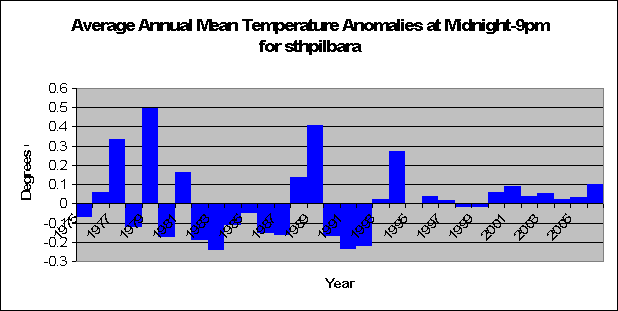
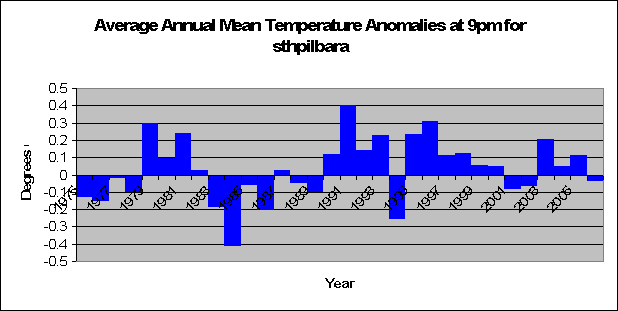
I decided to have a look at the differences in temperature anomalies for neighboring times over the years. In other words, I looked at the temperature anomalies for Midnight minus 9pm. As previously noted, 9pm doesn't have a lot of data for Southern Pilbara so it is hard to find a pattern, and the statistics suggest no difference (t = 0.24, p = 0.81). In other words, Midnight has not been heating up at a quicker rate than 9pm over the years in Southern Pilbara.

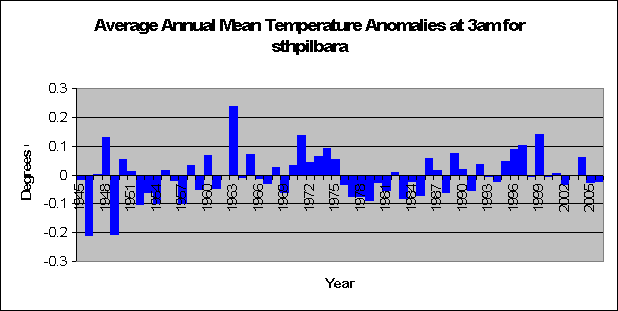
The same goes for 3am minus Midnight, only this time we have a good amount of data. There is no pattern. Temperatuers at 3am have not been heating up quicker or slower than Midnight over the years (t = 1.4, p = 0.15).

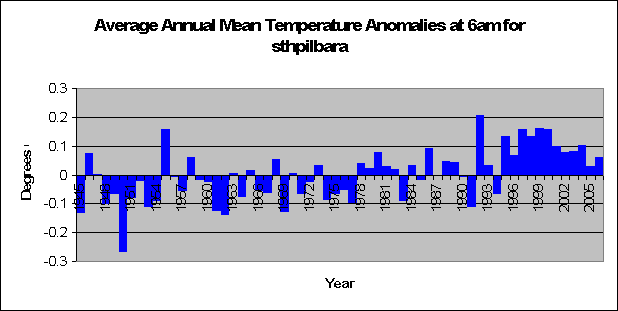
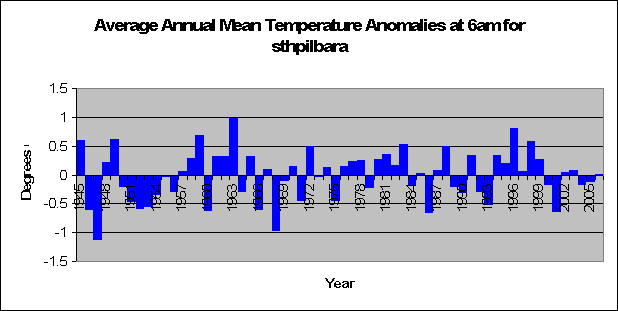
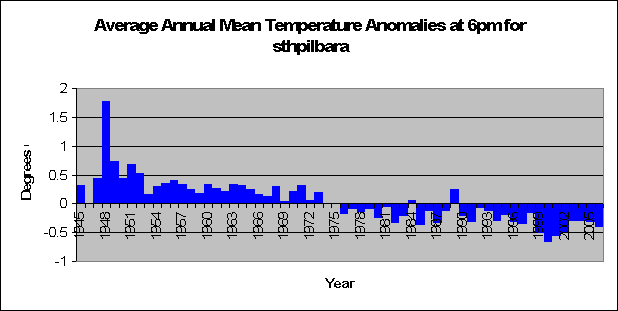
But wow, look at this. When looking at 6am minus 3am, we find that temperatures have increased at a significantly higher rate at 6am than 3am (t = 5.3, p < 0.01). Keeping in mind that we did not find a significant increase in temperature at 6am, however we have found that the temperature increase at 6am is significantly greater than 3am. This has occurred with especial magnitude in the last 10 years as shown in the graph.

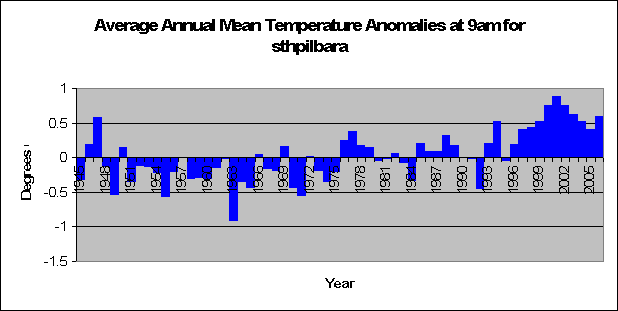
And a similar pattern occurs when looking at the 9am - 6am anomalies. A significant increase occurs (t = 6.04, p < 0.01). With temperatures increasing on average 0.5 degrees more in the past 10 years. If you look at the 6am and 9am graphs, this makes sence, as in the last 10 years 6am was about average temperature whilst 9am temperatures were about 0.5 degrees above the norm.

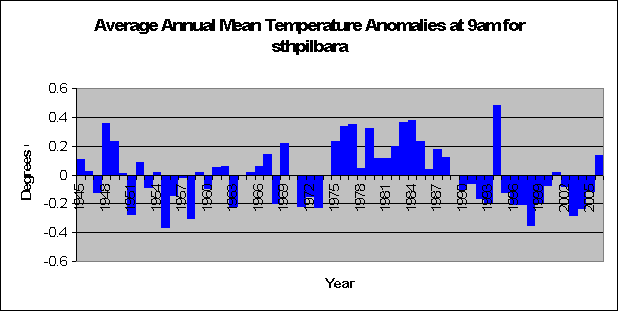
Surprisingly this is where the large boom stops. Analysis of Noon minus 9am temperatures suggest no increase or decrease in temperature (t = -0.6, p =0.55). A cyclic pattern can be seen, but this could be purely due to random variation.

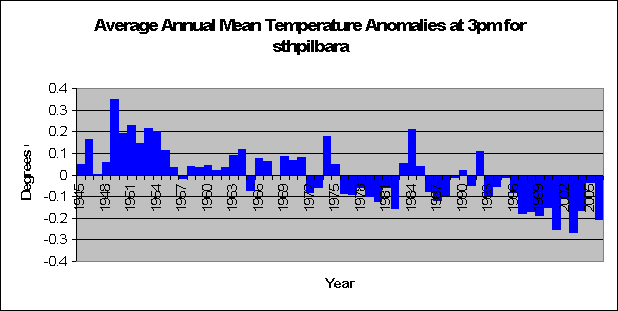
And now for the even more surprising results. 3pm minus Noon saw a significant decrease in anomaly temperatures (t = -8.1, p < 0.01). The decrease is almost perfectly linear and is clearly obvious. So despite significant increase in temperature for south Pilbara for Noon and 3pm, 3pm isn't heating up as much as it has been 3 hours before.

The obvious linear line in the graph of 6pm to 3pm is startling. So perfect is the line, that the amount of variability is very small. The decreasing trend is very significant (t = -10.8, p < 0.01).

There was no significant difference in temperatures when looking at the differences between the 9pm and 6pm anomalies, however a smaller database for temperatures at 9pm could have been a factor (t = 1.3, p = 0.18).

So what does all this mean? How is this all relevant. Well let's summarise what we have just found. The rate of increase or decrease in temperatures with respect to the time 3 years prior makes little difference at night, but when the sun is a factor the difference is significant. Temperature anomalies at 6am and 9am have increased significantly with respect to the time 3 hours previous over the years, whilst temperatures at 3pm and 6pm have decreased significantly with respect to the time 3 hours previous.

But to understand fully what this means, we have to discuss very briefly how daily temperature works. Basically we reach a maximum temperature, and from that point on the temperature generally decreases. When the sun as set, there is no general reason why temperatures will be on the rise, so they decrease until the sun makes an appearance again. In southern Pilbara the sun rises in general half way between 6am and 9am depending on the season.

We suggested before that is was relatively obvious that the sun was a major factor in determining the average maximum temperature in Southern Pilbara, as we saw no increases in temperature over night. We have also proven that the sun has made significant increases in maximum temperature rather than minimum during years when Australia is heating up. So would a stronger sun therefore also have an influence on minimum temperatures? Our analysis suggests so.

Whilst no increases in temperature were found for Southern Pilbara from between 9pm and 6am when the sun was set, at 6am, the temperature increase as compared to 3am was highly significant. The sun, whilst not risen, quite possibly was warming up neighbouring areas more than normal, and adding heat to the air above at a greater rate than normal. Thus paving the way for when it makes its grand entrance at sunrise.

Hence, whilst not making a significant temperature difference at 6am before sunrise, it made a significant increase in temperature compared to 3 hours prior at a time where normally the minimum temperature would have been reached. This extra layer of heat paved the way for massive increases in temperature at 9am after the sun had risen. Following, due to the massive increases in temperature 9am, Noon and 3pm also had increasing temperatures due to the intensity of the sun, but not quite as dramatic as that when the sun rose. Hence we have a situation where we have a significant increase in temperature at 3pm but a highly significant decrease in temperature at 3pm with relation to Noon. I guess there's only so much difference that the sun can make.

So what can we conclude about Southern Pilbara? That increases in the suns intensity has caused the area to heat up during the day, to stay at a constant temperature during the night, and most importantly, that increased intensity in the sun has not only caused increases in maximum temperatures but also increases in minimum temperatures.

Who would have thought that the sun has something to do with heat?


Australian submarine fleet still a joke

Short of salors and half-blind anyway. Australia should be buying proven designs, not trying to design its own defence equipment.

Australia's submarines are having trouble spotting the enemy because of faulty periscopes. The navy has become so concerned by the problematic periscopes that it has commissioned a series of studies to explore ways to improve or replace them. The so-called search-and-attack periscopes on the Collins-class submarines are described by the navy as being "critical" to the "mission effectiveness" of the submarine fleet.

Crammed with hi-tech sensors and stealth characteristics, they are a far cry from the simple periscopes portrayed in Hollywood war movies. They are needed to give the commander a visual sighting of an enemy and, if they break down, a submarine is partially blinded and would be a liability in battle. But after more than a decade at sea, the search-and-attack periscopes are wearing out. "The periscopes were originally specified and designed over 15 years ago," a Defence spokesman said. "Obsolescence and normal wear and tear dictate that the periscopes are assessed and their maintenance routines reviewed."

Defence sources say the periscopes in the six submarines had so many faults last year that the repair company, BAE Systems, could not keep up. Relief for the repairers has come only this year because the submarines are spending less time at sea because of an acute shortage of crew. The issue is a setback for the submarine, which has overcome serious teething problems [Like having to scrap their entire computer system after spending around $300 million on it] to become one of the country's most effective defence assets.

Sources say some of the periscope breakdowns have undermined submarine missions but none has been serious enough to force one back to shore. "Periscopes have a built-in redundancy to ensure that defects do not adversely affect operations," a Defence spokesman said. The navy has commissioned a study to examine the future of the periscopes and help the navy plan for next-generation technology. In December, the navy also commissioned a report on "periscope spares usage and maintenance effectiveness" to ensure that the problems could be properly repaired. The periscopes provide the primary sensors for the Collins combat system.

The sensor systems on the periscopes include optical and electro-magnetic sensors for all-weather, around-the-clock surveillance, situation awareness and target acquisition. "These provide the Collins with its stealth characteristics and are critical to its mission effectiveness," the navy says. Despite their current problems, the periscopes are a vast improvement on those used in the 1990s. A 1999 Defence report said the first periscopes on the Collins-class fleet vibrated badly and did not focus properly.

Meanwhile, Opposition defence spokesman Joel Fitzgibbon yesterday said revelations in The Australian yesterday about the acute shortage of submariners were an indictment on Defence Minister Brendan Nelson. "A recruitment, retention and skills crisis in the Australian Defence Force is undermining Australia's national security," Mr Fitzgibbon said. "Revelations that staffing shortfalls of 30per cent in the submarine arm are hampering submarine operations highlight minister Nelson's failure to properly manage these key defence assets." The navy has been forced to cut the number of sailing days because of the acute shortage of trained submariners."

Source

Friday, March 02, 2007

A LETTER FROM AN AUSTRALIAN FARMER

For over 18 months - in conjunction with others in 3 states and under the guidance of Constitutional lawyers, I have been researching our land ownership rights. What is becoming clear to us, is that the NSW and QLD state govts in particular, and including so-called democratic govts all around the world are in the process of removing firstly our land ownership rights and secondly our personal rights.

The threats of global warming have been an absolute boon to this long-term plan, allowing the greenies to whip up such fear in the community that the community then literally begs the govt to make laws to protect us from this threat. Hence, farmers (of whom I am one) are blamed for much of the development of warming and are being forced by laws and courts which were outlawed in Britain in the 1600's! to stand aside under duress while their land ownership rights - also supported via the Magna Carta, the 1688 Bill of Rights and onto our Constitution - are eroded and removed.

We Australians must learn our rights, speak them out and stand up for the cornerstone of our country. If you are interested in the issue of land ownership and our rights this site may inform you. http://www.websiteezy.com/Envirofarm/ We are currently preparing for 7 High Court cases asking the judiciary to clarify our rights and other relevant issues.

I do not believe in the threat that we are told global warming offers, but I do think that the changes people are making in their lives due to these GW threats are probably beneficial long term, but to force people to do so through rules and regulations is against everything every freedom fighter over the centuries stood for and against our basic Constitutional laws. Laws which were set in place by Godly men and are being removed by unGodly ones. We as average citizens cannot break the laws of our land without punishment, why then the guardians of those laws - our politicians and law makers?


Federal Leftists get on school standards bandwagon


The cartoon above refers to the fact that the new Federal Labor party policy is very similar to the policy of Australia's Federal conservatives. The main difference apears to be that the Left will not put much backbone into it

Kevin Rudd has pledged to introduce a back-to-basics national curriculum in maths, science, English and history within three years of winning office. In a move aimed at seizing the initiative on the national curriculum debate after years of discussion, the Labor leader said it should be "concise, in plain English and understandable to both parents and teachers".

And in a challenge to teachers' unions, Mr Rudd said union leaders would not be offered a place on the National Curriculum Board that a Labor government would establish to develop consistent national curriculums from kindergarten to Year 12.

The new benchmarks would include a recommended reading list of Australian literature and classics, which the Opposition confirmed last night would include Shakespeare. Younger maths students would be required to understand multiplication and fractions, and senior history students would have to demonstrate a systematic understanding of Australian history.

"Australia has been talking for years about the need for a national curriculum," Mr Rudd said yesterday. "A national curriculum will mean that a student moving between Western Australia, Queensland, NSW and Victoria will not be disadvantaged." Labor predicted the plan could be achieved in consultation with the states. It immediately won qualified support from Queensland Premier Peter Beattie, but the NSW Government remained sceptical about the value of a national curriculum, even under a federal ALP government.

Labor's plan would also include a new discussion to boost languages in schools, echoing the elevation of "language other than English" program in the Queensland Goss government during the 1990s, when Mr Rudd was director-general of the Department of Premier and Cabinet. The program, introduced in 1991, had set an ambitious target to have all Queensland students studying a second language by 2000.

A veteran of battles with the teachers' union in Queensland during his years as a public servant and more recently during the debate over the state's controversial Studies of Society and the Environment, Mr Rudd said there was no place for unions on the curriculum board. "We will not have representation from the unions," he said. "This is a professional curriculum body with representation from the states and territories and curriculum experts from the non-government sector as well."

Mr Rudd's show of determination to resist union pressure on education came as the Government sought to paint him as weak on industrial relations. A succession of government ministers demanded Labor reveal whether it would keep small business exempt from unfair dismissal laws after Labor frontbencher Craig Emerson hinted on Tuesday night that Labor would give the sector special treatment. Dr Emerson's comments at a meeting of small business people caused jitters among some Labor MPs and unionists, who are demanding Labor give all workers the same treatment, regardless of the size of their employer.

In parliament, Education Minister Julie Bishop accused Mr Rudd of plagiarising the term "education revolution" from [disgraced] former Labor leader Mark Latham. "Naughty boy! You stole that idea, didn't you?" she said, later adding: "You will have to go to the naughty corner, won't you?"

Ms Bishop said the suggestion that a national system could be achieved through co-operation with the states was "politically naive" and signalled she would introduce her own plan for a national curriculum by using the threat of funding to force action.

Labor was also on the attack over early childhood education in parliament, seizing on secret cabinet submissions revealing the Prime Minister had recommended action in 2003 but failed to deliver.

Mr Beattie yesterday backed the plan to develop a national curriculum, but only if standards were lifted. "We don't want to lose the edge that we have, but if it means lifting the national standard up to Queensland standards then we would support that," he said.

NSW Education Minister Carmel Tebbutt welcomed the more consultative approach adopted by Mr Rudd and Opposition education spokesman Stephen Smith, but said NSW would not accept a national curriculum simply for the sake of uniformity. "I remain concerned that any move to a national curriculum could result in an undermining of our standards," she said.

The chairwoman of the Australian Council of Deans of Education, Sue Willis, said progress towards a national curriculum framework was continually being derailed by short-term policy bursts that failed to provide any consistency over the long term. Victorian Education Minister John Lenders said he was confident that Mr Rudd's proposal would "lift standards rather than dumbing down standards to the lowest common denominator". "Ms Bishop's approach has been aggressive and confrontational," Mr Lenders said.

NSW Teachers Federation president Maree O'Halloran said it was essential for teachers to be involved in any national curriculum. "The people who actually develop and deliver the curriculum and understand the needs of students and teachers are the people in our classrooms currently," Ms O'Halloran said.

The announcements build on Labor's policy to invest $450 million to provide four-year-olds with 15 hours a week of high-quality early childhood education and provide $111 million to encourage students to study maths and science at university.

Source


More on police corruption in Victoria

Police union fingered

Victoria's police corruption watchdog has launched an inquiry into the force's disciplinary system after releasing a report accusing the police union of obstructing attempts to root out rotten officers for more than acentury.

The report on historic patterns of corruption within the force said the Police Association had nurtured a "them and us" culture that encouraged officers to "develop improper associations and protect corrupt officers". Office of Police Integrity director George Brouwer said the association needed to decide whether to act for the vast majority of honest officers or "throw all its weight and effort behind protecting or supporting people who have serious question marks about them".

Chief Commissioner Christine Nixon said the association's role in protecting its members' interests at times "may have hindered" attempts to fight corruption in the force.

The report sparked an angry reaction from the association, with secretary Paul Mullett describing its findings as "scaremongering", "ill-based" and "fundamentally flawed".

Announcing the inquiry, Mr Brouwer said there were a lot of weaknesses in the internal disciplinary system, including processes that could be manipulated by corrupt police to delay proceedings against them. The report outlines the association's role as a "militant group with significant political clout" in objecting to inquiries and fighting anti-corruption reforms stretching back more than 100 years. It said the use of the association's $14 million legal fighting fund had led to police accused of corruption receiving substantial financial support from the union.

Speaking after the opening session of a two-day national round table on police corruption hosted by the OPI, Mr Brouwer said the association was "one of the factors that has complicated issues" for the chief commissioner in cleaning up the force. "The association can play a very important constructive role in order to produce and support an ethical force. It can also play a negative role," he said.

Ms Nixon denied that her position as chief commissioner had been undermined by a secret pre-election deal negotiated directly between the Bracks Government and the association. While acknowledging that Queensland's Fitzgerald inquiry had recommended such negotiations should not be conducted behind the back of a police commissioner, Ms Nixon said she should not have been included in the talks. "That was a negotiation between a political party and a lobby group," she said. "I don't think my position has been undermined. I'm the police commissioner and I have a contract until 2009. I haven't had an undermined position."

Ms Nixon said she hoped the inquiry would lead to changes that made the disciplinary system more effective and overcame delays in dealing with officers who were guilty of corruption or misconduct.

Senior Sergeant Mullett denied that the association had hindered attempts to clean up Victoria Police, saying it was "totally opposed to corruption" and had only been defending the rights of its members. He accused Mr Brouwer and Ms Nixon of "working hand-in-glove" to undermine public confidence in rank-and-file police by attacks on the association. He said that not giving the association a chance to respond to matters raised in the report before it was tabled in parliament yesterday had been a denial of natural justice.

Source


Environmentalism: More facts, less evangelism needed

Comment by columnist Janet Albrechtsen

The timing is perfect. Al Gore wins an Oscar for An Inconvenient Truth. If Rolling Stone is right, Gore will soon be running for president with his “save the world” message. Then, next month, Nicholas Stern, author of the Stern Review on the Economics of Climate Change, will be in Australia preaching the same message. His visit will be the 21st-century version of a Billy Graham crusade, complete with demands that we come to Jesus. Sinners - those sceptics of the Stern gospel on global warming - will be urged to repent. Many of them, overcome by emotion and group hysteria, will do so. And if the eco-evangelists could arrange it, there would be television cameras to capture images of new believers swooning into their saviour’s arms.

Even for those of us who realise the human psyche is drawn to emotional claims of doom and gloom, it’s easy to fall for the hype. Catch a few glimpses of the Christmas bush fires, the drought, Gore looking like an ageing Superman impersonator predicting cities being swamped and headlines that Bondi beach is under threat. Add more headlines about the ostensible consensus among experts that humans are causing catastrophic global warming. Employees soon start to question the big companies they work for because, these days, big is synonymous with bad. The big bosses start embracing global warming so they look lean and clean in a competitive marketplace for goods, services and employees. People start calling on governments to do something. Governments then get drawn into the whirlwind of global warming, overreacting on the basis of emotion, not fact.

Before Stern arrives, it’s time to visit the other camps on climate change. Those who are sceptical of the degree and dangers of warming predicted by Stern and co. Those who point out there are benefits to global warming. And those who warn against regulatory overreach. Relegated to economic and scientific journals, the serious rebuttals of Stern rarely get a mention.

Instead, the sceptics of the global warming orthodoxy are the deniers. But when The Boston Globe columnist Ellen Goodman recently wrote: “Let’s just say that global-warming deniers are now on a par with Holocaust deniers”, it unveiled the emotion and zealotry driving this debate. In fact, it’s not a debate at all. If it were, we might see a headline along the lines of “Experts sink Stern” because that is precisely what a group of eminent scientists and economists did late last year.

The Stern Review: A Dual Critique in the December edition of World Economics debunked Stern’s claim that “much of the debate over the attribution of climate change has now been settled”. It warned that Stern’s exaggerated predictions depend on a selective and biased treatment of scientific sources and evidence. Stern’s review is classic come-to-Jesus stuff for those searching for a utopian, post-carbon world. No cost-benefit analysis of global warming. No careful prodding of uncertain studies. Just end-of-the-world scenarios. And the saviour is Stern’s prescription of hiked-up carbon taxes.

Stern points to emissions driving global temperatures to dangerous levels. The critique of Stern points out that the rate of warming during the late 20th century was similar to an earlier natural warming period between 1905 and 1940, a period preceding industrial-driven greenhouse gas emissions. In fact, the recent warming, according to these scientists, was of less magnitude than earlier millennial warmings during the medieval, Roman and Minoan warm periods. And a rapid rise in CO2 emissions for the two decades after 1940 was accompanied by a fall in temperature. That’s right: cooler temperatures.

In fact, scientists such as Nigel Calder, former editor of New Scientist, and Bob Carter from James Cook University point to the real possibility of global cooling should the sun revert to the lazier position associated with the Little Ice Age. The Russian Academy of Science has issued similar warnings.

Stern predicts a global population of 15 billion by 2100. More people means more suffering. Yet, according to the International Institute for Applied Systems Analysis, there is only a 2.5 per cent probability that world population will exceed 14.4billion by 2100.

Fewer people means less suffering, but that doesn’t suit Stern’s exaggerated claims. Stern’s executive summary points to anywhere from 15 per cent to 50 per cent of species facing risks of extinction if temperatures rise by even 2C. The critique points out that higher CO2 emissions will boost plant growth, promoting biodiversity that may assist ecosystems, something Stern ignores. The scientists conclude that Stern’s assessment, based on studies that are “fraught with uncertainties”, presents a “worse-than-worst scenario, based on a naive and one-sided appeal to literature”.

Stern’s most glaring omission is the human ability to adapt to changes. Apparently climates change but humans do not. Stern’s black predictions of declining agricultural yields and global hunger - “250 million to 550 million additional people may be at risk” - are based on studies that ignore human ingenuity: people developing new technologies, planting new crops, choosing different animal breeds and so on. As the critique points out, estimating “the impacts of climate change decades from now is tantamount to estimating today’s level of hunger (and agricultural production) based on technology of 50 years ago”.

Technology has transformed the world because people adapt. Ignoring such a basic feature of human history and progress tells you much about the lack of rigour behind the evangelists who preach the global warming message.

But wait, there’s more. The critique reveals that Stern relies on information from groups that have an “explicit policy of refusing to allow external examination” of their data. They point to the Climatic Research Unit, whose data feeds into global temperature predictions used by Stern. Phil Jones from the CRU has said: “Why should I make the data available to you when your aim is to try and find something wrong with it?”

The so-called consensus on global warming is a manufactured one built by those whose careers depend on acceptance of climate change fundamentalism. And the peer-review process means drawing peers from the same global warming orthodoxy milieu as the authors. But brace yourself for more preaching. Stern’s visit will be followed by Earth Hour, supported by the City of Sydney, the NSW Government and an array of businesses, when Sydneysiders will be asked to turn off their lights for one hour. Then a surge of electricity will be needed when the Save Our Selves from climate change 24-hour concert hits Sydney later this year. When we get more facts and less gimmicks, there will be a real debate on global warming. Until then, governments should tread carefully.

Source

Thursday, March 01, 2007

Anti-white bias in the South Australian Fire service

Surely the only criterion for selection as a fireman should be how good the person is likely to be in putting out fires. Lives could be lost by having incompetents on the fire trucks

A special Metropolitan Fire Service training course to help people pass tough entry tests has been restricted to women, Aborigines and ethnic minority groups, causing tension within MFS ranks, the firefighters union says. The "pre-application" pilot program run by the MFS has been criticised by firefighters, who say it is unfair to the hundreds of male Anglo-Saxon applicants who miss out every year.

The MFS is accepting applications for full-time firefighters in the metropolitan area and Port Pirie as part of its latest recruit course, expected to start by June. Recruitment data, obtained by The Advertiser under Freedom of Information laws, reveals the MFS is still failing to attract more applicants from diverse backgrounds. The FoI data shows there were 34 women invited to undertake the most recent recruiting process last year, nine people born overseas and 81 whose parents were of non-English background. This compares with 497 Anglo-Saxon male applicants invited to try out. The course success rate is just 8 per cent.

United Firefighters Union of SA president Bill Jamieson said there was a "great deal of angst" within MFS ranks about the special policy. "On the balance of fairness, we can't support this special program," he said. "The same opportunities are not given to other recruits, and in this case it is the employer helping them to pass."

MFS Chief Officer Grant Lupton said the course was designed to "level the playing field" in order to meet State Government targets of increasing the participation of women and Aboriginal people in the public sector. He said there were just four female full-time firefighters in a force of about 800. "All government agencies have a responsibility to reflect the community they serve," he said. "We serve a diverse community in South Australia yet our workforce doesn't reflect that at all. When I've got fire trucks rolling up to a job it would be great to have a woman, an indigenous person or an Asian there, rather than just all white men."

Emergency Services Minister Carmel Zollo yesterday said the State Government was "an equal opportunity employer . . . it is important that everyone has the opportunity to apply for jobs". Opposition emergency services spokesman Mark Goldsworthy said the MFS policy had merit.

Source


School authorities say: 'Be happy your son is bullied'

A mother who sought Education Department help amid repeated assaults on her six-year-old son by a classmate was twice told "bullying builds character", a court has heard. Angela Cox yesterday said she was stunned by the comment which came after her son Ben was choked by a nine-year-old boy at Woodberry Public School, near Maitland, on the Central Coast. "I was really annoyed the school hadn't done anything," she said. "(Department officer) Ian Wilson told me bullying builds character and it was a good thing."

Mrs Cox and her son Ben are suing the state, claiming the department was liable for the treatment of her son in 1995 and 1996, which left him depressed, anxious and reluctant to leave the house. "I couldn't believe something like this could happen," she told the Supreme Court yesterday. "(After the violence) he wasn't the same boy he used to be."

Ben, now 18, spends his days watching TV or playing computer games. He has only completed schooling to Year 7. Attempts to have his education continued at other schools and by correspondence failed. Mrs Cox said, with the school doing little more than occasionally putting the nine-year-old on detention, she removed him from class. "I went to the principal, said, 'I'm taking Ben out of school' because they couldn't provide a safe place for (him)," she said. "(The principal) said, 'Sorry, but you keep some, you lose some'."

Needing departmental permission to move him to a school outside the immediate area, she spoke to Mr Wilson again. "He said he couldn't provide total safety for my son and bullying could happen (anywhere). He told me bullying builds character."

When Mrs Cox was asked what the alleged bullying had done to her son's mental health, she replied tearfully: "In his mind he always thinks he's that little boy, ready to be hurt again." Mrs Cox's own psychiatric history was raised in court yesterday and she admitted spending time in hospital due to chronic depression. She denied she had kept her son or her daughters Hannah and Rebekah home from school because she needed companionship when she was too ill to leave home.

Ben had played rugby league in his mid-teens but there were still problems like his fear of the change rooms, she said. Counsel for the state Robert Sheldon asked her if her son had ever been any good at school. "I don't think we ever got the chance to see," she said. Mrs Cox also denied she made any attempt to stop her son from going to school because she was "worried about losing him" as he headed into high school.

Source


Australia getting it right about immigrant integration

Comment from American writer Herb London. There is another article here (or here) by Prof. London on the moral and intellectual vacuity of the student Left

In 1966 Australia's trade with Japan exceeded its trade with the United States and with Britain. At that time, it became increasingly difficult for Australia to maintain the exclusionary White Australia policy. That didn't stop Australian officials from trying. The Japanese at first were considered "Caucasian" under immigration provisions. But that stance was obviously unsustainable. Gradually and incrementally, the policy was revised to treat Asians as equals with Europeans.

But the liberalised immigration policy did not address the domestic condition of new immigrants. Was it desirable to have them integrated into Australian life? If so, how was this to be achieved? Or did it make more sense to have the immigrants relate to the larger culture through a form of modest separation - what can be described as cultural pluralism?

For decades, Australia countenanced the latter position, celebrating the cultural diversity of its immigrant population. It is now clear, however, that this celebration has turned into questioning and criticism. In some cases, physical separation has led to divisions in matters of national loyalty and adherence to national laws. As a result, the Government is moving from British-style multiculturalism to a policy of integration.

Although it might seem trivial, Australia has changed the name of its Department of Immigration and Multicultural Affairs to the Department of Immigration and Citizenship. This is one manifestation of an intense debate about what it means to be Australian, as rising nationalism is fuelled by worries that the nation is being torn apart by competing immigrant value systems.

Several incidents in which local Islamic groups have pledged loyalty to sharia (Islamic law) instead of the Australian constitution might be the catalyst for this national debate. The Prime Minister, John Howard, has often voiced his displeasure with multiculturalism, but he is acting to tighten requirements for attaining citizenship, including extending the waiting period and promoting a written test for new citizens.

Malcolm Turnbull, erstwhile parliamentary secretary and now the Minister for the Environment, gave voice to this policy shift by noting, "There was a time in the 1990s when I feared that multiculturalism was heading to a stage where the concept of Australia would cease to exist. So concerned were we about our ethnic or cultural backgrounds, we would forget what we were today, and Australia would be seen less as a nation than as just a place where people lived but did not call home."

The newly assertive voices on this matter are saying Australia is a liberal, democratic, English-speaking society, and it is up to new arrivals to adjust to this reality. About 25 per cent of Australians were born outside the country, more than in any other nation except Israel. The debate is addressing how far Australia should modify its identity in order to accommodate new arrivals.

In December 2005 a mob of white Australian youths, incensed by what they considered the harassment of women by Lebanese youths on a Sydney beach, went on a rampage, beating anyone with a Middle Eastern appearance. This riot left a scar on the nation that is still visible.

Muslims contend the policy shift is a form of discrimination that suggests that if you aren't white, you are "less equal". But Howard has addressed this concern: "You can't have a nation with a federation of cultures. You can have a nation where a whole variety of cultures constantly influence and mould and change and blend in with the mainstream. The core culture of this nation is very clear; we are an offshoot of Western civilisation."

Howard knows what he believes and believes what he knows. Moreover, he is unafraid to speak his mind, as he showed recently in condemning the US senator Barack Obama's misguided call for a timeline to withdraw troops from Iraq.

In a Western environment where the force of political correctness prevails, it is difficult to assert the superiority of Australian culture. To do so invites opprobrium from the multiculturalists. But no amount of criticism can change reality. Howard and Australia deserve congratulations for doing what is appropriate and right. If only we had a John Howard in the US.

Source


Greenhouse sceptics to congregate

Hard-core global warming sceptics will descend on Canberra today for the release of a book claiming environmentalism is the new religion. Former mining executive Arvi Parbo will launch Ray Evans' new publication, Nine Facts About Climate Change, at a function at Parliament House. The book claims climate change is nothing new and declares Howard Government investments in solar power and in cleaning up coal a "complete waste of taxpayers' money".

"Environmentalism has largely superseded Christianity as the religion of the upper classes in Europe and to a lesser extent in the United States," Mr Evans says in the publication. "It is a form of religious belief which fosters a sense of moral superiority in the believer, but which places no importance on telling the truth," he says. "The global warming scam has been, arguably, the most extraordinary example of scientific fraud in the postwar period."

The function is organised by the Lavoisier Group, founded in 2000 by Ray Evans and former mining executive Hugh Morgan to test claims that global warming is the result of human activity. Mr Evans is a longstanding friend and colleague of Mr Morgan and a committed activist on issues such as workplace reform through the HR Nicholls Society, which he founded with federal Treasurer Peter Costello.

Former Labor minister Peter Walsh also will attend today's function, and the group will hold a dinner to be addressed by climate-change sceptic Chris de Freitas, Associate Professor in the School of Geography, Geology and Environmental Science at Auckland University. Liberal MP Dennis Jensen has organised the function on behalf of the Lavoisier Group and expects about 50 people to attend the dinner. Dr Jensen, a nuclear physicist, has said he is not convinced that human activity is responsible for global warming.

In an interview with The Age last month, Mr Evans acknowledged that last September's visit by former US vice-president Al Gore to promote his Oscar-winning global-warming documentary An Inconvenient Truth had helped generate a lot of publicity on climate change. But he described Mr Gore's film as "bullshit from beginning to end". [Some good Australian bluntness] "The science from the anthropology point of view has collapsed. The carbon-dioxide link is increasingly recognised as irrelevant," Mr Evans said. "But the Government's frightened. "Cabinet, from what I understand, is by and large still sceptical of climate change, but it is scared of the drought and worried about how Labor will make use of it."

Source