 Australian Politics
Wednesday, January 04, 2023
Price caps: It’s the seductive solution that almost always goes badly
It's brainless in fact. It rapidly WORSENS the cost problem by restricting supply
It clearly came as something of a surprise to Anthony Albanese that one coal-fired power plant in Queensland could receive close to $450m in compensation for the coal price cap. And that’s just for starters. At this rate, taxpayers could end up paying as much to power plants as the financial compensation to low-income households hit by higher electricity prices.
Mind you, economists won’t be surprised because schemes designed to cap prices have a habit of going badly, with all sorts of unexpected and unintended consequences. If that’s not bad enough, the exit arrangements for these schemes are extremely tricky to construct and navigate.
By rights, Treasury strongly should have advised the government against imposing price caps based on the clear theoretical and empirical knowledge that this type of intervention is ultimately ineffective at meeting the policy objective of reducing prices while carrying high costs.
Of course, price caps are a seemingly seductive solution to rising prices. There are plenty of examples where governments have been tempted.
In August 1971, US president Richard Nixon ordered a 90-day freeze on all prices and wages. Initially the move was popular politically, with The New York Times declaring “we unhesitatingly applaud the boldness with which the president has moved”.
In combination with marked volatility in the value of the US dollar – Nixon had abandoned the gold standard at the same time – the freeze resulted in the onset of stagflation (inflation and rising unemployment).
Having said this, price caps never go totally out of fashion, with the city of St Paul, Minnesota recently deciding to impose rent controls to improve housing affordability. Rent increases were capped at 3 per cent a year. (The Greens are in favour of this policy here.) The effect on supply was immediate, with building applications for rental developments falling by more than 85 per cent in a year. Unsurprisingly, building activity soared in the twin city of Minneapolis with no rent controls. As The Wall Street Journal summed it up, “rent control is destructive because it reduces the supply of housing, especially for low-income households”.
Let us return to the policy dilemma faced by the federal government in relation to the sharp rises in the price of electricity and gas forecast in the October budget. Initially this news wasn’t accompanied by much concern, let alone policy relief. But as it dawned on the government leadership team that soaring energy costs would be politically unpopular as well as economically damaging, a view emerged that “something had to be done”.
In addition to encouraging more supply, the most straightforward way to deal with the problem was to provide targeted support for low-income households and affected businesses. To be sure, there is some automatic assistance for these households given the indexation of welfare payments. Moreover, several state governments have implemented schemes to provide electricity price relief for consumers.
The problems faced by Jim Chalmers were twofold: first, where was the money coming from to pay the compensation; and, second, compensation could be potentially inflationary in the context of a close-to-full capacity economy.
My assessment is that these problems were not insurmountable because, by the time the compensation was being rolled out, economic conditions would likely have weakened. Sure, fiscal affordability may have been an issue, but the government’s final policy position will involve substantial additional spending in any case.
With only a weak understanding of how the east coast electricity market operates – and bear in mind that it is complicated and varies from state to state – the federal government took the unexpected decision to impose a short-term price cap on gas of $12 a gigajoule, after which a “reasonable pricing provision” would apply, as well as a price cap on thermal coal of $125 per tonne.
Why a coal price cap was determined as necessary is anyone’s guess. While coal continues to supply most of the electricity on the east coast, it is rarely the price setter. It’s also unclear how many plants were paying more than the cap, with many plants having their own coalmines and with that coal not available for export.
What seems to have driven the policy is the small number of contracts signed by coal plants that referenced international coal prices and the owners of these plants being keen to break these contracts. Given the imprimatur of government legislation and compensation paid to the providers of coal making up the difference between the price cap and the international price, a deal was sealed. There is little doubt that this aspect of the policy will turn out to be very bad deal indeed.
The only rational explanation for a coal price cap was the avoidance of a marked shift to the use of gas to generate electricity. The worry may have been that a gas price cap without a coal price cap would have disproportionately swung the economics to gas production. This could prove problematic in the context of the relative shortage of gas on the east coast plus constraints on its movement.
Of course, this illustrates what a dense thicket is quickly created once a decision is taken to impose price caps. And there are just so many complications that the bureaucrats in Canberra have no knowledge of, including different types of coal, different contractual arrangements of the various plants, transport considerations – the list goes on.
When it comes to the gas price cap, most of the producers could probably have lived with the $12 figure for 12 months or slightly longer. Mind you, there is no compensation for these producers along the lines given to the coalmines. The real kicker in the legislation is the reasonable pricing provisions, which inevitably will have a chilling effect on supply. Indeed, we are already seeing the cancellation of some projects.
Moreover, the wholesale gas market has effectively collapsed as industrial gas users refuse to enter into contracts with the gas producers on the basis that a better deal is around the corner given the government’s intervention.
Without understanding the real reasons behind surging electricity and gas prices – the war in the Ukraine is only part of the story, with the turmoil in global energy markets apparent before then – the government has stumbled into a complicated, expensive and likely ineffective policy approach.
But given the inflammatory language used by federal Industry and Science Minister Ed Husic to demonise the gas industry, it’s hard to see a negotiated solution that could moderate prices while guaranteeing future supply options.
*****************************************************
Immunity from previous infection protects from new Covid strain
Only one in five people who reported an infection in December were known to have had COVID-19 previously, according to the ACT government.
While data is unavailable for most of the country, the numbers from the ACT suggest that past exposure to the disease provides some protection against the prevailing strains.
This contrasts with widely publicised fears that newer COVID-19 subvariants are highly effective at evading the body's immune defences.
The ACT is one of few jurisdictions that reports its reinfection rate, though its outbreaks largely mirrored those in New South Wales and Victoria last year.
About 46 per cent of Australians had already had COVID-19 by June last year, according to an analysis of antibodies in blood samples.
That proportion is almost certainly far higher today. This, combined with the ACT data, suggests a previous infection is strongly associated with avoiding infection during this latest surge.
Infectious diseases specialist Sanjaya Senanayake, an associate professor at the Australian National University, said the ACT data reflected what was happening overseas.
Singapore, for example, was also reporting that about 20 per cent of known new cases were reinfections.
Dr Senanayake said this relatively small number of reinfections showed that immunity — whether from vaccines or past exposure — was working for most people.
"It's hard to differentiate, in a place like Australia, between purely vaccine-induced immunity and infection-induced immunity, because many of us have both been COVID-19-infected and have had [several] vaccines," he said.
"This is hybrid immunity we're seeing.
"And what it tells us is that, even though in laboratory settings … these new subvariants have the potential to evade the immune system, this hybrid immunity is providing good protection."
***************************************************
Darwin CBD retailer Paul Arnold installs panic room in his store as others report being punched, grabbed by drunken itinerants
"Itinerant" is NT code for "Aboriginal"
Darwin's retailers are warning violent behaviour has increased to the point where their staff are no longer safe and it is driving customers away from the city centre.
In Darwin's central Smith Street shopping mall, food retailers and other business owners have claimed they are losing money hand over fist because drunk itinerants regularly brawl and aggressively demand money from their customers.
"People are scared, they are demanding food and money from my customers, which is very much [affecting] the business, and we don't know where to get help with this problem," one of the mall's food shop owners said.
Ashvin Gill — who manages another business in the mall — said she regularly has to lock her front door after violent, drunk itinerants try to force their way in.
"As the front face of this business, apart from doing my job, I also have to be aware and alert at all times of my own safety as well as my clients, so it can be pretty overwhelming and exhausting" she said.
Ms Gill said when her business had been attacked or she felt under threat, the police have come to assist, but sometimes it took a long time for them to arrive.
"Almost daily, I see police officers but, at the same time, it takes time to call these people. So, it's not an immediate effect of protection," she said.
Retailers report being grabbed, punched
A worker from another shop said she was attacked recently while walking to her car in a car park off the mall after work. "I was actually grabbed. He was drunk, and I just said: 'Let me go! let me go!'
She said she didn't tell police about the attack because being confronted by drunk itinerants on the street and in the shop has become such a regular occurrence.
Nigel manages another store in the mall.
"Two Friday nights ago, I got punched in the mouth because I didn't want someone sitting in my doorway and he objected," he said.
"Two weeks before that I had a drunk guy come in and completely trash the shop. "I've had rocks thrown at my window, rocks thrown at me."
Nigel said the violence was severely damaging the business. "It's scaring the living daylight out of the tourists, they come in and hide in my shop," he said.
Nigel said he felt the problem had escalated well beyond anti-social behaviour to a serious crime situation.
"As retailers, we've seen what's happened in Tennant Creek and Katherine. We've just lost Alice Springs, I fear that's where we're heading if we don't get this under control."
Photographer and Darwin city councillor Paul Arnold has a gallery in the mall. "This is the worst Christmas I've had in the CBD and I've got 15 years I've been in the CBD, people are voting with their feet and not coming into the city," he explained. "The cost to small business is getting out of control."
He said he had installed a lockable panic room in the back of his gallery for staff. "If the shop gets trashed, the shop gets trashed, and they can watch on CCTV and call police."
Calls for more police resources in the CBD
Mr Arnold said that, despite many meetings between retailers, government staff and police, the problem was getting worse.
"We've had public meetings and we hear there is short staffing," he said. "But the answer is that the police need to be keeping our retailers and business owners in the CBD, and patrons, they need to be keeping them safe, and I'm sorry, they're not."
For a few years, the Northern Territory government and Darwin City Council have been paying a private security almost $1 million a year to employ a few staff to patrol the CBD in golf buggies.
Nigel said the security guards were limited in what they could do, as they could not touch nor arrest people.
********************************************************
Problems in the Queensland government
This will come to be remembered as the year the Queensland Labor Party blew it. It was the year the Palaszczuk government poisoned the political ecosystem and caused pain to innocent bystanders.
When the Premier wasn’t gallivanting on the red carpet, she was frantically covering up one scandal after another.
The year ended on a tragic note with the alleged stabbing murder of Emma Lovell by teenage home invaders, one of whom was out on bail. Palaszczuk was forced to defend her government’s softening of juvenile justice laws.
Labor was especially shamed by failures in Queensland Health.
An enduring memory for me will be a story in the Gold Coast Bulletin about an 89-year-old great-grandmother who waited 7½ hours for an ambulance after falling in her kitchen and breaking her hip and leg.
Shirley Prestipino had to lie on the floor like a wounded animal, her daughter Tina Barber told the paper.
Inept Health Minister Yvette D’Ath was caviller and unconvincing in pretending long waits for emergency care was the new normal.
In a “bombshell” parliamentary hearing, the Opposition successfully pressed bureaucrats into admitting that Queenslanders were waiting up to 15 hours in overcrowded emergency departments.
The LNP also calculated that Queensland’s ambulance crisis was the worst in the country, with more than one in three ambulances routinely ramped outside hospitals.
Ministerial documents D’Ath kept hidden showed ramping was getting worse despite record federal hospital funding. A Right to Information search by the LNP revealed patients were waiting longer in the back of ambulances stuck outside hospitals, despite there being thousands fewer call-outs than the previous year.
D’Ath’s veracity was also under question. The RTI showed the Labor government did not once meet its Code 1A response time target in a three-month period, despite the Health Minister saying these targets were being met. Between June and September, paramedics and patients were ramped for close to 40,000 hours. The worst hospitals for ramping were Logan, Ipswich, PA and QEII.
A patient suffering severe abdominal pain and vomiting died after waiting 9hr 19min for an ambulance. An aged care resident who fell died after an ambulance took more than three hours to arrive, while a woman threatening self-harm took her own life after an ambulance delay of more than two hours.
The year ends with Queensland’s forensic laboratory in a terrible mess. Botched DNA testing saw murderers and rapists go free. An inquiry by Walter Sofronoff KC found the Queensland Health lab was run by a prolific liar who mishandled evidence and compromised thousands of cases.
The failures in the DNA tests have serious ramifications for the criminal justice system. Sofronoff, a retired Supreme Court judge, was “astounded” by what was uncovered and said the failings were “as big as it gets”.
He found several scientists employed at the lab had been clamouring for years about a dangerous lack of scientific integrity. As usual when bad news comes to the surface, the government was slow to act.
A low point in Labor’s political year came with revelations in parliament of interference in the independent watchdog groups. Ousted state archivist Mike Summerell said the government was “toxic”, with parliament misled and reports falsified to hide “bad news”.
Former integrity commissioner Nikola Stepanov had her staff slashed to one person with no legal training while she investigated alleged illegal lobbying. Her computer system was so old it lacked the capacity to update files relating to lobbying. Stepanov’s laptop was seized and the contents “deleted without my knowledge or consent”. In other evidence, she told the House she was referred to as “bitch on a witch hunt”.
Former legal services commissioner Bob Brittan called for a far-reaching inquiry, saying he was bewildered that ethical issues he raised were ignored. Auditor-General Brendan Worrall advocated law changes to bolster his independence amid concerns the state government holds too much power over his office.
There is much unfinished business. Parliament heard Logan city councillors had been involved in a “travesty of justice”. The councillors were forced out of office and unable to run again after charges were made against them that were later found to be unsubstantiated. They are suing. Also charged and thereby ineligible for re-election was Moreton Bay mayor Allan Sutherland. Charges against him were dropped.
Jonathan Horton (then) QC told the parliamentary inquiry that CCC chairman Alan MacSporran had not ensured the CCC acted impartially, independently, and fairly at all times in the Logan case. MacSporran’s appointment was terminated.
We also learned this year that Annastacia Palaszczuk has a tin ear, embarking on a jolly social life at taxpayer expense while middle-aged mortgage men and women were at home tightening the belt.
At the hands of her government, few were spared extra taxes and charges. Learner drivers are forced to pay $186.55 for their licence – seven times more than southern states.
And now resource companies are abandoning Queensland as a direct result of a controversial new royalties scheme introduced by Treasurer Cameron Dick. With Dick at the helm, service has never been worse while debt has never been higher.
Meanwhile, some are still not willing to forgive Palaszczuk for milking Covid-19 for political gain, extending lockdowns at great harm to families and small business.
Peter Beattie was chastised for saying so, but he was right when he said Palaszczuk should be grooming a successor. While she is happy to take the spotlight for good news announcements, she quickly retreats to the shadows when bad news arrives.
I’m convinced she will not survive another year.
************************************
Also see my other blogs. Main ones below:
http://dissectleft.blogspot.com (DISSECTING LEFTISM -- daily)
http://antigreen.blogspot.com (GREENIE WATCH)
http://pcwatch.blogspot.com (POLITICAL CORRECTNESS WATCH)
http://edwatch.blogspot.com (EDUCATION WATCH)
http://snorphty.blogspot.com/ (TONGUE-TIED)
http://jonjayray.com/blogall.html More blogs
***************************************

Tuesday, January 03, 2023
China border farce proves Covid alarmists have Anthony Albanese’s ear
Anthony Albanese has always been keen to remind us that he is a strong believer in science.
The only problem for the prime minister is that science doesn’t vote. Teals, Twitter hysterics, and doctors’ lobbies all do.
Hence the government’s bizarre decision to go over the top of its own high priest of science, Chief Medical Officer Paul Kelly, to impose what pretty much everyone agrees is a window dressing requirement for negative Covid tests for travellers from China.
Here it’s worth considering our two nations’ respective Covid caseloads.
To put it simply, while China and Australia may be very different countries, one thing we have in common is an absolute ton of Covid.
Australia, the incredibly helpful Worldometers website tells us, has something like the 16th highest number of new cases in the world – an amazing accomplishment for a nation that for a time was second only to China in its love of locking people up for their own good.
And we know that number is likely far higher because even pernickety rule-following Australians have for the most part stopped telling anyone connected with officialdom if they test positive, with growing numbers of people just acting normally and staying home if they feel a bit crook.
China, meanwhile, has basically stopped reporting its Covid cases altogether both because no one has ever trusted their figures and anyway if they did publish them the number of 0’s would run off the edge of the page.
Yet the country which terrified the world with what were in retrospect hilariously slapstick viral (ahem) videos of Covid sufferers collapsing in the streets is now seeing something like a million people infected every day.
The biggest problem with this, we are told, is not that their hospital system is overwhelmed – though it is probably not fun to be an ER doc at Shanghai General – but that so many people are calling in sick that the world is going to face delays getting parts and materials and electronic gewgaws out of mainland factories.
Oh, the humanity.
Of course, we are told that there are good scientific reasons behind the Albanese government’s flicking the switch to, if not full blown alarmism, then “an abundance of caution”.
We were also told that there was good scientific reasoning behind cops harassing and fining people for sitting in a park reading a book or going for a swim in the ocean.
The reasoning was so sound that in November a court finally vacated over 33,000 Covid related fines issued by NSW Police which, in far too many cases, seemed to relish its job “keeping us safe” a little too much.
And people wonder why there is a declining trust in “experts”.
*************************************************************
Treasurer Jim Chalmers on economic issues ahead
Treasurer Jim Chalmers has revealed his grim outlook for the Australian economy in 2023, with one “big issue” predicted to spell trouble for hip pockets.
Speaking to radio station 2GB on Tuesday, Dr Chalmers pointed at one in particular of five major concerns facing the national economy as the factor most likely to hurt Aussie bank balances.
“I think one of the big issues here is that a fifth of mortgages will become variable rate mortgages in 2023,” he said.
Many Aussies who entered into fixed-rate mortgages at the height of soaring house prices are going to see their contracts switch over to a variable rate in 2023.
Dr Chalmers reiterated that interest rate rises take some time to be felt in the economy and predicted Australians would be hit hardest in the “middle of the year”.
“That’s when the interest rate hikes are expected to hit the hardest,” Dr Chalmers said.
Interest rates are just one of five crucial issues the Treasurer forecasts will cause problems for Aussies this year.
“An extraordinarily large wave of Covid in China, the war in Ukraine, the situation in the US and UK, interest rates and the threat of natural disasters,” Dr Chalmers said.
He indicated the growing wave of Covid-19 cases in China will bring a “substantial” amount of risk to the supply chain. “We need to make our supply chain more resilient to these major global hits,” Dr Chalmers said. “There’s a process; we can’t just do that in one hit.”
Boosting manufacturing on home soil and “value-adding” to hard-hit areas of the global supply chain are medium-term strategies the federal government is considering.
*************************************************
Australia’s migration rate has made a stunning turnaround and is on track to return to pre-pandemic levels
The rapid increase is being turbocharged by the return of international students, many of them Chinese, since the lifting of Covid travel restrictions in December 2021, it reveals.
The federal government’s 2022 Population Statement, to be released on Friday, notes net overseas migration is “forecast to reach the pre-pandemic trend of 235,000 (people) from 2022-23 and remain at that level thereafter”.
“Had the pandemic not occurred, cumulative net overseas migration was expected to be 473,000 persons higher across 2019-20 to 2025-26,” an excerpt from the report states.
The statement notes that while the rebound in migration numbers is being led by international students, working holiday visa holders and permanent migrant arrivals have also jumped since Covid restrictions were eased.
“In mid-October (last year) there were 36,000 (or 90 per cent) more Chinese students in Australia than in mid-December 2021,” the report states. “The number of all international students in Australia increased by 122,000 in the same time period.
“Offshore student grants from January to September 2022 were higher than the corresponding period in any previous calendar year,” it reveals. “(And) offshore grants of working holiday visas and other temporary visas have also surpassed 2019 levels.”
But in a warning against over-optimism, Jim Chalmers said the strong rebound in migration numbers was not enough in itself to grow the nation’s economy.
“Migration is an important part of the story but should never be a substitute for training more Australians or making it easier for parents and seniors to work more if they want to,” the federal Treasurer said.
“Migration has played a crucial role in our economic development and will be critical in the future too if it’s well-considered and well-managed.
“This matters at multiple levels – the global scramble for talent, the filling of genuine skills shortages, and making sure migrant workers aren’t exploited,” the Treasurer said.
“Australia’s migration settings need to be sustainable, serve Australia’s national interest, and not be a substitute for … building the capacity of our domestic workforce.”
The federal government boosted the permanent migration program from 160,000 to 195,000 for 2022-23 in September, saying it would help to address skills gaps in areas such as nursing and technology.
The policy change “further strengthened” the outlook for permanent arrivals, the number of whom are forecast to continue rising after hitting a low in March 2021, the report states.
Dr Chalmers said the government was currently undertaking both a review of the migration system and developing an employment White Paper to ensure the nation has a bigger and better-trained workforce in 2023 and beyond.
“Migration policy is economic policy,” he said.
A common hope for many international students who come to Australia to study is to stay and work after they finish their university courses.
In Sydney for the new year celebrations, Yiping Qiao, who recently completed a masters degree in civil engineering at the University of Queensland, is one.
“I moved to Brisbane from China to study for a masters degree and I only graduated a couple of months ago … I hope to stay on and find a job in the design industry because of the way of life in Australia and the people,” the 25-year-old said.
************************************************************
Changing the date of Australia Day is nothing but a 'warm and fuzzy' notion that won't have any real impact on the lives of Indigenous Australians, Aboriginal professor warns
Installing an Indigenous Voice to Parliament is the thing that will truly have a tangible impact on the lives of Indigenous Australians, not changing the date of Australia Day, an Aboriginal professor has said.
Leading Indigenous Voice to Parliament campaigner Megan Davis claimed moving the date would only be 'symbolic' and give people a 'warm and fuzzy notion of reconciliation'.
She said Australians wanting to make a real difference should back constitutional changes like the Voice to Parliament.
'Supporting "change the date" is fine, but really supporting the referendum and the Voice to Parliament is something that's actually going to make a difference on the ground,' Professor Davis told Sydney Morning Herald.
'It's a tactile reform. So if changing the date comes after that, that makes a lot of sense, but to change the date without any substantive reform, it's a symbolic move.'
The Indigenous Voice to Parliament is a proposed body that will advise federal parliament on matters concerning Indigenous people.
Professor Davis said it would finally allow Aboriginals to be part of a democratic system 'in a way they haven't been up till now'.
Professor Davis has been pushing for a constitutionally enshrined Voice for years.
She is a Cobble Cobble woman, co-chair of the Uluru Dialogue and one of the architects of the 2017 Uluru Statement From the Heart.
Indigenous Australians Minister Linda Burney revealed the government planned to introduce legislation to parliament in March to set up the referendum.
Ms Burney said the 'yes' campaign would likely begin in late February.
'Once that all mobilises, I think we're going to have a country that's ready for change,' she said.
Ms Burney said the legislation would be scrutinised by a parliamentary committee once it was introduced.
The government will seek to have the legislation pass through parliament in May, which could allow a vote to be held as early as August or as late as November.
A spokesman for shadow attorney-general Julian Leeser said the opposition had asked for 'serious detail' on the constitutional change, which was important as the majority of referendums in Australia had failed.
'Australians are naturally cautious about changes to our governing document,' he said.
'Australians will want the detail about how the voice will work, that's only fair given the government is asking for Australians to decide.'
Last year, Prime Minister Anthony Albanese said the draft question for voters would be: 'Do you support an alteration to the constitution that establishes an Aboriginal and Torres Strait Islander voice?'
Mr Albanese has reiterated he believes the question regarding whether a voice should be enshrined in the constitution should be a simple yes-or-no referendum.
The Nationals have announced they will not support the referendum despite a split within the party after Calare MP Andrew Gee broke away as an independent to support the campaign.
The Liberals under Peter Dutton have not yet formed a position on the referendum, but the opposition leader has repeatedly called on the government to release more detail about the form the voice will take
************************************
Also see my other blogs. Main ones below:
http://dissectleft.blogspot.com (DISSECTING LEFTISM -- daily)
http://antigreen.blogspot.com (GREENIE WATCH)
http://pcwatch.blogspot.com (POLITICAL CORRECTNESS WATCH)
http://edwatch.blogspot.com (EDUCATION WATCH)
http://snorphty.blogspot.com/ (TONGUE-TIED)
http://jonjayray.com/blogall.html More blogs
**************************************
Monday, January 02, 2023
How Teal eco warriors fuel hypocrisy
If the radical parties pushing climate alarmism believed in their own messaging, they would lead by example, not by marketing novelty merchandise destined for landfills, shipped from Bangladeshi factories to Port Botany on polluting mega-carriers.
However, Climate 200 and the Greens were flogging novelty trinkets, such as shirts and water bottles, hoping recipients would parade them at their local gym to show how enlightened they are.
All the while, the Teals were bringing in a Bill to rush changes in Australian fuel standards which would see the end of cheap E10 as we know it, for highly refined European-standard fuel, capable of working only in hi-tech engines and which relies on a chemical so foul that it is illegal on our shores.
Climate 200’s North Sydney MP Kylea Tinks’ fuel Bill proposes keeping Australian standards in lock-step with Europe’s madness in perpetuity.
What does it matter to her if people can barely afford the rising living costs, let alone new cars with engines fitted with technology to use European-standard fuel by 2024 and the additional cost of refining imported crude oil to service them?
She doesn’t have to pay for fuel or her car — the taxpayer covers it for her.
The Bill wants to copy Europe. The problem is that European fuel uses a chemical, MTBE, which is banned in Australia. MTBE (methyl tert-butyl ether) may reduce pollution emissions in fuel, but it is highly pollutant in water, fouling it so it is unpalatable.
You would think so-called environmentalists from the second-driest continent on Earth after Antarctica would be across that.
Tink’s Bill claims there would be no financial impact, but every driver who doesn’t own an engine that can cope with European-standard fuel would need a new car to use it – and manufacturers still make cars that don’t. Flogging ill-considered proposals stands to drive people further into poverty and fails to address the big emitters.
Shipping emits three times as much as our entire country. So why are Australians who are just trying to get to school, the doctors and shops the focus for Climate 200?
These enormous ships are already taking Greens and, presumably, Climate 200 merch, along with 99 per cent of our trade, to Australia, creating three times the emissions our entire country does.
Instead of telling people to buy new cars, why not push for enormous cargo ships to adopt nuclear instead of heavy fuel oil? Nuclear on ocean vessels is not new. It’s already on submarines and naval ships.
Tink’s Bill stands to kick a massive own goal, forcing pensioners and families into unaffordable debt to take on a Climate 200-approved car.
The reality of this policy will be that people hold on to their old second-hand vehicles for longer because a new Mercedes is slightly out of their reach.
The coming safeguard mechanism will put more pressure on our last two oil refineries. If they shut down, we will rely entirely on imported fuel.
If our trade routes were shut down, our entire fleet would be zero-emission because none of them would be able to go anywhere.
Why not focus on expanding our Australian-made biofuel industry instead of vehicles that can only run on refined crude oil imported from Malaysia, Saudi Arabia and Qatar and shipped through waters with an expanding Chinese military presence?
If you want to have any conversation about fuel, we should be brutally honest about how exposed we are.
We cannot only see this issue through the prism of European cleanliness when we have our own homegrown opportunities, such as the biofuels industry — worth just 1.1 per cent of our national pool but worth $3.5 billion to the US and booming in South American nations.
Is total reliance on imports where you want to be? Europe is paying the price for outsourcing its energy sources to other countries.
We could have less international dependence if we grew our biofuel industry – which is recyclable and renewable.
You would think the Climate 200-funded independents who campaigned on reducing emissions would want to actually reduce emissions.
Yet for Climate 200, their “happy holidays” message centred on urging its donors to purchase merch in the form of gift cards to spend on “last-minute Teal coloured gifts”, including water bottles, T-shirts, and other paraphernalia that didn’t grow on trees.
This is the disconnect between Teals, who campaign against fossil fuel use, mining and exploration, yet use fossil fuels to manufacture and ship merchandise to foster the consumerist need to acquire more material possessions.
Teal voters will again fall prey to a marketing machine — and not even an original one. Their key shirt slogan, “A woman’s place is in the House”, takes directly from an Australian Greens Party shirt with the same etching of Parliament House with: “A woman’s place is in the House. And the Senate. And the Cabinet.”
Funny, they don’t think Senator Jacinta Price’s place is in the House.
Why is Climate 200 merchandise unnecessary waste serving no real purpose but to temporarily satisfy a desire for novelty from a community which wishes to be seen as environmental warriors while contributing to the ecological degradation they profess to rail against?
The Greens’ merch bearing slogans such as “This is a Climate Emergency” and “Big Green Power” are made in a part of Bangladesh powered by heavy fuel oil and doubling its coal-fired power stations to feed our desire for cheap clothes.
It is then shipped on a cargo carrier with more heavy fuel oil.
If you want to campaign for the environment, get Queensland to lift its uranium mining ban, refit massive transport ships with their own nuclear propulsion, and address the need for an Australian-made alternative to crude oil.
**************************************************************
Labor still botching Qld youth crime after eight years
The Palaszczuk government has had almost eight years – a dream run in political life – to action reform and yet: It. Still. Does. Not. Get. It.
The Premier had to be dragged to the table – under yet another harsh media spotlight – to address public outrage over the senseless stabbing death of mother-of-two Emma Lovell on Boxing Day.
Three days after the horrific incident, Annastacia Palaszczuk announced a handful of supposedly tougher measures to tackle youth crime.
She seemed serious about it too. “A lot of people aren’t going to like some of these announcements today, but I’m going to stand by them,” she told a press conference.
Not sure to which people she is referring – young criminals? – but the amendments are farcical, cosmetic and will not work.
No surprises there. This is a government that has consistently placed public image above practical solutions as it lurches from one crisis to the next.
I’m not the only one who thinks Ms Palaszczuk’s grandstanding on Thursday was offensive.
Waiting so very long – years – to even begin to address inadequate laws is an insult to families who have lost loved ones in crimes that could, and should, have been prevented.
And it provides zero comfort to the rest of us who, so far by a stroke of luck, have not had our lives wrecked by repeat juvenile offenders.
One of the laughably “bold” moves to stop young criminals in their tracks is to increase the maximum penalty for stealing a car from seven to 10 years. You can just see them mulling this over, can’t you, as they stand beside a Porsche nervously debating if should they risk it.
Another genius idea by Team Too-Little-Too-Late is to require courts to take into account bail history and previous criminal activity when sentencing.
Courts already do this so it’s hardly worth mentioning. The problem is left-leaning magistrates (which are in the majority as judicial officers are government appointed) have the power to release repeat offenders anyway – and they do.
In more ridiculous news, Palaszczuk has announced engine immobiliser trials. Fat lot of good that will do if someone breaks into your house and steals your car keys. But hey, let’s throw money at trials and make it seem like we’re doing something positive.
Palaszczuk and her pack of underperformers have missed yet another golden opportunity to make a dent in youth crime – which has reached epidemic proportions on their watch. At the very least, making breach of bail a crime needs to happen – not in February when Parliament resumes but right now.
And minimum sentences must be mandated so recidivist offenders are removed from our streets.
Following my column on Thursday when I said decisive action was missing, Judy Lindsay got in touch. Not a day goes by when she doesn’t miss her only child, Hayley Russell, who was killed by a drink-driver in 2009.
Ms Lindsay is now an ambassador for CARS (Citizens Against Road Slaughter) and somewhat of a thorn in the government’s side.
She is also the person who started the petition Clean up Queensland’s Youth Justice Act in January 2021 following the deaths of Matt Field, Kate Leadbetter and their unborn baby Miles. They were killed on Australia Day by a 17-year-old male who was out on bail and driving a stolen car.
That petition garnered more than 200,000 signatures in a matter of days and prompted a police taskforce to target criminal gangs.
Ms Lindsay, like the rest of us, is sick of political stunts and go-softly tactics. “We asked for a taskforce last year but nothing has come out of it,” she says. “The Premier has allowed youth crime to escalate to where it is now – she is accountable and she is wrong.”
Ms Lindsay says this week’s measures are “nowhere near hard enough”. “I think once you get caught for something, you don’t get let out at all, there is no bail,” she says.
“Yes, that will require the building of more facilities if they refuse to use Wellcamp, but it will save lives.
“The minimum sentencing for any serious crime, including stealing cars, should be at least seven years – and if you do the crime, you do the full time.
“If 16-year-olds are legally able to drive they should be sentenced as adults, and they don’t get out on good behaviour. “This generation has proved we can’t give them anything; they don’t show any respect for the law.”
Ms Lindsay is spot on when she says: “If we don’t take action now, we won’t be safe anywhere we go.”
Queenslanders deserve so much better than this band-aid rubbish from a tired government that is wholly reactionary and embarrassingly clueless.
Instead of telling the courts to “do their jobs”, Ms Palaszczuk should start doing hers.
**********************************************************
Andrew Bolt: Plans for ‘Voice’ is dangerous and dumb
ABC host Phillip Adams swears he’s no racist because – look! – his white-complexioned wife, former model Patrice Newell, is actually Aboriginal.
Yes, that’s his excuse for mocking Malaysian-born singer Kamahl as an “Honorary White”. An Uncle Tom.
“Adams a racist?” Adams tweeted after even fans complained. “I doubt my Aboriginal wife and youngest daughter would agree.”
That’s our race politics today. Adams insists the black Kamahl is white and his white wife is black. And uses that to excuse being cruel to Kamahl.
But I should thank the old fraud. Adams shows why the Albanese government’s plan for a referendum this year to create a “Voice” – a kind of Aboriginal-only parliament, enshrined in our Constitution – is dangerous and dumb.
This fuss with Kamahl blew up when a letter emerged, in which cricket legend Sir Donald Bradman congratulated then Prime Minister Malcolm Fraser two days after Fraser’s Liberals crushed Gough Whitlam’s Labor.
This infuriated Adams, a Labor tribalist who tweeted Bradman was “a RWNJ [right-wing nutjob]”, prompting Kamahl to defend Bradman, a friend for 13 years.
Adams turned savage: “Clearly, Kamahl, he made you an Honorary White. Whereas one of the most towering political figures of the 20th century [Nelson Mandela] was deemed unworthy of Bradman’s approval.”
Adams was not just vicious but wrong. Bradman certainly approved of Mandela, exchanging letters and inscribing a bat: “To Nelson Mandela. In recognition of a great unfinished innings.”
But Adams wouldn’t apologise, insisting instead he couldn’t be racist because his wife was Aboriginal.
Yet Adams’ pathetic excuse exposes some of the idiocy behind Labor’s planned “Voice”. He hasn’t just shown that the most avid backers of the Voice can be very cruel, more into dividing us than uniting. More importantly, who exactly is this Voice meant to represent? Adams’ wife?
Newell discovered only late in life her birth mother had Aboriginal ancestry, and Newell now calls herself a “proud Gundijtmara woman”, even though she was adopted by a white family and lived as a white woman for most of her life.
Why does she now need additional political rights as an Aborigine?
Indeed, the last two census collections show 130,000 Australians decided to identify as Aboriginal when they hadn’t the census before.
So Adams makes me ask again: shouldn’t the Albanese government sort out who really is Aboriginal before creating this extra parliament?
Even better, why not call off this madness and just ask everyone to be polite? Adams especially.
*********************************************************
Labor’s stage three tax cut plan ‘hasn’t changed’
Treasurer Jim Chalmers has reaffirmed Labor’s commitment to stage three tax cuts in the new year as the nation’s cost of living crisis continues.
Mr Chalmers flagged the Albanese government’s position on the tax plan remained firm.
“Our position on the tax cuts hasn’t changed,” he told reporters on Monday.
The tax cuts, due to come into effect in July 2024, are part of changes to the tax regime implemented by the Morrison government. Stage three involves abolishing the 37 per cent marginal tax bracket for those earning $120,000 to $180,000.
The threshold for the highest marginal tax bracket of 45 per cent will be raised to those earning above $200,000.
Stage three also involves placing everyone earning between $45,001 and $200,000 on the same tax rate of 30 per cent, with the majority of people in that bracket currently being taxed at a rate of 32.5 per cent.
Labor supported the plans when they were put to parliament in 2019 and Prime Minister Anthony Albanese went to the 2022 election promising no changes would be made to the scheme.
Australia’s current tax brackets look like this:
Up to $18,200 – no tax
$18,201 – $45,000: 19% tax rate
$45,001 – $120,000: 32.5% tax rate
$120,001 – $180,000: 37% tax rate
$180,001 and above: 45% tax rate
After Stage Three:
$18,200 – no tax
$18,201 – $45,000: 19% tax rate
$45,001 – $200,000: 30% tax rate
$200,001 and above: 45% tax rate
The changes were implemented by the previous government in an attempt to eliminate bracket creep, when inflation causes people to have more of their income lost to tax as they “creep” into higher brackets over time.
Critics of the cuts claim the measures only stop bracket creep for the highest-paid workers, as those earning up to $120,000 – approximately 90 per cent of Australians – will only see an adjustment of 2.5 per cent.
Mr Chalmers flagged the upcoming Budget will see more opportunities for cost of living relief for Australians.
“There will be cost-of-living relief in the budget, of course, because we’re working with the states and territories on some assistance for energy bills in particular,” he said.
“We will always do what we can to support people dealing with high inflation and provide responsible cost of living relief, as we did in October, as we will in May, if we can afford it.”
************************************
Also see my other blogs. Main ones below:
http://dissectleft.blogspot.com (DISSECTING LEFTISM -- daily)
http://antigreen.blogspot.com (GREENIE WATCH)
http://pcwatch.blogspot.com (POLITICAL CORRECTNESS WATCH)
http://edwatch.blogspot.com (EDUCATION WATCH)
http://snorphty.blogspot.com/ (TONGUE-TIED)
http://jonjayray.com/blogall.html More blogs
***************************************
Sunday, January 01, 2023
Cops arrest extremely disruptive African woman inside busy McDonald’s Adelaide CBD store
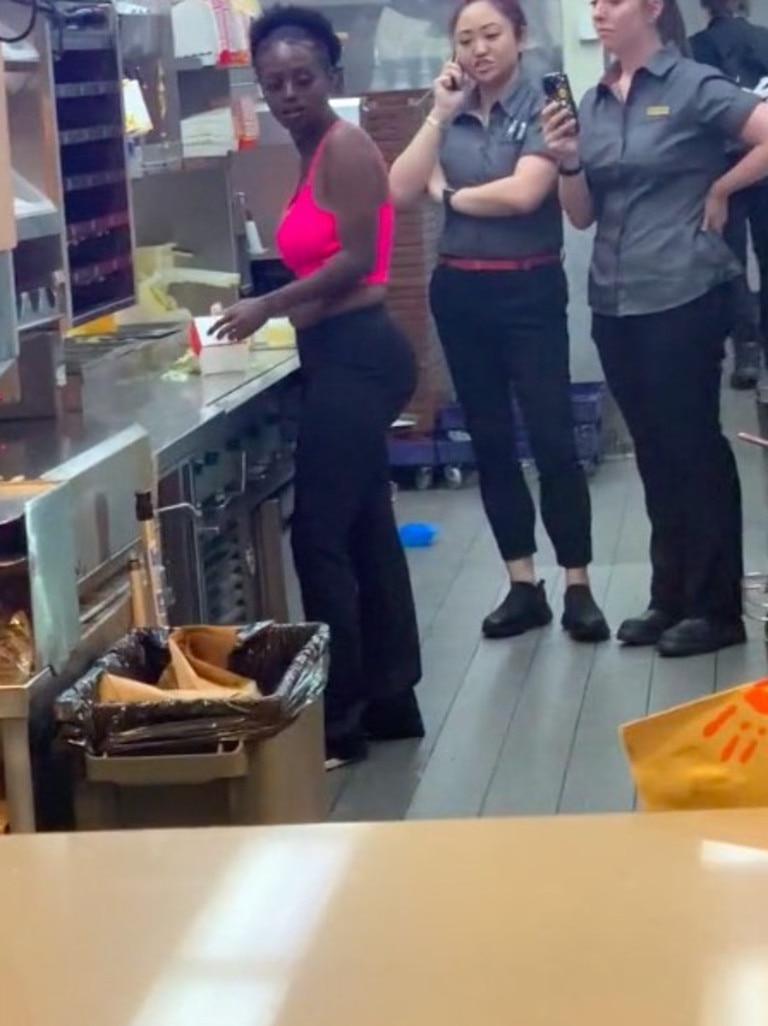
Customers and staff at an Adelaide McDonald’s were left in shock as they witnessed a woman go over the counter to hurl abuse at workers while helping herself to food and drinks.
The incident, which occurred on Thursday night at the Hindley St store in the CBD, led to the woman’s arrest and multiple criminal charges.
The two-minute video begins with the woman, 19, already on the wrong side of the counter as startled staff watch her warily, with fries scattered in the background.
“What? I’ll beat you up and I’ll leave,” she yells, pushing her face towards staff in a challenge as she holds two drinks.
“Oh what’s that, what’s in that?” she asks, then grabs a paper bag. Not satisfied with what’s inside, she throws it away and continues to confront staff. Customers watch from the other side of the counter, some filming her.
Staff attempt to walk away from her as she approaches them and appear to remain calm throughout the clip. The woman can then be seen in the kitchen of the McDonald’s restaurant.
She then heads towards the Macca’s process line where they make all the burgers and helps herself, picking up a burger box and using her bare hands to shove some chips inside.
At this point, two staff members appear to be keeping a close eye on her, with one on the phone while the other films her.
The woman opens the drinks fridge. As she peruses the shelves, she says “Ooh what do I want” before grabbing a bottle of water for herself. She calls one of the staff members a “dumbass b***h”.
A customer tells her to “get out” and she says “Get the f**k out? Aww okay” but on her way out she is distracted by the McCafe display. She picks something from behind the glass display and pops it into her mouth.
Two police officers have arrived by this point. They calmly surround her and escort her out.
One of the young McDonald’s workers begins to tear up after the ordeal is over. Some customers try to console the clearly shaken staff members.
In a statement to news.com.au, South Australian police confirmed that a 19-year-old woman was arrested after the incident which happened around 10.35pm on Thursday night.
“It will be alleged the woman damaged a door and threw a bottle of water at staff,” police said. She was charged with disorderly behaviour, property damage and assault. She made bail and is due to appear in the Adelaide Magistrates Court on March 3, according to police.
*****************************************************
Queenslanders now have the right to die
A very limited right
Terminally ill Queenslanders are able to ask for medically-assisted death at a time of their choosing after the state's voluntary-assisted dying scheme came into effect.
State parliament voted to legalise voluntary-assisted dying in September 2021 after Premier Annastacia Palaszczuk took to the policy to the 2020 election.
People suffering a disease, illness or medical condition that is advanced, progressive and terminal and with less than one year to live can ask for medically-assisted death as of Sunday.
The decision to grant a request will be made by a panel of medical experts and must be approved by the patient's treating doctor.
The laws include safeguards to protect vulnerable people and ensure they have the mental capacity to make a request and it has been made without coercion.
Euthanasia advocates argue it gives terminally ill patients the right to choose how they want to spend their final days and to die with dignity.
Clem Jones Trust chair David Muir says the start of the scheme was due to activists and politicians working for decades to give Queenslanders a wider range of choices at the end of their lives.
"Many individuals and organisations have worked hard not just for years but for decades to achieve VAD laws in Queensland," he said in a statement.
"We should also recognise the MPs in the Queensland parliament from across the political spectrum who voted for the new laws.
"They all knew that voluntary assisted dying was never about them or the beliefs they may or may not hold, but has always been about enabling terminally ill Queenslanders to make a personal choice.
"As experience elsewhere shows, some people who apply for and are granted approval to access voluntary assisted dying end up not using it, but the mere fact it is available can deliver a humane and palliative effect at the end of life."
Opponents have argued it raises ethical and moral concerns and may put pressure on vulnerable people to end their lives and called for more funding for palliative care.
Queensland was the fifth jurisdiction to legalise euthanasia after Victoria, Western Australia, South Australia and Tasmania.
NSW passed voluntary assisted dying laws in May, meaning the laws will come into effect universally over the next 18 months.
Last month, federal parliament repealed a 25-year-old law put in place by Liberal MP Kevin Andrews restricting the rights of the ACT and Northern Territory to make euthanasia laws after the latter legalised assisted dying in 1995.
The ACT government plans to introduce legislation next year but the NT is yet to reveal its plans.
https://au.news.yahoo.com/queenslanders-now-die-163041432.html
***********************************************Save the planet – ditch environmentalism
Since becoming custodians of the environment, left-wing politicians, bureaucracies, and businesses have done little except monetise the rapid expansion of renewable energy which, ironically, is one of the most wasteful and destructive technologies in modern history.
Far from ‘saving the planet’, these environmentalists have made their intentions perfectly clear – and we should listen to them.
‘This is about system change!’ read the banners held aloft by the likes of spiritual leader Greta Thunberg and her pre-pubescent minions. She is the moral guide for a generation of children, teaching them to stand in the street screeching at the sky while the clunk of public money hits the pockets of the elite.
In Climate Book, Greta Thunberg describes the capitalist system as: ‘defined by colonialism, imperialism, oppression, and genocide by the so-called Global North to accumulate wealth that still shapes our current world order.’
Who is going to tell her that capitalism has been the default economic position underpinning human trade since we wandered out of the caves? Would you trust a person who believes the West invented capitalism with the future of human civilisation?
This is a religion to absolve the guilty, not an economic policy.
It could not be clearer that those who lack an education will never be able to save the world from anything, let alone dangerous ideology such as this. The only thing brainwashed children are useful for are the votes they cast in adulthood.
By ‘system change’ what the activists behind the children mean is ‘communism’ – or even a new variation of collectivism that we are beginning to know as eco-fascism. The flavour of destruction depends on which group of activists you come across and what the personal beliefs were of its leaders before the arrival of the #ClimateChange hashtag.
Some environmentalists think a form of communism will ‘save the planet’ because only dictatorial governments have the necessary power over individuals and the economy to carry out ‘uncomfortable change’ (read mass theft of property and rights).
Canadian Prime Minister Justin Trudeau is one such individual who is warming up to the allure of dictatorship: ‘There’s a level of admiration I actually have for China. Their basic dictatorship is actually allowing them to turn their economy around on a dime.’ Before Trudeau gets too excited, someone should point out that China is the most polluted nation on Earth where the worst man-made famine in human history took place, all under the watch of communism.
Other activists have aligned themselves with international corporations whose influence over global politics dwarfs the democratic process. These are the suited class that sip their way around closed-door lobbying conferences like the World Economic Forum, pretending that innovation rather than political coercion is driving their eco-success. These environmentalists believe that an authoritarian marriage between the State and Corporate can deliver profit at a faster rate than sluggish market forces, held back by concerned citizens.
This magical fountain of money is to be ripped out of the general public via green taxes and unreasonable legislation. Like robbing a bank, no one has a plan for what happens tomorrow when there is no apocalypse and no capitalist economy creating public wealth. Perhaps they’ll start taxing the carbon in our bodies and air in our lungs to make up the difference in their parallel economy…
New Zealand offers a glimpse of the future, with socialist Prime Minister Jacinda Ardern proud of what is, quite literally, a race-based water management policy. Such incoherent madness would have been laughed off last century. Her propensity for hypocrisy allows her to demonise farmers for their emissions while pleading with America to send as many tourists as possible, via plane, to a volcanic sandpit which leaks greenhouses gases like an open valve.
The reason that no particular label accurately defines the modern environmentalist movement as a whole is because they are a fractured group of competing political ideologies, all of which are jumping on the ‘green’ bandwagon to elevate their sphere of power. It is time for rational people to see them clearly. These ideas are the weeds of politics, infesting Western Civilisation with the intent of colonisation and eventual suffocation.
Short-sighted businesses, unaware that the end game does not benefit them, think that ‘going green’ means that the government will both kill off their market competitors via legislation and make available fortunes of public money for ‘investment’ justified by the undefined label of ‘saving the planet’.
Politicians hitched a ride early on, seeing that universities and schools had been inundated by failed communists who, to hide the rapid decline in education standards, now elicit praise for raising ‘responsible global citizens’ (who cannot add, spell, or reason). Not only have political movements capitalised on Millennials, they are pushing to lower the voting age to prop up their regimes with children.
The Greens and Labor have never cared much for economic stability or civil liberty, so it was no surprise to see them lead the charge on this. It was similarly inevitable that a movement like the Teals would emerge comprised of bored, wealthy, affluent women funded by self-interested renewables billionaires. They get to virtue signal to the cafe class while their victims remain quarantined in the poorer suburbs.
What remains astonishing is how easily the Liberals and Nationals burned their principles, buried their morality, and scrambled up after unscrupulous Parliamentarians to get a piece of that green salvation.
To be clear, conservation is admirable – eco-fascism is disgraceful, and all we have seen of our politicians in the last decade is a race to install a carbon prison state.
Australians used to be responsible. Clean up Australia Day was one of those worthy initiatives that taught children to take care of the land. Now, instead of cleaning up their local area, kids are demanding that the world’s worst polluters ramp up operations because their teachers gave them a slogan that was never questioned.
How are children ‘making a better world’ by the installation of millions of solar panels and wind turbines destined for landfill within 20 years? Or hundreds of acres of battery farms that face the same fate?
Did any of them do the cost and environmental calculations on the mining, transport, manufacturing, installation, maintenance, and disposal of these ‘planet saving’ technologies? How many of them know that kids, just like them, are sitting in mud pits mining cobalt while entire nations are having their natural resources financially raped by China’s debt trap diplomacy leaving local residents impoverished?
Do they know that sacred sites and ancient communities throughout China’s ‘autonomous’ region of Tibet are destroyed for renewable mining operations, and that their first nations people are imprisoned if they protest? Are they aware that the oceans are facing danger from rare earths deep sea mining operations, or that rare earths represent the largest mining boom in modern history, triggering huge amounts of devastation?
Because it’s not ‘coal’, it doesn’t make the news… Speaking of fossil fuels, their demonisation is done without mention of the pharmaceutical industry which is wholly reliant on petrochemicals. You cannot have the socialist dream of free healthcare without fossil fuels.
Conservative parties had a duty to Australia to fight against destructive collectivism and to see through the cynical green cloak hiding its red core. Instead, they validated the incoherent, fanciful screeching. In their attempt to win a few elections, the conservatives kicked open the Pandora’s Box that formed the Teals. Affluent blue-ribbon seats never would have waded into this sick game without their friends in politics and business insisting it was ‘the right thing to do’. Those voters believed it without evidence, adopting Tealism as though it were a fashion trend.
Worse, these allegedly conservative politicians are still taking advice from the same green-eyed merchants of misery – the end result of which is Matt Kean.
As for the Nationals, there is no saving a party that sides with an international bureaucracy with policies devoted to the destruction of family agriculture. What farmer is going to vote for a local member who nods along while the United Nations demands herd culling to ‘meet Net Zero goals’? What food grower is going to sit by while Australia tries out the Sri Lankan approach to farming?
2023 is a new year, and if the conservatives want to have both an election future and a clean, environmentally friendly Australia – they have to apologise for adopting Net Zero garbage and immediately start a new course toward a genuinely sustainable future (that means, a future where Australians can afford to heat their homes and buy food for their kids).
Neither communism nor fascism does the environment any favours. Australia was clean and green when it was free of grifting activists rolling around in the hay of big business.
We absolutely should embrace conservation, but that is not going to happen if we impoverish, oppress, and starve Australians in pursuit of a Net Zero utopia. Utopias, by definition, do not exist.
Save the planet – ditch environmentalism.
https://spectator.com.au/2022/12/the-crimes-of-eco-fascism/
************************************************************If a race-based constitutional body is endorsed at next year’s referendum, it would send a permanent message that Australia is no longer committed to equal rights for all
Anthony Albanese’s warning this week about the “corrosive, insidious forces” attacking democracy needs to be taken seriously, particularly by those seeking a constitutional entity to represent Indigenous Australians.
The Prime Minister’s remarks, delivered at the Woodford Folk Festival, are a reminder about the ease with which well-meaning initiatives can damage the principles that hold this nation together.
In the same speech in which Albanese defended democracy he recommitted himself to a policy that would threaten democratic principles: establishing a race-based constitutional body to be known as the Aboriginal and Torres Strait Islander Voice.
If this is endorsed at next year’s referendum, it would send a permanent message that this country is no longer committed to equal rights for all.
The Prime Minister’s assessment of the challenge confronting democracy is consistent with the danger identified by the Washington-based Freedom House in its 2022 report on the state of democracy. Equality of citizenship takes pride of place at the start of the Freedom House report: “Around the world, the enemies of liberal democracy – a form of self-government in which human rights are recognised and every individual is entitled to equal treatment under law – are accelerating their attacks.”
The first step to defeating this threat is to recognise it when it is staring you in the face. That is only way to describe the proposed Indigenous voice to parliament.
The second step requires an understanding of what needs to be defended. And that means accepting that democracy means much more than regular elections and majority rule. According to Freedom House: “In its ideal form, it is a governing system based on the will and consent of the governed, institutions that are accountable to all citizens, adherence to the rule of law, and respect for human rights …
“It creates a level playing field so that all people, no matter the circumstances of their birth or background, can enjoy the universal human rights to which they are entitled and participate in politics and governance,” the Freedom House report says.
The threat to these principles from the Indigenous voice is real.
Equality of citizenship is ignored in the plan for the voice that has been drawn up by Tom Calma and Marcia Langton. This plan is outlined in a report that was endorsed by Albanese in parliament on November 30.
If enacted, some people, based on their race, would have two methods of influencing public policy: through their representatives in parliament and their representatives on the voice.
The Calma-Langton plan also falls short when assessed on the requirement for accountability.
The voice would not be accountable to ordinary indigenous voters but would answer to local and regional “voices”.
These unknown groups would decide who would sit on the national voice and whether any of its 24 members would be elected or merely selected. This is the system that the Calma-Langton report proposes: “The national voice membership would be structurally linked to the local and regional voices by the local and regional voices within each jurisdiction collectively selecting national voice members.
“Secondary options under this model may be used if Aboriginal and Torres Strait Islander people of the relevant jurisdiction agree.
“An election or expression of interest process may still be held for a jurisdiction if Aboriginal and Torres Strait Islander people in those areas prefer. This decision would be made with the relevant local and regional voices,” the report says.
The great strength of Albanese’s address was the implicit recognition that he has a responsibility not merely to govern, but to strengthen democracy for the next generation. “Our democracy is precious, something we have carefully grown and nurtured from one generation to the next. One of our core responsibilities is to make it stronger …” he said.
But this is matched by his failure to recognise that an indigenous voice, as proposed by the Calma-Langton report, would have a permanent corrosive impact on democracy.
It would divide the nation into those with additional influence over public policy and those without. It would not be limited to indigenous affairs.
“Restricting the scope of the advice function would diminish the role of the national voice as a national broadbased representative body,” the Calma-Langton report says.
Resentment at such inequitable treatment would be inevitable. Indigenous people would also have cause for complaint.
An institution of state, purporting to represent indigenous people, would have no direct accountability to ordinary indigenous people, stripping it of democratic legitimacy.
Despite these shortcomings, Albanese asserted at Woodford that the push for a “yes” vote at the referendum was gaining momentum. If that is the case, why are the government’s constitutional experts exploring other approaches?
On December 12 Linda Burney, the Minister for Indigenous Australians, posted a document on her website that outlined a summary of advice from the federal government’s constitutional experts group. Their advice concerned the draft constitutional amendment that would create the voice.
Without elaboration, the document says: “The expert group agreed that there could be – and gave consideration to – different policy and process approaches to key features of the draft constitutional amendment.”
Really? What are these key features that the experts believe are worth “different policy and process approaches”.
And why do the experts believe different approaches were worth exploring? Is there some weakness in the form of words unveiled by Albanese at the Garma festival in July? When does the government propose to share the expert group’s views with the community? Before or after the referendum?
This is not the way to secure informed consent for a change to the Constitution.
************************************
Also see my other blogs. Main ones below:
http://dissectleft.blogspot.com (DISSECTING LEFTISM -- daily)
http://antigreen.blogspot.com (GREENIE WATCH)
http://pcwatch.blogspot.com (POLITICAL CORRECTNESS WATCH)
http://edwatch.blogspot.com (EDUCATION WATCH)
http://snorphty.blogspot.com/ (TONGUE-TIED)
http://jonjayray.com/blogall.html More blogs
***************************************
Friday, December 30, 2022
US comedian's controversial Welcome to Country clip saying 'give it back or shut up' divides Australians
It's just tedious tokenism as far as I can see. It accomplishes nothing but it seems to give Leftists a warm glow. Tokenism is their thing: Very shallow
An American comedian's take on traditional land acknowledgements has exposed division among Australians over whether they are worthwhile or empty of meaning.
A video by US comedian Bill Maher talking about land acknowledgement - used in America and Canada as it is in Australia - on his show Real Time includes him telling the audience the statements are void of meaning when actual action isn't taken.
'To all the people who start every public event now with one of those land acknowledgements where they say, 'I'm standing on land that was stolen from the proud Indigenous people of the Chumash tribe', I say either give it back or shut the f*** up,' Maher said.
The clip has gained more than 48,000 likes since it was uploaded on Sunday.
The acknowledgement of land, or acknowledgement of Country, is typically used in Australia to recognise the traditional owners of the land on which an official ceremony is held. It is usually spoken at the beginning of an event.
While Maher was referring to Native Americans, his words also struck a chord with Australians who flocked to the comments section to share their thoughts.
'Australia has been doing this for years. I think the same thing every time,' one person wrote. 'It reminds me of a prayer before dinner or something,' another said. 'Every single event in Australia, at first I was like 'cool', now I'm like 'I'm done'. 'I did a course at TAFE and every single class our trainer had to do it,' another wrote.
However, not everyone was convinced stripping away the acknowledgement is the right way forward. 'Not exactly in our power to give it back. It's the least we can do,' one person commented. 'Honouring the treaties and relationships,' another said.
Earlier in the episode, Maher said he wished there was more focus on the progress countries - specifically the US - has made in its relationship with Indigenous people than its bloody history.
'That's what's so odd about this time that we're living in,' he said. 'For all the talk of fighting for the soul of America, nobody seems to like it very much.
'A country that started out bad and will always be bad and unable to change, but we have changed. A lot.'
************************************
A young woman has died from complications related to contracting Covid on a holiday with her partner
Heart damage was long played down as an effect of Covid but it is no myth
The 24-year-old woman from Aldinga in South Australia, Hayley Beadman, passed on Thursday, December 27 at an Adelaide hospital after going into a myocarditis-induced cardiac arrest.
Ms Beadman and her partner, Ben Moore, unknowingly returned Covid-positive from Bali on November 23 and soon after, she started experiencing chest pains.
Her family and friends believed she was 'slowly coming back' after her condition seemed to improve in mid-December.
She is being remembered by friends and family as 'one in a million', with a GoFundMe page started by Ms Beadman's friend, Moni Burrell, raising over $11,000 for her partner.
Ms Burrell wrote in a Facebook post on Thursday: 'You have left a hole in all of our hearts.'
Ms Beadman was rushed to Flinders Medical Centre in Adelaide's south when she couldn't control her breathing and was experiencing chest pains.
She went into cardiac arrest soon after reaching emergency, doctors diagnosing her with myocarditis due to a positive Covid test.
'We didn’t know we had Covid because we didn’t have any symptoms,' Mr Moore told The Advertiser.
She then underwent 50 minutes of CPR before doctors places her into an induced coma, one nurse dubbing Ms Breadman as 'one of the sickest patients in Adelaide'.
She stayed in the coma for just under a month, waking on December 16, responsive and blinking her eyes. Her family were hopeful for her future.
'She is now awake. She is blinking on demand and her eyes are moving around the room watching everyone,' an update from Ms Burrell on the GoFundMe reads.
Just under two weeks later, Ms Beadman would unfortunately suffer a lethal second cardiac arrest.
She and Mr Moore had been together for five years and recently purchased a house together in Aldinga, south of Adelaide.
'Do the right thing, wear a mask if you're in areas with lots and lots of people, you never know who has COVID,' Mr Moore told the ABC.
'It can happen to anyone.'
**************************************************
Christian couple who were banned from adopting after saying they would force their child to 'fight the sin' of homosexuality win payout
A devout Christian couple denied the chance to have a foster child because they believe homosexuality is a sin, have been awarded hefty compensation for their 'humiliation and hurt feelings'.
Byron and Keira Hordyk, from Perth, sued the Western Australian government for religious discrimination and received a $3000 payout each, after Wanslea Family Services denied their application in 2017.
The independent agency contracted by the state refused their request after the couple, who have kids of their own, said they would tell a child who says they are gay to 'fight the sin'.
The Hordyks are members of the conservative Free Reformed Church, a denomination that told the Tasmanian law reform institute in February 2021 that they practiced 'conversion therapy' for which they issued 'no apologies'.
Conversion therapy, which has been banned in the ACT, Queensland, Victoria and Western Australia, attempts to change a person's identified sexual orientation through Bible study and prayer.
The Hordyks had responded to a theoretical question about fostering a gay child by saying they would try to convert them to heterosexuality and that if this was unsuccessful the placement would have to be terminated, the State Administrative Tribunal heard.
'We certainly would not drop them off that day to another home,' the Hordyks said. 'However, we are taught and do believe that all LGBTQ identities are wrong and sinful but there will be people who have to fight against this sin,' they wrote in their answer.
'We will therefore offer our help and try and do what we can to help this child, but if the child continues to be gay and goes on to date etc. the placement will not work as this goes against our beliefs.'
Wanslea denied the Hordyks a foster child on the grounds that they could not provide a physically or emotionally safe environment for a young person who might identify as LGBTIQ+.
In response the Hordyks took the agency to the State Administrative Tribunal claiming religious discrimination. They asked for $3000 each in compensation 'for hurt feelings and humiliation'. Mrs Hordyk told the tribunal she felt 'gutted' and 'devastated' that her beliefs were labelled 'dangerous'.
In his testimony Mr Hordyk said the rejection of the core principles of his life left him feeling 'deflated'.
'It feels unfair for me to have to throw away my beliefs on these issues just so I can be acceptable to Wanslea. My religious convictions take centre stage in all aspects of my life,' Mr Hordyk told the hearing.
Wanslea argued that the couple's rigidity on issues of homosexuality and gender did not flow from their religious convictions.
However, the tribunal did not agree and ordered both the Hordyks be paid 'for the loss and damage they suffered as a result of Wanslea's discrimination'.
At the time they were knocked back by Wanslea, the Hordyks said they were speaking up for other people of faith.
'We do feel we have been discriminated against and also we felt that if we were quiet about this and didn't say anything about it, it could potentially harm or limit any people with the same Christian values as ours from fostering,' Mr Hordyk told The West Australian.
'We hold traditional Christian views on how the Bible teaches us on sexuality and marriage.
************************************
Backpackers in priority lane as numbers near pre-Covid levels
Working holiday visas are being rushed through within an average of 24 hours, lifting backpacker numbers closer to their pre-Covid levels as the government faces calls to raise the eligibility age to 50 to plug critical labour shortages and attract more skilled professionals.
Immigration Minister Andrew Giles said the number of backpackers working in the country had bounced back from lows of just 20,000 during the pandemic to about 120,000 as of last week.
Mr Giles said that, in addition to fast-tracking holiday-maker visas, he had changed the rules to allow backpackers to stay with a single employer for as long as they remained in the country rather than limiting them to one job for six months at a time, arguing Australia was in an international competition to attract talent.
“This is not simply an Australian skill shortage, so it’s important that we have our system moving effectively, because we’re in a global market,” Mr Giles said.
“We’ve got to make sure that we’re competitive with countries like Canada and like the UK.”
“And I’m really pleased that we are in that space now, that people are getting their visas turned around quickly and that employers can now approach this competence as well.”
The changes come as new figures from peak tourism bodies show more than 70 per cent of Australians will be holidaying domestically this summer, ratcheting up demand on tourism and hospitality businesses across the country which have already been struggling for months to find workers.
Tourism and Transport Forum chief executive Margy Osmond sounded the alarm, saying she was pushing the government to halve or remove all visa fees and increase the age of those eligible for working holiday visas from 35 to 50.
“A lot of businesses are still suffering in terms of getting the number of people optimal to run them,” Ms Osmond said.
“This is a massive competitive global market. Many countries have halved or removed visa fees.”
Increasing the age eligibility for working holiday visas to 50 would also give businesses a “wider pool of people with a bit more money likely to be able to afford to travel”.
“We need to fill other jobs as well. It’s not just pulling a beer at front of house; we need professionals,” Ms Osmond said.
Australian Chamber of Industry and Commerce chief executive Andrew McKellar welcomed the faster visa-processing times, but called for new requirements forcing backpackers to work in the sectors that needed them most.
“With many businesses unable to satisfy the demand for workers, the government should consider including three months of work in the tourism and hospitality sectors as qualification for extending working holiday maker visas,” Mr McKellar said.
Prior to the pandemic, Working Holiday Maker visas contributed about $3bn a year to the economy, with a usual pool of backpackers of between 150,000 and 200,000. But border closures during the Covid-19 outbreak drove down the number of working holiday visas by 85 per cent – the biggest drop of any visa class.
To fill skills shortages quickly, the government has prioritised Working Holiday Maker visas over others such as international student visas, which the Home Affairs Department in November reported were processed in about 14 days.
International students have played a major part in plugging skills gaps during the pandemic, following a move by the former government to lift the working cap of 20 hours a week.
However, higher education experts have expressed concern that the uncapped hours were creating a “de-facto work visa” for students coming to Australia primarily to earn money rather than study.
While Mr Giles said the practice of visas being used for collateral purposes was of concern and the capping of hours would return by June next year, Ms Osmond called for the uncapped hours to remain for at least all of 2023, if not longer.
“While I perfectly understand this was an interim measure because of problems we were facing, we’re not over those problems,” Ms Osmond said. “The measure should be in place for the full year. That would give industry and students certainty.”
Mr Giles said “people coming here to study should be coming here to study”.
“We have through the pandemic extended the hours that students can work,” he said. “That will continue through to 30 June (next year).
“We are constantly working with universities and other providers to make sure that the integrity of the system – and then fundamentally also the integrity of our schools and education system – is maintained.”
Mr Giles said the decision to process working holiday visas within a 24-hour timeframe was the result of new processes and investments in human resources in the department, arguing the shake-up had “finally got our visa system moving”.
“It’s got people connected to jobs and critically connected people to businesses … to address the skills shortage we are facing,” he said.
However, he recognised the challenges of backpackers getting to Australia, given the cost and availability of flights and accommodation.
“All of these are issues,” he said. “I don’t presume for a minute that changing the migration system in Australia can deal with all of these issues. But … the availability of visas … and turning around working holiday maker applications in less than a day, we are giving certainty to people who are coming here.”
Mr Giles revealed the government had fulfilled its promise to get the total visa backlog down to 600,000, with the number of visas now on hand down to about 599,000.
**************************************************
Also see my other blogs. Main ones below:
http://dissectleft.blogspot.com (DISSECTING LEFTISM -- daily)
http://antigreen.blogspot.com (GREENIE WATCH)
http://pcwatch.blogspot.com (POLITICAL CORRECTNESS WATCH)
http://edwatch.blogspot.com (EDUCATION WATCH)
http://snorphty.blogspot.com/ (TONGUE-TIED)
http://jonjayray.com/blogall.html More blogs
***************************************
Thursday, December 29, 2022
Kamahl slams ABC host as a 'bully with a black soul' amid calls for him to be sacked over 'disgusting' comment about the singer and cricket icon Don Bradman
Adams is is a Leftist so I am reluctant to defend him but I think he was misunderstood here. He was clearly criticizing Bradman, not Kamahl. He was comparing Bradman to a South African Apartheid believer. Bradman has recently been "outed" as very conservative.
But any mention of race is taboo these days. Adams should have known that. But he was too anxious to get in a dig at Bradman
Legendary singer Kamahl said he feels 'humiliated' by the ABC's Phillip Adams after the broadcaster claimed cricket icon Don Bradman treated him as 'an honorary white'.
The host of ABC Late Night Live created a storm of controversy by making the claim on social media.
In the tweet on Thursday, Adams compared the cricket icon's 13-year friendship with the popular entertainer with his reluctance to meet Nelson Mandela.
'Clearly, Kamahl, [Bradman] made you an Honorary White. Whereas one of the most towering political figures of the 20th century was deemed unworthy of Bradman’s approval,' Adams said in a tweet on Tuesday morning which later went viral.
The comment was blasted on Twitter, with Aboriginal leader Warren Mundine calling Adams 'a disgrace' and leading calls for his sacking.
A tearful Kamahl, now 88, broke down as he told Daily Mail Australia he felt 'humiliated' by Adams' hurtful remark.
The iconic entertainer, who has enjoyed a successful 55 year career in Australia, labelled Adams 'a bully'.
'I think he wanted to put me down, how dare I be so successful? How can I be black and be successful?' Kamahl told Daily Mail Australia.
'He was being flippant but he’s a bully, ironically Adams has possibly the best command of the English language and he chooses to be mean-spirited. I think he was trying to be nasty.'
'Daring to suggest that Sir Donald Bradman invited me to his home in August 1988 as a 'token white' is disgusting at best.
'You may be white, but oh your soul is black!'
Kamahl said he was proud of his 13-year friendship with Bradman, which began with the singer name-checking the cricket icon in a 1988 song 'What is Australia to Me?'
The pair exchanged almost 80 letters and Kamahl was a regular guest for lunch and dinner at Bradman's home in Kensington Park, Adelaide.
****************************************************
Some Australians spend Boxing Day trashing famous cricketer
Social media’s love affair with cancelling long-dead celebrities has reared its head again, this time with Australian cricket icon Don Bradman in the firing line.
Bradman, known as one of history’s greatest sportsmen, has been dead for 21 years. But now, a dusty old letter addressed to Prime Minister Malcolm Fraser, two days after the 1975 dismissal election, has apparently “exposed” the former cricketing great as a “right wing nutjob”.
In the letter, which was unearthed by Federation University’s Verity Archer, Bradman urged the new PM to scrap regulations on capital and warned of the risks inflation poses to Australia.
“A marvellous victory in which your personal conduct and dignity stood out against the background of arrogance and propaganda indulged in by your opponents,” Bradman wrote.
“Now you may have to travel a long and difficult road along which your enemies will seek to destroy you.”
Bradman — who was 67 at the time of writing the letter — also warned Mr Fraser about the power of unions and urged for the public to be “re-educated to believe private enterprise is entitled to rewards, as long as it obeys the rules”.
“What the people need are clearly defined rules which they can read and understand so that they can get on with their affairs,” Bradman continued.
“The public must be re-educated to believe that private enterprise is entitled to rewards as long as it obeys fair and reasonable rules laid down by government. Maybe you can influence leaders of the press to a better understanding of this necessity of presentation.”
Social media users and journalists expressed shock that Bradman — who was born in 1908 and raised in an era when horses outnumbered cars on the road — had conservative leanings.
Sydney Morning Herald writer Daniel Brettig described the letter as “extraordinary” and said it showed Bradman’s attempt at an “intervention at an explosive moment in Australian political history”.
Broadcaster Phillip Adams wrote, “Sad. Lost letter from Bradman to Fraser after Whitlam’s dismissal reveals ‘the Don’ to be a RWNJ [right-wing nutjob].”
************************************************
Tony Abbott: There are already Indigenous voices in parliament
Goodwill towards Aboriginal people has never been greater and there is all-but-universal support for recognising Indigenous people in the constitution.
But this proposal for a constitutionally entrenched Indigenous voice to the government and to the parliament is way beyond recognition.
It’s a special body for some, but not all, based on how long your ancestors have been in Australia.
Is that what we really want in our constitution: two classes of Australians, based on race? That’s why the coming referendum is almost sure to be the most important issue our country faces next year and why it deserves far more debate in detail than it’s had so far.
Actually, Indigenous people already have a voice.
It’s called the Australian parliament, which now has 11 Indigenous MPs, a record number, all of whom have been chosen and elected in the normal way. Because Australian voters have become so lacking in prejudice and are now so appreciative of the qualities of Indigenous people as to disproportionately put them into our national parliament.
Although our country has never tried harder to give minorities a fair go, Indigenous people especially, that’s not enough for the Albanese government.
Hence this push for a separate and special Indigenous body, over and above the Indigenous MPs already in the parliament, the national Indigenous “coalition of peaks”, and all the Aboriginal land councils that already cover the whole country and represent the traditional owners in whom authority used to rest.
This can’t be because Aboriginal people currently lack a voice. Many Indigenous people speak out powerfully and effectively in our public life.
Nor is it because Aboriginal people currently aren’t being listened to. As the now almost ubiquitous acknowledgements of country, routine presence of the Aboriginal flag alongside the national flag, and angst over Australia Day show, officialdom takes some Indigenous concerns very seriously indeed.
This new voice that the government wants to put to a referendum in the second half of next year is not about listening more closely to Indigenous views or about finally recognising in our constitution that Aboriginal people were here first.
It’s about introducing a kind of co-governance where nothing can be done for 100 per cent of the people without taking into account the concerns of that 4 per cent, some of whose ancestors came before 1788.
As the Prime Minister has said, only a very “brave” government could ignore the voice’s representations. That’s why, should this voice be approved at a referendum, it would constitute something approaching a “third chamber of the parliament”, as Malcolm Turnbull has said.
In fact, the government has two distinct and contradictory positions on the Voice: one, pitched to the wider Australian community, is that the Voice is really no big deal, and that not to support it would be disrespectful to Indigenous people — and perhaps even racist.
The other, pitched to Indigenous leaders and its own activist supporters, is that the Voice would start to redress the shame of dispossession and might help to close the education, employment and life expectancy gap between Indigenous people and the wider Australian community.
Paradoxically, in one of its first decisions, the same government that’s pushing this new Voice totally ignored all the Indigenous voices pleading with it not to scrap the cashless debit card and not to end the alcohol bans in remote Australia which were helping to keep vulnerable women and children safe.
It’s hard to avoid the conclusion that the Indigenous voices that this government heeds are largely urban activist ones that want to change the date of Australia Day, rewrite history, conclude treaties between the Commonwealth and groups of its own citizens, and press for reparations; as opposed to those in remote areas whose focus is on getting Indigenous kids to school and adults to work, and keeping communities safe.
Unless the government plans to release a lot more detail — about exactly who could stand and who could vote for this new body; exactly what will and what won’t be within its scope; how much its members might be paid and its deliberations resourced; and how it’s going to be possible to avoid extensive litigation about whether its representations have adequately been considered and responded to (and that’s a lot to think through) — people will be expected to vote essentially on the “vibe”.
And that’s hardly a safe way to make potentially far-reaching changes to the way we are governed.
If this really was likely to produce hitherto unknown solutions to all the scandalous problems afflicting remote Australia, and if this really was likely to generate a hitherto unprecedented united resolve to make a difference, it might just be worth the risk.
But instead of the appreciation that lasting change for the better happens person-by-person, institution-by-institution and community-by-community, and is akin to slow-boring through hard wood, this new body is likely to reinforce separatism and the quest for instant solutions. That’s when it’s not acting as an echo chamber for grievances or a gravy train for activists.
That’s why I hope you will join people like Senator Jacinta Price, a proud Celtic, Warlpiri Australian woman, not just to oppose this unnecessary Voice which would be wrong in principle and bad in practice, but in finding better ways to recognise Aboriginal people in our constitution and to have the original Australians participate more fully in the great life we have here.
************************************************************
Tesla chaos strikes: Long Christmas holiday queues for charging station reveals the harsh reality of owning an electric vehicle in Australia
The people caught out must be either gullible or a bit dim. Electric vehicles are just not suitable for long-distance travel
Australian Tesla drivers have been forced to wait in 90-minute queues at charging stations as thousands take to the roads over the holiday period.
Queues for charging stations have been spotted nationwide, including in Victoria and NSW.
The huge queues have angered Tesla owners, with many blasting Australia's lack of electric vehicle infrastructure.
ABC reporter Phil Williams shared a video of the electric cars all lined up at a charging bay in Wodonga, on the border of Victoria and NSW on Wednesday. 'Wodonga Tesla charge points overwhelmed with wait times around 90 mins,' he said.
In the footage, Tesla owners can be seen aimlessly standing around their cars as they wait for a charge before getting on their way more than an hour later.
There were similar scenes at a Coffs Harbour charging point in northern NSW on Wednesday, with Teslas stretching through the carpark as drivers waited their turn to power up.
Many Aussies were quick to call out electric vehicles after seeing the footage. 'Think I'll stick to a petrol powered car. Takes less than 5 minutes to fill up my car's tank, pay for the petrol and to then be on my way again,' one said.
'Why anyone would want an electric car that can take up to an hour to fully recharge is beyond me,' another declared. 'They obviously have way too much time on their hands to just wait either waiting to recharge or recharge!'
'So how do you travel during peak periods in an EV? Just be prepared to add 3 hours to your trip? That won't help with the take up of the technology?' a third said.
'I'm an expat Australian and this is the reason I left. We're 10 years behind the rest of the world with EV and innovation,' added another.
Others called for an expansion of the charging network across Australia to solve the problem of long wait times.
'There are eleven petrol stations in Wodonga, multiple outlets for every major brand, and only one place to charge EVs which is just outside the council offices.'
Another suggested: 'Every petrol station should have to fit charging points.'
Others suggested the long wait times were due to the Christmas holidays, while some said it was likely the scenes in Wodonga were from a Tesla club meet-up.
*****************************************************
Also see my other blogs. Main ones below:
http://dissectleft.blogspot.com (DISSECTING LEFTISM -- daily)
http://antigreen.blogspot.com (GREENIE WATCH)
http://pcwatch.blogspot.com (POLITICAL CORRECTNESS WATCH)
http://edwatch.blogspot.com (EDUCATION WATCH)
http://snorphty.blogspot.com/ (TONGUE-TIED)
http://jonjayray.com/blogall.html More blogs
***************************************
Subscribe to:
Posts (Atom)


 Evelyn Rae, a conservative Australian political commentator


 Margo Robbie -- a beautiful australian
 My son Joe at ANU
 One of the happiest pictures ever -- Cleo Smith, aged 4


