 Australian Politics
PM plans back to basics for nurse training
JOHN Howard has moved to dramatically overhaul nursing education, with a $170 million plan to build 25 privately operated nursing schools in hospitals. The radical shake-up, which will increase the number of nurses by 500 a year, involves a return to a traditional model of hospital-based training to supplement university-based degrees. The Prime Minister will reveal the plan in Sydney today in the first of a series of back-to-basics policy announcements aimed at battlers, the elderly and the bush, and designed to peg back Labor's huge poll lead.
The plan emerged last night with the news that the Government would also consider reviewing all pensions and offering retirees up to $30,000 in taxpayer-funded bonuses if they returned to work to help ease critical labour shortages.
The policy shifts came as the International Monetary Fund yesterday warned the Government against populist election initiatives, saying there should be no new government spending this year. In its annual review, the IMF praised the federal Government's handling of the economy as world-leading but cautioned against further stimulus to a stretched economy.
Coalition MPs were yesterday regrouping after a week of damaging leadership speculation that had many flirting with the idea ofdumping the Prime Minister and replacing him with Peter Costello. Having discarded the option of leadership change, the Government refocused yesterday, with senior ministers confirming Mr Howard would seek to turn the Labor tide by returning to his electoral roots with a large-scale policy revamp.
The new nursing schools will be modelled on the Government's 24 Australian Vocational Training Colleges, built by the commonwealth but run by community groups working with employers. The trainee nurses will provide immediate relief to hospitals suffering staff shortages. The courses will run for three years and students will emerge with a nationally recognised TAFE qualification - equivalent to university-based study. While they study, the commonwealth will subsidise their wages and also pay bonuses in the middle of their courses and at the end of their studies, to encourage their completion. Doctors, hospital administrators and private hospital employers will have input into the training programs to ensure the nurses emerge with skills sought by their industry.
According to a 2004 Australian Health Workforce Advisory Committee report, Australia will need up to 13,500 new registered nurses each year to meet the demand for nursing services over the next 10 years. In 2004 only 5631 nurses completed their training. Despite the shortfall, 2408 eligible applicants were turned away from university nursing courses last year because there were not enough places.
The Government's move is likely to be welcomed by the medical community because university training is often criticised as producing book-trained nurses with inadequate practical experience. The Government has already raised the plans with some hospitals and its announcement will come as the Australian Nursing Federation launches phase two of a four-week TV advertising campaign outlining the negative impact of the Howard Government's industrial relations laws on nurses working in aged care....
The new Government policy proposals followed heavy pressure from Labor yesterday. Kevin Rudd used parliamentary question time to pepper Mr Howard with questions aimed at convincing voters that the Prime Minister had no new policy ideas.
Source
A modest proposal: Government-funded health "Trainers" for all
The Fascist writer below recognizes that people mostly ignore "health" messages so "make people behave" is the proposed solution. That people have any right to eat what they want is not recognized. Nor is it recognized that "health" wisdom often goes into reverse.
THE idea that taxpayers should subsidise weight loss programs sparked an outcry this week, but it is the first solid policy proposal we have seen to stem a health problem that is costing Australia billions. It comes on the back of calls for cartoon characters to be banned from food packaging, for a tax to be placed on high sugar breakfast cereals and as some hospitals ban surgery on obese people and smokers. Unlike a weight loss program, none of these proposals does anything to change behaviour. That's why both sides of politics say they are seriously considering the weight loss subsidy.
Sixty per cent of our population is overweight. The problem - in defiance of government advertising campaigns to eat more fruit and vegetables and do more exercise - is, like Australians, only getting bigger.
A study in the Medical Journal of Australia has found these public health messages are being absorbed by the public. But it also found this knowledge does not readily translate into behavioural changes. We know what's good for us - but we won't do it.
Every year our public hospitals treat 500,000 people for preventable illnesses. Every year over 50,000 people die from illnesses caused by their poor lifestyle. It's time we asked whether scarce public health dollars should be spent fixing up health problems that are caused by our own unhealthy habits. We're making the unemployed take some responsibility for the public funding they get by working for the dole. In Aboriginal communities bureaucrats have taken control of welfare payments so they can't be spent on alcohol and drugs. The health system is the next area ripe for the new responsibility agenda.
Why should taxpayers fund repeated heart by-pass operations unless the patient receiving them signs a contract agreeing to give up smoking, do 30 minutes of exercise a day and lose weight? What's the point of the public subsidising diabetes or cholesterol tablets if the patient won't exercise and continues eating fatty foods?
A National Heart Foundation study estimates that seven lifestyle factors - obesity, low fruit and vegetable consumption, tobacco use, alcohol consumption, low physical activity, high cholesterol and high blood pressure - cause 52,738 deaths in Australia every year - 39 per cent of all deaths. If we don't start heeding these public health messages (and it doesn't seem likely we will) that number is bound to get even worse.....
The answers aren't necessarily expensive or difficult. We all know what we've got to do to address these health problems: eat healthier food, eat less food overall, quit smoking, take up regular exercise, and control our alcohol intake. But knowing isn't doing. That's why we need to consider a more interventionist approach to preventive health.
The health fund Australian Health Management, which runs an intensive diet and exercise preventive health program, has found spending $600 a year on a personalised health management program for its chronically ill members saves the fund $1800 a year per person. This health fund has found a much more intensive personalised coaching approach to preventive health does pay off.
Instead of spending millions kitting out our ambulances, hospitals and morgues with beds and stretchers that can cope with the morbidly obese, perhaps we should be spending the money on personal coaches that help the chronically ill reinvent their lifestyles. This health fund shows why a subsidy for weight loss programs is worth a trial. The doctors group proposing the plan wants to keep its costs down to $27 million by restricting it to obese people at risk of a chronic illness . But the extra expense of extending it to all overweight Australians could save us much more than it costs.
Telling people what's good for them hasn't worked. If we want cheaper health insurance and lower taxes, it's time to make people take that 30 minute walk and cut down on their calorie intake.
Source
Unify health systems to free up $4 billion
A reduction in bureaucracy is a commendable aim but abolishing health bureaucracies altogether would be much better. The many high-quality private hospitals show that no government bureaucracy at all is needed to run hospitals
AN extra $4 billion could be available to spend on patient treatment across Australia if duplication and inefficiency in the health system were fixed. The Australian Institute of Health Policy Studies argues that the nation's health services are not just financially inefficient but they also place Australians in physical danger. "Our healthcare system is unnecessarily dangerous and causes needless deaths and injuries, most of which we never hear about," said Monash University professor of public health Brian Oldenburg, a member of AIHPS. "(And) $4billion could be transferred into treating people without an added cent of taxpayers' money if we improved the productivity of health services."
Professor Oldenburg said there were large differences in healthcare efficiency among the states and territories. "The gap between the most efficient state (South Australia) and the least efficient (the Northern Territory) delivering healthcare (per patient) in public hospitals is 35 per cent."
The AIHPS will today release a paper calling for business to become more involved in efforts to reform the health system. "They are just beginning to realise how important it is to the economy and that the more a consumer spends on health, the less discretionary spending they have elsewhere," Professor Oldenburg told The Australian. As well, he said, "business leaders know how to get things done and that's what we need to have in this debate."
The AIHPS points to a report by the Productivity Commission, released in February last year, that identified billions that could be saved across the health sector. "It's the duplication, the unnecessary tests being conducted. It's no communication between hospitals and doctors on the one hand and community services on the other. It's also people being in hospital when they should be either supported in the community or in the aged care service." Early intervention programs for health problems such as diabetes should also be encouraged, as they had the potential to save thousands of hospital hours.
Despite strong recommendations contained in numerous previous inquiries, virtually none had been acted upon, said Peter Brooks, executive dean of the Health Sciences faculty at Queensland University. "Every opinion poll indicates that health is one of the most important issues for consumers in who wins their vote in federal elections," he said. "It's time for both major political parties to give the public the detail on how they will reform the health system."
Source
Forced adoption for kids of addicts
THE forced adoption of infants and toddlers should be the first response of child protection authorities dealing with at-risk children whose parents are drug addicts, according to a federal government report. The parliamentary committee on families said children under the age of five whose parents were drug addicts would be better off being permanently adopted out rather than being "shunted" between foster carers. Children adopted under the scheme would never be returned to their parents, even if the parents stopped using drugs, although the proposal would not preclude contact visits, committee chairwoman Bronwyn Bishop said yesterday.
Ms Bishop said making adoption the default response put the onus on parents and departments of community services "to show why adoption shouldn't be an option". Ms Bishop said an "anti-adoption attitude" permeated Australia's child protection bureaucracy and that the report aimed to put the spotlight on the "collateral damage" caused to children by drug use. "There was so much need to look at the rights of the child - not the rights of the mother, not whether giving the child back to the parent is going to help them get better," she said.
Ms Bishop repeated her criticism of the "drug industry" of treatment services, counsellors and research organisations, accusing them of not wanting to put themselves "out of business" by eliminating drug addiction altogether. The "drug industry" had captured the term "harm minimisation" and given it the meaning of "reduction of drug use but not with the aim of having an individual made drug-free". "We find that that's an unacceptable way to go," she said. "The aim should be to make the individual drug-free. We have found those in the drug industry take an amoral stance; they say that by harm minimisation the question of morality is out of the equation and they make no judgment as to whether drugs are good or bad."
The 31 recommendations of the Winning It For The Kids: Protecting Families From Illicit Drugs report include adding controversial detox drug naltrexone to the Pharmaceutical Benefits Scheme and cutting funding to organisations that don't aim to make drug users drug-free. It also called for a review of the methadone program and recommended parents be banned from receiving takeaway doses of methadone if they were caring for, or had access to, their children.
Ross Fitzgerald, who advises the federal and NSW governments on illicit drugs, said he supported the report's effort to focus policy on abstinence rather than controlled or moderate use, but said suggestions such as forced adoption were "absolutely over the top". Despite delivering a minority report, the Labor Party did not issue responses to the individual recommendations, saying only that it would consider them if it formed government.
Brian McConnell, president of Families and Friends for Drug Law Reform, which made a submission to the committee, said the report was a "road map to disaster" that ignored evidence and research. "It is a disgrace that a committee of our national parliament should display the ignorance that it has done and close its mind to science and reason," he said. "The course of the inquiry has been a scandal, with the committee refusing to consider a mountain of scientific evidence that is out there in support of existing drug policy."
Alex Wodak, president of the Australian Drug Law Reform Foundation and director of the alcohol and drug service at Sydney St Vincent's Hospital, said the report was "very disapointing" because it favoured moralism over science. He said the forced adoption would be "wanton cruelty". [As if the present policy is not!] "It would be totally counterproductive," Dr Wodak said. "Drug users would never go near a doctor or a nurse or a counsellor then because they would be worried that their kids would be taken from them
Source
Saturday, September 15, 2007

Friday, September 14, 2007
Foreign doctors 'avoiding security checks'
OVERSEAS trained doctors are avoiding police security checks and assessments of their medical skills because of holes in the system. And more than 1000 doctors employed as trainees in NSW public hospitals are being used to plug workforce gaps before they have been properly trained.
The Joint Parliamentary Committee on Migration last night exposed serious concerns about the scrutiny applied to the 2500 overseas trained doctors entering Australia each year. The committee found hospitals had been using the 457 visa to get doctors into the country quickly because a police security check was not required under this visa. And it called for urgent action to improve both the security and skills checks on doctors entering the country.
Alarm bells were first raised with when Dr Jayant Patel was accused of causing patient deaths in Queensland. Fears grew when the Federal Government this year cancelled the visa of Dr Mohammed Haneef who was related to UK terror suspects. A state and federal plan to improve the checks has foundered because not all states have agreed to them. The parliamentary committee also said the number of occupational overseas trainee doctors employed in NSW hospitals had doubled from 725 to 1326 between 2001 and 2006.
Source
Federal government housing pitch to counter Rudd surge
This should have been done long ago
PETER Costello will attempt to cripple Kevin Rudd's campaign on housing affordability by promising to release large parcels of commonwealth-owned land during the election campaign. Treasurer Peter Costello in Canberra after the decision that he will play a bigger role in the election campaign. The Treasurer has also vowed to defuse Labor's attack on the Government's Work Choices industrial relations laws by convincing Australians concerned about the laws that they have been duped by a union-backed advertising campaign.
Mr Costello outlined his stratgegy in an interview with The Australian last night in which he said the Opposition Leader was beatable, despite his lead in opionion polls, provided he was confronted on policy.
The Labor leader has campaigned hard on industrial relations and on his claim that the Government has been asleep at the wheel while the cost of housing and rental properties had grown out of the reach of many people. Mr Rudd has announced a series of proposals, including grants for councils to meet the cost of housing infrastructure such as sewers, greater rent subsidies for people paying more than 30 per cent of their income in rent and incentives for superannuation companies to invest in affordable rental property.
Asked what he proposed to do to make housing more affordable, Mr Costello stressed that land supply remained the key, rejecting the concept of using tax reform to boost investment in the low-cost housing sector. "If you get further investment into the housing market, you could actually push housing prices up," he said. "You have got to get supply-side measures in place - land." He said he had completed an audit of commonwealth-owned defence and CSIRO land and had indentified "substantial blocks" around cities that he hoped to release soon. "We are now looking at planning and environmental restrictions to see if we can get them on to the market," he said. "We are looking at these blocks to see if we can do our bit. We are appealing to the states to do their bit." Voters could expect to hear more during the election campaign, he said.
The Treasuer said Labor's battle against the Work Choices laws could be countered if the Government concentrated on bridging the gap between union advertising about Work Choices and the actual on-the-ground experience. He said he understood that the man on the street did not want to be ripped off. "I also think the man in the street is much more likely to have a job and a higher wage than under previous systems," Mr Costello said. "There is a conflict between what they are being told to fear and what they are actually experiencing. I think that as time goes by experience will win out over fear."
He also rejected Kevin Rudd's attempt to paint himself as a leader who could end the blame game between states and the commonwealth over services such as health and education. Mr Rudd was attempting to obscure the fact that state Labor governments were responsible for the poor services. Mr Costello said problems in service delivery almost universally originated from areas of state government responsibility, such as hospitals, transport and law and order, while people were satisfied with commonwealth-run services like social security, employment services and the Pharmaceutical Benefits Scheme. "Rudd is just patsying for the premiers," he said. "He doesn't want people to think for themselves and contrast the delivery of services by a federal Coalition government and the delivery of services by state Labor governments. If they did they wouldn't want a federal Labor government."
He said the commonwealth had provided the states with the growing revenue from the Goods and Services Tax and that the answer to poor state services was to press the states to use the money more wisely. "It's about $40 billion between them per annum," he said. "We want them to use that revenue to produce good services. If people don't like the state government, instead of getting rid of the federal Government, get rid of the state government."
Source
Pregnant women with diabetes refused treatment
You can rely on your government to look after you
A Ballarat University study has found some rural doctors are refusing treatment to pregnant women with type one diabetes. Doctors are reportedly worried that rural medical services would be insufficient to deal with diabetic complications during pregnancy.
The seven women interviewed as part of the national study say there's a lack of information on managing blood glucose levels during pregnancy. They say they rely on websites for information.
Ballarat University lecturer, Associate Professor Rosemary King, says the woman are deflated by the attitudes of some health professionals. "Being told that they might miscarry or the baby might die or they might have abnormalities... particularly when you're pregnant or you're wanting to be pregnant you're pretty vulnerable to those sorts of messages," she said. "[The women] really thought that people were being not very helpful and more judgemental and negative than constructive," Associate Professor King said.
She says the results are not surprising given the shortage of specialists in country areas. "We probably need to be thinking about how to have accessible information available both for professionals and for the women... how do we go about sort of finding out what it is that people want to know, how do we make the information available?" she said.
Source
There is no conspiracy
By Andrew Bolt
MATTHEW Ricketson until last year headed RMIT University's school of journalism, teaching tomorrow's reporters how the media "really" works. Now The Age's media writer, Ricketson is flogging his views to a wider audience of the Left that's always up for conspiracy theories. Last weekend they got fed a ripe one, with Ricketson warning "something is afoot among columnists on Rupert Murdoch's Australian newspapers: "Andrew Bolt of the Herald Sun and, yesterday, Janet Albrechtsen of The Australian, have abandoned their longstanding support for John Howard's prime ministership." Ricketson said: "Other News Limited columnists, such as Paul Kelly, editor-at-large of The Australian, and Steve Lewis of the Herald Sun have already jumped ship".
True enough, several News Ltd columnists - and not a single Fairfax one, strangely - have indeed seen the resignation of John Howard as inevitable and have said so. So, how does Ricketson interpret all this? He suggests only two options, both of which assume Murdoch gave his columnists orders to ditch Howard: "Is Murdoch creating public opinion, as is often alleged, or trying to catch the horse as it bolts from the PM?"
There is, of course, a third and obvious explanation, which Ricketson fails to mention: that Murdoch columnists simply write what they really think, reacting to events that are obvious to anyone with eyes to see and the courage to report. But Ricketson's preference for a conspiracy over reason is rampant among the Left and is even taking hold in the Right, too, as Howard's future now sinks with his polls.
Take Richard Farmer, Labor strategist and writer for an internet gossip site of former Fairfax editor Eric Beecher, who claims: "Murdoch tabloids (are) becoming friendlier to Labor" because "continuing with an anti-Labor campaign dominated by columnists Piers Akerman and Andrew Bolt, only for Labor to still win, would put an end to the illusion of power, which Rupert Murdoch uses to his advantage so ruthlessly".
This theory that Murdoch orders his writers to speak his own mind is peddled by many of the usual suspects, from radical propagandist John Pilger to RMIT's journalism graduates. But here's the hitch: if Murdoch has dictated an anti-Howard line to his columnists, why did two of them, The Australian's Dennis Shanahan and Christopher Pearson, persist this past week in saying Howard should stay? Why was the Daily Telegraph's Piers Akerman - another Murdoch man - on the radio just yesterday, backing Howard and whacking me? Why was his colleague Malcolm Farr counselling Howard to stay? And why did it take until last week for Albrechtsen to argue what I've said for months? Boy, some conspiracy, when half the plotters are attacking the other half.
I know you can't change Ricketson's mind with facts, but I'd love to hear him explain why Murdoch's columnists, allegedly all singing in their master's voice, include such loud Leftists as Jill Singer, Phillip Adams, Paul Syvret, Jim Soorley and NEWS.com.au's Tim Dunlop. Or have him try to work out why I keep fighting our global warming hysteria, when Murdoch says we must give the planet "the benefit of the doubt".
Sorry, Matthew, but Murdoch figured long ago that debate sold papers - and readers were adults with the brains to hear both sides of an argument and decide for themselves. That's why there are more Left-wing columnists on Murdoch's Australian papers than there are Right-wing presenters on the ABC. If Ricketson really has a nose for conspiracy, why won't he sniff at Aunty instead?
Source
OVERSEAS trained doctors are avoiding police security checks and assessments of their medical skills because of holes in the system. And more than 1000 doctors employed as trainees in NSW public hospitals are being used to plug workforce gaps before they have been properly trained.
The Joint Parliamentary Committee on Migration last night exposed serious concerns about the scrutiny applied to the 2500 overseas trained doctors entering Australia each year. The committee found hospitals had been using the 457 visa to get doctors into the country quickly because a police security check was not required under this visa. And it called for urgent action to improve both the security and skills checks on doctors entering the country.
Alarm bells were first raised with when Dr Jayant Patel was accused of causing patient deaths in Queensland. Fears grew when the Federal Government this year cancelled the visa of Dr Mohammed Haneef who was related to UK terror suspects. A state and federal plan to improve the checks has foundered because not all states have agreed to them. The parliamentary committee also said the number of occupational overseas trainee doctors employed in NSW hospitals had doubled from 725 to 1326 between 2001 and 2006.
Source
Federal government housing pitch to counter Rudd surge
This should have been done long ago
PETER Costello will attempt to cripple Kevin Rudd's campaign on housing affordability by promising to release large parcels of commonwealth-owned land during the election campaign. Treasurer Peter Costello in Canberra after the decision that he will play a bigger role in the election campaign. The Treasurer has also vowed to defuse Labor's attack on the Government's Work Choices industrial relations laws by convincing Australians concerned about the laws that they have been duped by a union-backed advertising campaign.
Mr Costello outlined his stratgegy in an interview with The Australian last night in which he said the Opposition Leader was beatable, despite his lead in opionion polls, provided he was confronted on policy.
The Labor leader has campaigned hard on industrial relations and on his claim that the Government has been asleep at the wheel while the cost of housing and rental properties had grown out of the reach of many people. Mr Rudd has announced a series of proposals, including grants for councils to meet the cost of housing infrastructure such as sewers, greater rent subsidies for people paying more than 30 per cent of their income in rent and incentives for superannuation companies to invest in affordable rental property.
Asked what he proposed to do to make housing more affordable, Mr Costello stressed that land supply remained the key, rejecting the concept of using tax reform to boost investment in the low-cost housing sector. "If you get further investment into the housing market, you could actually push housing prices up," he said. "You have got to get supply-side measures in place - land." He said he had completed an audit of commonwealth-owned defence and CSIRO land and had indentified "substantial blocks" around cities that he hoped to release soon. "We are now looking at planning and environmental restrictions to see if we can get them on to the market," he said. "We are looking at these blocks to see if we can do our bit. We are appealing to the states to do their bit." Voters could expect to hear more during the election campaign, he said.
The Treasuer said Labor's battle against the Work Choices laws could be countered if the Government concentrated on bridging the gap between union advertising about Work Choices and the actual on-the-ground experience. He said he understood that the man on the street did not want to be ripped off. "I also think the man in the street is much more likely to have a job and a higher wage than under previous systems," Mr Costello said. "There is a conflict between what they are being told to fear and what they are actually experiencing. I think that as time goes by experience will win out over fear."
He also rejected Kevin Rudd's attempt to paint himself as a leader who could end the blame game between states and the commonwealth over services such as health and education. Mr Rudd was attempting to obscure the fact that state Labor governments were responsible for the poor services. Mr Costello said problems in service delivery almost universally originated from areas of state government responsibility, such as hospitals, transport and law and order, while people were satisfied with commonwealth-run services like social security, employment services and the Pharmaceutical Benefits Scheme. "Rudd is just patsying for the premiers," he said. "He doesn't want people to think for themselves and contrast the delivery of services by a federal Coalition government and the delivery of services by state Labor governments. If they did they wouldn't want a federal Labor government."
He said the commonwealth had provided the states with the growing revenue from the Goods and Services Tax and that the answer to poor state services was to press the states to use the money more wisely. "It's about $40 billion between them per annum," he said. "We want them to use that revenue to produce good services. If people don't like the state government, instead of getting rid of the federal Government, get rid of the state government."
Source
Pregnant women with diabetes refused treatment
You can rely on your government to look after you
A Ballarat University study has found some rural doctors are refusing treatment to pregnant women with type one diabetes. Doctors are reportedly worried that rural medical services would be insufficient to deal with diabetic complications during pregnancy.
The seven women interviewed as part of the national study say there's a lack of information on managing blood glucose levels during pregnancy. They say they rely on websites for information.
Ballarat University lecturer, Associate Professor Rosemary King, says the woman are deflated by the attitudes of some health professionals. "Being told that they might miscarry or the baby might die or they might have abnormalities... particularly when you're pregnant or you're wanting to be pregnant you're pretty vulnerable to those sorts of messages," she said. "[The women] really thought that people were being not very helpful and more judgemental and negative than constructive," Associate Professor King said.
She says the results are not surprising given the shortage of specialists in country areas. "We probably need to be thinking about how to have accessible information available both for professionals and for the women... how do we go about sort of finding out what it is that people want to know, how do we make the information available?" she said.
Source
There is no conspiracy
By Andrew Bolt
MATTHEW Ricketson until last year headed RMIT University's school of journalism, teaching tomorrow's reporters how the media "really" works. Now The Age's media writer, Ricketson is flogging his views to a wider audience of the Left that's always up for conspiracy theories. Last weekend they got fed a ripe one, with Ricketson warning "something is afoot among columnists on Rupert Murdoch's Australian newspapers: "Andrew Bolt of the Herald Sun and, yesterday, Janet Albrechtsen of The Australian, have abandoned their longstanding support for John Howard's prime ministership." Ricketson said: "Other News Limited columnists, such as Paul Kelly, editor-at-large of The Australian, and Steve Lewis of the Herald Sun have already jumped ship".
True enough, several News Ltd columnists - and not a single Fairfax one, strangely - have indeed seen the resignation of John Howard as inevitable and have said so. So, how does Ricketson interpret all this? He suggests only two options, both of which assume Murdoch gave his columnists orders to ditch Howard: "Is Murdoch creating public opinion, as is often alleged, or trying to catch the horse as it bolts from the PM?"
There is, of course, a third and obvious explanation, which Ricketson fails to mention: that Murdoch columnists simply write what they really think, reacting to events that are obvious to anyone with eyes to see and the courage to report. But Ricketson's preference for a conspiracy over reason is rampant among the Left and is even taking hold in the Right, too, as Howard's future now sinks with his polls.
Take Richard Farmer, Labor strategist and writer for an internet gossip site of former Fairfax editor Eric Beecher, who claims: "Murdoch tabloids (are) becoming friendlier to Labor" because "continuing with an anti-Labor campaign dominated by columnists Piers Akerman and Andrew Bolt, only for Labor to still win, would put an end to the illusion of power, which Rupert Murdoch uses to his advantage so ruthlessly".
This theory that Murdoch orders his writers to speak his own mind is peddled by many of the usual suspects, from radical propagandist John Pilger to RMIT's journalism graduates. But here's the hitch: if Murdoch has dictated an anti-Howard line to his columnists, why did two of them, The Australian's Dennis Shanahan and Christopher Pearson, persist this past week in saying Howard should stay? Why was the Daily Telegraph's Piers Akerman - another Murdoch man - on the radio just yesterday, backing Howard and whacking me? Why was his colleague Malcolm Farr counselling Howard to stay? And why did it take until last week for Albrechtsen to argue what I've said for months? Boy, some conspiracy, when half the plotters are attacking the other half.
I know you can't change Ricketson's mind with facts, but I'd love to hear him explain why Murdoch's columnists, allegedly all singing in their master's voice, include such loud Leftists as Jill Singer, Phillip Adams, Paul Syvret, Jim Soorley and NEWS.com.au's Tim Dunlop. Or have him try to work out why I keep fighting our global warming hysteria, when Murdoch says we must give the planet "the benefit of the doubt".
Sorry, Matthew, but Murdoch figured long ago that debate sold papers - and readers were adults with the brains to hear both sides of an argument and decide for themselves. That's why there are more Left-wing columnists on Murdoch's Australian papers than there are Right-wing presenters on the ABC. If Ricketson really has a nose for conspiracy, why won't he sniff at Aunty instead?
Source
Thursday, September 13, 2007
"The Never-Never Declaration - An APEC Reality Check"
A press release below from Australian group, "The Carbon Sense Coalition" (info@carbon-sense.com) -- in the wake of the strong climate focus during the recent APEC meeting of heads of government in Sydney
The Carbon Sense Coalition today called for a Royal Commission of Enquiry [an independent but government-funded judicial enquiry with wide powers] into the scientific evidence for man-made climate cvhange. The Chairman of "Carbon Sense", Mr Viv Forbes, said that the Sydney APEC Declaration was a clear signal that most APEC nations are not going to swallow the pseudo-science and economic poison being peddled by Dark Greens from yesterday's states like Europe and New Zealand.
The APEC nations told Australia, as politely as possible "You may commit economic suicide if you wish, but we are not going to put our feet on the sticky paper." This "Never-Never" declaration is a warning call that Australia should re-examine the basis for its enormous waste of money on "Global Warming".
China and India recognise clearly that "Global Warming" is just another European plan to hobble economic competition from Asia. The Global Warming Scam would deny cheap clean power to millions of energetic Asians.
France closed its last coal mine in 2004 and is now heavily dependent on nuclear power. German coal mines are no longer economic, and even in Britain, fewer than 5,000 coal miners work the mines that once fuelled an empire. Thanks to their Dark Greens, Europe is now dependent on imported coal for steel production and gets its power from imported uranium and gas piped in from Russia and beyond.
France has always envied and feared the cheap and abundant coal of the Anglo American world. The world dominance of Britain and then America in steel, manufacturing, metals, steam, railways, electricity and naval power was fuelled by coal, supported later by oil. China and India are about to tread the same road. The Dark Greens of Europe, secretly supported by their decaying industrialists, fear the growing power, energy and competitiveness of these emerging giants.
This is not about climate - it is about using public hysteria to benefit certain countries, business interests and ideologies. There was no declaration of carbon emission targets from last week's Russian delegation to Queensland. Russian scientists are not sucked in by distortions, exaggerations, half truths and poor science being peddled by the likes of Al Gore and Bob Brown.
The Russians, the Arabs, the Indians and the Chinese cannot believe the apparent stupidity of the English speaking world. They have no intention of adding to their energy costs or forcing their businesses to waste money on dreamtime research such as carbon sequestration - they are cynically planning exploit the declining competitiveness of western industries and to milk stupid westerners of any "carbon offset credits" they can find or invent.
There is already a groundswell of opposition from well informed scientists, engineers and individuals all over the world to the lack of evidence supporting the Greenhouse Religion. A recent scientific conference in Melbourne organised by the Lavoisier Society drew scientists and delegates from all over Australia and South Africa. Even the PM's own backbench contains well informed climate sceptics, and the ranks of scientific sceptics are growing all over the world.
A Royal Commission taking evidence from more than a few government or United Nations hacks would soon establish the facts that:
* 1934 was the hottest year of the twentieth century.
* There was no global warming from 1940 to 1980, a time when CO2 emissions grew strongly.
* There has been no global warming since 1998.
* Current temperatures are not extreme or unusual.
* Past records and scientific evidence show that changing surface temperature is more likely to be a cause (not a result) of increased CO2 in the atmosphere.
* CO2 and water vapour have always been essential components of the atmosphere. Neither is toxic, both tend to retain some of the sun's warmth, and both are absolutely essential and beneficial to all life on earth.
* The most likely causes of variations in surface temperature are connected with solar cycles, variations in the heat output of the sun and eras of volcanic activity.
* More CO2, water vapour and warmth in the atmosphere would be a boon to most of humanity.
* There is empirical evidence to suggest that earth's temperature is more likely to fall than rise - ice ages are more normal than today's balmy climates.
* There is significant scientific opposition to the proposition that man's emissions of CO2 are causing global warming or any other harm.
Earth's climate is always changing and we must do what every generation of our ancestors did - "adapt to whatever nature has in store for us". Our ability to adapt is severely reduced by crippling our economy and misdirecting billions of dollars of research funds into nonsense like carbon sequestration or rich man's toys like windmills and solar panels.
While billions of dollars are being spent on na‹ve attempts to build ever more complex computer models of atmospheric heat circulation, our oceans are largely unexplored. The vast deposits of methane under our oceans are both a threat and a promise for future generations, but too little research is being done in this field. And the hundreds of thousands of undersea volcanoes, which may hold the key to past and future climate change, remain largely unmapped and un-monitored.
Australia, an island almost alone in the Great Southern Ocean which circles the globe, should take the lead in ocean research instead of letting scheming politicians from abroad mis-direct our research priorities to spurious questions.
The depersonalization of government medicine continues apace
HOSPITAL patients in Queensland are to be stamped with barcodes in a move to prevent operations being performed on the wrong body parts. Last financial year 31 mistaken procedures were performed, including three cases of the wrong tooth extracted and two operations on the incorrect part of patients' spines. In another instance, a person's left tonsil was removed in error and a separate patient had botox injected into the wrong body part.
Queensland Health's Patient Safety Centre senior director John Wakefield presented the figures to a Royal Australasian College of Surgeons state meeting near Cairns. They represented a huge increase on 2005-06 numbers, when six such cases were recorded, but Dr Wakefield said the centre had been actively encouraging public hospital staff to report incidents. "You might think: 'Oh gosh, how do these things happen?' " he said. "But as medicine has become more complex and we get people through the system quicker, there's more opportunities for mistakes to be made. "It usually happens in very busy hospitals. A major Brisbane hospital when I was working there three years ago had 22 operating theatres. That's a surgical factory."
Dr Wakefield said although the mistakes were rare, with more than 800,000 patients admitted to Queensland public hospitals in 2006-07, they were all preventable. "For the vast majority, there was very little harm but we regard all these errors potentially as leading to serious harm," Dr Wakefield said outside the meeting. "We're unearthing a problem, a risk in our system, which we've got to fix."
An analysis of the cases found patient misidentification was a significant cause of the problem. Dr Wakefield said Queensland Health planned pilot projects to eliminate the problem, including a study into the benefits of barcoding patients. "In the US veterans' health system, basically every patient has a barcode on the normal hospital wristband as well as their name and date of birth," he said. "It's a big technical investment but we'd like to explore that. "It doesn't just protect against patient misidentification, it protects against the wrong drug being administered as well."
Source
Australians to be paid to lose weight?
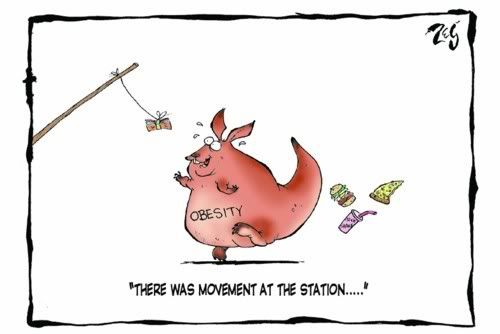
Many Australians who have recently been through what now passes for an Australian education will probably be unaware that the quote in the above cartoon is from a much-loved Australian poem by A.B. Paterson, called "The Man from Snowy River". Zeg appears to think that money might get results
TAXPAYERS should subsidise 12-week weight loss programs for overweight Australians, a leading doctors group says. The Australian General Practice Network also wants $40 million spent on a national program to teach good parenting techniques. And it is pushing for general practice nurses to visit nursing homes and carry out home visits to check on elderly and frail patients.
The network is calling on major parties to commit in this year's election to pay 75 per cent of the cost of a 12-week weight loss program, such as Weight Watchers or Jenny Craig. The $170 subsidy would be triggered by a doctor's referral. Doctors would get feedback about a patient's progress six weeks into the program.
Subsidising weight-loss courses would cost taxpayers $27 million a year. The GP Network says evidence shows obesity is linked to low-income status. "Effective weight management programs do exist but access to them can be difficult," it says. "Fees to attend can be prohibitively high."
Source
Feds support private universities
THE latest round of higher education place allocations cements a plan by John Howard for private providers to be as important in tertiary education as they are in school education. Of 375 new teaching places announced by federal Education, Science and Training Minister Julie Bishop yesterday, more than 50 per cent went to Christian institutions including Avondale College (NSW), Tabor College (Adelaide and Melbourne), the University of Notre Dame (Sydney and Perth) and the Christian Heritage College (Brisbane). These colleges won just over 10 per cent of the 2300 new commonwealth-supported places, or 260 places, including 200 for teaching and 60 for nursing. Last year private colleges received a lower proportion, just 6 per cent of 4600places. Ms Bishop defended the allocations, saying they were for places in accredited courses in areas of national priority.
In contrast with recent years, when regional and outer metropolitan campuses subject to low student demand have been favoured in the allocation of new places, Group of Eight universities featured prominently this year. The University of NSW, Sydney, Adelaide, Monash, Melbourne and the University of Western Australia all were granted more than 100 places each.
Ms Bishop said allocations were based on national and state priorities and fields of workforce shortage. There are more new places in engineering than any other discipline, at 560, followed by nursing (395) and science (390). Ms Bishop said all institutions that applied and were eligible had been granted places. An unprecedented number, 15, did not apply. "This is strong evidence that we have now created as many commonwealth-supported places that are needed to meet eligible student demand," Ms Bishop said. These were the last places to be allocated under the Backing Australia's Future plan for more than 39,000 places over 10 years.
Alan Robson, vice-chancellor of the UWA and incoming president of the Group of Eight research intensive universities, said it was not surprising that Go8 universities had applied for and received more places. "I think the Group of Eight mainly are the universities of first choice for students and hence, when there is a weakening of demand, it filters less into the Group of Eight," he said.
Among regional universities, only Sunshine Coast, Charles Darwin and Ballarat applied for 2008 places. Last year several regional universities including Southern Queensland and James Cook struggled to fill their places, as did Edith Cowan University in Perth. The Government has also revealed figures showing private providers are blitzing public universities in the market for full-fee paying domestic undergraduate places.
Contrary to a recent erroneous media report seized on by the Australian Labor Party and National Union of Students, the number of domestic full-fee paying students in award courses at public universities has risen a modest 6.9 per cent, comparing enrolments for the first half of 2005 with the first half of 2006. That category of enrolments increased by 24 per cent for the private universities, Bond and Notre Dame, during the same period. Among other private higher education providers accredited for the FEE-HELP student loan scheme, domestic full-fee paying enrolments rose by 95 per cent to more than 8000.
Ms Bishop said this showed students were discerning in their choice of educators. "No eligible student is forced to take a place at a private university because there are now sufficient commonwealth-supported places. This is evidence that students are making choices based on factors other than (the availability of government places)." Quality, flexibility in course provision and the availability of niche courses might be among the factors, she said.
University of Adelaide acting vice-chancellor Fred McDougall said the institution was very happy with the additional 235 places, which fit with the university's strategic plan to increase student numbers from 16,000 to 20,000. He said most of the courses targeted areas of high demand such as engineering and mining as well as nursing and other health sciences. "Clearly, given the mining boom, it was important to get extra places in engineering," Professor McDougall said. He said the extra federal funding also allowed the university to establish South Australia's first veterinary school. "We know there is unmet demand nationally for students wanting to study veterinary science," Professor McDougall said. "A new school will help to slow the brain drain of students from South Australia who are leaving to study at vet schools interstate or overseas." ...
Source
A press release below from Australian group, "The Carbon Sense Coalition" (info@carbon-sense.com) -- in the wake of the strong climate focus during the recent APEC meeting of heads of government in Sydney
The Carbon Sense Coalition today called for a Royal Commission of Enquiry [an independent but government-funded judicial enquiry with wide powers] into the scientific evidence for man-made climate cvhange. The Chairman of "Carbon Sense", Mr Viv Forbes, said that the Sydney APEC Declaration was a clear signal that most APEC nations are not going to swallow the pseudo-science and economic poison being peddled by Dark Greens from yesterday's states like Europe and New Zealand.
The APEC nations told Australia, as politely as possible "You may commit economic suicide if you wish, but we are not going to put our feet on the sticky paper." This "Never-Never" declaration is a warning call that Australia should re-examine the basis for its enormous waste of money on "Global Warming".
China and India recognise clearly that "Global Warming" is just another European plan to hobble economic competition from Asia. The Global Warming Scam would deny cheap clean power to millions of energetic Asians.
France closed its last coal mine in 2004 and is now heavily dependent on nuclear power. German coal mines are no longer economic, and even in Britain, fewer than 5,000 coal miners work the mines that once fuelled an empire. Thanks to their Dark Greens, Europe is now dependent on imported coal for steel production and gets its power from imported uranium and gas piped in from Russia and beyond.
France has always envied and feared the cheap and abundant coal of the Anglo American world. The world dominance of Britain and then America in steel, manufacturing, metals, steam, railways, electricity and naval power was fuelled by coal, supported later by oil. China and India are about to tread the same road. The Dark Greens of Europe, secretly supported by their decaying industrialists, fear the growing power, energy and competitiveness of these emerging giants.
This is not about climate - it is about using public hysteria to benefit certain countries, business interests and ideologies. There was no declaration of carbon emission targets from last week's Russian delegation to Queensland. Russian scientists are not sucked in by distortions, exaggerations, half truths and poor science being peddled by the likes of Al Gore and Bob Brown.
The Russians, the Arabs, the Indians and the Chinese cannot believe the apparent stupidity of the English speaking world. They have no intention of adding to their energy costs or forcing their businesses to waste money on dreamtime research such as carbon sequestration - they are cynically planning exploit the declining competitiveness of western industries and to milk stupid westerners of any "carbon offset credits" they can find or invent.
There is already a groundswell of opposition from well informed scientists, engineers and individuals all over the world to the lack of evidence supporting the Greenhouse Religion. A recent scientific conference in Melbourne organised by the Lavoisier Society drew scientists and delegates from all over Australia and South Africa. Even the PM's own backbench contains well informed climate sceptics, and the ranks of scientific sceptics are growing all over the world.
A Royal Commission taking evidence from more than a few government or United Nations hacks would soon establish the facts that:
* 1934 was the hottest year of the twentieth century.
* There was no global warming from 1940 to 1980, a time when CO2 emissions grew strongly.
* There has been no global warming since 1998.
* Current temperatures are not extreme or unusual.
* Past records and scientific evidence show that changing surface temperature is more likely to be a cause (not a result) of increased CO2 in the atmosphere.
* CO2 and water vapour have always been essential components of the atmosphere. Neither is toxic, both tend to retain some of the sun's warmth, and both are absolutely essential and beneficial to all life on earth.
* The most likely causes of variations in surface temperature are connected with solar cycles, variations in the heat output of the sun and eras of volcanic activity.
* More CO2, water vapour and warmth in the atmosphere would be a boon to most of humanity.
* There is empirical evidence to suggest that earth's temperature is more likely to fall than rise - ice ages are more normal than today's balmy climates.
* There is significant scientific opposition to the proposition that man's emissions of CO2 are causing global warming or any other harm.
Earth's climate is always changing and we must do what every generation of our ancestors did - "adapt to whatever nature has in store for us". Our ability to adapt is severely reduced by crippling our economy and misdirecting billions of dollars of research funds into nonsense like carbon sequestration or rich man's toys like windmills and solar panels.
While billions of dollars are being spent on na‹ve attempts to build ever more complex computer models of atmospheric heat circulation, our oceans are largely unexplored. The vast deposits of methane under our oceans are both a threat and a promise for future generations, but too little research is being done in this field. And the hundreds of thousands of undersea volcanoes, which may hold the key to past and future climate change, remain largely unmapped and un-monitored.
Australia, an island almost alone in the Great Southern Ocean which circles the globe, should take the lead in ocean research instead of letting scheming politicians from abroad mis-direct our research priorities to spurious questions.
The depersonalization of government medicine continues apace
HOSPITAL patients in Queensland are to be stamped with barcodes in a move to prevent operations being performed on the wrong body parts. Last financial year 31 mistaken procedures were performed, including three cases of the wrong tooth extracted and two operations on the incorrect part of patients' spines. In another instance, a person's left tonsil was removed in error and a separate patient had botox injected into the wrong body part.
Queensland Health's Patient Safety Centre senior director John Wakefield presented the figures to a Royal Australasian College of Surgeons state meeting near Cairns. They represented a huge increase on 2005-06 numbers, when six such cases were recorded, but Dr Wakefield said the centre had been actively encouraging public hospital staff to report incidents. "You might think: 'Oh gosh, how do these things happen?' " he said. "But as medicine has become more complex and we get people through the system quicker, there's more opportunities for mistakes to be made. "It usually happens in very busy hospitals. A major Brisbane hospital when I was working there three years ago had 22 operating theatres. That's a surgical factory."
Dr Wakefield said although the mistakes were rare, with more than 800,000 patients admitted to Queensland public hospitals in 2006-07, they were all preventable. "For the vast majority, there was very little harm but we regard all these errors potentially as leading to serious harm," Dr Wakefield said outside the meeting. "We're unearthing a problem, a risk in our system, which we've got to fix."
An analysis of the cases found patient misidentification was a significant cause of the problem. Dr Wakefield said Queensland Health planned pilot projects to eliminate the problem, including a study into the benefits of barcoding patients. "In the US veterans' health system, basically every patient has a barcode on the normal hospital wristband as well as their name and date of birth," he said. "It's a big technical investment but we'd like to explore that. "It doesn't just protect against patient misidentification, it protects against the wrong drug being administered as well."
Source
Australians to be paid to lose weight?
Many Australians who have recently been through what now passes for an Australian education will probably be unaware that the quote in the above cartoon is from a much-loved Australian poem by A.B. Paterson, called "The Man from Snowy River". Zeg appears to think that money might get results
TAXPAYERS should subsidise 12-week weight loss programs for overweight Australians, a leading doctors group says. The Australian General Practice Network also wants $40 million spent on a national program to teach good parenting techniques. And it is pushing for general practice nurses to visit nursing homes and carry out home visits to check on elderly and frail patients.
The network is calling on major parties to commit in this year's election to pay 75 per cent of the cost of a 12-week weight loss program, such as Weight Watchers or Jenny Craig. The $170 subsidy would be triggered by a doctor's referral. Doctors would get feedback about a patient's progress six weeks into the program.
Subsidising weight-loss courses would cost taxpayers $27 million a year. The GP Network says evidence shows obesity is linked to low-income status. "Effective weight management programs do exist but access to them can be difficult," it says. "Fees to attend can be prohibitively high."
Source
Feds support private universities
THE latest round of higher education place allocations cements a plan by John Howard for private providers to be as important in tertiary education as they are in school education. Of 375 new teaching places announced by federal Education, Science and Training Minister Julie Bishop yesterday, more than 50 per cent went to Christian institutions including Avondale College (NSW), Tabor College (Adelaide and Melbourne), the University of Notre Dame (Sydney and Perth) and the Christian Heritage College (Brisbane). These colleges won just over 10 per cent of the 2300 new commonwealth-supported places, or 260 places, including 200 for teaching and 60 for nursing. Last year private colleges received a lower proportion, just 6 per cent of 4600places. Ms Bishop defended the allocations, saying they were for places in accredited courses in areas of national priority.
In contrast with recent years, when regional and outer metropolitan campuses subject to low student demand have been favoured in the allocation of new places, Group of Eight universities featured prominently this year. The University of NSW, Sydney, Adelaide, Monash, Melbourne and the University of Western Australia all were granted more than 100 places each.
Ms Bishop said allocations were based on national and state priorities and fields of workforce shortage. There are more new places in engineering than any other discipline, at 560, followed by nursing (395) and science (390). Ms Bishop said all institutions that applied and were eligible had been granted places. An unprecedented number, 15, did not apply. "This is strong evidence that we have now created as many commonwealth-supported places that are needed to meet eligible student demand," Ms Bishop said. These were the last places to be allocated under the Backing Australia's Future plan for more than 39,000 places over 10 years.
Alan Robson, vice-chancellor of the UWA and incoming president of the Group of Eight research intensive universities, said it was not surprising that Go8 universities had applied for and received more places. "I think the Group of Eight mainly are the universities of first choice for students and hence, when there is a weakening of demand, it filters less into the Group of Eight," he said.
Among regional universities, only Sunshine Coast, Charles Darwin and Ballarat applied for 2008 places. Last year several regional universities including Southern Queensland and James Cook struggled to fill their places, as did Edith Cowan University in Perth. The Government has also revealed figures showing private providers are blitzing public universities in the market for full-fee paying domestic undergraduate places.
Contrary to a recent erroneous media report seized on by the Australian Labor Party and National Union of Students, the number of domestic full-fee paying students in award courses at public universities has risen a modest 6.9 per cent, comparing enrolments for the first half of 2005 with the first half of 2006. That category of enrolments increased by 24 per cent for the private universities, Bond and Notre Dame, during the same period. Among other private higher education providers accredited for the FEE-HELP student loan scheme, domestic full-fee paying enrolments rose by 95 per cent to more than 8000.
Ms Bishop said this showed students were discerning in their choice of educators. "No eligible student is forced to take a place at a private university because there are now sufficient commonwealth-supported places. This is evidence that students are making choices based on factors other than (the availability of government places)." Quality, flexibility in course provision and the availability of niche courses might be among the factors, she said.
University of Adelaide acting vice-chancellor Fred McDougall said the institution was very happy with the additional 235 places, which fit with the university's strategic plan to increase student numbers from 16,000 to 20,000. He said most of the courses targeted areas of high demand such as engineering and mining as well as nursing and other health sciences. "Clearly, given the mining boom, it was important to get extra places in engineering," Professor McDougall said. He said the extra federal funding also allowed the university to establish South Australia's first veterinary school. "We know there is unmet demand nationally for students wanting to study veterinary science," Professor McDougall said. "A new school will help to slow the brain drain of students from South Australia who are leaving to study at vet schools interstate or overseas." ...
Source
Wednesday, September 12, 2007
Learn from Asia
THERE is much to learn from successful overseas systems, but some Australian educationalists argue that all is well and we need not change. Education, especially in the classroom, in countries such as Japan, Singapore and South Korea is characterised as inflexible, outdated and conservative. Not so. Research published in The Chinese Learner, edited by David Watkins and John Biggs, as well as Trends in International Mathematics and Science Study-related videotapes of Japanese classrooms demonstrate that Asian classrooms are interactive and lessons deal with concepts and skills as well as facts.
APEC has a role in strengthening education, a source of prosperity, in member economies, including ours. Beginning in 1993, the APEC Education Network has met regularly to collect information describing the education systems of members and to research topics such as mathematics and science education, the place of information and communication technologies in the classroom and ways to achieve an increase in the number of multilingual citizens. Australia has much to learn from members' education systems that achieve world's-best results in international tests such as the TIMSS. Held every four years, the TIMSS tests measure student performance in mathematics and science curriculums at middle-primary and lower and final years of secondary school.
Since the tests began in 1995, Australian students have performed above average, but we are in the second XI when it comes to results. While we like to win in sport, in education we are consistently beaten by students from Singapore, Japan, Hong Kong, South Korea and Taiwan. In the 2003 TIMSS test, out of 49 countries, Australia was ranked 14th in Year8 mathematics and 10th in science. At Year4 level, our students were placed 16th in mathematics and 11th in science. Of concern, when compared with Australia's results in the 1999 tests, is that countries we once outperformed now achieve better results. Indeed, notwithstanding the millions spent on curriculum development and the changes forced on hapless teachers, such was Australia's relatively poor performance that Geoff Masters, the chief executive of the Australian Council for Educational Research and a strong supporter of outcomes-based education, has admitted that all is not well.
"During the 1990s, considerable effort went into the reform of curriculums for the primary and middle years of schooling in Australia, resulting in new state curriculum and standards frameworks," he says. "In the same period, education systems introduced system-wide testing programs to monitor student and school achievement. It is not clear that these efforts have improved levels of mathematics and science performance in Australian primary schools."
Some other APEC-member education systems are able to get more students to perform at the highest level when compared with Australia. In the 2003 test, only 9 per cent of Year8 students reached the advanced level, compared with 25 per cent from Taiwan and 15per cent from Japan. In mathematics, only 7per cent of our Year8 students achieved the advanced level, compared with 44 per cent of students from Singapore.
It also needs to be noted that while Australian students are in the second XI -- as a result of OBE's focus on nurturing self-esteem rather than telling children when they have failed -- our students regard themselves as highly confident and successful. By comparison, students from Japan, Singapore and Hong Kong, even though they perform at the top of the table, do not feel as confident. Why are Australian students underperforming? One reason is that, since the early 1990s, Australian states and territories, to varying degrees, have adopted an OBE model of curriculum. With this model, the focus is on teachers facilitating rather than teaching information. Students are described as "knowledge navigators"' and essential content gives way to new-age generic competency and skills.
As noted last year with Tasmania's so-called Essential Learnings and the debacle represented by forcing OBE into years 11 and 12 in Western Australia, it is also the case that the types of syllabus documents given to Australian teachers are second-rate. Not only are OBE curriculum documents full of jargon and edubabble, but what students are expected to learn is couched in hundreds of vague, confusing and vacuous learning statements that drown teachers in useless detail.
Stronger-performing education systems within APEC never experimented with OBE. More formal approaches to teaching are emphasised and, as a result, students have a clear idea of what is expected of them. There is less disruption and students, given regular testing and feedback, know where they stand in the class. The curriculum is academically based, competition is valued and students are rewarded for success. Teachers are also given clear, concise, year-level syllabuses that detail what needs to be taught. The last point is critical. Unlike in Australia, where teachers are supposed to be curriculum experts and each school has to reinvent the wheel in terms of mapping out what is to be taught, overseas education systems make more time available for teachers to mentor one another and to strengthen classroom practice.
The federal Labor Party and the Coalition Government have both announced that Australia is to have a national curriculum. One approach is to rely on those responsible for Australia's adoption of the OBE model to do the work, in particular the Australian Council for Educational Research and the Curriculum Corporation. As an alternative, given those APEC systems that consistently achieve results that place them at the top of the table in the TIMSS mathematics and science tests, why not look internationally and evaluate any new model of curriculum against overseas best practice?
Source
Amazing claim: School counsellor says pedophile "loved" schoolgirls
A SCHOOL counsellor employed by the Government to help teenage girls has supported a pedophile in court, describing Gary Faux as caring and loving to his victims. Heatherhill Secondary College student welfare co-ordinator Robyn Hughes appeared in the County Court on behalf of Faux, who admitted sexually abusing two schoolgirls. "He cared about them and he loved them," Ms Hughes said during a pre-sentence plea hearing before Judge Jeanette Morrish. Ms Hughes, who also sits on the Heatherhill school council, is a friend of Faux and told the court she was not concerned he may have been manipulating the girls.
The County Court was told Faux took sexually explicit videos and photographs of himself having sex and performing indecent acts with the 16-year-old girls, who did not attend Heatherhill school. Some were taken while one of the girls was wearing her school uniform. The court was told Faux, who was 48 at the time, gave one of the girls alcohol, cigarettes, compact discs, concert tickets and money, and performed sexual acts after encouraging her to wag school. She told police Faux would give her $50 to take photos of her.
Ms Hughes told the court "in normal relationships you buy gifts for each other". She agreed with prosecutor Kevin Doyle the relationship was completely inappropriate, but said Faux had not seen it as "a normal non-sanctioned relationship". "He shared things about himself with the girls, personal things about himself that he wouldn't share with anyone he didn't care about," she said. Ms Hughes told the court she thought Faux believed he was "having an equal relationship with the girls". "I didn't think he felt he was in a position of power in that relationship. I think he cared for them as any relationship does," she said.
Ms Hughes told Judge Morrish that dealing with young people's problems was her specific role at Heatherhill Secondary College, where she was acting assistant principal when she gave evidence.
Judge Morrish sentenced Faux to five years' jail with a minimum of three years. Faux had earlier pleaded guilty to four counts of sexual penetration and eight counts of indecent acts with a 16-year-old under care, supervision or authority. Police believed the offences started when the girls were 15, but could not prove the dates. Judge Morrish was told the charges had been resolved after negotiation and involved rolled-up counts of more than one incident in each charge.
The mother of two girls sexually abused by Faux said yesterday she was horrified Ms Hughes was still counselling girls. "I'm appalled. She shouldn't be dealing with kids," the mother said. "She doesn't even know my girls. She's never met them yet she's made that sort of outrageous assumption. "I just can't believe that the Education Department is turning a blind eye to someone with that attitude being in that sort of position".
Both the education department and the principal of Ms Hughes' school have told the Herald Sun her comments were none of their business. Ms Hughes hung up when contacted by the Herald Sun and asked to respond to criticism of her behaviour. Heatherhill principal Heather Lindsay also refused to comment. "It's purely a matter for the individual concerned," she said. An Education Department spokeswoman, Anna Malbon, also failed to address parents' concerns about Ms Hughes. "The teacher acted as a private citizen. In no way was she representing the school or the department," Ms Malbon said. She said the department had "no role in this case".
Faux denied taking sexually explicit photographs or videos of the girls until police found them when his unit was searched. Police also found two lists describing sexual positions and activities, which Faux later admitted during an interview were ideas he had for one of the girls. The Crown case was that Faux was guilty of a profound breach of trust and was motivated by lust. Prosecutor Kevin Doyle said there had clearly been a degree of grooming of the girls before sexual activity began. He said Faux regularly told one of the girls he had given her so much she should give something back.
Defence counsel Reg Keating told the judge Faux had been addicted to gambling and marijuana but was now being treated. He said Faux had suffered enormously during his life through the loss of people for whom he cared. Psychologist Sharon Groch said Faux's behaviour was not predatory. The court was told Faux suffered a stress-related heart problem caused by a blood clot last February and had been on sick leave since.
Source
Stupid Australian consumer watchdog hates Google but doesn't quite know why
Blind Freddy can see that search results and advertisements are separate. If the ACCC cannot, it suggests that they still live in the fountain pen era
The consumer watchdog suffered a blow in its mammoth court case against Google Inc, when a judge said yesterday its court documents were almost "incomprehensible", "opaque" and "somewhat repetitious". The Australian Competition and Consumer Commission was ordered to write out summaries of its key allegations against various Google companies to clarify its case.
The ACCC launched court action against Google and its subsidiaries in July, alleging misleading and deceptive conduct. The watchdog claims Google does not clearly distinguish between "organic" search results and "sponsored links", which are advertisements. Google says it is clear that the wording "sponsored links" and coloured shading indicates those listings are advertisements.
In a further blow yesterday, the judge hearing the case, James Allsop, said correspondence between the parties made it "tolerably clear" the ACCC did not have a misleading and deceptive case against subsidiaries Google Ireland and Google Australia as their pleadings currently stood. The parties were in court yesterday to ask the judge for separate orders. The watchdog asked the judge to give it permission to serve court documents on Google Inc and Google Ireland, which are outside the Australian jurisdiction. Google Ireland and Google Australia asked the judge to rule the case against them be thrown out of court, because there was no evidence they had engaged in any of the alleged conduct.
Justice Allsop said he would reserve his decision on those matters but made several comments on the documents he had seen so far, in which the ACCC had provided numerous definitions of internet-related concepts, some of which required further definition. "It becomes very difficult to succinctly and precisely explain matters using this technique and with respect it had caused many of the problems identified by (Google's barrister) Mr (Tony) Bannon as to lack of clarity," Justice Allsop said. "Very often an inability to express a proposition with the clarity (required) reflects something wrong with the proposition."
Earlier, Justice Allsop asked the ACCC's barrister, Christine Adamson, to give further details to back its claim that members of the public had been misled by Google. "These representations would have been made where?" Justice Allsop asked? "To the world you say. "Let's narrow it down to the Australian public. Where are those representations made?" Ms Adamson replied: "By Google itself but also in quite a lot of websites."
The ACCC's barrister also cited Google's annual report as a place where customers were told that search results were given by relevance to a user's inquiry. "This is evidence you need to identify in a pleading, how it is the representation has arisen," Justice Allsop said. Justice Allsop ordered the ACCC to file two-page summaries clarifying its position against the various subsidiaries.
Google Australia spokesman Rob Shilkin said the company had said from the outset that the case was wrongly based.
Source
Victorian Leftists defend selective schools
LABOR has launched an assault on the Greens for their policy to phase out selective government high schools such as MacRobertson Girls High. The ALP has funded a mail-out highlighting Greens education policy ahead of this weekend's Albert Park and Williamstown by-elections. Labor's claims have been branded a lie by the Greens.
Former MacRob student Sue Loukomitis yesterday said she approached the ALP to assist after hearing of the "kooky" Greens policy. The policy states that the Greens would work towards "phasing out selective schools, streaming and other models in the government system".
Ms Loukomitis is a former Labor member who works for Auspoll, which is the party's pollster. She does not live in the Albert Park electorate where the letter was distributed. ALP candidate Martin Foley said education had emerged as one of the key issues in Albert Park. "People want to see a good-quality public school option in their community," Mr Foley said.
Labor state secretary Stephen Newnham yesterday compared the Greens' education blueprint with their now-abandoned policy of decriminalising drugs. "The letter is completely accurate. They actually want to shut these schools," Mr Newnham said. The letter does not mention the ALP or Mr Foley, and the only indication the letter is from Labor is fine print declaring it was authorised by Mr Newnham. Labor made a dramatic U-turn on selective schools just before the November election last year, promising two new schools for talented students.
Greens MP Greg Barber dismissed Labor's interpretation of its education policy. "This is a lie. The Greens won't shut down any school," Mr Barber said. Voters this Saturday will choose replacement MPs for former premier Steve Bracks and his deputy, John Thwaites.
Source
THERE is much to learn from successful overseas systems, but some Australian educationalists argue that all is well and we need not change. Education, especially in the classroom, in countries such as Japan, Singapore and South Korea is characterised as inflexible, outdated and conservative. Not so. Research published in The Chinese Learner, edited by David Watkins and John Biggs, as well as Trends in International Mathematics and Science Study-related videotapes of Japanese classrooms demonstrate that Asian classrooms are interactive and lessons deal with concepts and skills as well as facts.
APEC has a role in strengthening education, a source of prosperity, in member economies, including ours. Beginning in 1993, the APEC Education Network has met regularly to collect information describing the education systems of members and to research topics such as mathematics and science education, the place of information and communication technologies in the classroom and ways to achieve an increase in the number of multilingual citizens. Australia has much to learn from members' education systems that achieve world's-best results in international tests such as the TIMSS. Held every four years, the TIMSS tests measure student performance in mathematics and science curriculums at middle-primary and lower and final years of secondary school.
Since the tests began in 1995, Australian students have performed above average, but we are in the second XI when it comes to results. While we like to win in sport, in education we are consistently beaten by students from Singapore, Japan, Hong Kong, South Korea and Taiwan. In the 2003 TIMSS test, out of 49 countries, Australia was ranked 14th in Year8 mathematics and 10th in science. At Year4 level, our students were placed 16th in mathematics and 11th in science. Of concern, when compared with Australia's results in the 1999 tests, is that countries we once outperformed now achieve better results. Indeed, notwithstanding the millions spent on curriculum development and the changes forced on hapless teachers, such was Australia's relatively poor performance that Geoff Masters, the chief executive of the Australian Council for Educational Research and a strong supporter of outcomes-based education, has admitted that all is not well.
"During the 1990s, considerable effort went into the reform of curriculums for the primary and middle years of schooling in Australia, resulting in new state curriculum and standards frameworks," he says. "In the same period, education systems introduced system-wide testing programs to monitor student and school achievement. It is not clear that these efforts have improved levels of mathematics and science performance in Australian primary schools."
Some other APEC-member education systems are able to get more students to perform at the highest level when compared with Australia. In the 2003 test, only 9 per cent of Year8 students reached the advanced level, compared with 25 per cent from Taiwan and 15per cent from Japan. In mathematics, only 7per cent of our Year8 students achieved the advanced level, compared with 44 per cent of students from Singapore.
It also needs to be noted that while Australian students are in the second XI -- as a result of OBE's focus on nurturing self-esteem rather than telling children when they have failed -- our students regard themselves as highly confident and successful. By comparison, students from Japan, Singapore and Hong Kong, even though they perform at the top of the table, do not feel as confident. Why are Australian students underperforming? One reason is that, since the early 1990s, Australian states and territories, to varying degrees, have adopted an OBE model of curriculum. With this model, the focus is on teachers facilitating rather than teaching information. Students are described as "knowledge navigators"' and essential content gives way to new-age generic competency and skills.
As noted last year with Tasmania's so-called Essential Learnings and the debacle represented by forcing OBE into years 11 and 12 in Western Australia, it is also the case that the types of syllabus documents given to Australian teachers are second-rate. Not only are OBE curriculum documents full of jargon and edubabble, but what students are expected to learn is couched in hundreds of vague, confusing and vacuous learning statements that drown teachers in useless detail.
Stronger-performing education systems within APEC never experimented with OBE. More formal approaches to teaching are emphasised and, as a result, students have a clear idea of what is expected of them. There is less disruption and students, given regular testing and feedback, know where they stand in the class. The curriculum is academically based, competition is valued and students are rewarded for success. Teachers are also given clear, concise, year-level syllabuses that detail what needs to be taught. The last point is critical. Unlike in Australia, where teachers are supposed to be curriculum experts and each school has to reinvent the wheel in terms of mapping out what is to be taught, overseas education systems make more time available for teachers to mentor one another and to strengthen classroom practice.
The federal Labor Party and the Coalition Government have both announced that Australia is to have a national curriculum. One approach is to rely on those responsible for Australia's adoption of the OBE model to do the work, in particular the Australian Council for Educational Research and the Curriculum Corporation. As an alternative, given those APEC systems that consistently achieve results that place them at the top of the table in the TIMSS mathematics and science tests, why not look internationally and evaluate any new model of curriculum against overseas best practice?
Source
Amazing claim: School counsellor says pedophile "loved" schoolgirls
A SCHOOL counsellor employed by the Government to help teenage girls has supported a pedophile in court, describing Gary Faux as caring and loving to his victims. Heatherhill Secondary College student welfare co-ordinator Robyn Hughes appeared in the County Court on behalf of Faux, who admitted sexually abusing two schoolgirls. "He cared about them and he loved them," Ms Hughes said during a pre-sentence plea hearing before Judge Jeanette Morrish. Ms Hughes, who also sits on the Heatherhill school council, is a friend of Faux and told the court she was not concerned he may have been manipulating the girls.
The County Court was told Faux took sexually explicit videos and photographs of himself having sex and performing indecent acts with the 16-year-old girls, who did not attend Heatherhill school. Some were taken while one of the girls was wearing her school uniform. The court was told Faux, who was 48 at the time, gave one of the girls alcohol, cigarettes, compact discs, concert tickets and money, and performed sexual acts after encouraging her to wag school. She told police Faux would give her $50 to take photos of her.
Ms Hughes told the court "in normal relationships you buy gifts for each other". She agreed with prosecutor Kevin Doyle the relationship was completely inappropriate, but said Faux had not seen it as "a normal non-sanctioned relationship". "He shared things about himself with the girls, personal things about himself that he wouldn't share with anyone he didn't care about," she said. Ms Hughes told the court she thought Faux believed he was "having an equal relationship with the girls". "I didn't think he felt he was in a position of power in that relationship. I think he cared for them as any relationship does," she said.
Ms Hughes told Judge Morrish that dealing with young people's problems was her specific role at Heatherhill Secondary College, where she was acting assistant principal when she gave evidence.
Judge Morrish sentenced Faux to five years' jail with a minimum of three years. Faux had earlier pleaded guilty to four counts of sexual penetration and eight counts of indecent acts with a 16-year-old under care, supervision or authority. Police believed the offences started when the girls were 15, but could not prove the dates. Judge Morrish was told the charges had been resolved after negotiation and involved rolled-up counts of more than one incident in each charge.
The mother of two girls sexually abused by Faux said yesterday she was horrified Ms Hughes was still counselling girls. "I'm appalled. She shouldn't be dealing with kids," the mother said. "She doesn't even know my girls. She's never met them yet she's made that sort of outrageous assumption. "I just can't believe that the Education Department is turning a blind eye to someone with that attitude being in that sort of position".
Both the education department and the principal of Ms Hughes' school have told the Herald Sun her comments were none of their business. Ms Hughes hung up when contacted by the Herald Sun and asked to respond to criticism of her behaviour. Heatherhill principal Heather Lindsay also refused to comment. "It's purely a matter for the individual concerned," she said. An Education Department spokeswoman, Anna Malbon, also failed to address parents' concerns about Ms Hughes. "The teacher acted as a private citizen. In no way was she representing the school or the department," Ms Malbon said. She said the department had "no role in this case".
Faux denied taking sexually explicit photographs or videos of the girls until police found them when his unit was searched. Police also found two lists describing sexual positions and activities, which Faux later admitted during an interview were ideas he had for one of the girls. The Crown case was that Faux was guilty of a profound breach of trust and was motivated by lust. Prosecutor Kevin Doyle said there had clearly been a degree of grooming of the girls before sexual activity began. He said Faux regularly told one of the girls he had given her so much she should give something back.
Defence counsel Reg Keating told the judge Faux had been addicted to gambling and marijuana but was now being treated. He said Faux had suffered enormously during his life through the loss of people for whom he cared. Psychologist Sharon Groch said Faux's behaviour was not predatory. The court was told Faux suffered a stress-related heart problem caused by a blood clot last February and had been on sick leave since.
Source
Stupid Australian consumer watchdog hates Google but doesn't quite know why
Blind Freddy can see that search results and advertisements are separate. If the ACCC cannot, it suggests that they still live in the fountain pen era
The consumer watchdog suffered a blow in its mammoth court case against Google Inc, when a judge said yesterday its court documents were almost "incomprehensible", "opaque" and "somewhat repetitious". The Australian Competition and Consumer Commission was ordered to write out summaries of its key allegations against various Google companies to clarify its case.
The ACCC launched court action against Google and its subsidiaries in July, alleging misleading and deceptive conduct. The watchdog claims Google does not clearly distinguish between "organic" search results and "sponsored links", which are advertisements. Google says it is clear that the wording "sponsored links" and coloured shading indicates those listings are advertisements.
In a further blow yesterday, the judge hearing the case, James Allsop, said correspondence between the parties made it "tolerably clear" the ACCC did not have a misleading and deceptive case against subsidiaries Google Ireland and Google Australia as their pleadings currently stood. The parties were in court yesterday to ask the judge for separate orders. The watchdog asked the judge to give it permission to serve court documents on Google Inc and Google Ireland, which are outside the Australian jurisdiction. Google Ireland and Google Australia asked the judge to rule the case against them be thrown out of court, because there was no evidence they had engaged in any of the alleged conduct.
Justice Allsop said he would reserve his decision on those matters but made several comments on the documents he had seen so far, in which the ACCC had provided numerous definitions of internet-related concepts, some of which required further definition. "It becomes very difficult to succinctly and precisely explain matters using this technique and with respect it had caused many of the problems identified by (Google's barrister) Mr (Tony) Bannon as to lack of clarity," Justice Allsop said. "Very often an inability to express a proposition with the clarity (required) reflects something wrong with the proposition."
Earlier, Justice Allsop asked the ACCC's barrister, Christine Adamson, to give further details to back its claim that members of the public had been misled by Google. "These representations would have been made where?" Justice Allsop asked? "To the world you say. "Let's narrow it down to the Australian public. Where are those representations made?" Ms Adamson replied: "By Google itself but also in quite a lot of websites."
The ACCC's barrister also cited Google's annual report as a place where customers were told that search results were given by relevance to a user's inquiry. "This is evidence you need to identify in a pleading, how it is the representation has arisen," Justice Allsop said. Justice Allsop ordered the ACCC to file two-page summaries clarifying its position against the various subsidiaries.
Google Australia spokesman Rob Shilkin said the company had said from the outset that the case was wrongly based.
Source
Victorian Leftists defend selective schools
LABOR has launched an assault on the Greens for their policy to phase out selective government high schools such as MacRobertson Girls High. The ALP has funded a mail-out highlighting Greens education policy ahead of this weekend's Albert Park and Williamstown by-elections. Labor's claims have been branded a lie by the Greens.
Former MacRob student Sue Loukomitis yesterday said she approached the ALP to assist after hearing of the "kooky" Greens policy. The policy states that the Greens would work towards "phasing out selective schools, streaming and other models in the government system".
Ms Loukomitis is a former Labor member who works for Auspoll, which is the party's pollster. She does not live in the Albert Park electorate where the letter was distributed. ALP candidate Martin Foley said education had emerged as one of the key issues in Albert Park. "People want to see a good-quality public school option in their community," Mr Foley said.
Labor state secretary Stephen Newnham yesterday compared the Greens' education blueprint with their now-abandoned policy of decriminalising drugs. "The letter is completely accurate. They actually want to shut these schools," Mr Newnham said. The letter does not mention the ALP or Mr Foley, and the only indication the letter is from Labor is fine print declaring it was authorised by Mr Newnham. Labor made a dramatic U-turn on selective schools just before the November election last year, promising two new schools for talented students.
Greens MP Greg Barber dismissed Labor's interpretation of its education policy. "This is a lie. The Greens won't shut down any school," Mr Barber said. Voters this Saturday will choose replacement MPs for former premier Steve Bracks and his deputy, John Thwaites.
Source
Tuesday, September 11, 2007
A man with one blind spot (apparently)
The writer of the excerpt below is Clive Hamilton, executive director of the Leftist Australia Institute. He starts by acknowledging how baseless political scares usually are so the naive reader might think him plausible when he says that global warming is the exception. It's a clever approach from a diehard warmist but when he gets to the point of hinting at the need to "suspend" democracy, I hope most people can see the Stalinist behind the mask.
His lack of intellectual seriousness can also be seen in his reliance on the pronouncements of chief climate hysteric James Hansen -- who in typical Stalinist style relies of fudged statistics to make his case. If his statistics are not fudged, why will he not release the raw data on which they are based? It's a gross breach of normal scientific procedure not to give open access to your data so Hansen's refusal speaks for itself. It shows he has much to fear from independent examination of his work. Even with the roadblocks put up by Hansen, McKitrick recently found glaring errors in Hansen's statistics so the unreliability of what Hansen says is more than mere suspicion. Hamiliton should know all that but his aim is obviously propagation of panic, not the propagation of truth
POLITICAL actors typically engage in exaggeration to advance their agenda, and in the case of climate change the situation is no different. The Labor Party exaggerated the likely damage due to the introduction of the GST, despite the fact that Paul Keating wanted to introduce just such a tax. The Coalition is exaggerating the economic effects of Labor's industrial relations policy. Social-welfare campaigners often overstate the extent of poverty, hoping that appreciation of the magnitude of the problem will spur the public or politicians into doing something about it. Environmental campaigns are no different. Environmentalists have often overstated the effects of environmental decline.
The risks of nuclear power, though considerable, have been exaggerated. The dangers of urban air pollution have been inflated. The threats posed by DDT, lead pollution and pesticides, while significant, have usually been presented as much scarier than they actually are. And the likely effects of genetically modified crops have been blown out of proportion. The purpose of political exaggeration is to stimulate stronger emotional responses, usually fear, and make us more likely to act in the way desired. When your opponents are busily exaggerating the other way, the pressure is almost irresistible.
Yet there is one area where the opposite is the case, where the protagonists on one side have for years systematically understated the dangers. Climate scientists have been afraid to talk about the true extent of the dangers of global warming. Those who have looked closely at what the scientists are concluding believe that the truth is so frightening that, if told, it will stop people from acting, rather than stimulate them to do more. There is a cavernous gap between the urgency of the warnings from science and the political response to it. The concern among the public is way ahead of that of our politicians but it remains true that the public simply has no grasp of the magnitude of the disaster that looms ahead of us.
Nowhere in the rich world, except perhaps in the US, is this radical disconnect greater than in Australia. In June the journal Atmospheric Chemistry and Physics carried a paper by James Hansen and others clarifying the danger of human-induced climate change. Hansen is widely recognised as the world's most eminent climate scientist. The authors concluded that an additional warming of 1C above the year-2000 level will have effects that "may be highly disruptive", using expected sea-level rise as the best indicator of danger. A 1C increase above the 2000 level means an average temperature increase of about 1.7C above the pre-industrial age average. The authors' analysis suggests that this "tipping point" is almost locked in.
They acknowledge that avoiding this danger point is "still technically feasible" but in practice keeping global temperatures from rising by less than 2C is now beyond us. As industrial activity in China and India increases, the effects of global warming will be intensified. In short, we are already past the point that locks in 2C of warming, and will without question go well beyond it. Even a 3C rise is looking very hard to avoid. Very few people, even among environmentalists, have truly faced up to what the science is telling us.
This is because the implications of 3C, let alone 4C or 5C, are so horrible that we look to any possible scenario to head it off, including the canvassing of "emergency" responses such as the suspension of democratic processes.
More here
A thug "protester"
The Stalin types are ever with us
AN APEC protester threw a dart into a police officer's skull before attacking other officers with a metal pole, a court heard yesterday. Gavin George Begbie, 40, is facing 12 charges over the alleged attack on police in Sydney during Saturday's demonstrations. Mr Begbie was one of the five people arrested and kept in custody following 18 arrests. The group yesterday faced Sydney's Parramatta Bail Court via audio visual link from the Sydney Police Centre in Surry Hills.
Two of the protesters, including Marcelea Fabiola Olea, 31, from Victoria, were granted bail. Police allege Ms Olea, who was filming the rally, punched a policeman in the face. Three others, including Mr Begbie, were remanded in custody by Magistrate Kevin Flack.
Mr Begbie, a part-time farmhand from Pimlico in northern NSW, allegedly threw a dart at Chief Insp Mark Death about 11.30am on Saturday. It is alleged the metal-tipped dart pierced the officer's baseball cap and the point lodged in his skull. According to police documents tendered to the court, when other officers tried to arrest Mr Begbie, he swung a metal pole covered in newspaper at them and then struck Constable Michael Nolan in the forehead, causing him to bleed profusely.
Police allege Mr Begbie lashed out at two other officers, allegedly striking one in the thigh and arm and the other in the nose and back, before he was restrained and taken into custody. Police allege he said: "I didn't even get the guy in the eye. What's the big deal?"
Police prosecutor Andrea Rodriguez strongly opposed bail. "There are multiple assaults on multiple police officers ... throwing of a metal dart, embedding someone's skull and hitting a police officer with a metal pole requiring four stitches," Sgt Rodriguez told the court. Mr Begbie faces four counts of assaulting police, five of resisting arrest and one count of throwing a missile.
The five accused were not arrested in restricted APEC areas and face charges including assaulting police, resisting arrest and hindering police.
Mr Begbie, Andrew Edward Pearson, 37, of the Sydney suburb of Balmain and Stephen Martin, 25, of Queensland, were refused bail and were remanded in custody to appear before Sydney's Central Local Court today. Daniella Olea said she was with her sister Marcelea at the protests and that they were both independent filmmakers. She said she witnessed the entire incident with police and said her sister did not assault police. "We were filming and they (the police) basically wanted the camera. That's what they wanted and that's what they were trying to get," the 25-year-old said.
Source
$30 a fortnight extra promised for veterans' affairs
Smart move
LABOR stands to gain the backing of the veterans' community after unveiling a $55 million plan to increase pensions for former Diggers and war widows. In a pre-election pitch to the 175,000 services community, Kevin Rudd will tomorrow promise to increase pensions by up to $30 per fortnight for all disabled war veterans.
The promise, to be made by the Opposition Leader during a keynote speech to the RSL National Congress, follows a strong campaign by veterans to have pension increases pegged to a higher annual rate. Labor's plan will affect nearly 140,000 disabled war veterans who have served in some of history's bloodiest conflicts, including World War II and the Vietnam War. But it will also flow to veterans injured during more recent conflicts, including Iraq, Afghanistan and the UN-led peacekeeping efforts in East Timor.
"Veterans have sacrificed so much for our nation and they deserve more than having this Government tell them they have never been better off," Mr Rudd said. "This announcement is a further step by Labor on the road to ensuring that our veterans and their widows receive the compensation that they so richly deserve."
The RSL and other veterans' groups have been lobbying the Government for years to index all disabled veterans and war widows pensions to the higher rate, known as MTAWE. Mr Rudd said the increased pension payment would see veterans earning up to $30 extra per fortnight. "Our veterans and their widows have paid a very high price for their service to our country. This is about fixing an injustice," he said.
Last night, the RSL national president Bill Crews said war veterans would be thrilled by the Labor announcement. "Currently there is an inequity because these pensions have been falling behind the cost of living," Mr Crews said. He expected Labor to win plaudits from the RSL. "We'll tell our members that Labor has signed up to it (the higher pension plan)," he said. "But we are not playing favourites here."
Labor's veterans affairs spokesman Alan Griffin said the commitment on pensions would take effect from September 2008. "We have listened to our nation's veterans and their widows and we have responded to their concerns," Mr Griffin said. He said veterans from recent conflicts were already needing assistance as a result of their injuries. "The Howard Government has steadfastly refused to index the domestic component of the war widows' pension."
Source
Amazing defence of false allegations
With constant false allegations against teachers by vindictive girls, it is minimal justice for all allegations to be shielded from publicity unless and until a guilty verdict is reached
A PARENTS' group has attacked union calls for teachers accused of misconduct to be spared being named and shamed.
The Australian Education Union said teachers who were hauled before disciplinary hearings, including those being investigated for sexual misconduct with minors, should remain anonymous unless found guilty. The union suggested the ban in its submission to a government review of the Victorian Institute of Teaching. AEU state president Mary Bluett said the VIT's practice of naming accused teachers who were found not guilty was ruining careers. "Anyone can make an accusation to the VIT and the VIT must investigate it," Ms Bluett said. "For a teacher who is not guilty, simply being named can be enough for some schools to avoid employing that teacher."
Gail McHardy from Parents Victoria said the ban could make a teacher think twice about the consequences of making a wrong choice. "Why should teachers be treated any differently than any other professional or member of the public?" she said.
Source
The writer of the excerpt below is Clive Hamilton, executive director of the Leftist Australia Institute. He starts by acknowledging how baseless political scares usually are so the naive reader might think him plausible when he says that global warming is the exception. It's a clever approach from a diehard warmist but when he gets to the point of hinting at the need to "suspend" democracy, I hope most people can see the Stalinist behind the mask.
His lack of intellectual seriousness can also be seen in his reliance on the pronouncements of chief climate hysteric James Hansen -- who in typical Stalinist style relies of fudged statistics to make his case. If his statistics are not fudged, why will he not release the raw data on which they are based? It's a gross breach of normal scientific procedure not to give open access to your data so Hansen's refusal speaks for itself. It shows he has much to fear from independent examination of his work. Even with the roadblocks put up by Hansen, McKitrick recently found glaring errors in Hansen's statistics so the unreliability of what Hansen says is more than mere suspicion. Hamiliton should know all that but his aim is obviously propagation of panic, not the propagation of truth
POLITICAL actors typically engage in exaggeration to advance their agenda, and in the case of climate change the situation is no different. The Labor Party exaggerated the likely damage due to the introduction of the GST, despite the fact that Paul Keating wanted to introduce just such a tax. The Coalition is exaggerating the economic effects of Labor's industrial relations policy. Social-welfare campaigners often overstate the extent of poverty, hoping that appreciation of the magnitude of the problem will spur the public or politicians into doing something about it. Environmental campaigns are no different. Environmentalists have often overstated the effects of environmental decline.
The risks of nuclear power, though considerable, have been exaggerated. The dangers of urban air pollution have been inflated. The threats posed by DDT, lead pollution and pesticides, while significant, have usually been presented as much scarier than they actually are. And the likely effects of genetically modified crops have been blown out of proportion. The purpose of political exaggeration is to stimulate stronger emotional responses, usually fear, and make us more likely to act in the way desired. When your opponents are busily exaggerating the other way, the pressure is almost irresistible.
Yet there is one area where the opposite is the case, where the protagonists on one side have for years systematically understated the dangers. Climate scientists have been afraid to talk about the true extent of the dangers of global warming. Those who have looked closely at what the scientists are concluding believe that the truth is so frightening that, if told, it will stop people from acting, rather than stimulate them to do more. There is a cavernous gap between the urgency of the warnings from science and the political response to it. The concern among the public is way ahead of that of our politicians but it remains true that the public simply has no grasp of the magnitude of the disaster that looms ahead of us.
Nowhere in the rich world, except perhaps in the US, is this radical disconnect greater than in Australia. In June the journal Atmospheric Chemistry and Physics carried a paper by James Hansen and others clarifying the danger of human-induced climate change. Hansen is widely recognised as the world's most eminent climate scientist. The authors concluded that an additional warming of 1C above the year-2000 level will have effects that "may be highly disruptive", using expected sea-level rise as the best indicator of danger. A 1C increase above the 2000 level means an average temperature increase of about 1.7C above the pre-industrial age average. The authors' analysis suggests that this "tipping point" is almost locked in.
They acknowledge that avoiding this danger point is "still technically feasible" but in practice keeping global temperatures from rising by less than 2C is now beyond us. As industrial activity in China and India increases, the effects of global warming will be intensified. In short, we are already past the point that locks in 2C of warming, and will without question go well beyond it. Even a 3C rise is looking very hard to avoid. Very few people, even among environmentalists, have truly faced up to what the science is telling us.
This is because the implications of 3C, let alone 4C or 5C, are so horrible that we look to any possible scenario to head it off, including the canvassing of "emergency" responses such as the suspension of democratic processes.
More here
A thug "protester"
The Stalin types are ever with us
AN APEC protester threw a dart into a police officer's skull before attacking other officers with a metal pole, a court heard yesterday. Gavin George Begbie, 40, is facing 12 charges over the alleged attack on police in Sydney during Saturday's demonstrations. Mr Begbie was one of the five people arrested and kept in custody following 18 arrests. The group yesterday faced Sydney's Parramatta Bail Court via audio visual link from the Sydney Police Centre in Surry Hills.
Two of the protesters, including Marcelea Fabiola Olea, 31, from Victoria, were granted bail. Police allege Ms Olea, who was filming the rally, punched a policeman in the face. Three others, including Mr Begbie, were remanded in custody by Magistrate Kevin Flack.
Mr Begbie, a part-time farmhand from Pimlico in northern NSW, allegedly threw a dart at Chief Insp Mark Death about 11.30am on Saturday. It is alleged the metal-tipped dart pierced the officer's baseball cap and the point lodged in his skull. According to police documents tendered to the court, when other officers tried to arrest Mr Begbie, he swung a metal pole covered in newspaper at them and then struck Constable Michael Nolan in the forehead, causing him to bleed profusely.
Police allege Mr Begbie lashed out at two other officers, allegedly striking one in the thigh and arm and the other in the nose and back, before he was restrained and taken into custody. Police allege he said: "I didn't even get the guy in the eye. What's the big deal?"
Police prosecutor Andrea Rodriguez strongly opposed bail. "There are multiple assaults on multiple police officers ... throwing of a metal dart, embedding someone's skull and hitting a police officer with a metal pole requiring four stitches," Sgt Rodriguez told the court. Mr Begbie faces four counts of assaulting police, five of resisting arrest and one count of throwing a missile.
The five accused were not arrested in restricted APEC areas and face charges including assaulting police, resisting arrest and hindering police.
Mr Begbie, Andrew Edward Pearson, 37, of the Sydney suburb of Balmain and Stephen Martin, 25, of Queensland, were refused bail and were remanded in custody to appear before Sydney's Central Local Court today. Daniella Olea said she was with her sister Marcelea at the protests and that they were both independent filmmakers. She said she witnessed the entire incident with police and said her sister did not assault police. "We were filming and they (the police) basically wanted the camera. That's what they wanted and that's what they were trying to get," the 25-year-old said.
Source
$30 a fortnight extra promised for veterans' affairs
Smart move
LABOR stands to gain the backing of the veterans' community after unveiling a $55 million plan to increase pensions for former Diggers and war widows. In a pre-election pitch to the 175,000 services community, Kevin Rudd will tomorrow promise to increase pensions by up to $30 per fortnight for all disabled war veterans.
The promise, to be made by the Opposition Leader during a keynote speech to the RSL National Congress, follows a strong campaign by veterans to have pension increases pegged to a higher annual rate. Labor's plan will affect nearly 140,000 disabled war veterans who have served in some of history's bloodiest conflicts, including World War II and the Vietnam War. But it will also flow to veterans injured during more recent conflicts, including Iraq, Afghanistan and the UN-led peacekeeping efforts in East Timor.
"Veterans have sacrificed so much for our nation and they deserve more than having this Government tell them they have never been better off," Mr Rudd said. "This announcement is a further step by Labor on the road to ensuring that our veterans and their widows receive the compensation that they so richly deserve."
The RSL and other veterans' groups have been lobbying the Government for years to index all disabled veterans and war widows pensions to the higher rate, known as MTAWE. Mr Rudd said the increased pension payment would see veterans earning up to $30 extra per fortnight. "Our veterans and their widows have paid a very high price for their service to our country. This is about fixing an injustice," he said.
Last night, the RSL national president Bill Crews said war veterans would be thrilled by the Labor announcement. "Currently there is an inequity because these pensions have been falling behind the cost of living," Mr Crews said. He expected Labor to win plaudits from the RSL. "We'll tell our members that Labor has signed up to it (the higher pension plan)," he said. "But we are not playing favourites here."
Labor's veterans affairs spokesman Alan Griffin said the commitment on pensions would take effect from September 2008. "We have listened to our nation's veterans and their widows and we have responded to their concerns," Mr Griffin said. He said veterans from recent conflicts were already needing assistance as a result of their injuries. "The Howard Government has steadfastly refused to index the domestic component of the war widows' pension."
Source
Amazing defence of false allegations
With constant false allegations against teachers by vindictive girls, it is minimal justice for all allegations to be shielded from publicity unless and until a guilty verdict is reached
A PARENTS' group has attacked union calls for teachers accused of misconduct to be spared being named and shamed.
The Australian Education Union said teachers who were hauled before disciplinary hearings, including those being investigated for sexual misconduct with minors, should remain anonymous unless found guilty. The union suggested the ban in its submission to a government review of the Victorian Institute of Teaching. AEU state president Mary Bluett said the VIT's practice of naming accused teachers who were found not guilty was ruining careers. "Anyone can make an accusation to the VIT and the VIT must investigate it," Ms Bluett said. "For a teacher who is not guilty, simply being named can be enough for some schools to avoid employing that teacher."
Gail McHardy from Parents Victoria said the ban could make a teacher think twice about the consequences of making a wrong choice. "Why should teachers be treated any differently than any other professional or member of the public?" she said.
Source
Monday, September 10, 2007
Treaty tightens US military ties
AUSTRALIA'S defence co-operation with the US will be significantly upgraded under a new treaty that gives unprecedented access to the latest American military technology and equipment. The deal will provide lucrative opportunities for Australian companies to tap into leading US defence projects, including the $15billion Joint Strike Fighter project. The treaty will also ease restrictions on the purchase of Australian-made defence equipment by the US. The treaty was among several new measures, including more joint training and military exchanges, announced yesterday by John Howard and US President George W.Bush.
The measures usher in a new era of defence co-operation between the two allies, who have already forged closer links in recent years through their shared military commitments in Iraq and Afghanistan. Mr Bush described the new Treaty on Defence Trade Co-operation as an important step for the two countries. "It helps cut through the bureaucracy so that we can transform our forces better, share technology better and, frankly, enable our private sectors to work together to develop new defence capabilities to defend ourselves," he said.
The Prime Minister said the new defence initiatives were a significant enhancement of an already close relationship. He said the treaty would clear the red tape that had previously hampered Australian companies from acquiring US technology. Australia would now enjoy the same privileged access to the US market as British defence companies had.
Mr Howard said other measures included more joint training and operations with US forces. Joint training capability would be enhanced by the provision of additional support for training by US and Australian forces in Australia, and further co-operative efforts to develop access and capabilities for international surveillance and reconnaissance.
He also said Australia and the US would increase co-operation on humanitarian assistance and disaster relief to better cope with regional disasters such as the 2004 tsunami. This could involve the stationing by the US in Australia of equipment and stores that would be readily available for use in disaster relief in our immediate region, Mr Howard said.
The new defence trade treaty will allow the licence-free export of defence equipment, technology and information between Australia and the US, removing the logjam of delays caused by the slow licensing processes. It would also provide for greater access and sharing of equipment, technology, information and services between the twocountries, a Defence spokesman said.
Raytheon Australia, the country's leading missile systems integrator, said the treaty represented an important step forward insecurity co-operation with theUS. "It is a real plan for real jobs," said Raytheon Australia managing director Ron Fisher. "By giving Australia's emerging defence industry greater autonomy and enabling easier technology transfer, the agreement removes a big roadblock to the growth of jobs."
Source
Aspirational climate goals needed - APEC
Tokenism is probably the safest electoral strategy at the moment
APEC leaders have agreed to the need for long-term aspirational goals to reduce greenhouse gas emissions, Prime Minister John Howard said today, but they have not set any specific targets. "(They agreed) the need for a long-term aspirational, global emissions reduction, goal," he said in a statement read to camera.
After the conclusion of the first day of the APEC leaders' summit, Mr Howard released the so-called Sydney Declaration, which also requires all nations to be part of the solution to the global warming problem. "(It also includes) the need for all nations, no matter what their stage of development, to contribute according to their own capacity and their own circumstances to reducing greenhouse gases," Mr Howard said. The third component of the declaration is specific goals for the 21 Asia Pacific Economic Cooperation (APEC) economies on energy intensity and forestry, Mr Howard said.
The lack of specific greenhouse reduction targets was widely expected after a draft of the statement was leaked last month. "This is even worse than the low expectations people had because it doesn't even set a long-term aspirational goal, there's no figure like 50 per cent by 2050, or 20 per cent by 2020," Greenpeace's Ben Oquist said.
Mr Howard said the Sydney Declaration emphasised the "relevance of APEC". "It demonstrates that APEC is very much alive and kicking. It does illustrate again the strength in consensus-based diversity and informal meetings and this declaration does transcend a number of international divisions." The declaration affirms the primary importance of the United Nations framework to deal with climate change, a point China's President Hu Jintao indicated was critical to any agreement on the statement.
Mr Howard said APEC would add to the momentum on climate change, particularly a meeting of major economies dealing with the problem in Washington later this month and a UN forum in Bali in December. "The Sydney Declaration ... is very important in the march towards a sensible international agreement on climate change which recognises the need to make progress but also recognises that different economies bring different perspectives to addressing the challenge of climate change," he said.
In the statement, the APEC leaders declared their recognition that "economic growth, energy security and climate change are fundamental and interlinked challenges for the APEC region". "The dynamism of APEC, underpinned by open trade and investment, has reduced poverty, improved living standards and delivered economic and social development," the Sydney Declaration said. "Our success has relied in part on secure supplies of energy, the use of which has also contributed to air quality problems and greenhouse gas emissions. "We are committed, through wide-ranging and ambitious actions, to ensuring the energy needs of the economies of the region while addressing the issue of environmental quality and contributing to the reduction of greenhouse gas emissions."
Mr Howard said it was a major international challenge to meet energy needs and development priorities while at the same time addressing the problem of climate change. "In the Sydney Declaration, the leaders have moved to forge a new international consensus," he said. "We are serious about addressing, in a sensible way compatible with our different economic needs, the great challenge of climate change. "Each of us comes to the APEC table with different perspectives, reflecting both our diversity and strengths. "And yet in the Sydney Declaration we have agreed on three very important and quite specific things."
Source
More encouragement to have babies?
HISTORIC legislation will be introduced to the Senate this week that aims to make all working women eligible for 14 weeks' Government-funded maternity leave at the minimum wage. Senator Natasha Stott Despoja, the Australian Democrats' spokeswoman on the status of women, will introduce the Private Senator's Bill on Thursday.
She said a national scheme of paid maternity leave was long overdue. "Australia lags miserably behind the rest of the world. We are one of only two OECD nations, along with the United States, that don't provide it," she said. "There's been a clear lack of political will on both sides of politics, and a continual under-estimation of the needs of working women in this country. "The fact we have a gender pay gap as bad as it was in 1978 suggests to me that women and work issues have fallen off the agenda."
Senator Stott Despoja, who became a mother in 2004 to Conrad Stott Smith, said this was a serious election issue. "We need to hear from Labor and the Coalition about what they will do for working women generally, and their commitment to paid maternity leave." Only about a third of working women receive paid leave.
A Newspoll survey in June found more than 75 per cent of Australians supported a national paid maternity leave scheme. The Workplace Relations (Guaranteeing Paid Maternity Leave) Amendment Bill 2007 updates Senator Stott Despoja's 2002 Private Senator's Bill for paid maternity leave, to reflect changes to the Workplace Relations Act.
Source
Don't have an accident on the weekend
MATTHEW Lawson was a code one patient who died at the scene of his accident near the Gold Coast. Despite his urgent need for medical treatment, it took ambulance officers 25 minutes to reach the father of two young daughters. Records obtained under Freedom of Information laws also reveal ambulance officers pressed the "on-scene button" more than five minutes before they actually arrived, a practice the Queensland Ambulance Service Commissioner has vehemently denied is used to falsify response-time records.
As concern continues to build about the state of our ambulance service, Mr Lawson's family desperately wants to know whether he could have been saved if medical treatment had been delivered sooner. Mr Lawson, 35, of Ormeau Hills, died about an hour after his motorbike collided with a car on August 26 last year at Ormeau, just a few minutes away from the closest ambulance station.
An ambulance spokeswoman said that station was closed on the weekends and the nearest operating station was about 10km away at Beenleigh. "At the time of the call, ambulance teams in the area were responding to a number of life-threatening cases, including two patients with chest pain and a patient with breathing problems," she said. Mr Lawson's family said they were told by a Queensland Health official that he might have been saved if medical help had arrived sooner because he most probably bled to death from his multiple fractures.
A coroner is investigating his death. An autopsy found he died of "multiple injuries due to a motorcycle accident". Mr Lawson's sister, Michelle Lawson, said the QAS was endangering lives with its lengthy response times. "It's just not fair. Matthew bled to death on the side of the road and I feel that the ambulance service and the Government as a whole are responsible for his death.," she said. "I think if the ambulance did get there within a certain time frame he probably could have survived."
Ambulance records show the first officers reached the scene at 6.19pm but treatment did not begin until 6.26pm after a second crew arrived. A statement from QAS said the time recording of 6.19pm was a mistake. "The Woodridge unit pressed the on-scene button at 6.19pm when adjacent to the incident but the crew then realised that they were unable to cross the Pacific Motorway at that location and had to proceed down the motorway to an exit and return along the service road to the incident," the statement said. The service also lost an electrocardiogram strip the family had requested.
Source
AUSTRALIA'S defence co-operation with the US will be significantly upgraded under a new treaty that gives unprecedented access to the latest American military technology and equipment. The deal will provide lucrative opportunities for Australian companies to tap into leading US defence projects, including the $15billion Joint Strike Fighter project. The treaty will also ease restrictions on the purchase of Australian-made defence equipment by the US. The treaty was among several new measures, including more joint training and military exchanges, announced yesterday by John Howard and US President George W.Bush.
The measures usher in a new era of defence co-operation between the two allies, who have already forged closer links in recent years through their shared military commitments in Iraq and Afghanistan. Mr Bush described the new Treaty on Defence Trade Co-operation as an important step for the two countries. "It helps cut through the bureaucracy so that we can transform our forces better, share technology better and, frankly, enable our private sectors to work together to develop new defence capabilities to defend ourselves," he said.
The Prime Minister said the new defence initiatives were a significant enhancement of an already close relationship. He said the treaty would clear the red tape that had previously hampered Australian companies from acquiring US technology. Australia would now enjoy the same privileged access to the US market as British defence companies had.
Mr Howard said other measures included more joint training and operations with US forces. Joint training capability would be enhanced by the provision of additional support for training by US and Australian forces in Australia, and further co-operative efforts to develop access and capabilities for international surveillance and reconnaissance.
He also said Australia and the US would increase co-operation on humanitarian assistance and disaster relief to better cope with regional disasters such as the 2004 tsunami. This could involve the stationing by the US in Australia of equipment and stores that would be readily available for use in disaster relief in our immediate region, Mr Howard said.
The new defence trade treaty will allow the licence-free export of defence equipment, technology and information between Australia and the US, removing the logjam of delays caused by the slow licensing processes. It would also provide for greater access and sharing of equipment, technology, information and services between the twocountries, a Defence spokesman said.
Raytheon Australia, the country's leading missile systems integrator, said the treaty represented an important step forward insecurity co-operation with theUS. "It is a real plan for real jobs," said Raytheon Australia managing director Ron Fisher. "By giving Australia's emerging defence industry greater autonomy and enabling easier technology transfer, the agreement removes a big roadblock to the growth of jobs."
Source
Aspirational climate goals needed - APEC
Tokenism is probably the safest electoral strategy at the moment
APEC leaders have agreed to the need for long-term aspirational goals to reduce greenhouse gas emissions, Prime Minister John Howard said today, but they have not set any specific targets. "(They agreed) the need for a long-term aspirational, global emissions reduction, goal," he said in a statement read to camera.
After the conclusion of the first day of the APEC leaders' summit, Mr Howard released the so-called Sydney Declaration, which also requires all nations to be part of the solution to the global warming problem. "(It also includes) the need for all nations, no matter what their stage of development, to contribute according to their own capacity and their own circumstances to reducing greenhouse gases," Mr Howard said. The third component of the declaration is specific goals for the 21 Asia Pacific Economic Cooperation (APEC) economies on energy intensity and forestry, Mr Howard said.
The lack of specific greenhouse reduction targets was widely expected after a draft of the statement was leaked last month. "This is even worse than the low expectations people had because it doesn't even set a long-term aspirational goal, there's no figure like 50 per cent by 2050, or 20 per cent by 2020," Greenpeace's Ben Oquist said.
Mr Howard said the Sydney Declaration emphasised the "relevance of APEC". "It demonstrates that APEC is very much alive and kicking. It does illustrate again the strength in consensus-based diversity and informal meetings and this declaration does transcend a number of international divisions." The declaration affirms the primary importance of the United Nations framework to deal with climate change, a point China's President Hu Jintao indicated was critical to any agreement on the statement.
Mr Howard said APEC would add to the momentum on climate change, particularly a meeting of major economies dealing with the problem in Washington later this month and a UN forum in Bali in December. "The Sydney Declaration ... is very important in the march towards a sensible international agreement on climate change which recognises the need to make progress but also recognises that different economies bring different perspectives to addressing the challenge of climate change," he said.
In the statement, the APEC leaders declared their recognition that "economic growth, energy security and climate change are fundamental and interlinked challenges for the APEC region". "The dynamism of APEC, underpinned by open trade and investment, has reduced poverty, improved living standards and delivered economic and social development," the Sydney Declaration said. "Our success has relied in part on secure supplies of energy, the use of which has also contributed to air quality problems and greenhouse gas emissions. "We are committed, through wide-ranging and ambitious actions, to ensuring the energy needs of the economies of the region while addressing the issue of environmental quality and contributing to the reduction of greenhouse gas emissions."
Mr Howard said it was a major international challenge to meet energy needs and development priorities while at the same time addressing the problem of climate change. "In the Sydney Declaration, the leaders have moved to forge a new international consensus," he said. "We are serious about addressing, in a sensible way compatible with our different economic needs, the great challenge of climate change. "Each of us comes to the APEC table with different perspectives, reflecting both our diversity and strengths. "And yet in the Sydney Declaration we have agreed on three very important and quite specific things."
Source
More encouragement to have babies?
HISTORIC legislation will be introduced to the Senate this week that aims to make all working women eligible for 14 weeks' Government-funded maternity leave at the minimum wage. Senator Natasha Stott Despoja, the Australian Democrats' spokeswoman on the status of women, will introduce the Private Senator's Bill on Thursday.
She said a national scheme of paid maternity leave was long overdue. "Australia lags miserably behind the rest of the world. We are one of only two OECD nations, along with the United States, that don't provide it," she said. "There's been a clear lack of political will on both sides of politics, and a continual under-estimation of the needs of working women in this country. "The fact we have a gender pay gap as bad as it was in 1978 suggests to me that women and work issues have fallen off the agenda."
Senator Stott Despoja, who became a mother in 2004 to Conrad Stott Smith, said this was a serious election issue. "We need to hear from Labor and the Coalition about what they will do for working women generally, and their commitment to paid maternity leave." Only about a third of working women receive paid leave.
A Newspoll survey in June found more than 75 per cent of Australians supported a national paid maternity leave scheme. The Workplace Relations (Guaranteeing Paid Maternity Leave) Amendment Bill 2007 updates Senator Stott Despoja's 2002 Private Senator's Bill for paid maternity leave, to reflect changes to the Workplace Relations Act.
Source
Don't have an accident on the weekend
MATTHEW Lawson was a code one patient who died at the scene of his accident near the Gold Coast. Despite his urgent need for medical treatment, it took ambulance officers 25 minutes to reach the father of two young daughters. Records obtained under Freedom of Information laws also reveal ambulance officers pressed the "on-scene button" more than five minutes before they actually arrived, a practice the Queensland Ambulance Service Commissioner has vehemently denied is used to falsify response-time records.
As concern continues to build about the state of our ambulance service, Mr Lawson's family desperately wants to know whether he could have been saved if medical treatment had been delivered sooner. Mr Lawson, 35, of Ormeau Hills, died about an hour after his motorbike collided with a car on August 26 last year at Ormeau, just a few minutes away from the closest ambulance station.
An ambulance spokeswoman said that station was closed on the weekends and the nearest operating station was about 10km away at Beenleigh. "At the time of the call, ambulance teams in the area were responding to a number of life-threatening cases, including two patients with chest pain and a patient with breathing problems," she said. Mr Lawson's family said they were told by a Queensland Health official that he might have been saved if medical help had arrived sooner because he most probably bled to death from his multiple fractures.
A coroner is investigating his death. An autopsy found he died of "multiple injuries due to a motorcycle accident". Mr Lawson's sister, Michelle Lawson, said the QAS was endangering lives with its lengthy response times. "It's just not fair. Matthew bled to death on the side of the road and I feel that the ambulance service and the Government as a whole are responsible for his death.," she said. "I think if the ambulance did get there within a certain time frame he probably could have survived."
Ambulance records show the first officers reached the scene at 6.19pm but treatment did not begin until 6.26pm after a second crew arrived. A statement from QAS said the time recording of 6.19pm was a mistake. "The Woodridge unit pressed the on-scene button at 6.19pm when adjacent to the incident but the crew then realised that they were unable to cross the Pacific Motorway at that location and had to proceed down the motorway to an exit and return along the service road to the incident," the statement said. The service also lost an electrocardiogram strip the family had requested.
Source
Sunday, September 09, 2007
Loosen curbs on our liberty
Comment from the publisher of "The Australian"
DAVID Marr's essay "His Master's Voice: The Corruption of Public Debate Under Howard", weaves such a tapestry of alleged lies, deception, censorship, intimidation and persecution that, if we believed it all, Australians should be in a state of despair. While I agree with Marr some of the time, I can't accept much of his reasoning (in his article, published in Quarterly Essay Issue 26). Debate in Australia is vibrant and intense at all levels of society and through all media: newspapers, radio, television, at public meetings, through the internet and in journals like this.
The problem I see is the degree to which the flow of information that generates or fuels informed debate has been stifled. When information is suppressed, our right to know how we are governed and how our courts dispense justice is diminished. Our democracy loses some of its spark. Unlike Marr, I think there are many underlying causes and I am optimistic (they) can befixed.
Marr's passionate analysis of life during John Howard's 11 years as Prime Minister is undermined by the zeal and doggedness of his ideology and jaundiced by his dislike of the man. The problems we now face have occurred at the hands of Australian governments of all political stripes and at federal, state and local levels. Many hundreds of statutes, some federal, some unique to different states, have cumulatively created a wall of prohibitions (that hampers) what Australians can know about how our governments and courts function. It is, quite frankly, unhelpful to lay all the blame at the gates of the Lodge.
Some of the worst examples of the erosion of free speech can be seen in the adoption of spin at all levels of government and business. Debates on issues as important as this should be conducted with a view to achieving change rather than polarising positions so that problems simply become entrenched. Government decision-makers are unlikely to be swayed by rhetoric describing Howard as an evil object of derision. For example, Marr's statement: "After being belittled for most of his political career, Howard came to power determined public debate would be conducted on his terms." Belittled for most of his political career? Really? Only by his political opponents.
Marr applauds actor Terry Servio's "devastating" portrait (of Howard) in the stage show Keating! The Musical that made him "a figure of fun, but strangely unfunny". Do these observations advance the cause of free speech? Marr accuses the Government of discrediting its critics to undermine their arguments. Isn't Marr guilty of the same? Howard may well have come to power determined public debate would be conducted on his terms, but show me the politician who doesn't. There is no doubt he has deliberately built a public relations machine that ensures the "correct" spin is applied to stories affecting his Government. It rivals the propaganda machines of previous governments.
But it is disingenuous to suggest the erosion of free speech has come about as a result of a Machiavellian blueprint carefully implemented over just the past decade and by just one man. The erosion has been gradual, over at least three decades, and has occurred at the hands of commonwealth and state governments of all colours. Still, an event that happened halfway through Howard's tenure significantly compounded the problem: the 9/11 terrorist attacks.
Marr contends that 9/11 was just one of a string of events, including the internet, that "changed everything". I believe 9/11 differed immensely because it was an attack on democracy and capitalism and on innocent human life that until then was inconceivable. The 9/11 attack created the climate of public acceptance that strong measures had to be introduced to counter the terrorist threat, and this was heightened in Australia by the Bali bombing and our participation in the coalition of the willing in Iraq.
These events led to a string of anti-terrorism laws that gave rise to intrusive surveillance, holding of suspects without charge and curbs on the security matters that journalists could report. While the Government regards this as a practical approach to extraordinary events and the public generally (sees) it as a necessary evil, there must be balance between security and preservation of civil liberties and the public's right to know. The recent Haneef saga is proof enough that even in times of heightened security, there must be an open process.
If citizens are to effectively participate in a democracy, form opinions freely and to protect their rights and interests, they need access to information directly or via the media on theirbehalf. But across all levels of government, this balance has shifted away from the people to governments, which makes today's freedom of information laws unworkable.
The incidents are numerous. Just recently in NSW, despite repeated attempts, access was denied to an Education Department report on violence in schools. We were also not allowed to know which pubs have the highest levels of alcohol-related incidents of assault and robbery. These surely are things that the public should be allowed to know.
At the commonwealth level, News Limited is still smarting from our costly two-year battle between The Australian and the Treasurer, Peter Costello, for the release of details of the effect on taxpayers of bracket creep, and the first home buyers scheme. Costello believed release of this information was not in the public interest. The High Court agreed his decision should be final, but I believe the media's role is to lift the veil on exactly this kind of information.
Over the 25 years the commonwealth's Freedom of Information Act has been in place, decisions like this have chipped away at the integrity of the act. An entrenched culture of resistance to disclosure of information has developed and technological changes render it at odds with the way the modern media operates. It's time for a wholesale overhaul of the act.
Another way in which debate is stifled can be seen in the recent conviction of Herald Sun reporters Gerard McManus and Michael Harvey for refusing to divulge the identity of someone who embarrassed the Government by leaking information about the workings of Veterans Affairs policy. It has become commonplace for federal police to investigate journalists to identify leaks and to relentlessly pursue public servants suspected of being informants, even when the information they have leaked is patently in the public interest. The man charged in the Harvey-McManus case was convicted and later freed through lack of evidence, but he lost his job. This could be perceived as deliberate intimidation to demonstrate the consequences for any other public servant who might consider leaking.
Perhaps the worst case of trying to gag an issue followed The Australian's disclosure of lax security and organised crime at Sydney airport, which was found by an inquiry to be chillingly accurate. But rather than fix the problems, the Government unleashed the federal police to seek and destroy the whistleblower. It's my view that in a healthy democracy there would be no need for whistleblowers because governments would be transparent when it came to matters of genuine public interest. Unfortunately, there are times when governments get things very wrong and exposure is necessary. The security issues at Sydney airport were serious and exposure of them led to an inquiry and a $200 million upgrade. Was the decision by the whistleblower to expose the problems, or the work by The Australian to publish them, in the public interest or not?
Across all Australian jurisdictions, there must be a process and protection for public servants to make public interest disclosures. But given that, even with sound protection, some public servants will not use the process, it needs to be accompanied by laws that allow journalists to protect the identity of their sources in cases of public interest.
Attorney-General Philip Ruddock's recent tinkering with the Evidence Act to give judges the discretion to decide whether to force journalists to give up their sources is inadequate. The new act does not provide real protection for journalists as the burden of proof remains on the journalist to show why they should not be compelled to reveal their source. It should be the other way around, where the prosecution must show why disclosure is necessary.
Judges must also take some responsibility for the lack of transparency. An important issue overlooked by Marr is the propensity for judges in all jurisdictions to close access to courts and suppress details of cases, often with scant reason. Our media is buckling under more than a thousand court suppression orders preventing publication of certain facts from court cases. Some of these, for example protecting the identity of an undercover police operative, are clearly justified, but many are not. For example, is it fair that a public figure may be protected from embarrassment by having his identity in a court case suppressed? And should an entire anti-terrorism trial be closed even though not all the information is related to national security?
It seems our courts increasingly view the media as a nuisance. No doubt we are sometimes, but shoving us away and denying us access to the workings of our justice system is dangerously short-sighted. Democracy relies on the fact justice is not only done but is seen to be done.
Recently the mishmash of Australia's defamation laws were made uniform. While not perfect, the defamation laws have improved vastly, and this leads me to be a much more optimistic man than Marr is. The significant progress made shows how, with leadership at the commonwealth level, improvement and consistency could also be achieved in areas such as suppression orders.
So how did the erosion of public debate happen? Marr believes it happened because Howard in 1996 set out on a deliberate campaign to cower his critics, intimidate the ABC, gag scientists, silence non-government organisations by threatening their finances, neuter Canberra's mandarins, curtail parliamentary scrutiny, censor the arts, ban books, criminalise protest and prosecute whistleblowers. I'm less paranoid.
I also have trouble accepting Marr's analysis of the Australian character. He believes Australians project themselves as easygoing larrikins with contempt for authority, when in reality he says they passively accept it. He traces this to the mood of the British settlers from whom most of us descend. He says those who settled America did so to secure freedom in a time of repression, hence their preoccupation with freedom. Meanwhile, those who settled Australia were content with British law and customs and compliance with authority. But then he makes the extraordinary claim that Australian children are taught not to speak. "It's a big part of our upbringing, learning to shut up, to listen, to wait until we're spoken to," he says. "Somehow the habit of holding back has been drilled into the character of the nation." He continues: "Perhaps at some obscure level we still think keeping quiet will do us good when Canberra tells us what we can say, what we can know, when we can speak."
I grew up in a different Australia. The one I see encourages children to think and talk and develop self-confidence and be part of a vibrant open multicultural and prosperous society. And the evidence of this is everywhere. In Australia we talk, we question, we read, we listen to dissenting views and we work for change. We're doing it now: three months ago, an unprecedented coalition of Australia's major media organisations formed to work for improvements to free speech. I'm proud that News Limited is part of that coalition and I'm confident that we really can effect change.
Of course, freedom comes with responsibility and we must continually strive to ensure that our media deserves to represent the public in its right to know. I accept that we haven't always been as careful and responsible as we should be in our reporting. But errors by the media should not allow us to lose sight of the far bigger issues at stake and we should all accept that a healthy democracy is also a place where people argue, disagree, criticise and speak out fearlessly when they believe it's important to do so.
Source
The know-nothing generation
This is a pretty clear proof that the educational system no longer teaches the basics
The last time Neville Wran sued The Sun newspaper it was over a picture that cast him as Adolf Hitler. The news shot, circa 1982, captures the then NSW premier with dark, slicked hair and square-rimmed glasses, speaking from a lectern with a bulbous black microphone. The microphone looms over Wran's upper lip like a Hitler-style moustache. The accompanying story speaks of Neville Hitler and Adolf Wran and a matter of rising interest rates. Back then it caused outrage on Macquarie Street. It also cost the now-defunct Sun some serious cash.
These days it makes a humorous case for students of media law. Yet each time I show the clipping to a university class, I have to explain who Wran was. I choose not to explain who Hitler was, but it would not surprise me if some students needed reminding.
For centuries universities have been held up as hallowed halls of light and learning. Even in this country, where a decade of budget cuts has crippled classics departments and left research funding pools in drought, universities are valued for their contribution to intellectual debate. They are also seen as a salve for unemployment and social disharmony. But Australian educators face a serious problem: how to enliven a student body that thinks googling a wiki is a serious academic endeavour. In a world swamped by information, many students have little interest in accessing it. We have law students who have never read a case, English students who do not read books and journalism students who do not buy newspapers. Don't laugh, it's true.
Each semester I ask my students how many of them buy newspapers. Five at most raise their hands. The showing is even more dismal when it comes to listening to radio. Television and online news sites are more popular. But when I ask how many get their main news from headlines on their Yahoo! webmail there is a round of sheepish laughter. For journalism students in particular, the past month has been a great time to be following the news. First there was Rupert Murdoch's controversial take-over of The Wall Street Journal. Then there was the biggest ethical issue since the cash-for-comment debate, when the ABC journalist Michael Brissenden broke an off-the-record agreement with the Treasurer, Peter Costello. The sad reality is that many students do not know who Murdoch is. Let alone Brissenden and Costello. Cash for comment, huh?
When the information technology revolution crashed onto our shores, educators were excited about the possibilities of online learning. They saw the internet as a way of moving learning into the 21st century and online forums as a way of bolstering flagging classroom discussions. Instead, what we have experienced is an information tsunami. Too much data is as dangerous as too little data. We're drowning, not waving. And students have simply tuned out. One NSW lecturer recalls asking a class of second-year law students to name a radio station on the AM band. Not one could. Another law faculty lecturer recalls how her discussion about Nixon and Watergate drew a blank. No one had any idea about either. A health sciences lecturer recalls how she played her students a YouTube clip of geriatric musicians covering the Who's My Generation. "My students had no idea who the Who were," she says. "And no idea why it was significant that the single was recorded at Abbey Road."
In my classes, eyes glaze over when I talk about Michael Harvey and Gerard McManus and the case for journalistic shield laws. There are yawns when I question whether Fairfax journalists should have pounced on the Kevin Rudd strip-club scandal first. And when I argue the importance of leaks in the Mohamed Haneef case, I see the worried brows before me. Mohamed who?
Recently, ABC TV's Media Watch took issue with a Today Tonight story in which Chinese students were interviewed about Australian values. The story, dubbed "Passing The Pavlova Test", featured two young women who admitted they had never eaten pavlova and did not know Don Bradman. Sadly, it is not only international students who admit a gaping lack of general knowledge. Spelling among local students is atrocious. Plagiarism is rife. Academic references include wikis and lecturers' notes. Cut-and-paste technology has made libraries redundant. Many students do not know where the library is and some leave their laptops only reluctantly to attend classes. Some academics believe that in an industry worth almost $10 billion, as many as one in two students are cheating.
It must be said, this is not a criticism of students. Students for the most part are doing it tough. Most full-timers work part-time jobs and all part-timers arrive straight from work. International students are grappling with homesickness and language barriers. What must be addressed is the ideology of the ignorance. Students know what needs to be done and they'll be damned if they'll do any more. One colleague pointed me to the book Age of Extremes, in which the historian Eric Hobsbawm recalls a student asking whether the description "World War II" meant there had also been a first world war.
Contemporary curriculums must move with the times. Completing the assessment and working through the required readings is not enough. If we require students to consider the past, we must also allow them the opportunity to consider the future. Neville Hitler and Adolf Wran would both probably have something to say about that.
Source
Antisemitism was once accepted worldwide -- including Australia
Recently I was involved in one of those conversations most parents end up having. I had to try to explain to a young person how the Holocaust could have occurred. For me it involves not just what was unique about Nazi Germany, but what was not unique about it. It seems to me that unless you realise just how widespread anti-Semitism once was around the world, it's almost impossible to comprehend the road to the death camps. Of course it existed in Australia, too. The problem is that it's very hard to explain this today, because we've done a pretty good job of removing anti-Semitism from our society. It's so remote from most young people's experience that it's difficult to make it real for them.
But there are traces of the way things used to be, and a while ago I came upon a striking example in an old copy of this very newspaper. It was a letter to the editor, published on October 16, 1940. It's not a letter that would be published today, and the fact it was published then says a lot about the different public values of the time. The writer was the artist and critic Lionel Lindsay, and it was inspired by a visit he'd just made to an exhibition of the Contemporary Art Society. Lindsay, who like his good friend Robert Menzies had traditional tastes in art, was ropable. "The Australian public is perhaps yet unaware," he wrote from Wahroonga, "that modernism was organised in Paris by the Jew dealers, whose first care was to corrupt criticism, originate propaganda . and undermine accepted standards so that there should be ample merchandise to handle. It was Uhde, the Jew art critic, who proudly boasted that three-fourths of the art dealers, critics and collectors were Jews." Lindsay claimed that one-third of the artists in the exhibition had foreign names, due to the "influx of refugees", and observed that "true art grows like a tree from its native soil, and not from the sludge of decadent civilisations".
That the letter was published at all is a sobering indication of the extent to which anti-Semitism was tolerated by many of our ancestors at the same time Europe's Jews were about to be murdered. The good news (and this is part of the picture the young need to see) is that not everyone shared Lindsay's prejudices. There was a vigorous response in the Herald the next day from Peter Bellew, honorary secretary of the Contemporary Art Society. He wrote that Lindsay's letter "is unlikely to achieve any more than an enthusiastic 'heil' from the inmates of our internment camps, and maybe an autographed watercolour from Hitler".
He noted that Lindsay's maths was out, and only 17 of the 72 exhibitors carried foreign names. And most of them were not refugees, but had been born in Australia. Unpersuaded, Lindsay went on to write a book called Addled Art, published by Angus & Robertson in 1942. The book's cover showed a monkey, drawn as a caricature of a Jew and dressed as an artist, throwing rotten fruit at the Venus de Milo. The fact that a book like this could be put out by Australia's leading publishing house at such a point in history is worth pondering. Naturally each of us likes to think he or she would have been appalled by the publication. But on the whole our ancestors, people much like ourselves, weren't.
Lindsay was a conservative who believed modern art (by which he meant the work of most of the big names after the impressionists) was caused by "the age of speed, sensationalism, jazz, and the insensate adoration of money". Like many conservatives, he was incapable of admitting that lots of people had enthusiastically embraced the art that grew from these developments, so he assumed they must have been duped. This is where the Jews came in, for Lindsay shared the common belief that they were unusually interested in money. He believed the Jews, "the shrewdest race in the world", had seen the opportunity to promote an art that matched this new spirit, and Jewish dealers had forced it on a "defenceless public" by paying critics to praise it.
Like many a true conservative, Lindsay was not at ease with 20th-century capitalism, including advertising. He thought advertising had been given a big boost by the propaganda efforts of World War I, which showed just what could be done on a grand scale. Postwar the Jews, he said, applied this new expertise to art at a time when the public craved novelty, another manifestation of the spirit of the age. They did it well, in the process debasing public taste. "Now every kind of folly flew from the asylum cage," Lindsay wrote. "Cubism, purism, constructivism, neoplasticism, vorticism, expressionism and surrealism - to name but the leading creeds . how proverbially shrewd was the confraternity of Jewish dealers, who added the pleasure of 'taking down the Goysher' for immensely overpriced works of ultimate questionable value to forcing the painters of their race on the credulous Christian."
We tend to remember only those ideas from the past we find inspiring, or which seem to have contributed to the way we think today. But there is an argument we should also teach the young about some of the bad old ideas. After all, like smallpox, they're still out there somewhere.
Source
"Protester" update

Seventeen protesters were arrested and two officers left injured after clashes between police and demonstrators during today’s anti-APEC rally. Police said one officer suffered a head wound when hit with an iron bar while another was hit in the head with a dart during the protest which attracted about 5000 demonstrators.
NSW Police Commissioner Andrew Scipione said that it was unfortunate that a few people decided to become violent. “I am extremely happy with the police operation and the fact that the majority of protesters complied with the wishes of police,” Mr Scipione said. “That said, I am not happy that police were targeted and assaulted in such a violent manner.” The 17 protesters arrested will face charges of assaulting police, offensive behaviour and resisting arrest.
NEWS.com.au witnessed two men being slammed onto the ground after police spotted them in the middle of the angry, vocal mob as it headed along Park St towards Hyde Park. However, the majority of the thousands who took part avoided any violence, and the gathering took on a carnival atmosphere upon reaching Hyde Park North. Police had feared a full-scale riot could break out and riot squad officers were out in force, fanning along the entire march route. Police dogs and the water cannon were stationed on side streets.
As the arrests were made, other protesters began shouting, "The whole world's watching, the whole world's watching." In the first arrest, a shout of "Watch out for that man" was heard before police sprinted nearly the entire length of a city block to crash-tackle him into the gutter. Other protesters rushed over to watch the action. In the second arrest, police again rushed into the crowd, dragging a tall man wearing a black mask from the middle of the road and slamming him heavily onto the footpath. He was then marched to a waiting police van. A third man - wearing nothing but a nappy - was also arrested and taken away.
Another four arrests took place at Town Hall station, while another was person was arrested by plain-clothed officers near the southern exit of Hyde Park. The protesters gathered at Sydney's Town Hall from about 9.30am (AEST) before proceeding along Park Street on the route approved by police following a court action banning access to Martin Place.
Source
Comment from the publisher of "The Australian"
DAVID Marr's essay "His Master's Voice: The Corruption of Public Debate Under Howard", weaves such a tapestry of alleged lies, deception, censorship, intimidation and persecution that, if we believed it all, Australians should be in a state of despair. While I agree with Marr some of the time, I can't accept much of his reasoning (in his article, published in Quarterly Essay Issue 26). Debate in Australia is vibrant and intense at all levels of society and through all media: newspapers, radio, television, at public meetings, through the internet and in journals like this.
The problem I see is the degree to which the flow of information that generates or fuels informed debate has been stifled. When information is suppressed, our right to know how we are governed and how our courts dispense justice is diminished. Our democracy loses some of its spark. Unlike Marr, I think there are many underlying causes and I am optimistic (they) can befixed.
Marr's passionate analysis of life during John Howard's 11 years as Prime Minister is undermined by the zeal and doggedness of his ideology and jaundiced by his dislike of the man. The problems we now face have occurred at the hands of Australian governments of all political stripes and at federal, state and local levels. Many hundreds of statutes, some federal, some unique to different states, have cumulatively created a wall of prohibitions (that hampers) what Australians can know about how our governments and courts function. It is, quite frankly, unhelpful to lay all the blame at the gates of the Lodge.
Some of the worst examples of the erosion of free speech can be seen in the adoption of spin at all levels of government and business. Debates on issues as important as this should be conducted with a view to achieving change rather than polarising positions so that problems simply become entrenched. Government decision-makers are unlikely to be swayed by rhetoric describing Howard as an evil object of derision. For example, Marr's statement: "After being belittled for most of his political career, Howard came to power determined public debate would be conducted on his terms." Belittled for most of his political career? Really? Only by his political opponents.
Marr applauds actor Terry Servio's "devastating" portrait (of Howard) in the stage show Keating! The Musical that made him "a figure of fun, but strangely unfunny". Do these observations advance the cause of free speech? Marr accuses the Government of discrediting its critics to undermine their arguments. Isn't Marr guilty of the same? Howard may well have come to power determined public debate would be conducted on his terms, but show me the politician who doesn't. There is no doubt he has deliberately built a public relations machine that ensures the "correct" spin is applied to stories affecting his Government. It rivals the propaganda machines of previous governments.
But it is disingenuous to suggest the erosion of free speech has come about as a result of a Machiavellian blueprint carefully implemented over just the past decade and by just one man. The erosion has been gradual, over at least three decades, and has occurred at the hands of commonwealth and state governments of all colours. Still, an event that happened halfway through Howard's tenure significantly compounded the problem: the 9/11 terrorist attacks.
Marr contends that 9/11 was just one of a string of events, including the internet, that "changed everything". I believe 9/11 differed immensely because it was an attack on democracy and capitalism and on innocent human life that until then was inconceivable. The 9/11 attack created the climate of public acceptance that strong measures had to be introduced to counter the terrorist threat, and this was heightened in Australia by the Bali bombing and our participation in the coalition of the willing in Iraq.
These events led to a string of anti-terrorism laws that gave rise to intrusive surveillance, holding of suspects without charge and curbs on the security matters that journalists could report. While the Government regards this as a practical approach to extraordinary events and the public generally (sees) it as a necessary evil, there must be balance between security and preservation of civil liberties and the public's right to know. The recent Haneef saga is proof enough that even in times of heightened security, there must be an open process.
If citizens are to effectively participate in a democracy, form opinions freely and to protect their rights and interests, they need access to information directly or via the media on theirbehalf. But across all levels of government, this balance has shifted away from the people to governments, which makes today's freedom of information laws unworkable.
The incidents are numerous. Just recently in NSW, despite repeated attempts, access was denied to an Education Department report on violence in schools. We were also not allowed to know which pubs have the highest levels of alcohol-related incidents of assault and robbery. These surely are things that the public should be allowed to know.
At the commonwealth level, News Limited is still smarting from our costly two-year battle between The Australian and the Treasurer, Peter Costello, for the release of details of the effect on taxpayers of bracket creep, and the first home buyers scheme. Costello believed release of this information was not in the public interest. The High Court agreed his decision should be final, but I believe the media's role is to lift the veil on exactly this kind of information.
Over the 25 years the commonwealth's Freedom of Information Act has been in place, decisions like this have chipped away at the integrity of the act. An entrenched culture of resistance to disclosure of information has developed and technological changes render it at odds with the way the modern media operates. It's time for a wholesale overhaul of the act.
Another way in which debate is stifled can be seen in the recent conviction of Herald Sun reporters Gerard McManus and Michael Harvey for refusing to divulge the identity of someone who embarrassed the Government by leaking information about the workings of Veterans Affairs policy. It has become commonplace for federal police to investigate journalists to identify leaks and to relentlessly pursue public servants suspected of being informants, even when the information they have leaked is patently in the public interest. The man charged in the Harvey-McManus case was convicted and later freed through lack of evidence, but he lost his job. This could be perceived as deliberate intimidation to demonstrate the consequences for any other public servant who might consider leaking.
Perhaps the worst case of trying to gag an issue followed The Australian's disclosure of lax security and organised crime at Sydney airport, which was found by an inquiry to be chillingly accurate. But rather than fix the problems, the Government unleashed the federal police to seek and destroy the whistleblower. It's my view that in a healthy democracy there would be no need for whistleblowers because governments would be transparent when it came to matters of genuine public interest. Unfortunately, there are times when governments get things very wrong and exposure is necessary. The security issues at Sydney airport were serious and exposure of them led to an inquiry and a $200 million upgrade. Was the decision by the whistleblower to expose the problems, or the work by The Australian to publish them, in the public interest or not?
Across all Australian jurisdictions, there must be a process and protection for public servants to make public interest disclosures. But given that, even with sound protection, some public servants will not use the process, it needs to be accompanied by laws that allow journalists to protect the identity of their sources in cases of public interest.
Attorney-General Philip Ruddock's recent tinkering with the Evidence Act to give judges the discretion to decide whether to force journalists to give up their sources is inadequate. The new act does not provide real protection for journalists as the burden of proof remains on the journalist to show why they should not be compelled to reveal their source. It should be the other way around, where the prosecution must show why disclosure is necessary.
Judges must also take some responsibility for the lack of transparency. An important issue overlooked by Marr is the propensity for judges in all jurisdictions to close access to courts and suppress details of cases, often with scant reason. Our media is buckling under more than a thousand court suppression orders preventing publication of certain facts from court cases. Some of these, for example protecting the identity of an undercover police operative, are clearly justified, but many are not. For example, is it fair that a public figure may be protected from embarrassment by having his identity in a court case suppressed? And should an entire anti-terrorism trial be closed even though not all the information is related to national security?
It seems our courts increasingly view the media as a nuisance. No doubt we are sometimes, but shoving us away and denying us access to the workings of our justice system is dangerously short-sighted. Democracy relies on the fact justice is not only done but is seen to be done.
Recently the mishmash of Australia's defamation laws were made uniform. While not perfect, the defamation laws have improved vastly, and this leads me to be a much more optimistic man than Marr is. The significant progress made shows how, with leadership at the commonwealth level, improvement and consistency could also be achieved in areas such as suppression orders.
So how did the erosion of public debate happen? Marr believes it happened because Howard in 1996 set out on a deliberate campaign to cower his critics, intimidate the ABC, gag scientists, silence non-government organisations by threatening their finances, neuter Canberra's mandarins, curtail parliamentary scrutiny, censor the arts, ban books, criminalise protest and prosecute whistleblowers. I'm less paranoid.
I also have trouble accepting Marr's analysis of the Australian character. He believes Australians project themselves as easygoing larrikins with contempt for authority, when in reality he says they passively accept it. He traces this to the mood of the British settlers from whom most of us descend. He says those who settled America did so to secure freedom in a time of repression, hence their preoccupation with freedom. Meanwhile, those who settled Australia were content with British law and customs and compliance with authority. But then he makes the extraordinary claim that Australian children are taught not to speak. "It's a big part of our upbringing, learning to shut up, to listen, to wait until we're spoken to," he says. "Somehow the habit of holding back has been drilled into the character of the nation." He continues: "Perhaps at some obscure level we still think keeping quiet will do us good when Canberra tells us what we can say, what we can know, when we can speak."
I grew up in a different Australia. The one I see encourages children to think and talk and develop self-confidence and be part of a vibrant open multicultural and prosperous society. And the evidence of this is everywhere. In Australia we talk, we question, we read, we listen to dissenting views and we work for change. We're doing it now: three months ago, an unprecedented coalition of Australia's major media organisations formed to work for improvements to free speech. I'm proud that News Limited is part of that coalition and I'm confident that we really can effect change.
Of course, freedom comes with responsibility and we must continually strive to ensure that our media deserves to represent the public in its right to know. I accept that we haven't always been as careful and responsible as we should be in our reporting. But errors by the media should not allow us to lose sight of the far bigger issues at stake and we should all accept that a healthy democracy is also a place where people argue, disagree, criticise and speak out fearlessly when they believe it's important to do so.
Source
The know-nothing generation
This is a pretty clear proof that the educational system no longer teaches the basics
The last time Neville Wran sued The Sun newspaper it was over a picture that cast him as Adolf Hitler. The news shot, circa 1982, captures the then NSW premier with dark, slicked hair and square-rimmed glasses, speaking from a lectern with a bulbous black microphone. The microphone looms over Wran's upper lip like a Hitler-style moustache. The accompanying story speaks of Neville Hitler and Adolf Wran and a matter of rising interest rates. Back then it caused outrage on Macquarie Street. It also cost the now-defunct Sun some serious cash.
These days it makes a humorous case for students of media law. Yet each time I show the clipping to a university class, I have to explain who Wran was. I choose not to explain who Hitler was, but it would not surprise me if some students needed reminding.
For centuries universities have been held up as hallowed halls of light and learning. Even in this country, where a decade of budget cuts has crippled classics departments and left research funding pools in drought, universities are valued for their contribution to intellectual debate. They are also seen as a salve for unemployment and social disharmony. But Australian educators face a serious problem: how to enliven a student body that thinks googling a wiki is a serious academic endeavour. In a world swamped by information, many students have little interest in accessing it. We have law students who have never read a case, English students who do not read books and journalism students who do not buy newspapers. Don't laugh, it's true.
Each semester I ask my students how many of them buy newspapers. Five at most raise their hands. The showing is even more dismal when it comes to listening to radio. Television and online news sites are more popular. But when I ask how many get their main news from headlines on their Yahoo! webmail there is a round of sheepish laughter. For journalism students in particular, the past month has been a great time to be following the news. First there was Rupert Murdoch's controversial take-over of The Wall Street Journal. Then there was the biggest ethical issue since the cash-for-comment debate, when the ABC journalist Michael Brissenden broke an off-the-record agreement with the Treasurer, Peter Costello. The sad reality is that many students do not know who Murdoch is. Let alone Brissenden and Costello. Cash for comment, huh?
When the information technology revolution crashed onto our shores, educators were excited about the possibilities of online learning. They saw the internet as a way of moving learning into the 21st century and online forums as a way of bolstering flagging classroom discussions. Instead, what we have experienced is an information tsunami. Too much data is as dangerous as too little data. We're drowning, not waving. And students have simply tuned out. One NSW lecturer recalls asking a class of second-year law students to name a radio station on the AM band. Not one could. Another law faculty lecturer recalls how her discussion about Nixon and Watergate drew a blank. No one had any idea about either. A health sciences lecturer recalls how she played her students a YouTube clip of geriatric musicians covering the Who's My Generation. "My students had no idea who the Who were," she says. "And no idea why it was significant that the single was recorded at Abbey Road."
In my classes, eyes glaze over when I talk about Michael Harvey and Gerard McManus and the case for journalistic shield laws. There are yawns when I question whether Fairfax journalists should have pounced on the Kevin Rudd strip-club scandal first. And when I argue the importance of leaks in the Mohamed Haneef case, I see the worried brows before me. Mohamed who?
Recently, ABC TV's Media Watch took issue with a Today Tonight story in which Chinese students were interviewed about Australian values. The story, dubbed "Passing The Pavlova Test", featured two young women who admitted they had never eaten pavlova and did not know Don Bradman. Sadly, it is not only international students who admit a gaping lack of general knowledge. Spelling among local students is atrocious. Plagiarism is rife. Academic references include wikis and lecturers' notes. Cut-and-paste technology has made libraries redundant. Many students do not know where the library is and some leave their laptops only reluctantly to attend classes. Some academics believe that in an industry worth almost $10 billion, as many as one in two students are cheating.
It must be said, this is not a criticism of students. Students for the most part are doing it tough. Most full-timers work part-time jobs and all part-timers arrive straight from work. International students are grappling with homesickness and language barriers. What must be addressed is the ideology of the ignorance. Students know what needs to be done and they'll be damned if they'll do any more. One colleague pointed me to the book Age of Extremes, in which the historian Eric Hobsbawm recalls a student asking whether the description "World War II" meant there had also been a first world war.
Contemporary curriculums must move with the times. Completing the assessment and working through the required readings is not enough. If we require students to consider the past, we must also allow them the opportunity to consider the future. Neville Hitler and Adolf Wran would both probably have something to say about that.
Source
Antisemitism was once accepted worldwide -- including Australia
Recently I was involved in one of those conversations most parents end up having. I had to try to explain to a young person how the Holocaust could have occurred. For me it involves not just what was unique about Nazi Germany, but what was not unique about it. It seems to me that unless you realise just how widespread anti-Semitism once was around the world, it's almost impossible to comprehend the road to the death camps. Of course it existed in Australia, too. The problem is that it's very hard to explain this today, because we've done a pretty good job of removing anti-Semitism from our society. It's so remote from most young people's experience that it's difficult to make it real for them.
But there are traces of the way things used to be, and a while ago I came upon a striking example in an old copy of this very newspaper. It was a letter to the editor, published on October 16, 1940. It's not a letter that would be published today, and the fact it was published then says a lot about the different public values of the time. The writer was the artist and critic Lionel Lindsay, and it was inspired by a visit he'd just made to an exhibition of the Contemporary Art Society. Lindsay, who like his good friend Robert Menzies had traditional tastes in art, was ropable. "The Australian public is perhaps yet unaware," he wrote from Wahroonga, "that modernism was organised in Paris by the Jew dealers, whose first care was to corrupt criticism, originate propaganda . and undermine accepted standards so that there should be ample merchandise to handle. It was Uhde, the Jew art critic, who proudly boasted that three-fourths of the art dealers, critics and collectors were Jews." Lindsay claimed that one-third of the artists in the exhibition had foreign names, due to the "influx of refugees", and observed that "true art grows like a tree from its native soil, and not from the sludge of decadent civilisations".
That the letter was published at all is a sobering indication of the extent to which anti-Semitism was tolerated by many of our ancestors at the same time Europe's Jews were about to be murdered. The good news (and this is part of the picture the young need to see) is that not everyone shared Lindsay's prejudices. There was a vigorous response in the Herald the next day from Peter Bellew, honorary secretary of the Contemporary Art Society. He wrote that Lindsay's letter "is unlikely to achieve any more than an enthusiastic 'heil' from the inmates of our internment camps, and maybe an autographed watercolour from Hitler".
He noted that Lindsay's maths was out, and only 17 of the 72 exhibitors carried foreign names. And most of them were not refugees, but had been born in Australia. Unpersuaded, Lindsay went on to write a book called Addled Art, published by Angus & Robertson in 1942. The book's cover showed a monkey, drawn as a caricature of a Jew and dressed as an artist, throwing rotten fruit at the Venus de Milo. The fact that a book like this could be put out by Australia's leading publishing house at such a point in history is worth pondering. Naturally each of us likes to think he or she would have been appalled by the publication. But on the whole our ancestors, people much like ourselves, weren't.
Lindsay was a conservative who believed modern art (by which he meant the work of most of the big names after the impressionists) was caused by "the age of speed, sensationalism, jazz, and the insensate adoration of money". Like many conservatives, he was incapable of admitting that lots of people had enthusiastically embraced the art that grew from these developments, so he assumed they must have been duped. This is where the Jews came in, for Lindsay shared the common belief that they were unusually interested in money. He believed the Jews, "the shrewdest race in the world", had seen the opportunity to promote an art that matched this new spirit, and Jewish dealers had forced it on a "defenceless public" by paying critics to praise it.
Like many a true conservative, Lindsay was not at ease with 20th-century capitalism, including advertising. He thought advertising had been given a big boost by the propaganda efforts of World War I, which showed just what could be done on a grand scale. Postwar the Jews, he said, applied this new expertise to art at a time when the public craved novelty, another manifestation of the spirit of the age. They did it well, in the process debasing public taste. "Now every kind of folly flew from the asylum cage," Lindsay wrote. "Cubism, purism, constructivism, neoplasticism, vorticism, expressionism and surrealism - to name but the leading creeds . how proverbially shrewd was the confraternity of Jewish dealers, who added the pleasure of 'taking down the Goysher' for immensely overpriced works of ultimate questionable value to forcing the painters of their race on the credulous Christian."
We tend to remember only those ideas from the past we find inspiring, or which seem to have contributed to the way we think today. But there is an argument we should also teach the young about some of the bad old ideas. After all, like smallpox, they're still out there somewhere.
Source
"Protester" update
Seventeen protesters were arrested and two officers left injured after clashes between police and demonstrators during today’s anti-APEC rally. Police said one officer suffered a head wound when hit with an iron bar while another was hit in the head with a dart during the protest which attracted about 5000 demonstrators.
NSW Police Commissioner Andrew Scipione said that it was unfortunate that a few people decided to become violent. “I am extremely happy with the police operation and the fact that the majority of protesters complied with the wishes of police,” Mr Scipione said. “That said, I am not happy that police were targeted and assaulted in such a violent manner.” The 17 protesters arrested will face charges of assaulting police, offensive behaviour and resisting arrest.
NEWS.com.au witnessed two men being slammed onto the ground after police spotted them in the middle of the angry, vocal mob as it headed along Park St towards Hyde Park. However, the majority of the thousands who took part avoided any violence, and the gathering took on a carnival atmosphere upon reaching Hyde Park North. Police had feared a full-scale riot could break out and riot squad officers were out in force, fanning along the entire march route. Police dogs and the water cannon were stationed on side streets.
As the arrests were made, other protesters began shouting, "The whole world's watching, the whole world's watching." In the first arrest, a shout of "Watch out for that man" was heard before police sprinted nearly the entire length of a city block to crash-tackle him into the gutter. Other protesters rushed over to watch the action. In the second arrest, police again rushed into the crowd, dragging a tall man wearing a black mask from the middle of the road and slamming him heavily onto the footpath. He was then marched to a waiting police van. A third man - wearing nothing but a nappy - was also arrested and taken away.
Another four arrests took place at Town Hall station, while another was person was arrested by plain-clothed officers near the southern exit of Hyde Park. The protesters gathered at Sydney's Town Hall from about 9.30am (AEST) before proceeding along Park Street on the route approved by police following a court action banning access to Martin Place.
Source
Subscribe to:
Posts (Atom)


 Evelyn Rae, a conservative Australian political commentator


 Margo Robbie -- a beautiful australian
 My son Joe at ANU
 One of the happiest pictures ever -- Cleo Smith, aged 4


